

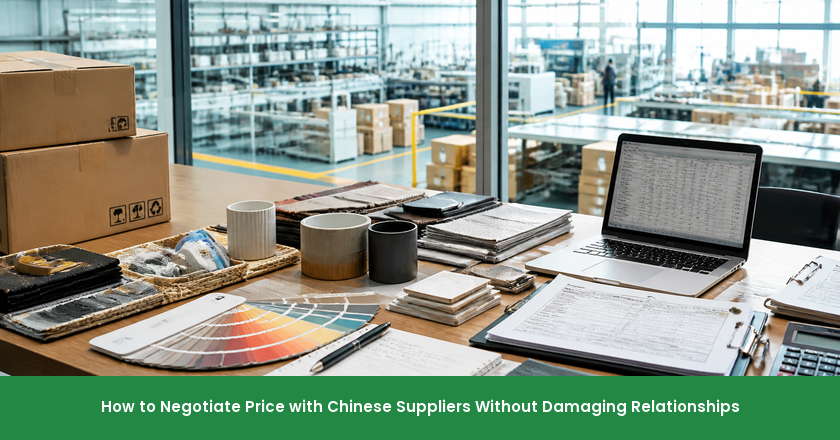
The safest way to negotiate with Chinese suppliers is to reduce cost through clear trade-offs, not through pressure that quietly weakens quality.
A buyer can win a small discount and still lose the order. That happens when a supplier protects margin by changing material, simplifying packaging, rushing production, lowering inspection cooperation, or deprioritizing future reorders. The goal is not to avoid firm negotiation. The goal is to negotiate in a way that protects price, quality, delivery, and the working relationship at the same time.
Key Takeaways
- Start with the specification: price talks before material, packaging, testing, and Incoterms are clear usually create later conflict.
- Ask for cost drivers: a supplier is more likely to cooperate when the discussion is about where cost sits, not whether the quote is "too high."
- Use trade-offs: volume tiers, forecasts, packaging simplification, payment timing, and combined SKUs can reduce cost without damaging quality.
- Protect the relationship: every discount should be documented with what changed and what did not change from the approved sample.
Lock the Specification Before You Talk About Price
Price is only meaningful when both sides are quoting the same product, packaging, delivery term, and inspection standard.
The most common negotiation problem is not supplier stubbornness. It is an unclear requirement. If the supplier does not know the exact material, size, color, surface finish, packaging, target market, testing requirement, and expected volume, the first quote is partly a guess. When the buyer clarifies details later, the supplier may raise the price. The buyer sees a price increase; the supplier sees a changed requirement.
Before negotiating, send a sourcing brief with drawings, photos, material requirements, packaging structure, target market, compliance concerns, quantity plan, lead time, preferred Incoterm, and inspection standard. Consumer product buyers should check the CPSC Business Education Library early when U.S. product safety rules may apply. If branding, molds, or product design are involved, review the USPTO China IP resources before sharing sensitive files widely.
Before sending the first counteroffer, also define three internal boundaries. The first is your target cost: the number that protects your margin if all other assumptions stay normal. The second is your maximum acceptable landed cost: the number that includes shipping, duties, packaging, inspection, and expected handling. The third is your walk-away point: the moment when a lower-quality product, a weaker supplier, or a longer delay would cost more than the savings. Without these boundaries, buyers often negotiate emotionally and then accept a deal that does not actually fit the business.
Ask for Cost Drivers Before Asking for a Discount
A cost-driver question turns negotiation from confrontation into joint problem solving.
Instead of saying, "Your price is too high," ask the supplier to explain the main cost drivers. The answer may involve raw material, labor, tooling, small-batch setup, packaging, testing, domestic freight, or factory capacity. Once you know where the cost sits, you can negotiate the part of the offer that actually moves.
If packaging is expensive, simplify the insert, carton, or printing method. If MOQ is the issue, ask for price tiers at 1,000, 3,000, and 5,000 units. If labor is high, ask whether a minor design adjustment can reduce assembly time. If material cost is high, ask for two material options with clear quality differences. The relationship stays healthier because you are not accusing the supplier of overcharging; you are asking where the commercial design can improve.
The cost-driver discussion also reveals supplier maturity. A strong supplier can usually explain why a price is high, where flexibility exists, and which changes would damage quality. A weak supplier may only repeat the same number or promise a sudden discount without explaining what changed. That second response should make the buyer cautious. If a factory can reduce price instantly but cannot explain the source of the reduction, the saving may appear later as thinner material, weaker packaging, slower production, or less inspection cooperation.
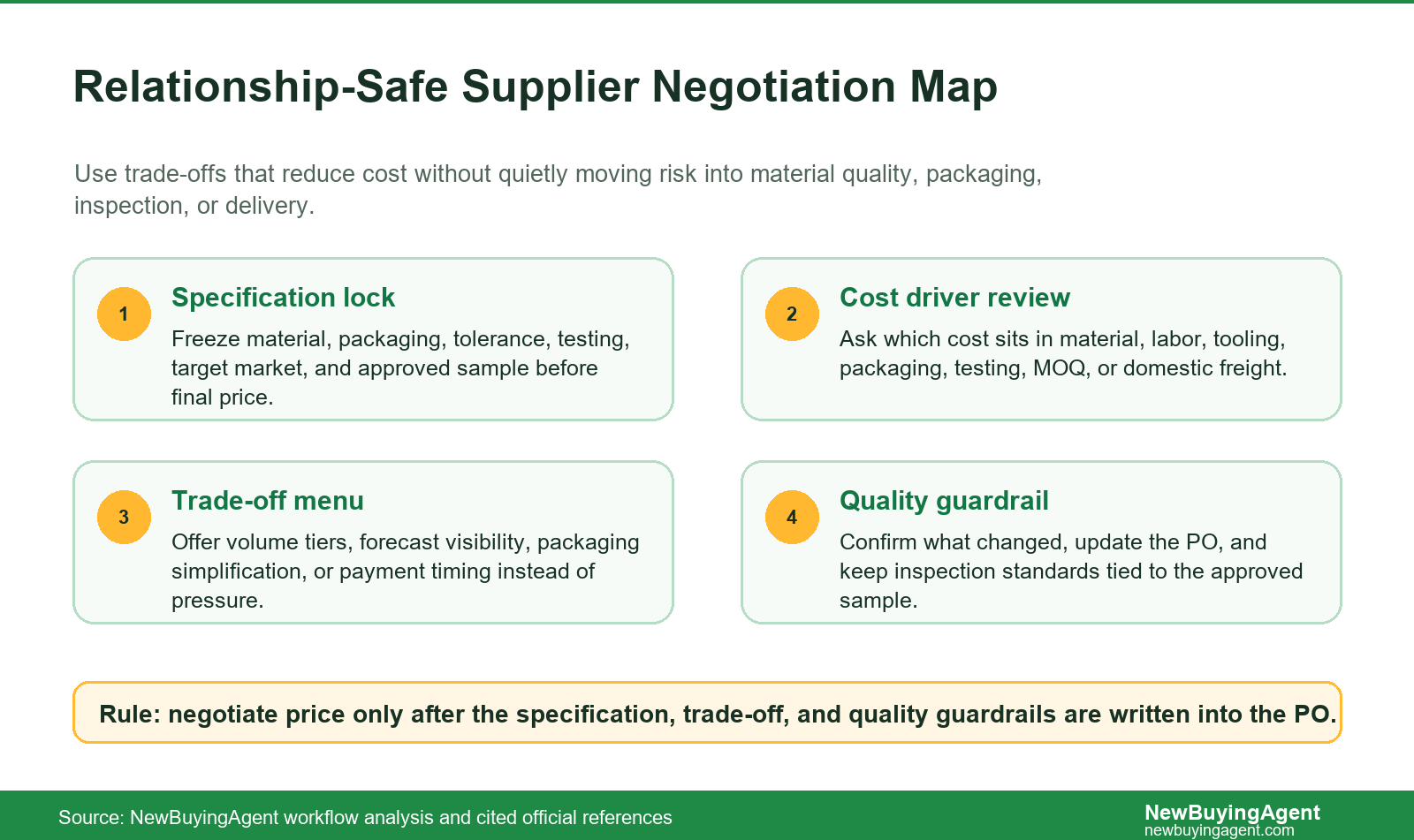
Relationship-safe negotiation separates specification, cost drivers, trade-offs, and quality guardrails before the final price is confirmed.
Compare Quotes on the Same Commercial Basis
Do not use one supplier's lower number as leverage until you know both quotes include the same responsibilities.
Two prices are not comparable if one is EXW and another is FOB, or if one includes retail packaging while another includes only a plain carton. The ICC Incoterms 2020 rules are the standard reference for defining seller and buyer responsibilities. For importers, CBP importing guidance is also relevant because the buyer remains responsible for correct import processes and documentation.
| Quote element | What to confirm | Why it affects negotiation |
|---|---|---|
| Specification | Material, thickness, finish, function, tolerance | A lower price may reflect a different product |
| Packaging | Retail box, inner carton, master carton, labels | Packaging can change cost and damage risk |
| Incoterm | EXW, FOB, CIF, DDP, or another agreed term | Responsibility and cost shift by term |
| Testing | Included, excluded, or buyer-arranged | Compliance cost may be outside the quote |
| Inspection | Factory QC only or buyer-side inspection | Release evidence affects defect risk |
Once the basis is consistent, negotiation becomes cleaner. You can say, "For the same specification, FOB term, and retail packaging, our target is X. Which cost drivers can we adjust without changing the approved quality level?"
Do not turn every quote comparison into a threat. Suppliers know that buyers collect multiple quotes. What damages the relationship is using an unmatched quote as a weapon. A professional comparison sounds different: "We are comparing on the same specification and FOB term. Your quality level is a good fit, but the landed cost is above our target. Can you help us identify whether packaging, quantity tier, or payment timing can move the price without changing the approved sample?" That wording keeps leverage while showing that the buyer is evaluating the offer fairly.
Use Trade-Offs That Preserve Supplier Cooperation
The best discount is usually attached to a reason the factory can accept.
Factories care about stable production, predictable demand, payment timing, capacity planning, and fewer surprise changes. If you can improve one of those factors, you may gain price room without creating resentment. Useful trade-offs include larger quantity tiers, rolling forecasts, simplified packaging, fewer color variants in the first run, consolidated SKUs, faster sample approval, or a clearer reorder plan.
Do not promise volume you cannot place. A realistic forecast builds trust; an inflated promise damages it. A better phrase is: "Our first order will be 1,000 units. If sell-through is stable, we expect to reorder every 45 to 60 days. Can you quote tiers for 1,000, 3,000, and 5,000 units?"
Negotiation theory also supports knowing your alternative before you push. Harvard's Program on Negotiation explains the value of understanding your BATNA, or best alternative to a negotiated agreement. In sourcing terms, this means you should know whether another supplier, specification version, or launch timeline gives you a credible walk-away option.
A buyer with no alternative often negotiates too aggressively or too nervously. A buyer with a real alternative can be calmer. If the current supplier cannot meet the target cost without changing the product, the buyer can move to a second supplier, adjust the product version, split the first order, or delay launch until the economics make sense. That does not mean using alternatives to threaten the factory. It means knowing your real options before the conversation begins.
Payment terms can also be part of the trade-off, but they should be used carefully. A faster deposit or clearer payment schedule may help a factory plan materials, while a larger final balance after inspection may protect the buyer. The best term depends on trust level, order value, and how much evidence will exist before final release.
Protect Quality When the Price Changes
Every price reduction needs a written answer to one question: what changed?
When a supplier offers a lower price, ask whether material, thickness, packaging, production process, inspection scope, lead time, or payment terms changed. If the supplier says nothing changed, confirm that in the purchase order and inspection checklist. If something changed, update the approved sample reference and decide whether the change is acceptable for your market.
Quality frameworks such as ISO 9001 can support supplier evaluation, but they do not replace order-specific controls. The factory may have a quality management system while your product still requires a clear defect standard, packaging requirement, and release gate.
This is where NewBuyingAgent's factory management service naturally fits. The point is not only to negotiate a better price. It is to keep price, production, inspection, and delivery connected so the final goods still match the buyer's approved requirement.
For a first order, the buyer should be especially careful with discounts that appear after sample approval. The approved sample is the commercial anchor. If the supplier offers a cheaper version, the buyer should treat it as a new version and ask for a written difference list. In many categories, even a small material or packaging change can affect customer returns, retail presentation, FBA handling, or safety documentation. A lower price is useful only if the buyer can still defend the product in the target market.
A Relationship-Safe Email Template
The wording should be firm about the target cost and equally firm about protecting the approved quality level.
Use this as a starting point and adapt it to the product:
Subject: Quote review for [product name] - specification and cost options
Hi [Supplier Name], thank you for the quotation and details. We reviewed the offer internally. The product is a good fit, but our target cost for this project is [target price/range] based on the landed cost we need for our market. Could you help us review the main cost drivers in the current quote?
We would like to understand whether there is room to optimize material options, packaging structure, production quantity tiers, assembly process, lead time, payment schedule, or consolidation with future orders without reducing the approved quality level. Please quote two options if possible: current specification and a cost-optimized version with all changes clearly listed.
Our goal is to find a sustainable price that works for both sides while keeping quality consistent with the approved sample.
When NewBuyingAgent Should Step In
Bring in a reliable sourcing and procurement partner when price pressure could turn into hidden quality, timing, or supplier-cooperation risk.
If suppliers keep changing prices after sampling, if quotes are difficult to compare, or if the order involves private label, testing, or packaging risk, buyers often need more than another supplier conversation. They need NewBuyingAgent to take responsibility for the full procurement process in a clear and controlled way.
Buyers share sourcing requirements such as product specs, quantity, target price, destination, and timing. NewBuyingAgent handles product selection, cost negotiation, quality management, production follow-up, and logistics coordination, with the goal of delivering products that meet market demand, arrive on time, and support healthy margins.
For buyers who want to understand how sourcing support extends beyond a one-time price discussion, NewBuyingAgent's success stories show how end-to-end procurement, from supplier coordination and quality control to production tracking and delivery management, operates as a structured, accountable process.
Who Is NewBuyingAgent?
NewBuyingAgent is a one-stop China sourcing agent for global buyers that want to source products from China without managing factory conversations, production follow-up, quality control, and logistics themselves.
Backed by 30 years of trade, manufacturing and quality control experience, NewBuyingAgent supplies products that meet buyers' purchasing requirements. Buyers share their purchasing needs, and NewBuyingAgent handles product selection, cost negotiation, quality management, and logistics—delivering goods that satisfy market demand, ship on schedule, and safeguard the buyers' bottom line.
Its sourcing network includes 50,000+ partner factories and 20,000+ product development & QC experts. NewBuyingAgent uses that network internally to supply products from China across categories at better price, quality, and service, while buyers avoid managing factory selection or daily supplier communication themselves.
FAQ
How much discount should I ask from a Chinese supplier?
There is no reliable universal discount percentage. The right request depends on material cost, order quantity, tooling, packaging, testing, lead time, and supplier margin, so start by asking for cost drivers and quantity tiers instead of naming a random discount.
Should I mention that another factory quoted a cheaper price?
You can mention market comparison if the quotes are truly comparable. Confirm specification, packaging, Incoterm, quantity, testing, and inspection scope first; otherwise, the cheaper quote may reflect a different product or a different responsibility split.
Is it better to negotiate before or after sampling?
Negotiate a preliminary range before sampling, then finalize the commercial agreement after the sample standard is clear. The final price should match the approved specification, not an earlier assumption that changes after packaging, materials, or testing are confirmed.
Can a sourcing agent negotiate better supplier prices?
A sourcing agent can sometimes improve price, but the larger value is often quote normalization and risk control. Better quote-basis review, specification discipline, production follow-up, and inspection evidence can protect total landed cost more than a small unit-price discount.
NewBuyingAgent
Related Resources
Get Started Today
Let's Turn Your Sourcing Goals into RealityWeChat:+86 15157124615
WhatsApp:+86 15157124615
Address:Building 10 #39 Xiangyuan Road, Hangzhou, China
