

Introduction
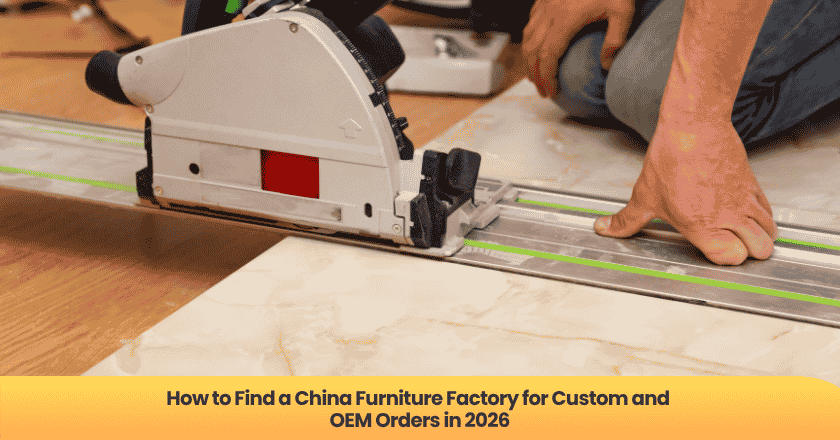
Stock furniture is easy to buy and impossible to differentiate — which is why more buyers are commissioning custom and OEM pieces from China rather than picking from a catalog everyone else is picking from too. The catch is that finding a factory that can execute your design, at your quality, with your branding, is a different search than finding one that sells what it already makes. A factory brilliant at its own range can be the wrong choice for building yours.
Custom and OEM furniture sourcing rewards a specific kind of factory and a specific kind of vetting. You're not asking "what do you sell?" but "can you build what I designed, to spec, and keep my design mine?" The projects that go well start with finding the right capability rather than the cheapest quote.
Key Takeaways
• Custom and OEM furniture needs a factory built to make your design, not just sell its own catalog.
• Verify real design-and-development capability, not just production capacity, before committing.
• A detailed spec package is essential — the factory builds what you document, not what you imagine.
• Custom work carries higher MOQs and tooling costs; understand them before designing.
• Settle design ownership and exclusivity in writing before production begins.
Where to Find the Right Factory
OEM-capable is not the same as production-capable
Many factories can run a production line; fewer can take your design and develop it into a manufacturable product. OEM furniture (Original Equipment Manufacturer — the factory builds your original design to your specifications) demands development capability: reading a spec package, advising on manufacturability, prototyping, and solving the problems that arise turning a drawing into a real piece. A factory that only makes its own designs may take your custom order and improvise, producing something that's "close" in all the wrong ways.
Look for evidence of development work — a sample department, engineers or technicians who discuss your design intelligently, and a portfolio of custom projects for other clients (not just their own catalog). The first conversation reveals a lot: a development-capable factory asks about your materials, tolerances, and intended use; a production-only one just quotes your drawing.
There's a meaningful middle ground worth knowing about, too. Some factories offer ODM (Original Design Manufacturer — the factory adapts one of its existing designs to your requirements) as a faster, cheaper path than full OEM. If your "custom" need is really a modification of something close to what the factory already makes — different dimensions, a different finish, your branding — ODM can deliver a semi-custom result at a lower MOQ and shorter timeline than developing from scratch. The trade-off is less originality, since the base design isn't exclusively yours. Deciding honestly whether you need true OEM or whether a well-adapted ODM piece would serve can save significant cost and time, so it's worth raising with capable factories rather than assuming full custom is the only route.
Reaching beyond the visible factories
The right OEM-capable factory often isn't the one with the slickest English website. The strongest development partners fill their books through relationships and may not market abroad at all. The visible, English-facing slice is self-selected, not necessarily the best for custom work, so the factory with genuine development capability may sit entirely outside the listings you can reach from abroad.
The cost picture for custom work also rewards going beyond the obvious. A single buyer commissioning one custom design has limited bargaining power, and verifying a factory's development capability from abroad is hard to do alone. For custom furniture, where matching the right development-capable factory is the whole game and a wrong match means an expensive failed prototype, the reach to find that factory and the means to verify it often matter more than the headline quote.
Expert Tip: Test development capability before you commit by sending your spec and asking the factory to mark up anything it would change for manufacturability. A real OEM partner returns notes — "this joint won't hold at that thickness," "this finish needs a different substrate" — because it thinks about how the piece gets built. A factory that accepts your drawing without comment is either not engaging or planning to improvise. The markup is free engineering insight and the clearest signal of who can actually develop your product.
Specifying a Custom Order
The spec package is the product
For custom furniture, what you document is what you get. A complete spec package includes dimensioned drawings, materials by type and grade, joinery method, finish specification, hardware, and packing format. Gaps get filled by the factory's assumptions, which rarely match yours, and every assumption is a potential defect in the bulk order. Treating the spec as the real deliverable — and the sample as a test of it — is the mindset that produces furniture you're proud of rather than furniture you tolerate.
A first-time custom buyer needn't be an engineer. A reference piece plus clear notes on every difference, developed together with a capable factory's sample department, can serve as the spec. The non-negotiable is that you direct every meaningful decision rather than leaving it to the floor.
MOQ, tooling, and cost reality
Custom and OEM furniture carries higher minimums than buying stock, because custom components, tooling, and jigs each have economics that only work over enough units. Expect higher MOQs and possible one-time tooling or mold fees, amortized across the run. Clarify these before you finalize a design, since a feature that needs custom tooling can change the whole cost picture. Often the real constraint is container economics — furniture is bulky, and how efficiently your custom piece packs affects landed cost more than the unit price. Designing with knock-down (flat-pack) shipping in mind can cut freight cost sharply, a question worth raising with the factory at the design stage.
Common Mistake to Avoid: Finalizing a custom design before discussing manufacturability and cost with the factory. Buyers fall in love with a design, then learn it needs expensive tooling, a high MOQ, or packs badly into a container — after the design is locked. The fix is to involve a development-capable factory early, while the design can still flex. A small change at the drawing stage — a different joint, a knock-down structure — can transform the MOQ, the cost, and the freight before any of it is committed.
Sampling and quality sign-off for custom work
Custom furniture makes the sample stage more important, not less, because there's no existing product to fall back on — the sample is the first physical proof your design works. Pay for the prototype, expect a round or two of refinement, and approve a pre-production sample in your exact materials and finish before any deposit toward bulk. Lock it as a sealed reference, photographed and documented, so your pre-shipment inspection has an objective standard to check against. Independent quality control matters even more with custom pieces, since a factory developing something new may make judgment calls you'd want to catch — independent eyes exist precisely so a custom design is verified at the sample stage and held consistent through production, rather than drifting once the line starts and the buyer isn't watching.
Protecting Your Design and the 2026 Picture
Ownership and exclusivity
Custom work means handing over your design, so settle ownership before production. Confirm in writing that you own the design, the patterns, and any tooling you paid for, and that the factory won't produce your piece for other buyers. Reputable factories sign these terms readily; resistance is a warning sign. Clarify whether you keep the tooling if you change factories, since a mold you funded but don't control quietly ties you to one supplier. Design copying remains a real risk, so a short, specific IP-and-exclusivity agreement is now standard practice for custom furniture, not an over-precaution.
The exclusivity point deserves emphasis for custom furniture specifically, because a distinctive design is the whole reason to commission custom work rather than buy stock. If the factory is free to sell your design to others, you've paid development costs to create a product your competitors can buy off the same floor — losing the differentiation you were paying for. Spell out exclusivity in plain terms: the factory may not produce, sell, or show your specific design to any other buyer. A factory confident in the relationship agrees without hesitation, and the written term gives you recourse if your design later turns up under someone else's brand.
What's changed for 2026
The sourcing landscape is shifting in ways that affect custom buyers. China+1 diversification has pushed some volume toward Vietnam and elsewhere, but China's depth in components, finishing, and development capability keeps it the strongest choice for genuinely custom work — many "Southeast Asian" pieces still rely on Chinese materials and OEM expertise. Freight and tariff costs have stayed in flux, so landed-cost math for a custom program deserves a fresh look this year rather than relying on older assumptions. Remote development has also matured: video sample reviews and digital spec collaboration mean a buyer can develop a custom piece with a Chinese factory without flying out, which has widened access to OEM partners that were previously hard to work with from abroad.
How NewBuyingAgent Helps You Source Custom Furniture
Custom and OEM work isn't about whose catalog looks best — it's about which factory can actually build your drawing and keep your design yours, and telling that capability apart from a distance, then verifying it, is hard to do solo, which is why many buyers bring in a sourcing partner to steer it. NewBuyingAgent is your perfect partner for global sourcing from China, backed by 30 years of expertise in trade, manufacturing and quality control.
The strongest development-capable factories rarely sit in the English-marketing column, so connecting your design to a genuine OEM partner is the first task: with 100% Access to China's Factories, you use their 50,000+ cooperated partner factories—no language/region/time zone barriers. Their local reputation gets you full factory cooperation. A wrong factory match on a custom piece usually means an expensive scrapped prototype, and a wider network leaves more room to choose well and to price keenly: with Lower Prices Than Direct Sourcing, their wide factory network lets them pick low-cost, high-cooperation suppliers. Even with their margin included, they cut your costs by 5%-10%. With no off-the-shelf product to fall back on, the sample stage demands close watching, and quality has to be held from prototype through production: NewBuyingAgent's 20,000+ product development & QC experts ensure your products match market needs and stay high-quality. Contact now.
Frequently Asked Questions
What's the difference between a stock furniture supplier and an OEM factory?
A stock supplier sells what it already makes; an OEM factory builds your original design to your specs, which requires development capability — prototyping, advising on manufacturability, and solving production problems. Many factories can run a line but can't develop a custom product, so verify development capability, not just production capacity.
How do I know if a factory can really do custom work?
Look for a sample department, technicians who discuss your design intelligently, and a portfolio of custom client projects rather than only their own catalog. Send your spec and ask them to mark up anything they'd change for manufacturability — a development-capable factory returns engineering notes, while a production-only one just quotes your drawing.
What's a typical MOQ for custom furniture in China?
Higher than for stock items, because custom components, tooling, and jigs only make economic sense over enough units. Expect higher minimums and possible one-time tooling fees amortized across the run. Discuss these before finalizing a design, since a feature requiring custom tooling can change the MOQ and cost significantly.
How do I protect my custom furniture design?
Agree in writing before production that you own the design, patterns, and paid-for tooling, and that the factory won't make your piece for others. Reputable factories accept these terms readily. Clarify whether you keep the tooling if you change factories, so a mold you funded doesn't lock you in.
Can I develop a custom furniture piece without visiting China?
Increasingly, yes. Remote development has matured through 2026 — video sample reviews and digital spec collaboration let you develop a custom piece with a Chinese factory from abroad. Pairing remote development with third-party inspection of samples and production gives you most of the assurance of being there in person.
Conclusion
Finding a China furniture factory for custom and OEM work is about capability, not catalog. Seek a factory that can develop your design rather than just produce its own, document your spec as the real deliverable, understand the MOQ and tooling economics before you finalize, and lock down design ownership in writing. Do that and custom furniture becomes a genuine advantage rather than a sourcing headache. When finding a development-capable factory and managing a custom build from a distance is more than you want to handle, it's worth having a partner match your design to the right OEM factory and see it through to a verified first order.
NewBuyingAgent
Related Resources
Get Started Today
Let's Turn Your Sourcing Goals into RealityWeChat:+86 15157124615
WhatsApp:+86 15157124615
Address:Building 10 #39 Xiangyuan Road, Hangzhou, China
