

A China sourcing agent earns a place in the buying plan only when its China-side work removes a measurable cost that the direct route leaves with the buyer. The practical test is net cost after the service fee, retained buyer work, and a reserve for outside volatility—not the headline difference between two factory quotations.
The 8-20% Range Is a Planning Hypothesis, Not a Discount
The 8-20% range stated by NewBuyingAgent should be treated as a planning hypothesis and tested against comparable buyer costs. It is not a promised discount, and it is not an industry average. A China sourcing agent creates value only when the work changes a cost the buyer can name, measure, and compare against a direct-sourcing baseline.
That distinction matters because a direct factory quote can look cheaper while leaving inspection scope, carton consolidation, production follow-up, document handoffs, and exception handling outside the number. The right question is not “Can an agent get a lower price?” It is “After the service fee and a realistic reserve for volatility, does the supported route reduce the total cost of getting the right goods to the agreed destination?”
- Start with the same product, quantity, Incoterm, destination, and review period.
- Separate controllable execution leakage from duty, currency, and freight-market movement.
- Subtract the support fee and retained buyer work before reporting a net result.
A savings claim is credible only when the direct route and the supported route use the same product, volume, Incoterm, destination, quality standard, and comparison period.
Build a Comparable Direct-Sourcing Baseline First
A baseline starts with the sale term, not a spreadsheet total. The International Chamber of Commerce explains that Incoterms® allocate cost, risk, and obligations between buyer and seller. Name the version and location—such as FCA Shenzhen, FOB Ningbo, or DAP a named site—before comparing a direct purchase with any supported arrangement.
Then define total landed cost: the comparable cost of purchasing, preparing, moving, and receiving goods under one agreed scope. It should include the product amount, China-side handling, inspection or rework assumptions, freight and insurance where applicable, documents, destination charges, and the buyer's own coordination time when that time is material. In the United States, for example, CBP describes entry summary documentation as part of assessing duties and determining whether other legal requirements have been met. That does not make a China-side provider the importer of record; it shows why importer obligations need their own owner and cost line.
| Cost line | Direct-sourcing baseline | Agent-supported comparison | Buyer check |
|---|---|---|---|
| Product and agreed specification | Quoted price and revision | Same product, quantity, and revision | No scope substitution |
| Quality control | Existing inspection, rework, and claim costs | Defined inspection and response scope | Same acceptance rule |
| Logistics handoff | Freight, consolidation, documents, exceptions | Same route and handoff scope | Separate market variance |
| Support cost | Internal coordination cost, if material | Service fee plus buyer retained work | Count each cost once |
A useful comparison has a named owner beside every line. If a cost has no owner, it usually reappears later as an expedite, a quality dispute, a missed document, or an internal fire drill. If the buyer has never tracked a line, use a conservative assumption and mark it as an assumption rather than quietly assigning it to the agent.
For background on publicly described outcomes, buyers can keep their own baseline in view and review NewBuyingAgent success stories.
Where an Agent Can Create Savings - and Where It Cannot
The first potential lever is preventing avoidable quality leakage before goods ship. But inspection is not a magic recovery number. NIST explains that acceptance sampling is used to decide whether a lot is likely acceptable, not to estimate the quality of every unit. The buyer should therefore define the lot, sample method, acceptance rule, defect severity, and response to failure before production. A savings model may credit fewer avoidable failures only when that control is actually in scope; it should never assume that sampling makes every quality loss disappear.
The second lever is coordination across handoffs. The World Bank's 2023 Logistics Performance Index covers 139 countries and links reliable supply-chain connections to logistics services, infrastructure, and border controls. For one buyer, the relevant opportunity may be fewer disconnected carton, document, or consolidation handoffs. For another, it may be clearer status evidence before a booking cutoff. Neither point means an agent controls the ocean rate; it means the buyer can reduce avoidable coordination work when responsibilities are explicit.
The third lever is commercial clarity. The ICC’s guidance on Incoterms® and commercial contracts distinguishes obligations, risks, and costs between buyer and seller. That makes them a poor place to hide a comparison advantage. A change in spot freight, foreign exchange, duty, port congestion, or destination storage should be separated from the savings attributed to sourcing support. Put those movements in a variance reserve, then compare the two routes over the same time window.
An agent can influence execution quality and information flow where the buyer assigns a clear scope. It cannot honestly claim ownership of every market movement or every importer obligation.
Calculate Net Savings After Service Fees and Variance
Net savings = comparable direct-sourcing cost − comparable agent-supported cost − service fee − variance reserve. The formula is deliberately strict. It prevents a buyer from reporting the gross reduction in a factory quote or a single avoided inspection invoice while ignoring the fee, retained internal workload, or a rate movement that had nothing to do with the support model.
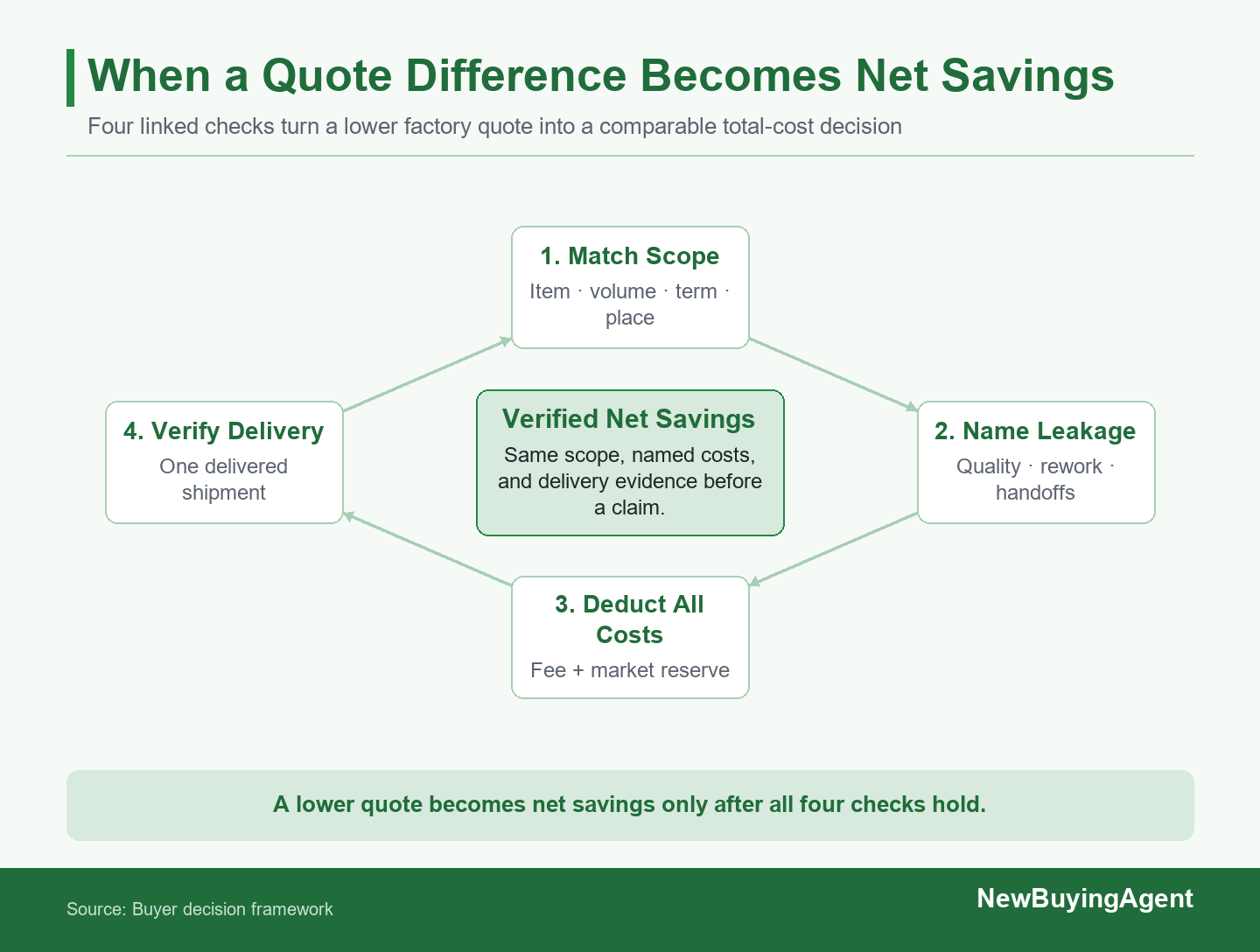
A quote difference becomes net savings only after scope, leakage, fee and variance, and delivery evidence agree.
Use a variance reserve for items neither route fully controls—such as currency movement, temporary freight conditions, or a buyer-caused specification change. The reserve does not make the model pessimistic; it keeps an operational improvement from being confused with a market tailwind. If the buyer wants to calculate a percentage, divide the verified net saving by the comparable direct-sourcing baseline, not by a selectively chosen product-price line.
The range in the title is a planning prompt, not a promise that every product, order size, destination, or starting factory will produce the same result. A buyer with a mature direct program and low coordination leakage may see little net benefit. A buyer with repeat product requirements and recurring China-side exceptions may have more to test.
| Illustrative comparison input | How to treat it | Do not do this |
|---|---|---|
| Supplier price | Compare the same specification and quantity | Compare a lower quote with a reduced requirement |
| Quality leakage | Use prior rework, claims, or agreed control cost | Assume inspection removes every defect |
| Freight and currency | Use the same period or reserve a variance | Credit a market drop to the agent |
| Service fee | Subtract it in the same model | Report gross savings as net savings |
Consider the model a release gate. If it produces a positive result only by leaving out a cost, the buyer does not yet have savings; the buyer has an incomplete baseline. If it remains positive with conservative inputs, the next step is a controlled trial—not a multi-year conclusion from one quotation.
Design the Controls That Make Savings Measurable
Start with a small control file that follows the order: approved requirement, quote revision, inspection rule, packing and document handoff, shipment record, and post-shipment comparison. Because acceptance sampling is a lot decision, the control file should state the lot, sample method, acceptance rule, and failure response before production. This creates a defensible link between a proposed control and the cost it is expected to influence.
Documentation belongs in that file too. The WTO Trade Facilitation Agreement addresses release and clearance of goods, risk management, and import, export, and transit documentation formalities. The practical buyer lesson is simple: specify who provides, checks, approves, and pays for each record or handoff. China-side coordination can support execution, while the buyer remains responsible for decisions and obligations assigned by the contract and destination market.
Use the same review period, ownership map, and evidence gates when comparing a trial with the baseline. Review after a completed shipment, not only when a quotation is accepted. That timing lets the buyer distinguish a genuine change in process cost from a temporary movement in freight, exchange rates, or product scope.
One record is rarely sufficient for every risk. NIST lists supplier declarations, sampling and testing, inspection, certification, and management-system assessment among conformity-assessment activities. The point is not to add paperwork indiscriminately. Match the evidence to the risk: a specification revision needs a revision check; a shipment condition risk needs a packing or logistics check; a defect-risk assumption needs an agreed quality control.
Controls create savings only when they are narrow enough to execute, attributable enough to review, and proportionate to the cost they are meant to prevent.
When buyers keep existing China factories and need a defined execution scope, they can review China-side production, quality, and logistics support.
Illustrative: A Mixed-Category Order That Did Not Need a Lower Unit Price
In the illustrative scenario, the buyer tests net cost after the support fee rather than declaring success from a modest unit-price difference. A home-and-lifestyle buyer is consolidating three repeat products from China for quarterly releases to one destination market. The quarterly release covers 3 product families, 4,800 total units, and 1 consolidated shipment. The buyer wants the same specification, stated quality controls, and delivery scope used in both comparisons. The buyer has existing quotations and prior landed-cost records, but has not assigned ownership to quality checks, carton consolidation, or document handoffs.
The lowest direct quote excluded a pre-shipment inspection and left carton consolidation to separate coordination. The initial comparison mixed a prior freight invoice with a new quotation and omitted internal expediting time. The unit-price change is deliberately modest. The decision turns on whether disconnected coordination and failure costs are visible and whether the support fee is included before a net result is claimed.
Run one controlled release only if comparable direct cost exceeds agent-supported cost plus the support fee and an agreed variance reserve. The buyer standardizes the RFQ, assigns a quality gate to each product family, sets a carton-ready handoff, and records the support fee in the same comparison sheet. After shipment, review the same cost categories, ownership map, and variance rule before using the result to reset the baseline. This is an illustrative scenario, not a client outcome or pricing promise. Actual pricing, freight, inspection scope, compliance requirements, and fees must be quoted and approved for the buyer order.
When a China Sourcing Agent Is Worth Testing
A controlled comparison is most useful when the buyer has a repeatable product requirement, a known volume or release pattern, a defined Incoterm and destination, and visible cost leakage to test. Those conditions make it possible to distinguish a better process from a better-looking quote. It is also reasonable to retain direct sourcing when the buyer already has stable factory execution, clear cost ownership, reliable quality evidence, and enough internal capacity to manage the work without delays.
For a new requirement, prepare a defined brief before asking any provider to quote. The useful input is not “find the lowest price.” It is a product brief, quantity, target term, destination, current cost baseline, and the controls the buyer needs verified.
Before starting a trial, set four rules: use the same requirement on both sides of the comparison; give every cost an owner; subtract all support fees; and review the delivered shipment before extending the arrangement. Put the comparison into one worksheet with the direct baseline on the left and the supported route on the right. Record the quote revision, the Incoterm and named place, the inspection rule, the packing and consolidation assumptions, the service fee, and the buyer work that remains outside the scope. Mark uncertain items separately rather than blending them into an expected saving. That discipline makes a negative result useful: it tells the buyer whether the gap is a fee, an unmanaged handoff, or a cost that belongs to neither route. It also prevents an early factory quotation from becoming a decision before the delivered-order evidence is available.
Keep the request narrow enough to test a decision, yet complete enough to price. State whether the buyer needs new product supply or support for a current factory, then attach product images, technical specifications, packaging requirements, and any required compliance evidence. List the order quantity and release cadence, the target Incoterm and named destination, the expected delivery window, and current quality checkpoints. Identify which party owns freight booking, import decisions, and destination clearance. Finally, name the past cost, delay, or quality issue that prompted the comparison and flag any uncertainty that requires a quote assumption.
If those inputs are ready, buyers can contact NewBuyingAgent to share your China sourcing requirements for a comparable quote.
The best trial is not the broadest one. It is the smallest repeatable purchase where the buyer can verify scope, cost ownership, evidence, and net result.
Frequently Asked Questions
These answers apply the total-cost framework; they do not promise a percentage outcome or replace import, legal, or product-specific review.
Does a Lower FOB Price Equal Total Savings?
No. A lower FOB price changes only one part of total cost, which also depends on the agreed Incoterm, quality outcomes, freight, documentation, and coordination. Compare the same product, quantity, destination, and ownership split. If the lower FOB quote removes an inspection, changes the packing requirement, or moves an activity to the buyer, it is not yet a like-for-like saving.
Can a China Sourcing Agent Guarantee 8-20% Savings?
No. The 8-20% range is a planning hypothesis that must be tested against the buyer baseline, scope, service fee, and market conditions. It is stronger to forecast a conservative range, name the assumptions, and review one completed release than to present a gross percentage as a guaranteed result. The buyer should approve only the scope that can be measured.
What Costs Should Stay With the Buyer?
The buyer should retain commercial approvals, destination-market compliance decisions, and import obligations assigned under the agreed contract and Incoterm. A China-side sourcing agent can support defined execution work, but support does not erase the buyer's duty to understand the sale terms, approve product requirements, or arrange appropriate specialist advice for the destination market.
When Is Direct Sourcing Likely the Better Choice?
Direct sourcing may be better when the buyer already has stable factory execution, clear cost ownership, quality evidence, and enough internal capacity to manage the work without costly delays. The decision is not ideological. If the agent-supported route cannot show a positive net result after its fee and a fair variance reserve, direct sourcing remains the more disciplined commercial choice.
NewBuyingAgent
Related Resources
Get Started Today
Let's Turn Your Sourcing Goals into RealityWeChat:+86 15157124615
WhatsApp:+86 15157124615
Address:Building 10 #39 Xiangyuan Road, Hangzhou, China
