

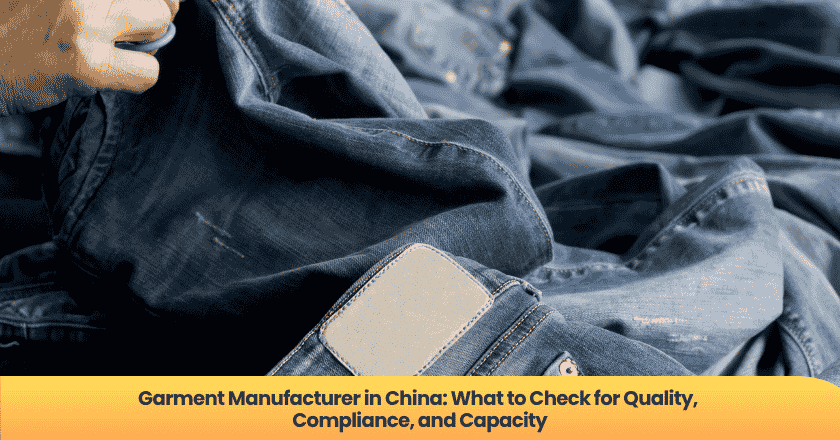
Introduction
A factory can pass your call, send a perfect sample, quote a great price, and still wreck your order. The reasons it fails usually aren't visible in the inbox: a social audit that lapsed, a line booked solid the month you need production, a quality system that exists on paper but not on the floor. By the time these surface, your deposit is already gone.
Vetting a garment manufacturer in China is less about finding a good first impression and more about checking three things that don't show up in a sales pitch — quality systems, compliance standing, and real available capacity. Running this verification before you commit matters because the cost of skipping it lands at the worst possible moment: after the balance is paid.
These three checks are separate skills, and a factory can be strong on one while weak on another. A manufacturer with excellent stitching can still carry a lapsed audit; a fully compliant factory can still be too booked to deliver on time. Treating them as one undifferentiated "is this factory good?" judgment is how buyers miss the specific gap that later breaks the order.
The sections below take each in turn, with the questions that surface problems while you can still walk away.
Key Takeaways
• A factory's quality system is judged by its defect-handling process, not by the sample it sends you.
• Compliance means current, verifiable audits (BSCI, Sedex, WRAP) — not a certificate that expired last year.
• Real capacity is about available line time during your window, not the factory's theoretical monthly maximum.
• Always confirm whether the factory subcontracts, and to whom, before you place an order.
• A pre-shipment inspection tied to your balance payment is your strongest protection.
Quality: Look at the System, Not the Sample
Why one good sample proves little
A sample is made by the factory's best workers with extra time and attention. Your bulk order is made by the full line under deadline pressure. The gap between the two is where most quality complaints live. So the real question isn't "is this sample good?" — it's "what happens on line 4 at 6pm when a roll of fabric comes in slightly off-shade?"
Ask how the factory handles defects mid-production. A capable manufacturer describes an AQL (Acceptable Quality Limit — the statistical sampling standard for how many defects an order can contain) inspection process, a documented rework procedure, and an in-line QC checkpoint, not just a final check. Vague answers here predict vague quality control.
The role of independent QC
In-house QC reports come from the party with an incentive to ship. That's why independent inspection matters. A dedicated QC layer — product development and quality experts who answer to the buyer, not the factory — catches the issues a factory's own team is motivated to overlook, so products keep matching their approved spec across runs rather than drifting after the sample everyone signed off on.
The distinction isn't about distrust — it's about incentives. A factory's QC team wants to keep the line moving and the shipment on schedule; a slipped deadline costs them. An independent inspector's only job is to confirm the goods match your approved standard, so a borderline defect gets flagged rather than waved through. The two roles aren't enemies, but they answer to different pressures, and on the day a fabric lot runs slightly off-shade, you want the eyes in the room to be the ones working for you. This is why most experienced buyers treat third-party inspection as non-negotiable for any order large enough to hurt if it fails.
Expert Tip: Ask any garment manufacturer for their defect rate on the last three orders of a similar product, and how they measured it. A factory with real quality control answers with numbers — "around 2% minor defects, mostly loose threads, all reworked before shipment." A factory winging it gives you reassurance instead of data. The specificity of the answer tells you whether QC is a system or a slogan.
In-line versus final inspection
There's a meaningful difference between a factory that checks garments only at the end and one that inspects during production. Final-only QC catches defects when it's too late to fix them efficiently — a fabric flaw discovered after 3,000 pieces are sewn means 3,000 pieces to rework or scrap. In-line inspection catches the same flaw on piece 50, when the line can be stopped and corrected cheaply. When you ask about quality control, listen for whether the factory describes checkpoints during the run, not just at the end. A manufacturer that pulls and measures samples at the cutting stage, mid-sewing, and pre-packing is one that finds problems while they're still small. That layered approach is the difference between a quality system and a quality gesture.
Compliance: Current, Verifiable, and Relevant
The audits that count
For apparel sold into the US or EU, buyers increasingly require a current social compliance audit: BSCI, Sedex SMETA, or WRAP. These cover labor conditions, safety, and basic environmental controls. The word that matters is *current* — audits expire, typically within a year or two, and a lapsed certificate signals either cost-cutting or something the factory would rather not re-audit.
Don't accept a PDF at face value. Audit reports carry an auditor and a reference number; legitimate ones can be verified with the issuing body. Forged or recycled certificates circulate widely, so a report you can't independently confirm is worth no more than an unverified claim.
Compliance is shifting in 2026
Regulatory pressure keeps rising. Through 2026, supply-chain transparency rules — including stricter due-diligence expectations in the EU and forced-labor import enforcement in the US — have made traceability of raw materials, especially cotton, a live compliance issue, not just an ethics one. Buyers now ask manufacturers to document fabric origin, not only finished-goods conditions. A manufacturer that can trace its yarn supply is increasingly the only safe choice for Western-market apparel.
Common Mistake to Avoid: Accepting a compliance certificate without checking its date and authenticity. Buyers see a WRAP logo and assume the factory is cleared, then discover at customs that the audit lapsed two years ago — or never existed. The consequence can be a held shipment or a blocked import under forced-labor rules. Verify every certificate with the issuing body, and confirm it covers the actual facility making your goods, not a sister site.
Product compliance versus social compliance
Two different compliance worlds often get conflated. Social compliance audits (BSCI, Sedex, WRAP) cover how the factory treats workers and runs its operation. Product compliance covers whether the garment itself meets the destination market's safety and labeling laws — flammability standards for sleepwear, restricted chemical limits like those under REACH or CPSIA, fiber-content and care-label rules. A factory can be socially compliant and still ship you garments that fail a chemical test at the border. Confirm both: ask whether the manufacturer has produced for your target market before and can meet its specific product regulations, then build the relevant lab testing into your order. Skipping product compliance is a quiet risk that surfaces only when customs or a regulator flags the shipment.
Capacity: Available, Not Theoretical
The number that misleads everyone
When a factory says it produces 100,000 pieces a month, that's its maximum across all clients in a good month. What you need to know is different: how much line time is open during *your* production window, and where your order sits in the queue. A factory at full capacity will still take your deposit and then quietly push your order behind a bigger client's.
Ask directly for a production slot — a committed start and finish date — and get it in the order contract. Then ask what their current lead time is and whether it accounts for peak-season congestion. Chinese apparel lines run tight before Western holiday seasons and around Chinese New Year, when output drops for weeks.
Subcontracting: the capacity question behind the question
A factory short on capacity may accept your order anyway and subcontract part of it to a workshop you've never vetted. Your compliance audit and quality checks then cover a facility that isn't making your goods. Ask plainly: "Will any part of this order be produced outside this facility?" Get the answer in writing.
Subcontracting isn't inherently wrong — many legitimate factories outsource specialized steps like embroidery or washing to dedicated partners, and that can be perfectly fine. The risk is undisclosed subcontracting, where the whole make moves to a workshop with none of the oversight you arranged. The distinction is transparency: a manufacturer that volunteers "we do the cutting and sewing here, but washing goes to a partner two streets over" is being honest about its process. One that insists everything happens in-house, then can't show you the relevant equipment, is hiding something. Require disclosure of any subcontractor, and reserve the right to inspect their facility too. The goods are only as compliant as the least-checked place they pass through.
Reaching factories with genuine open capacity — rather than the few that aggressively market to foreigners — is its own advantage, and the factory with the right capacity at the right time is often not the one easiest to find from abroad.
Expert Tip: Time your capacity check to the calendar. Ask a factory for its delivery date on an order placed today, then ask for the same on an order placed six weeks before Chinese New Year. If both answers are identical, they're not accounting for the seasonal shutdown that idles most Chinese garment lines for two to three weeks every year. A manufacturer that builds the holiday into its lead time is one that plans capacity honestly.
Matching machinery to your product
Capacity isn't a single number — it's specific to the equipment your garment needs. A factory may have plenty of open sewing lines but only one machine capable of the flatlock seams your activewear requires, creating a bottleneck no headline capacity figure reveals. Before assuming a factory can handle your volume, confirm it owns enough of the specialized equipment your product depends on: the right knitting gauges, embroidery heads, or specialty stitch machines. Ask how many units of that specific machine they run, not how many workers they employ. The narrowest piece of equipment in your production path sets your real ceiling, and a factory that's honest about that constraint is one worth trusting with the order.
How NewBuyingAgent Helps You Vet Garment Manufacturers
Running quality, compliance, and capacity checks well from a distance is hard, which is why many buyers work through a sourcing partner. NewBuyingAgent is your perfect partner for global sourcing from China, backed by 30 years of expertise in trade, manufacturing and quality control.
For buyers who put quality first, the verification is built in: NewBuyingAgent's 20,000+ product development & QC experts ensure your products match market needs and stay high-quality.
And when the challenge is reaching factories with the right capacity rather than just the ones marketing to you, the network does the work: with 100% Access to China's Factories, you use their 50,000+ cooperated partner factories—no language/region/time zone barriers. Their local reputation gets you full factory cooperation. Contact now.
Frequently Asked Questions
What's the most important thing to check in a garment manufacturer?
Their quality system, demonstrated through how they handle defects and in-line inspection — not the quality of a single sample. Samples are made under ideal conditions; bulk production reveals the real system. Ask for defect data from recent comparable orders.
How do I verify a factory's compliance audit is real?
Get the audit's reference number and issuing body, then confirm it directly with that body (BSCI/amfori, Sedex, or WRAP). Check the date is current and that the audited facility is the one actually producing your order, not an affiliated site.
How can I tell if a factory has real capacity for my order?
Ask for a committed production slot — specific start and finish dates — in your contract, not just a monthly maximum figure. Then confirm their lead time accounts for peak-season congestion and the Chinese New Year shutdown.
Should I worry about subcontracting?
Yes. Subcontracting moves your order to a facility your audits and quality checks never covered. Ask in writing whether any part of production happens outside the main facility, and require disclosure of any subcontractor before you agree to terms.
Is a pre-shipment inspection really necessary?
For most orders, yes. A pre-shipment inspection against your approved sample and AQL standard, tied to release of your balance payment, is the single most effective protection against receiving goods that don't match what you approved.
Conclusion
A garment manufacturer earns your order by passing three tests that a sales call can't show you: a quality system that survives the full production line, compliance that's current and verifiable, and real capacity in your actual window. Check those before the deposit, not after the complaint, and most sourcing disasters never get started. When running that verification on the ground in China isn't practical from where you sit, it's worth arranging for someone who can audit, inspect, and confirm capacity before your order is ever confirmed.
NewBuyingAgent
Related Resources
Get Started Today
Let's Turn Your Sourcing Goals into RealityWeChat:+86 15157124615
WhatsApp:+86 15157124615
Address:Building 10 #39 Xiangyuan Road, Hangzhou, China
