

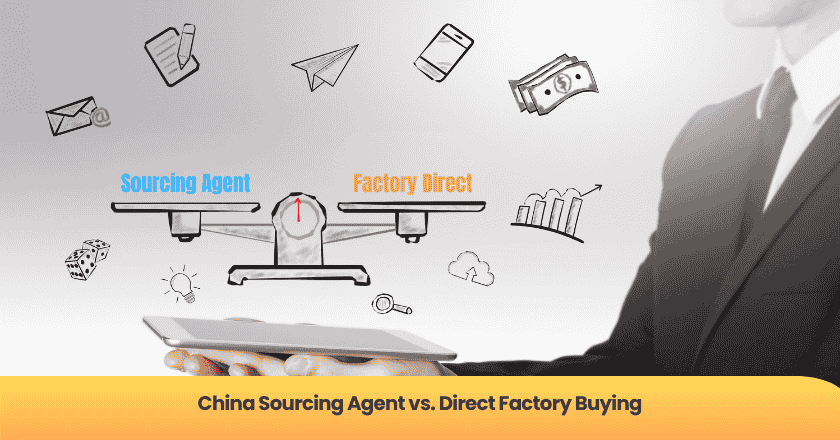
Every year, tens of thousands of global buyers travel to Guangzhou, Yiwu, or Shenzhen convinced that direct factory access is the holy grail of cost savings. Some leave with solid deals. Many leave with broken promises, delayed shipments, and invoices that somehow swelled between the sample stage and full production. The reality of sourcing from China in 2026 is far more layered than it was ten years ago — and the buyers who understand that nuance are quietly outcompeting everyone else.
Key Takeaways
- Going direct to factories does not automatically mean lower prices. Limited leverage, language barriers, and fragmented supplier management routinely cancel out any apparent savings.
- Traditional commission-based sourcing agents charge 5%–20% on top of factory prices, effectively raising your total procurement cost — often without taking on any accountability for outcomes.
- A new generation of order-driven sourcing models takes full ownership of procurement from factory selection through final delivery, with no separate commission charged. NewBuyingAgent operates on this model, backed by 30 years of trade and manufacturing expertise, and is capable of delivering 5%–10% cost reductions compared to direct sourcing.
- AI-powered product analysis is now a practical, real-world tool for identifying trending products and supporting new product development — not just a buzzword.
- Quality control is not a one-time pre-shipment event. Production monitoring from start to finish is the only reliable way to protect your product margins and brand reputation.
- When evaluating a sourcing partner, depth of factory relationships and in-country QC capacity matter far more than a polished website or fast pre-sale replies.
1. Why China Manufacturing Still Dominates Global Supply Chains in 2026
China's position as the world's manufacturing hub hasn't weakened — it has matured. The conversation in 2026 is less about labor cost arbitrage and more about an unmatched combination of industrial depth, logistics infrastructure, and speed to market. Within a 200-kilometer radius of major manufacturing clusters — the Pearl River Delta, the Yangtze River Delta, and the commodity markets of Yiwu — you can find qualified suppliers for virtually any product category.
What has shifted is the competitive environment. More international buyers are sourcing from China than ever before, which means factory capacity gets absorbed quickly, lead times fluctuate, and the "best price" quoted on a B2B platform today may look different by the time your production slot is confirmed.
Three structural advantages that keep China sourcing compelling for global buyers:
- Category breadth that no other market matches. No single country offers the same density of suppliers across electronics, textiles, home goods, industrial components, and consumer products simultaneously. Cross-category procurement from one country simplifies logistics, customs handling, and payment consolidation in ways that multi-country sourcing never quite replicates.
- A mature, competitive export infrastructure. China's export supply chain — freight forwarders, bonded warehouses, customs brokers, third-party inspection agencies — is deeply developed and internationally experienced. Factories and logistics providers deal with complex export documentation routinely, in ways that newer manufacturing hubs in Southeast Asia are still building toward.
- Prototype speed that changes product development math. Turnaround times that would take 8–12 weeks in other markets can happen in 2–3 weeks within China's manufacturing clusters. For businesses developing new products, this compressed cycle is a genuine competitive lever, not just a convenience.
Expert Tip: Don't evaluate a factory solely by its export volume or ISO certificates. Ask specifically about their experience supplying buyers in your target market. A factory regularly shipping to European retailers understands regulatory compliance — REACH, CE, RoHS — very differently from one that primarily serves domestic Chinese buyers. That institutional knowledge is worth a lot.
2. The Hidden Costs of Going Direct
The logic seems airtight: cut out the middleman, deal with factories directly, pay less. In practice, this works well for large-volume buyers with dedicated sourcing teams based in China. For most businesses, the math gets complicated fast — and the complications tend to be invisible until they've already cost you.
Price isn't always lower when you go direct. A factory's "direct price" is quoted based on their read of your leverage. Without a known purchasing track record in China, without the ability to benchmark across multiple factories quickly, and without a trusted local presence, buyers routinely pay more than an experienced intermediary would. Language, regional negotiation norms, and the relationship-based purchasing culture in China mean the same product can carry a 15–30% price spread depending on who's asking and how.
Multi-factory management is a full-time operational burden. Most product lines require components or finished items from different factories across different provinces. Coordinating production timelines, consolidating shipments, and maintaining quality accountability across five or ten separate factory relationships consumes enormous internal bandwidth. This operational cost rarely shows up in a cost-per-unit calculation — but it shows up everywhere else: in staff time, in errors, and in delayed market responses.
Quality inconsistency is the slow leak that sinks margins. A factory that delivered excellent samples may produce to a different standard once at full production volume, particularly when they're juggling capacity across multiple customers. Without a dedicated on-site presence during production — not just a final pre-shipment inspection — catching deviations in time to fix them is nearly impossible.
Common Mistake to Avoid: Treating the pre-shipment inspection (PSI) as the primary quality checkpoint. By the time goods reach that stage, production issues are already locked in. Effective quality management requires monitoring during production — what the industry calls a DUPRO (During Production Inspection) — not just a pass/fail check at the finish line. If your current sourcing setup doesn't include mid-production monitoring, you're managing quality retroactively.
3. Traditional Commission Agents vs. Order-Driven Sourcing Models
The sourcing agent market in China is large and varied. "Sourcing agent" covers a wide spectrum of service models — and the difference between them has material consequences for your total cost and risk exposure.
The traditional commission model works like this: the buyer negotiates a product price directly with a factory, and the agent charges a service commission on top — typically 5%–20% of order value — for handling tasks like supplier outreach, quality checks, and logistics coordination. The buyer negotiates, the buyer carries the risk, and the agent earns a fee regardless of outcome quality. It's a transparent structure, but it adds a compounding cost layer as volumes grow. And critically, a commission-based agent has limited financial accountability for production problems or quality failures — their fee is earned independent of your outcome.
The order-driven model is structurally different. Rather than inserting themselves between a buyer and a factory the buyer has already found, the sourcing partner accepts the buyer's purchasing requirements directly and takes full ownership of the entire procurement process — factory selection, price negotiation, production oversight, quality control, and logistics — as a single integrated service. The buyer doesn't manage individual factories. They submit requirements; they receive finished goods meeting target specifications.
NewBuyingAgent operates on this order-driven model. Founded under the ShiningHub Group in 1995 — giving the business a 30-year operating history in Chinese trade and manufacturing — the company has built a network of over 50,000 cooperated factories across China, backed by 20,000 product development and quality control experts stationed nationwide. There are no commissions charged separately. The model is built around delivering a target price and specification, which consistently yields 5%–10% cost reductions compared to buyers' previous direct-sourcing costs — without the added burden of managing factory relationships independently.
This structure works especially well for buyers sourcing across multiple product categories simultaneously, businesses without a dedicated China procurement team, and brands looking to expand product lines with AI-assisted new product development.
Expert Tip: When comparing sourcing models, always calculate total landed cost — not just the FOB factory price. Agent commissions, inspection fees, logistics markups, and rework costs from quality failures all accumulate. A somewhat higher apparent unit price from an accountable order-driven partner is frequently cheaper in total than a "direct" approach with fragmented oversight and no one bearing responsibility for problems.
4. AI-Powered Sourcing and New Product Development
The integration of AI into product sourcing has moved decisively from concept to practice. In 2026, the real-world applications are reshaping how buyers identify winning products, manage procurement risk, and develop new lines.
AI-driven market analysis now enables sourcing partners to cross-reference real-time sales data from major e-commerce platforms, search trend signals, and social commerce activity to identify high-demand products before they reach market saturation. For buyers developing new products, this kind of data-backed selection reduces the guesswork that has historically made new product launches expensive and unreliable.
NewBuyingAgent integrates this capability directly into its sourcing service — applying AI analysis of trending, high-demand products across categories to support buyers in new product development decisions. The output isn't just a trend report; paired with direct factory access, buyers can move from identifying a market opportunity to receiving a physical sample on an accelerated timeline, with better-informed specifications than traditional sourcing research allows.
Supply chain risk monitoring is another AI application gaining real traction. Algorithms that surface factory capacity constraints, raw material price movements, or regional disruption signals before they affect delivery timelines give buyers meaningful lead time to adjust purchasing plans — rather than absorbing the shock after the damage is done.
This doesn't mean AI replaces experienced sourcing professionals. Factory relationship management, production problem-solving, and quality judgment still require people with genuine ground-level knowledge. What AI does is give those professionals better information, faster — and that combination is where the real sourcing advantage lives.
Expert Tip: When evaluating a sourcing partner's capabilities in 2026, ask specifically how they use data to inform factory selection and product recommendations. "We have connections" is not a sourcing strategy. A partner worth working with can explain, concretely, how market intelligence shapes their sourcing decisions.
5. What to Look for in a China Sourcing Partner
Choosing the wrong partner costs more than just money. Here's what actually separates capable sourcing partners from the rest:
Factory network depth and relationship history. A partner with a large, long-established factory network has negotiating leverage that newer agents simply don't possess. Factories prioritize buyers they trust — and that trust is built over years of consistent, high-volume business. NewBuyingAgent's roots tracing back to 1995 reflect a genuinely different caliber of factory relationship than a company built recently on a database of Alibaba contacts.
In-country QC infrastructure. Ask how many quality control professionals they have on the ground, where they're stationed geographically, and what their inspection protocols actually cover at each production stage. A partner that subcontracts quality inspection to a rotating third-party agency has far less control over outcomes than one with a dedicated, trained internal QC team.
Full-category coverage. If your purchasing spans multiple product categories, your partner needs to match that breadth. A sourcing specialist in one vertical will not reliably serve a buyer who needs electronics, packaging, textiles, and home goods from the same procurement cycle.
Payment terms and cash flow flexibility. Standard direct-factory payment structures — 30% deposit, 70% balance against bill of lading — can strain cash flow, particularly for buyers managing seasonal inventory. Sourcing partners who offer flexible credit periods tailored to buyer needs provide real operational value that compounds over time.
Genuine accountability structure. Who actually bears responsibility if goods arrive with quality defects or delivery falls behind schedule? The answer to this question separates a true end-to-end partner from a coordinator. Concrete, defined remedies — not just goodwill — are what make accountability meaningful.
Common Mistake to Avoid: Selecting a sourcing partner based primarily on responsiveness and enthusiasm during the inquiry phase. Pre-sale communication is easy to polish. The real test is how a partner handles a production problem mid-order, a quality dispute on delivery, or a factory default. Ask for specific case examples of how they've managed past failures before you commit.
FAQ
Q: What's the difference between a sourcing agent and a trading company?
A trading company purchases and resells products — it holds inventory and applies its own markup. A sourcing agent acts on your behalf to find and manage factory production, earning a fee for that service. An order-driven sourcing partner, like NewBuyingAgent, takes direct order responsibility from requirement to delivery — a model that combines the pricing transparency of a sourcing agent with the operational accountability of a principal buyer.
Q: Do sourcing agents charge commission on top of factory prices?
Traditional sourcing agents typically charge 5%–20% commission on order value, layered on top of the factory price. Order-driven models work differently: the sourcing partner owns the pricing and procurement end-to-end, with no separate commission charged to the buyer. NewBuyingAgent operates on this commission-free, order-driven basis.
Q: How do I verify a factory is legitimate before placing a first order?
Request business license documentation and export license verification. Ask for recent customer references from buyers in your target market. Third-party factory audits — covering social compliance, production capacity, and financial stability — are standard practice for significant orders. A well-connected sourcing partner can facilitate these verifications faster and with more contextual judgment than an overseas buyer working independently.
Q: Is sourcing from China still cost-competitive given current freight rates and tariffs?
For most product categories, yes — though the margin advantage has narrowed in some markets. The relevant calculation is total landed cost, including current freight rates, applicable import duties, compliance costs, and quality-related rework risk. China's manufacturing cost base, category depth, and export logistics ecosystem still represent substantial value when procurement is managed efficiently and strategically.
Q: What does "end-to-end sourcing responsibility" actually mean in practice?
It means one partner handles every step: factory selection, price negotiation, order placement, production monitoring, quality inspection, logistics coordination, and delivery confirmation. The buyer's role is to specify requirements and confirm orders — not to manage individual factories or coordinate across time zones. This model is particularly valuable for buyers expanding product lines or entering new categories without existing supplier relationships in China.
Q: How is AI being used in China product sourcing in 2026?
Practically, AI is being applied to analyze e-commerce platform data, search trends, and social commerce signals to identify high-demand products earlier in their growth cycle. It's also being used for supply chain risk monitoring and factory capacity analysis. Leading sourcing partners — including NewBuyingAgent — are using these tools to inform new product development recommendations, moving procurement strategy beyond reactive supplier searches toward data-backed product decisions.
NewBuyingAgent
Related Resources
Get Started Today
Let's Turn Your Sourcing Goals into RealityWeChat:+86 15157124615
WhatsApp:+86 15157124615
Address:Building 10 #39 Xiangyuan Road, Hangzhou, China
