

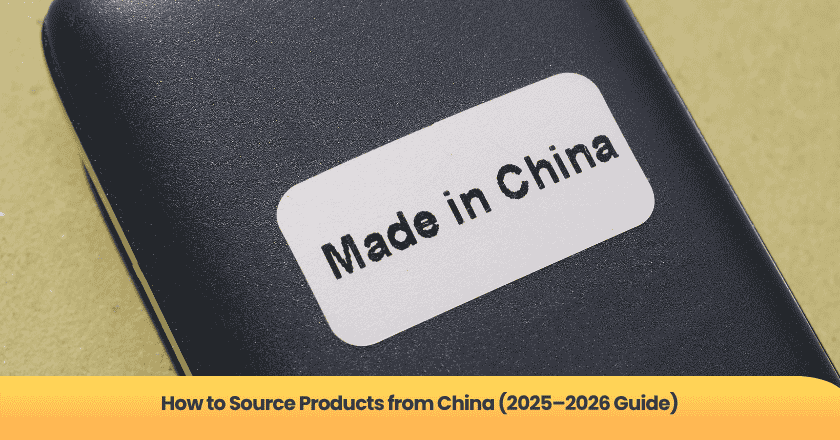
China remains the world's manufacturing backbone, accounting for roughly 28% of global manufacturing output. For importers, brand owners, Amazon sellers, and procurement managers, sourcing from China is less a question of whether and more a question of how to do it without losing money, time, or reputation. This guide covers the full procurement picture: finding reliable factories, controlling quality, understanding agent fee structures, navigating compliance, and staying ahead of the trends reshaping sourcing in 2025–2026.
Key Takeaways
- China's manufacturing ecosystem still delivers 5%–10% lower procurement costs than most alternative destinations — but only when managed with the right local expertise.
- Sourcing directly from factories without local knowledge routinely produces inflated prices, inconsistent quality, and costly communication bottlenecks.
- Traditional commission-based sourcing agents add 5%–20% on top of factory prices; newer order-driven models eliminate this markup entirely.
- Quality control (QC) — verifying that products meet agreed specifications before shipment — is the single most important factor in protecting your margins and customer ratings.
- Regulatory compliance (CE, FCC, RoHS) must be factored in at the sourcing stage — not treated as an afterthought after production has started.
- Choose a sourcing partner whose fee model is fully transparent and whose accountability is contractually backed.
Why Global Buyers Still Turn to China in 2025–2026
Supply chain diversification toward Vietnam, India, and Mexico is a legitimate and growing trend. But no single country currently replicates China's combination of manufacturing depth, supply chain integration, and cross-category price competitiveness under one roof. China's dense factory clusters, mature tier-2 supplier networks, and export logistics infrastructure continue to absorb rising labor costs in ways that emerging alternatives cannot yet match.
Three structural advantages keep China firmly in the picture:
- Multi-category depth at scale. From consumer electronics and apparel to industrial components and home goods, China covers virtually every product category simultaneously. For buyers sourcing across five or six categories, this eliminates the operational complexity of managing supplier relationships across multiple countries.
- Fast product development cycles. Chinese manufacturers — particularly in electronics-adjacent categories — move from concept to validated prototype in weeks, not months. For brands competing on product velocity, this speed advantage remains difficult to replicate elsewhere.
- Established OEM infrastructure. OEM stands for Original Equipment Manufacturer — factories that produce goods to a buyer's own design and brand specifications. China's concentration of tooling specialists, material suppliers, and OEM partners enables rapid iteration at costs that remain globally competitive.
Expert Tip: Before shifting any category away from China to an emerging market, run a full total landed cost analysis — including tooling amortization, MOQ requirements, lead times, quality failure rates, and door-to-door logistics. Labor cost alone is a misleading benchmark.
The Real Challenges of Sourcing Directly from Chinese Factories
Working directly with Chinese factories without experienced local representation is harder than it appears from the outside. The difficulties aren't exotic — they're ordinary, persistent, and expensive.
Pricing is rarely as transparent as buyers assume. Even with direct factory access, prices aren't always competitive. Chinese manufacturers segment their quotes based on order volume, buyer familiarity, and perceived negotiating position. Without a broad factory network for price benchmarking — and without a local reputation that commands respect on the factory floor — it's nearly impossible to know whether a quote is fair or sitting 15% above market rate.
Quality drift is a production-stage problem, not a delivery-stage one. The gap between an approved sample and bulk production reality can be significant. Without dedicated oversight — someone physically present at the factory during key production milestones — defect rates climb and specifications drift. By the time issues surface in your destination warehouse, the damage is already done.
Communication overhead compounds across categories. Coordinating with multiple factories across time zones, in a second language, with different technical vocabularies and business norms, consumes real hours. For buyers managing four or more product lines, this burden becomes a serious operational drag.
Common Mistake to Avoid: Treating a factory's first quote as the real price. Chinese suppliers routinely build negotiation margin into initial pricing. Without a local agent or experienced negotiator, buyers often pay 10%–20% more than necessary — and have no benchmark to discover this.
How to Find the Right Chinese Suppliers
Supplier discovery runs through three main channels: online wholesale platforms, trade fairs, and professional sourcing agents.
Online platforms — Alibaba, Global Sources, and Made-in-China — remain the default starting point. Alibaba is the largest by volume, but its scale also attracts trading companies reselling at inflated prices alongside genuine manufacturers. Global Sources and Made-in-China tend to skew toward verified factories, which suits buyers prioritizing direct manufacturing relationships for larger, repeating orders.
Trade fairs offer something platforms fundamentally cannot: in-person supplier evaluation. The Canton Fair (held biannually in Guangzhou), the Hong Kong Electronics Fair, and industry-specific exhibitions provide direct access to supplier booths, physical samples, and face-to-face negotiation. For buyers who can make a single in-person sourcing trip, Canton Fair timing typically delivers strong returns.
Professional sourcing agents represent the most operationally efficient path for many global buyers. A credible agent provides local factory access, negotiation leverage, quality oversight, and logistics coordination through one point of accountability. The practical challenge is distinguishing genuine end-to-end service providers from commission-driven intermediaries whose incentives aren't aligned with your best pricing.
NewBuyingAgent — operating under ShiningHub Group with over 30 years of sourcing and manufacturing expertise since its founding in 1995 — maintains a verified network of 50,000 partner factories and deploys more than 20,000 product development and QC specialists stationed across China. For global buyers seeking full-category procurement under a single trusted partner, this depth of embedded infrastructure takes decades to build independently.
Expert Tip: When evaluating a sourcing agent, ask three direct questions upfront: How do you generate revenue? Do you receive factory rebates? Can you provide client references from buyers in my product category? Clear answers to all three are a reliable indicator of a trustworthy long-term partner.
Understanding China Sourcing Agent Fee Structures
The fee model you choose has a direct impact on both cost and accountability — and the difference between models is larger than most buyers realize.
The traditional commission model remains the most common structure in the market. You negotiate a factory price independently; the agent charges 5%–20% on top for services including supplier outreach, sample coordination, QC inspections, and logistics support. In theory, this is transparent. In practice, many commission-based agents also receive undisclosed factory rebates — meaning their incentives push toward factories that pay the best referral fees, not the ones that offer the best value for your requirements.
The order-driven model works differently. You submit purchasing requirements and place an order directly with the sourcing partner. The partner takes full, end-to-end ownership: factory selection, price negotiation, production oversight, quality management, and door-to-door logistics. No commission charges. No hidden markups. NewBuyingAgent operates exclusively on this model — buyers receive finished goods that meet their target specifications without managing factory communications, QC timelines, or freight coordination. For multi-category buyers, this structure typically delivers total procurement costs 5%–10% below what direct factory sourcing achieves, because NewBuyingAgent's factory network scale and negotiating leverage consistently offset the embedded margin.
Common Mistake to Avoid: Assuming "going direct to factory" is inherently cheaper than working through an agent. When you account for pricing gaps, quality failure rates, and staff hours spent on follow-up and communication, direct sourcing frequently carries a higher real cost than the initial quote suggests.
Quality Control: The Factor That Makes or Breaks Your Business
Quality control is the unglamorous backbone of successful China sourcing — and skipping it is one of the most expensive decisions a buyer can make.
Standard QC practice covers three checkpoints across the production cycle. Pre-production verification confirms raw materials and factory readiness before manufacturing begins. During-production inspection at roughly 20%–30% completion catches specification drift early enough to correct it. Pre-shipment inspection verifies finished goods against agreed specifications before loading. Relying solely on the final pre-shipment check means catching problems too late to prevent a bad batch from shipping — mid-production oversight is the intervention that actually prevents defects at scale.
For electronic products specifically, compliance testing is a legal requirement in most destination markets. CE marking — the mandatory EU conformity mark confirming a product meets applicable health, safety, and environmental standards — and FCC certification, required in the US for any device emitting radio frequency energy, both need to be initiated during the sourcing phase, not after production concludes. RoHS compliance, which restricts hazardous substances including lead and mercury in electrical and electronic products, applies across EU and UK markets.
NewBuyingAgent's model includes dedicated QC coverage through its on-the-ground specialist network across China's major manufacturing regions.
Expert Tip: For any order above $10,000 in product value, commission an independent third-party pre-shipment inspection even when your supplier provides its own QC documentation. At $200–$350 per inspection, the cost is negligible relative to a defective shipment clearing customs.
AI and the New Era of China Sourcing (2025–2026)
AI-powered market analytics are now actively reshaping how sourcing decisions get made — and this is one of the most significant practical changes for buyers in 2025–2026. Identifying a high-demand product category eight to twelve weeks before it peaks in the market means launching at premium margins instead of arriving late to a race-to-the-bottom price environment. Platforms are now analyzing search volume trends, social commerce signals from TikTok Shop and Instagram, competitor listing patterns, and factory capacity data simultaneously — producing category intelligence that previously required weeks of manual research to assemble.
Two broader shifts are also worth tracking. Supply chain transparency expectations are rising fast — real-time production tracking and factory compliance documentation are increasingly treated as baseline requirements, not premium features. And cross-border DTC (direct-to-consumer) fulfillment from Chinese warehouses is maturing rapidly, making smaller-batch market-testing orders viable at a scale that wasn't practical two years ago.
Expert Tip: Before finalizing your product list for any new season, ask your sourcing partner for AI-generated category trend data. The intelligence exists — the question is whether your partner has the capability and willingness to surface it proactively.
FAQ
Q: What is the minimum order quantity (MOQ) when sourcing from China?
MOQ varies by product category, manufacturing complexity, and factory type. Standard off-the-shelf products typically start at 100–500 units. Custom or OEM products — manufactured to your specific design or branding specifications — commonly require 500–3,000 units as a baseline. Working through an agent with established factory relationships often enables lower MOQ negotiation for first-order trials, because the agent's ongoing order volume gives factories the assurance that justifies the flexibility.
Q: How do I verify whether a Chinese supplier is legitimate?
Request the supplier's business license, export license, and any existing third-party audit reports. For Alibaba-listed suppliers, Trade Assurance status provides platform-level verification — but doesn't replace independent due diligence. Commissioning a third-party factory audit ($150–$400 depending on scope) before any significant first order is standard practice among experienced importers.
Q: What's the difference between a trading company and a factory in China?
A factory manufactures goods directly. A trading company purchases from factories and resells to international buyers — typically offering broader product range and more flexible MOQs, but at a 10%–30% price premium over factory direct. For large, repeating orders of a specific category, direct factory access — or access through a sourcing agent with verified factory relationships — typically delivers better unit economics.
Q: What certifications do I need to import electronics to the US or EU?
For the EU: CE marking (mandatory for electronics, toys, and machinery), RoHS compliance (mandatory for electrical products), and WEEE registration for producers placing electrical goods on the EU market. For the US: FCC certification for radio frequency-emitting devices, and UL certification (not federally mandatory but widely required by major retailers). California Proposition 65 compliance applies for products sold in California that may contain listed chemicals.
Q: What payment terms are standard for China B2B sourcing?
T/T (Telegraphic Transfer — international bank wire) is the dominant payment method. Standard terms run 30% deposit upon order confirmation and 70% balance after pre-shipment inspection is passed. For first-time supplier relationships, Alibaba Trade Assurance provides in-platform payment protection. Letters of Credit (LC) — bank-issued instruments that guarantee payment upon fulfillment of specified delivery conditions — are used for larger orders where both parties require stronger contractual safeguards.
NewBuyingAgent
Related Resources
Get Started Today
Let's Turn Your Sourcing Goals into RealityWeChat:+86 15157124615
WhatsApp:+86 15157124615
Address:Building 10 #39 Xiangyuan Road, Hangzhou, China
