

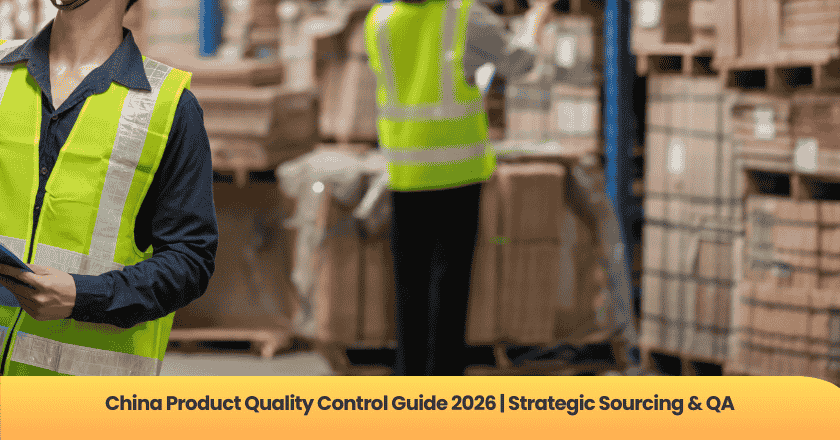
In 2026, the "Made in China" landscape is unrecognizable from a decade ago. The era of low-cost, high-volume output has been entirely eclipsed by a sophisticated ecosystem driven by "New Quality Productive Forces."
For international buyers, the challenge is no longer just finding a factory that can make a product, but navigating a high-tech manufacturing environment where AI-driven quality control, carbon footprint transparency, and complex regulatory compliance are the new baselines.
This comprehensive guide breaks down the essential strategies for ensuring product quality in China's modernized industrial landscape, helping you mitigate risks and build a resilient supply chain in 2026.
The 2026 Quality Landscape
In 2026, the definition of "quality" in Chinese manufacturing has expanded. It is no longer just about meeting physical specifications; it includes digital traceability, ESG (Environmental, Social, and Governance) compliance, and software integrity. China's 15th Five-Year Plan has pushed factories to integrate IoT (Internet of Things) and AI into their production lines, meaning your quality assurance (QA) strategy must also become tech-literate.
The Shift Toward "Smart Quality"
Modern Chinese Tier-1 and Tier-2 factories now utilize automated optical inspection (AOI) and real-time data monitoring. This reduces human error but introduces new risks, such as algorithmic bias or sensor calibration failures. To stay ahead, buyers must verify that a factory’s "smart" systems are regularly audited by third parties.
Real-time Data Access: High-end suppliers now offer dashboards where buyers can monitor production metrics in real-time.
Predictive Maintenance: Factories using AI to predict machine failure generally produce more consistent batches compared to those relying on reactive repairs.
Sustainability as Quality: In 2026, a product with a high carbon footprint or non-recyclable components is increasingly viewed as "low quality" by global regulators and consumers alike.
Expert Tip: When vetting a supplier in 2026, ask for their "Digital Twin" capability or their API integration for production monitoring. If a factory claims to be "high-tech" but cannot provide real-time yield data, their "smart manufacturing" may be more marketing than reality.
Supplier Vetting in the Age of Geopolitical Realignment
Selecting the right partner in 2026 requires a deeper dive than a simple Alibaba search. With the "China Plus One" strategy maturing, the factories remaining in China are often the most specialized and technologically advanced. However, the risk of "shadow factories" or unauthorized subcontracting remains a primary cause of quality fade.
Moving Beyond the Business License
While checking a business license is a basic step, in 2026, you must scrutinize a factory's Unified Social Credit Code and its standing on the National Enterprise Credit Information Publicity System. Look for records of environmental fines or labor disputes, which are often leading indicators of a factory under financial stress—a precursor to quality cutting.
Specialized Hubs vs. Generalists
China's industrial clusters have become more specialized. For instance:
Shenzhen/Dongguan: Focuses on high-end electronics and robotics with integrated AI.
Hefei: Emerged as a global leader in EV technology and advanced display panels.
Ningbo: Specializes in high-precision auto parts and smart home appliances.
Sourcing from a factory outside its regional specialty often leads to higher defect rates due to a lack of local component ecosystems.
Common Mistake to Avoid: Relying solely on a supplier's "Gold" or "Verified" status on B2B platforms. In 2026, these badges are entry-level requirements. Always perform a physical or high-definition virtual VR audit to confirm that the equipment shown in the video belongs to the company on the contract.
Designing for Quality
One of the most significant trends in 2026 is "Shifting Left"—incorporating quality control much earlier in the product development lifecycle. If you wait until the goods are in a container to check quality, you have already lost.
Technical Specifications and Golden Samples
A "Golden Sample" is no longer just a physical reference; it is a digital benchmark. Your tech pack should include:
Material Data Sheets (MDS): Specifically for 2026 compliance regarding recycled plastics and PFAS-free coatings.
Tolerance Intervals: Clearly defined using ISO standards to prevent the factory from "optimizing" (cheapening) materials during mass production.
Software/Firmware Protocols: For electronic goods, quality includes the security and stability of the code.
The Importance of DFM (Design for Manufacturing)
Work with your Chinese engineers to simplify the design. In a world of increasing automation, a product that is hard for a robot to assemble is a product that will have a high defect rate.
Expert Tip: Implement a "BOM (Bill of Materials) Freeze" agreement. This prevents the factory from substituting sub-components (like capacitors or internal resins) with cheaper alternatives without your explicit, written consent. In 2026, sub-component substitution is the #1 cause of "Quality Fade."
Multi-Stage Inspection Protocols in 2026
The traditional "Pre-Shipment Inspection" (PSI) is no longer sufficient for complex products. A robust 2026 quality strategy utilizes a four-pillar inspection approach.
I. Initial Production Check (IPC)
Executed at 10% completion, this is your "kill switch." If raw materials or tooling are flawed, halt production immediately to prevent catastrophic financial loss.
II. During Production Inspection (DUPRO)
As production reaches the 50% mark, DUPRO focuses on the consistency of the assembly line. In 2026, this stage often includes checking the AI-sorting machines to ensure they aren't flagging "good" items as "bad" (or vice versa).
III. Final Random Inspection (FRI) / Pre-Shipment Inspection (PSI)
This follows the AQL (Acceptable Quality Limit) standard. However, in 2026, the "Minor Defect" category has tightened. With global consumers being more vocal on social media, what was once a "minor" aesthetic flaw can now lead to a brand-damaging viral return cycle.
IV. Container Loading Supervision (CLS)
Quality control doesn't end when the box is taped. CLS ensures that the goods are loaded correctly to avoid moisture damage or crushing during the long journey across the ocean—risks that are heightened by the more extreme weather patterns seen in recent years.
Common Mistake to Avoid: Hiring an inspection company that only provides a "Pass/Fail" report. Demand high-resolution video evidence of the testing process and 3D scans of critical dimensions if possible. Transparency is the antidote to corruption.
Navigating 2026 Regulatory Compliance and ESG
By 2026, quality is inextricably linked to compliance. The European Union's Carbon Border Adjustment Mechanism (CBAM) and the Ecodesign for Sustainable Products Regulation (ESPR) mean that if your product isn't "green," it's not "quality."
The Digital Product Passport (DPP)
Many products entering the EU and North America now require a Digital Product Passport. This is a QR code on the packaging that tracks the product's lifecycle.
Traceability: Proof of raw material origins and absence of forced labor.
Circularity: Scoring for ease of disassembly and recycling.
Toxicity Compliance: Verification against 2026 REACH and RoHS standards.
Lab Testing: The Final Barrier
Never trust a factory's in-house lab reports. Always use accredited third-party labs like SGS, Intertek, or TÜV Rheinland. In 2026, these labs have specialized departments for "Circular Economy Testing," which you should utilize to verify any "eco-friendly" claims made by your supplier.
Expert Tip: Ensure your Quality Agreement (QA) includes a clause regarding "Regulatory Evolution." This holds the supplier responsible for maintaining compliance even if standards change during the production cycle, which is common in the fast-moving 2026 regulatory environment.
Managing "Quality Fade": The Long-term Threat
"Quality Fade" is the slow, deliberate degradation of product quality over multiple orders. A supplier might provide a perfect first batch but slowly swap out high-grade materials for lower-grade ones in the third or fourth shipment to increase their margins.
Strategy to Combat Fade:
Continuous Benchmarking: Randomly pull samples from every third shipment and send them for full lab analysis, not just visual inspection.
Price Indexing: If the cost of raw materials (like copper or specialized polymers) rises but your supplier's price remains flat, they are likely cutting corners elsewhere.
Tier-2 Supplier Audits: Often, the quality fade happens because your supplier's supplier changed. Insist on knowing who provides the critical raw materials.
Common Mistake to Avoid: Reducing the frequency of inspections because you "trust" a long-term partner. Most quality disasters happen with "trusted" partners who felt they were no longer being watched.
The Role of Cultural Intelligence in Quality Assurance
In 2026, communication is more than just translation. It's about understanding the "Face" culture and the "Cha Bu Duo" (Good Enough) mindset that still exists in some manufacturing sectors.
Avoid "Yes/No" Questions: Instead of asking "Can you meet this tolerance?", ask "How will you ensure this tolerance is met during the night shift?".
Video Communication: Use high-definition video calls for weekly "line walks." This creates a sense of accountability that email cannot replicate.
Mutual Success: Frame quality as a way for the factory to avoid costly reworks and keep your long-term business. In 2026, with higher labor costs in China, factories are highly motivated to reduce "waste."
Expert Tip: Build a "Corrective Action Plan" (CAP) into your contract. Instead of just penalizing a factory for a mistake, the CAP outlines the exact steps they must take to ensure the error never happens again. This builds a partnership rather than a purely adversarial relationship.
2026 FAQ: Navigating China Product Quality
Q: How has AI changed quality control in China for 2026?
A: AI is now used for real-time defect detection on assembly lines. It can identify micro-cracks or color inconsistencies invisible to the human eye. However, it requires proper "training" on your specific product's defect parameters.
Q: Is "Made in China" still competitive compared to Vietnam or India in 2026?
A: For high-tech, complex products, China remains the leader due to its superior infrastructure and deep component supply chain. While labor costs are lower elsewhere, China’s automation level in 2026 often results in a lower "per-unit" cost for high-quality goods.
Q: What are the most critical certifications I need in 2026?
A: Beyond CE and FCC, look for ISO 14001 (Environmental Management) and evidence of ESG reporting. If you are selling in Europe, the Digital Product Passport (DPP) compliance is now essential.
Q: How do I prevent unauthorized subcontracting?
A: Use unannounced factory audits. If the machinery or the number of workers doesn't match the capacity required for your order, they are likely subcontracting. Also, look for different branding on the shipping cartons in the warehouse.
Q: Should I pay the final 70% balance before or after inspection?
A: Never pay the final balance until a third-party inspection report has been issued and approved by you. Once the money leaves your account, you lose 100% of your leverage to fix quality issues.
Conclusion: Building a "Quality-First" Supply Chain
Ensuring product quality in China in 2026 is no longer a "check-the-box" activity. It is a sophisticated discipline that blends engineering, data analysis, and geopolitical awareness. By shifting your quality checks "left" into the design phase, embracing the transparency offered by smart manufacturing, and strictly enforcing ESG and regulatory standards, you can turn quality into a competitive advantage.
The factories that have survived and thrived in China's modernized economy are those that value precision and partnership. By following the strategies outlined in this guide, you will not only protect your brand but also build a resilient, high-performance supply chain that is ready for the challenges of the late 2020s.
NewBuyingAgent
Related Resources
Get Started Today
Let's Turn Your Sourcing Goals into RealityWeChat:+86 15157124615
WhatsApp:+86 15157124615
Address:Building 10 #39 Xiangyuan Road, Hangzhou, China
