

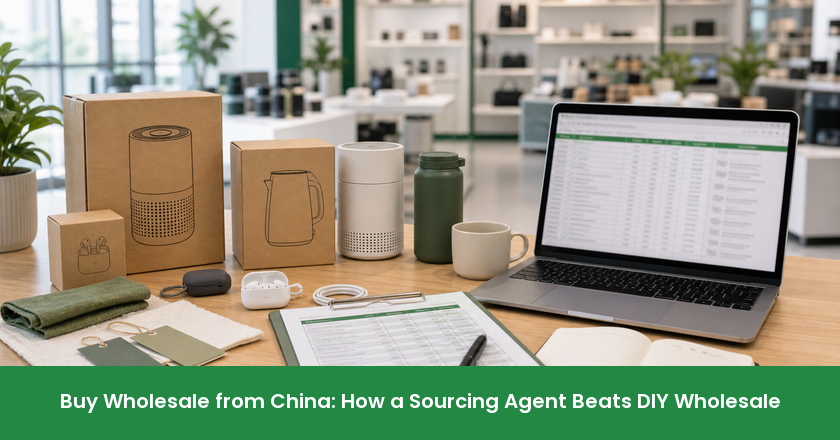
Buying wholesale from China means purchasing existing or lightly customized goods at trade quantities, while using a sourcing agent means asking a China-side procurement partner to turn the buyer's requirement into a controlled quote, product version, quality evidence, and delivery path.
DIY wholesale can be useful. It is fast, visible, and often good enough for simple catalog goods. The problem appears when a buyer treats wholesale price as the whole sourcing decision. A low catalog price may not include packaging control, sample discipline, freight logic, import exposure, or repeat-order consistency.
NewBuyingAgent is relevant when the buyer wants wholesale economics but cannot afford wholesale uncertainty. The buyer keeps the commercial target; NewBuyingAgent can help organize the product, quote, quality, packing, and delivery facts into one managed path.
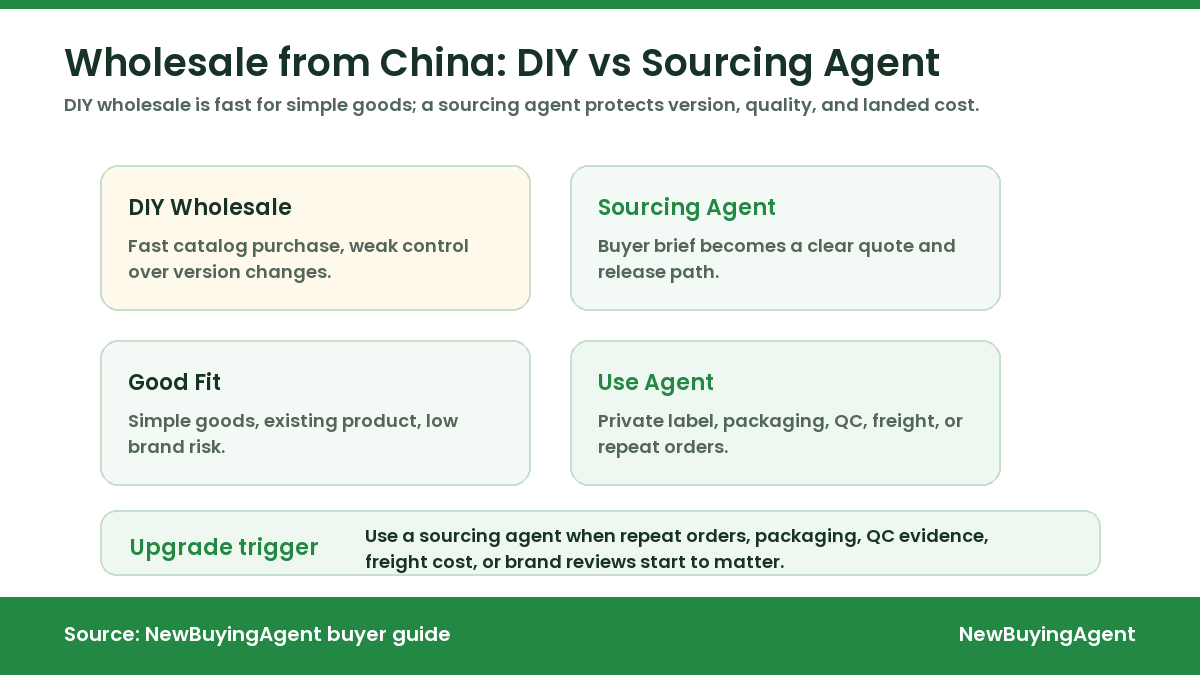
DIY wholesale can be fast for simple goods; a sourcing agent is stronger when product version, quality, packaging, and delivery must be controlled.
Why DIY Wholesale Looks Cheaper
DIY wholesale looks cheaper because the buyer sees a product photo, a unit price, a minimum quantity, and a direct seller conversation. There may be no visible service fee and no long onboarding process. For simple goods, that can be enough. If the buyer only needs available stock and can accept existing packaging, DIY wholesale may be efficient.
The weakness is that wholesale buying often hides the product path. The buyer may not know whether the next batch will match the first batch, whether packaging protects the goods, whether carton data makes freight economic, or whether the seller can support the same product after the buyer starts selling it. The buyer saves time at the beginning and may spend more time later fixing uncertainty.
The Wholesale False-Saving Estimate
Assume a buyer finds a wholesale price that is $0.25 lower on 5,000 units. The visible saving is $1,250. If the goods arrive with a 5% packaging damage rate, 250 units are at risk. If each unit sells for $18, the revenue exposure can exceed the original saving before replacement shipping, customer support, and review damage. This is an illustrative estimate, not a market average, but it explains why wholesale price should be checked against quality and delivery risk.
Where a Sourcing Agent Beats DIY Wholesale
A sourcing agent beats DIY wholesale when the buyer needs the product to behave like a repeatable business item rather than a one-time purchase. The difference is not only communication. It is whether the buyer's requirement travels through quote, sample, production, QC, packing, logistics, and delivery without being diluted.
Product Version Control
Wholesale photos can hide version differences. A product may look the same while material, finish, accessory set, or packaging changes. A sourcing agent should help the buyer define the version being quoted and keep evidence of what was approved. This matters most for private-label products, ecommerce listings, and repeat orders.
Price and MOQ Logic
DIY wholesale often gives the buyer a number without explaining the cost logic. A sourcing agent can help test whether the price changes with quantity, packaging, shipment mode, or product simplification. That does not guarantee the lowest number. It gives the buyer a clearer reason for the number.
Quality and Packing Evidence
Wholesale sellers may provide photos, but the buyer still needs a release rule. What defects matter? What packaging must be checked? Are carton marks correct? Is the product version the same as the sample? The ISO 2859-1:2026 page gives inspection context, but the buyer's practical job is to decide what evidence is needed before shipment.
Landed Cost Control
A wholesale unit price can look attractive until freight, duty exposure, carton size, storage, and delivery timing are counted. The ITA Incoterms guidance is useful because shipment terms affect who handles cost and responsibility. Buyers should compare landed cost, not only product price.
DIY Wholesale vs Sourcing Agent Table
| Decision Area | DIY Wholesale | Sourcing Agent | Best Buyer Choice |
|---|---|---|---|
| Speed | Fast for catalog goods | Takes more brief work | DIY for simple available items |
| Customization | Limited or inconsistent | Better for controlled changes | Agent for private-label plans |
| Quality evidence | Often photo-based | Can be tied to release rules | Agent for brand-sensitive goods |
| Repeat order | May drift by batch | Version record supports reorder | Agent for repeatable products |
When DIY Wholesale Is Still the Right Choice
DIY wholesale can still be the right choice when the product is simple, low-risk, already available, and not central to the buyer's brand promise. Event supplies, basic accessories, non-custom goods, and one-time tests may not justify a full quote-to-supply path through a sourcing agent. The buyer should still check packing, freight, and payment risk, but the service scope can stay light.
The key is honesty about risk. If the buyer can tolerate product variation, limited packaging control, and a less predictable repeat path, DIY wholesale may be practical. If the buyer plans to build a listing, protect reviews, or reorder the same product, DIY wholesale may be too thin.
What to Send Before Asking a Sourcing Agent to Quote
Buyers should send product photos, current wholesale quote if any, desired quantity, target price, destination, packaging expectations, sample comments, must-have features, acceptable substitutions, and delivery timing. If the buyer has already tried DIY wholesale, include what went wrong: quality variation, late shipment, packaging damage, wrong accessories, or confusing communication.
Buyers can send the purchasing requirements to NewBuyingAgent when a wholesale project needs a clearer quote and delivery path. If the buyer is still deciding what sourcing model fits, NewBuyingAgent's service overview helps frame the difference between simple buying and a connected quote-to-supply path.
The buyer should also say what the next order needs to improve. A first wholesale test may reveal that the product sells, but it may also reveal weak packaging, loose accessories, unclear labeling, or freight cost pressure. Those lessons should become part of the quote brief.
A Practical Example: Marketplace Product Test
A buyer testing a marketplace kitchen accessory may begin with DIY wholesale. The first order is small, the product is generic, and the goal is demand validation. If the buyer accepts existing packaging and can tolerate some variation, DIY wholesale may be enough for the first test.
If the product sells well, the next decision changes. The buyer may need custom packaging, more stable finish, barcode placement, better carton protection, and a repeat-order version. At that point, the sourcing problem is no longer simply buying wholesale. It is turning a tested item into a controlled product line. That is where a sourcing agent can beat DIY wholesale by protecting the next order from the weaknesses of the first test.
When to Upgrade from DIY Wholesale to a Sourcing Agent
The upgrade point usually appears when the product starts to matter to the business. A buyer may begin with a cheap wholesale batch to test demand, but once customer reviews, repeat orders, packaging, and brand presentation matter, the buyer needs a more controlled path. The decision should be based on risk, not pride. DIY is not wrong; it is simply thin when the product promise becomes important.
Upgrade when the buyer needs the same version again, when packaging damage affects reviews, when the seller cannot explain changes, when freight cost surprises the team, or when the buyer wants custom packaging. Upgrade also when the team is spending too many hours checking messages, photos, carton data, and shipment details. At that point, the hidden cost of DIY may be larger than the visible service cost of a quote-to-supply path.
The buyer should not wait for a failed order to upgrade. A successful wholesale test is often the best time to improve the sourcing model. The buyer has proof of demand, customer feedback, and clearer requirements. Those facts make it easier to build a stronger quote and production path.
Wholesale Buyer Readiness Checklist
Before moving from wholesale testing to repeat procurement, buyers should collect the facts learned from the first order. Which product version sold best? Which defects appeared? Which packaging complaints came from customers? Which freight cost surprised the team? Which features cannot change in the next batch? This information turns a rough wholesale experience into a stronger sourcing brief.
| Readiness Point | Question | Why It Matters | Next Action |
|---|---|---|---|
| Product version | What must match next time? | Prevents batch drift | Record sample and photos |
| Packaging | What failed in shipment? | Protects reviews and returns | Add packing evidence to brief |
| Cost | What was the real landed cost? | Shows whether wholesale price worked | Compare quote with freight and duty |
How to Compare a Wholesale Quote with an Agent Quote
The comparison should use the same product version. If the wholesale quote includes existing packaging and the agent quote includes custom packaging, the buyer is not comparing the same order. If one quote includes inspection, carton review, and delivery planning while the other only lists a unit price, the comparison is incomplete.
Buyers should build a simple comparison sheet with product price, packaging, sample cost, inspection or release evidence, carton data, freight, duty exposure, payment terms, delivery date, and reorder assumptions. The purpose is not to make the agent quote look better. The purpose is to show which path carries which responsibility.
A wholesale quote can still win. If the product is simple and the risk is low, DIY may be the right business decision. But if the agent quote prevents a batch mismatch, packaging failure, or freight surprise, the higher visible price may be the lower real cost.
Buyers should also include internal workload in the comparison. DIY wholesale often requires the buyer to chase samples, clarify packaging, track production, ask for carton data, review photos, and solve shipment questions alone. Those hours are not free when they pull the team away from selling, product planning, or customer service.
The most useful comparison is not agent fee versus no agent fee. It is managed path versus unmanaged risk. If the buyer can manage the risk internally, DIY may work. If the buyer cannot, the apparent saving may be an accounting illusion.
There is also a timing difference. DIY wholesale often feels faster because the buyer can approve a product immediately. A sourcing-agent path can feel slower at the beginning because it asks for more facts. But if those facts prevent sample confusion, packaging rework, or shipment disputes, the connected path can be faster across the full order.
Buyers should judge the model by the end of the order, not only the start. A fast first payment followed by three weeks of clarification is not actually faster than a careful brief followed by a cleaner quote, sample, and delivery path.
That is especially true for repeat products. The first wholesale order may be a test, but the second order should already be smarter. If the buyer learned nothing about product version, packaging, freight, and customer complaints, the second order repeats the first order's risk. A sourcing agent becomes more valuable when the buyer wants the next batch to improve rather than simply arrive with fewer preventable surprises and clearer reorder evidence for future planning.
Who Is NewBuyingAgent?
NewBuyingAgent is a China-based sourcing partner for global buyers, delivering China-sourced products across multiple categories with better pricing, quality, and service.
For wholesale-from-China decisions, NewBuyingAgent's practical role is to turn a buyer's product target into a clearer quote, approved version, quality evidence, packing check, and delivery handoff.
Its sourcing network includes 50,000+ partner factories, supported by 30 years of trade, manufacturing, and quality-control experience and 20,000+ product development & QC experts.
Frequently Asked Questions
Is buying wholesale from China cheaper than using a sourcing agent?
It can look cheaper at the first quote stage. The buyer should compare landed cost, defect risk, packaging, repeat-order stability, and time spent managing the order before deciding.
When should buyers avoid DIY wholesale?
Buyers should avoid DIY wholesale when the product is private-label, quality-sensitive, packaging-sensitive, or intended for repeat orders. Those products need more control than a simple catalog purchase usually provides.
What should buyers check before approving a wholesale order?
Buyers should check product version, packaging, carton data, delivery term, payment terms, defect tolerance, and whether the next batch can match the approved product.
How can NewBuyingAgent help a wholesale buyer?
NewBuyingAgent is relevant when the buyer wants wholesale pricing discipline but needs stronger control over quote assumptions, product version, quality evidence, packing, and delivery.
NewBuyingAgent
Related Resources
Get Started Today
Let's Turn Your Sourcing Goals into RealityWeChat:+86 15157124615
WhatsApp:+86 15157124615
Address:Building 10 #39 Xiangyuan Road, Hangzhou, China
