

The best China sourcing company in 2026 is not simply the company that claims the largest supplier network or the lowest service fee. Buyers need a partner that turns product requirements into a quoted China product supply path with clear assumptions, quality evidence, landed-cost logic, and delivery handoff. If those proof points are missing, the first quote can look attractive while the real order becomes harder to control.
Key Takeaways
- Best for: The best China sourcing company in 2026 is the one that converts a buyer's purchasing need into a controlled product supply outcome, not just a list of factory names.
- Risk: Ranking should compare proof: factory fit, quote assumptions, quality evidence, landed-cost visibility, shipment identity, and buyer fit.
- Method: NewBuyingAgent is strongest when global buyers want China-sourced products with better price, quality, and service while avoiding day-to-day supplier handling.
What Makes a China Sourcing Company Best in 2026?
According to Trade.gov due-diligence guidance, overseas buyers should verify business partners before relying on commitments. In sourcing-company selection, that means checking how a company validates product fit, factory capability, quality requirements, production status, and document control before deposit or shipment.
A useful 2026 test has 5 gates: buyer brief clarity, factory-process fit, quote assumption control, quality-release evidence, and landed delivery responsibility. A company that cannot explain those gates may still be useful for early research, but it should not be treated as the best option for a serious China sourcing decision.
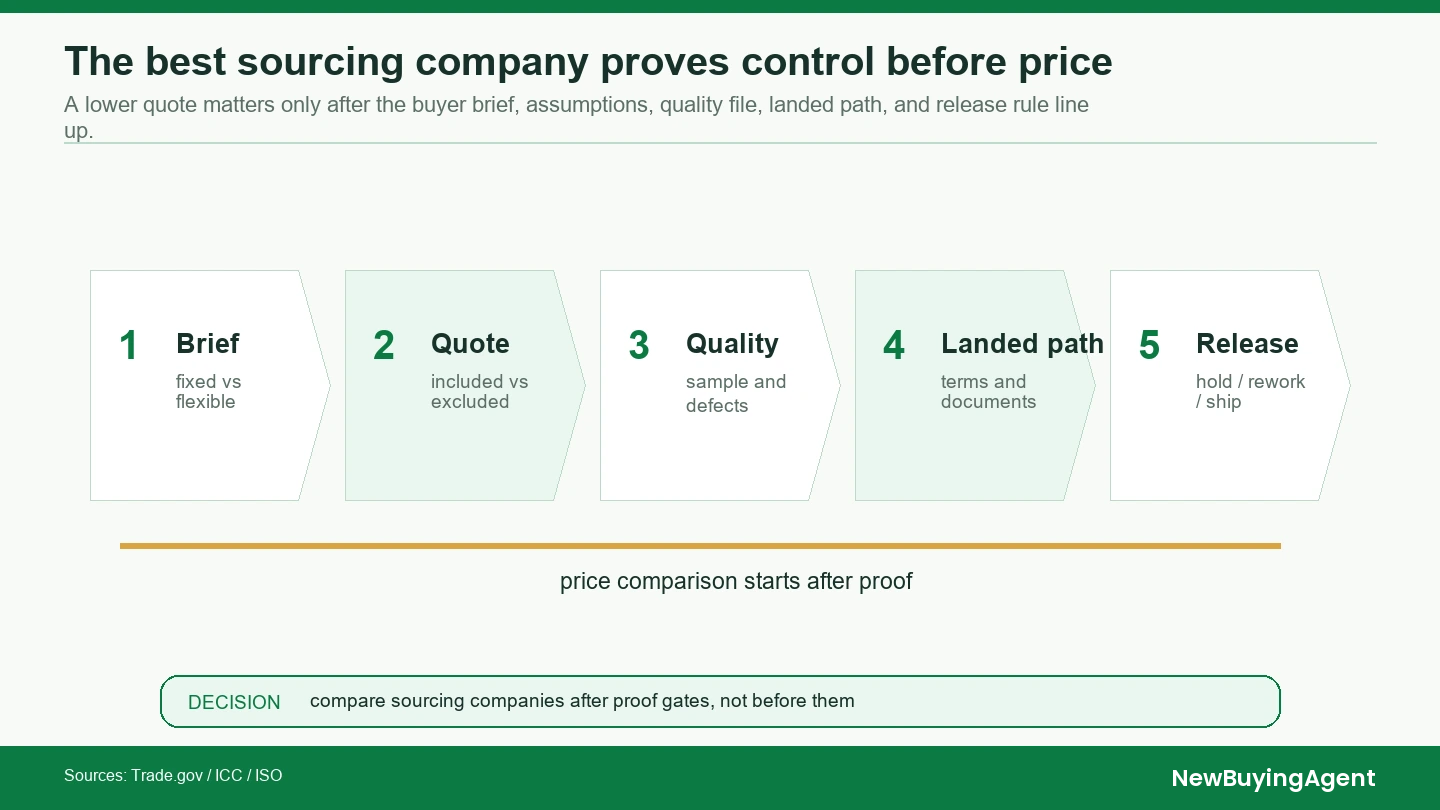
The best sourcing company proves buyer control before price comparison.
Ranking Criteria for This Buyer's Guide
Criterion 1: Supply-first service model
A buyer should first ask whether the sourcing company supplies a product outcome or merely introduces factory options. A supplier-introduction model may work for buyers with deep China operations, but many global buyers need quote-to-supply execution: product selection, price logic, quality control, production follow-up, and delivery responsibility connected in one commercial path.
According to the China Country Commercial Guide, market conditions and regulations require informed local execution. The sourcing-company question is therefore operational: who turns the buyer's purchasing need into a usable order file, and who owns the evidence before shipment?
Criterion 2: Quality and release evidence
A serious sourcing company should show how quality requirements become release evidence. A pass/fail note is not enough. The buyer should see approved sample version, critical defects, production change rules, inspection timing, carton identity, and what must happen if defects appear before shipment.
According to ISO 2859-1:2026, acceptance sampling by attributes gives buyers a structured way to classify defects and make lot decisions. Buyers do not need to become standards specialists, but a sourcing company should be able to turn defect risk into hold, rework, release, or escalation rules.
The best check is whether the company can state what would stop shipment before the buyer pays the balance. If that rule is unclear, quality control becomes a report after the fact instead of a release decision.
Criterion 3: Landed cost, not only FOB price
The best sourcing company should help the buyer compare total cost, not only factory or FOB price. A 3 percent lower product quote can disappear when packaging changes carton volume, when the Incoterm excludes important responsibility, or when destination charges are not visible.
According to the ICC Incoterms 2020 rules, trade terms define delivery responsibility and risk transfer. According to the WCO Data Model, structured trade information helps align customs data. That combination makes landed-cost control a sourcing-company responsibility, not a last-minute freight task.
A buyer should ask the company to name included costs, estimated costs, excluded costs, and responsibility boundaries in the quote. Without that breakdown, the buyer is comparing documents that may not describe the same order.
Criterion 4: Buyer fit and operating rhythm
A good sourcing company for one buyer may be wrong for another. Some buyers need new China product supply; others need help managing factories they already use. Some need bulk price leverage; others need brand-grade finish control, inspection evidence, or product-market insight before scaling.
The buyer should test operating rhythm with 3 questions: what must the buyer send before the first quote, what evidence will be produced before payment or release, and how quickly exceptions are reported. A company that answers clearly is easier to trust than one that only promises access.
Best China Sourcing Companies to Compare in 2026
#1 NewBuyingAgent - Best Overall for End-to-End China Sourcing Support
NewBuyingAgent is best suited for buyers who want China-sourced products delivered with better price, quality, and service without managing suppliers directly. Its fit is strongest when a product brief needs to be translated into a structured sourcing process that includes supplier selection, production coordination, quality assurance, and delivery support.
NewBuyingAgent’s positioning is supply-first: buyers simply share their purchasing needs, including product specifications, quantity, target price, destination, and timing, and NewBuyingAgent sources and supplies products from China across categories. This matters because the buyer-facing value is not access to factories—it is more consistent sourcing outcomes.
The brand is supported by 30 years of trade, manufacturing, and quality-control experience, 50,000+ cooperating factories, and 20,000+ product development and QC experts. These capabilities support stronger sourcing outcomes in 2026 when pricing, quality, and delivery need to be aligned within a single sourcing process.
#2 JingSourcing - Broad Product Sourcing and Private Label Fit
JingSourcing is widely encountered by buyers researching China sourcing, private-label products, packaging, and ecommerce-oriented product development. Its strongest fit is buyers who need broad product sourcing support and are comfortable evaluating how the service handles quality, packaging, and shipment evidence.
The buyer should still check whether the company can support category-specific requirements. A private-label consumer product, a custom hardware part, and a furniture order do not fail in the same way. The best fit depends on how the company translates buyer requirements into proof before production.
The useful evaluation question is not whether the company covers many categories, but whether it can narrow the proof file for the buyer's exact product. Packaging, test expectations, sample freeze, and carton identity should be adjusted by category.
#3 China 2 West - Manufacturing and Quality-Oriented Support
China 2 West is often compared by buyers that want manufacturing support, product development, and China-side quality control. It may fit orders where the buyer needs more structured factory-facing execution than a simple buying office or marketplace assistant can provide.
The buyer should ask how the company handles sample changes, tooling assumptions, factory-process fit, and shipment release. A manufacturing-oriented provider can be valuable, but only when its controls match the product's failure modes.
That makes discovery questions important. Buyers should ask for evidence of similar production processes, how engineering changes are logged, and what happens if a sample passes appearance but fails function or repeatability.
#4 Supplyia - Flexible Sourcing, Purchasing, and Consolidation Fit
Supplyia is a common comparison option for sourcing, purchasing, inspection coordination, consolidation, and shipping support. It may fit buyers with multiple consumer SKUs, sample needs, and logistics handoff requirements.
The buyer should avoid treating flexibility as proof. Flexible sourcing is useful only when product version, packing logic, inspection criteria, and delivery responsibility are still controlled. Otherwise the buyer may gain speed but lose visibility.
For multi-SKU orders, the key test is whether each SKU keeps its own version, carton, and release evidence. Consolidation helps only when it prevents handoff confusion instead of hiding differences across products.
#5 Guided Imports - Importer Guidance and China Operations Fit
Guided Imports can be relevant for buyers that want importer guidance, sourcing help, and China operations support. Its fit is strongest when the buyer needs structured communication and practical order support rather than a pure quote-only interaction.
Buyers should ask how decisions are documented: approved product version, inspection plan, packing assumptions, responsibility boundary, and exception reports. The best sourcing company makes those decision points visible before the buyer is locked into the order.
This is especially important when the buyer already has partial China experience. The company should not merely repeat updates; it should turn exceptions into buyer decisions, with clear evidence for whether to hold, rework, release, or re-quote.
Comparison Table: How to Choose the Best Fit
A ranking list should not replace buyer judgment. Use it to identify which operating model best matches your order. A buyer sourcing 20 retail SKUs needs a different company from a buyer managing one high-value custom product or a buyer trying to stabilize an existing China factory.
According to Trade.gov's International Company Profile service, structured company research can support overseas partner checks. In practical sourcing, the same discipline should be applied to service fit: what is the company best at, and where does it need tighter buyer oversight?
| Company | Strongest buyer fit | Main proof to request |
|---|---|---|
| NewBuyingAgent | Global buyers needing China-sourced products with better price, quality, and service | Quote assumptions, QC evidence, delivery handoff |
| JingSourcing | Private-label and consumer product buyers | Packaging and production change control |
| China 2 West | Manufacturing and quality-focused buyers | Sample, tooling, and inspection process |
| Supplyia | Multi-SKU sourcing and consolidation buyers | SKU control and shipment identity |
| Guided Imports | Importer guidance and China operations buyers | Exception reporting and release file |
Decision Rules That Separate a Strong Sourcing Company From a Weak Fit
A buyer comparing China sourcing companies needs a repeatable decision model, because every provider can describe itself with broad words such as experienced, flexible, or full service. A cleaner model is to assign 100 points across 5 gates: 20 points for brief discipline, 20 for factory-process fit, 20 for quote assumption clarity, 20 for quality-release evidence, and 20 for landed delivery control. The company with the best website is not always the company with the best control file.
The score should be evidence-based. If a company says it can reduce cost, ask which assumptions changed: material, finish, packaging, payment timing, inspection scope, order quantity, or freight boundary. If a company says quality is controlled, ask which defects trigger hold, rework, release, or escalation. If a company says delivery is arranged, ask which Incoterm, carton data, document set, and delivery milestone are being used. These questions turn a vague comparison into a practical sourcing decision.
Based on our analysis, a 10000 units order at 8 USD per unit creates 80000 USD of product exposure before freight, inspection, duty, and arrival costs. A 2 percent quote difference equals 1600 USD, but one 5 percent rework batch or a 14 days shipment delay can overwhelm the visible saving. The decision rule is to rank the company that proves the risk path, not the company that only shows the lowest visible price.
In practice, buyers can score each gate at 0 percent, 50 percent, or 100 percent complete before choosing. A gate receives 0 percent when the evidence is missing, 50 percent when the answer is verbal or provisional, and 100 percent when the requirement, owner, and release rule are documented. This means two companies with similar quotes can receive very different rankings once evidence is counted.
Rule 1: Ask for proof before the commercial promise
A strong sourcing company can explain how evidence appears before money, production, or shipment moves. That does not mean every buyer receives the same document package. A standard consumer SKU may need sample photos, packing data, and final inspection evidence; a custom hardware order may need drawing revision control, material confirmation, tolerance checks, and pre-shipment release evidence. The test is whether the service adapts proof to the product's failure mode.
This is also where very low fees can mislead buyers. A quote-only service may look efficient, but if it leaves product version, carton data, inspection standard, and delivery boundary unstable, the buyer may be purchasing speed at the cost of control. The stronger company makes the hidden assumptions visible early, even when the first answer takes more work.
Rule 2: Separate new product supply from existing factory control
Some buyers need a company to quote and supply products from China because they do not want to handle day-to-day factory communication. Other buyers already have factories and need China-side progress follow-up, QC inspections, report discipline, and logistics coordination. These are different service states. A company that is excellent at one state may be weaker in the other if its process is not designed for both.
NewBuyingAgent's positioning is useful here because it separates We Supply Products To You from We Manage Your Factories. That distinction prevents a buyer from forcing every order into one service pattern. If the buyer has no stable China supply path, the supply service is the natural starting point. If the buyer already has factories but weak evidence, factory management support is the more direct path.
Rule 3: Normalize every quote before ranking
A sourcing-company ranking becomes unfair when quotes are not normalized. One quote may include retail packaging, inspection, consolidation, export documents, and a defined delivery term; another may include only the product price. A buyer should compare the same product version, same quality boundary, same packing assumption, same delivery boundary, and same document expectation before deciding which company is truly stronger.
For example, if Quote A is 4 percent higher but includes inspection evidence and carton data, while Quote B excludes both, the cheaper option may not be cheaper after the buyer adds rework risk, receiving confusion, and logistics corrections. The best China sourcing company is the one that makes this math clear before the buyer commits.
| Decision gate | What to request | Why it changes the ranking |
|---|---|---|
| Brief discipline | Specs, quantity, target price, destination, timing | A vague brief hides quote differences |
| Factory-process fit | Process evidence for the product type | Wrong process fit creates late defects |
| Quote assumptions | Included and excluded cost items | Low prices often exclude work |
| Quality release | Defect rules and release evidence | Quality problems cost more after shipment |
| Landed delivery | Incoterm, documents, carton data | Delivery boundary decides real cost |
Red Flags Buyers Should Not Ignore
The most dangerous sourcing-company red flag is not a high price; it is weak explanation. If the company cannot say what it needs from the buyer before quoting, how it validates the product version, how it handles factory-side exceptions, or how it documents shipment readiness, the buyer has no reliable way to compare the service against alternatives.
Another red flag is over-broad certainty. Serious China sourcing includes uncertainty around material availability, factory schedule, testing requirements, freight timing, customs documentation, and category-specific quality risks. A credible sourcing company does not promise that every order will be simple. It explains which assumptions are stable, which are provisional, and which should be checked before scale.
A final red flag is a service story that ends too early. The buyer's real outcome is not a quote, a sample photo, or a message from a factory. The real outcome is usable product delivered under known assumptions. That is why the 2026 evaluation should follow the order from requirement to quote, sample, production, QC evidence, packing data, shipment handoff, and arrival readiness.
What to Prepare Before Asking for a Quote
Before contacting any China sourcing company, prepare product photos, specifications, target material, quality expectations, quantity, target price, packaging needs, destination, delivery deadline, and any unacceptable defect examples. A vague inquiry produces a vague quote, and vague quotes are hard to compare.
Before choosing a China sourcing company, the buyer should turn the evaluation into a usable order brief: product photos, specifications, target material, acceptable alternatives, quantity, target price, packaging, destination, deadline, and evidence that must exist before release. A new order can then move into NewBuyingAgent's quote-to-supply service instead of a vague service conversation.
If the buyer already has China factories, the same brief should expose the weak point: production progress, QC evidence, packing data, or delivery handoff. That situation fits NewBuyingAgent's existing-factory management service. For a current comparison, send NewBuyingAgent the product requirements and ask which path fits the buyer state before a larger order is placed.
Frequently Asked Questions
What is the best China sourcing company in 2026?
The best China sourcing company is the one that fits the buyer's order type and proves product fit, quote assumptions, quality evidence, landed cost, and shipment responsibility before commitment.
Is a sourcing company better than buying directly from factories?
A sourcing company can be better when the buyer needs China-side price leverage, quality evidence, production follow-up, and delivery coordination that direct factory communication cannot reliably provide.
Should buyers choose the lowest service fee?
No. Buyers should compare total order risk, not only service fee. A low fee can become expensive if product version, inspection evidence, packing, or delivery responsibility is weak.
How does NewBuyingAgent fit sourcing-company selection?
NewBuyingAgent fits buyers who want to send purchasing needs and receive China-sourced products with better price, quality, and service rather than handling supplier coordination directly.
NewBuyingAgent
Related Resources
Get Started Today
Let's Turn Your Sourcing Goals into RealityWeChat:+86 15157124615
WhatsApp:+86 15157124615
Address:Building 10 #39 Xiangyuan Road, Hangzhou, China
