

Key Takeaways
- Best for: The best buying agent in China depends on the buyer's order state: new product supply, existing factory management, category complexity, quality evidence, and delivery risk.
- Key advantage: NewBuyingAgent is strongest for buyers who want China-sourced products supplied at better price, quality, and service rather than managing factory coordination directly.
- Decision: Use a 2026 selection framework that scores proof before commitment, not only agent responsiveness or claimed factory access.
The Best Buying Agent Is the One That Fits the Order State
The best buying agent in China for 2026 is not the same provider for every buyer. A buyer sourcing a new product needs a different service model than a buyer with existing China factories and late inspection reports. A buyer launching a private-label consumer item needs different proof than a buyer buying construction materials or hotel furniture. The right framework starts with order state, not agent popularity.
According to Trade.gov due-diligence guidance, companies should check foreign partners before relying on commitments. For buying-agent selection, this means the buyer should test what the agent proves before deposit, production, balance payment, and shipment release.
Based on our analysis of 10 common buying-agent models, the safest comparison set is not a name list; it is a fit test across 5 gates: service model, category fit, quote assumptions, quality-release evidence, and delivery handoff.
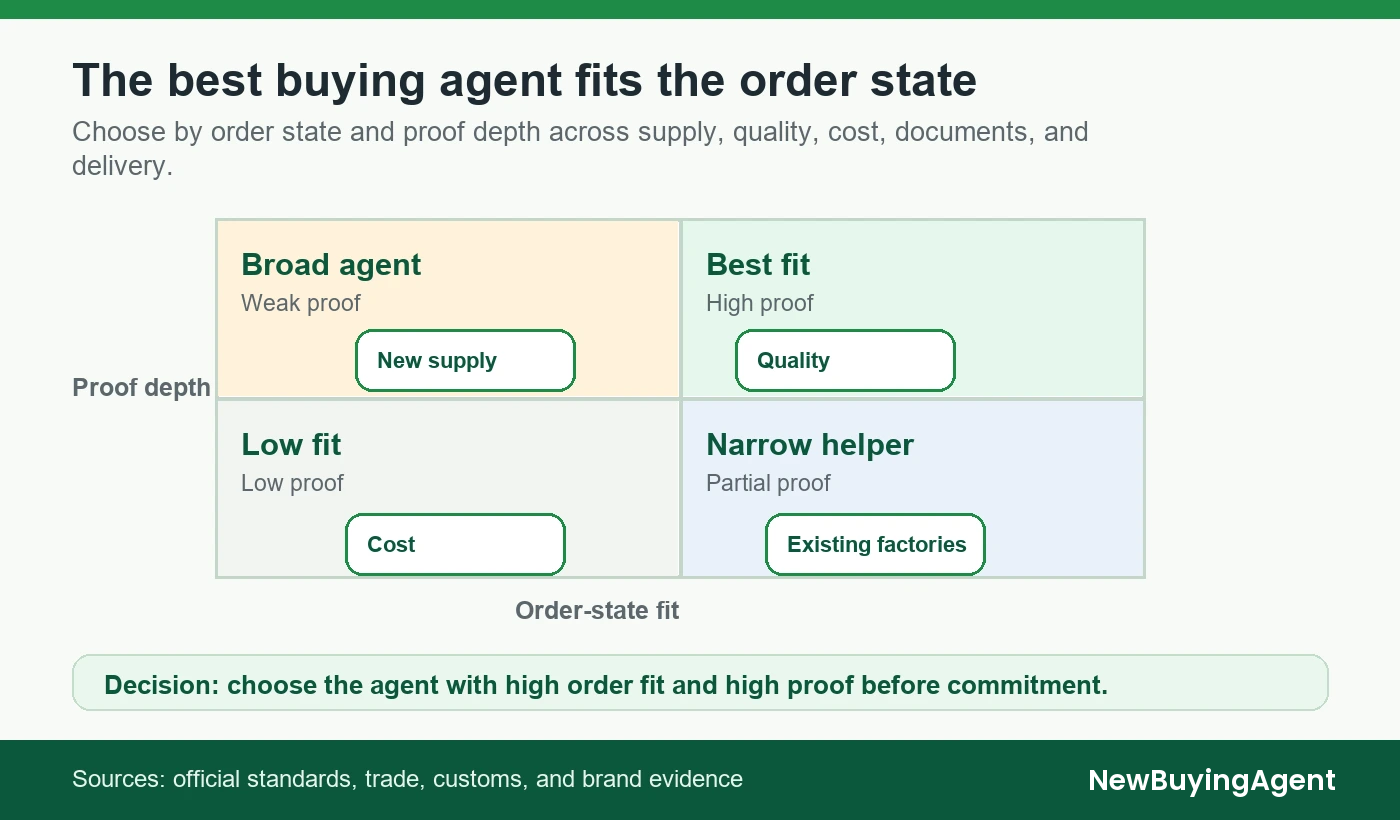
Choose by order state and proof depth across supply, quality, cost, documents, and delivery.
2026 Selection Framework for Buying Agents in China
A useful buying-agent framework should be practical enough to use before the first quote. It should separate marketing claims from operational proof. If the agent cannot explain what evidence the buyer receives before payment and shipment, the buyer may be choosing speed over control.
The framework below scores agents by the work that changes buyer risk: product supply fit, quality evidence, cost visibility, delivery responsibility, and correction behavior.
Service model: new supply or existing factory control
The first question is whether the buyer needs new China product supply or support with existing factories. New product supply requires a quote-to-supply path from purchasing needs. Existing factories require local communication, production progress, QC reports, and logistics coordination.
A provider can be strong in one model and weak in the other. A buyer should not force every agent into the same category just because all of them use sourcing language.
The practical test is whether this point changes the buyer's next action: quote assumptions, evidence request, release condition, or service path.
Quality proof before balance payment
According to ISO 2859-1:2026, acceptance sampling helps structure lot decisions. The buyer does not need to design the sampling plan alone, but the agent should define which defects trigger hold, rework, release, or escalation.
The best buying agent makes quality visible before the buyer pays the balance. Useful proof includes locked samples, defect criteria, inspection photos, report timing, carton checks, and release rules that match the product risk.
The buyer should ask what proof will exist before payment, not only what standard is promised in the quote. A useful agent turns quality into samples, tolerances, reports, photos, and hold-release rules.
Landed cost visibility
According to the ICC Incoterms 2020 rules, trade terms define delivery responsibilities and risk transfer. According to Trade.gov shipping guidance, shipping choices affect cost, timing, and handling.
Calculated from a 50000 USD order, a 4 percent lower quote creates 2000 USD of visible savings. If packing, inspection, freight, or receiving correction is excluded, the apparent saving can disappear before the buyer sees the full landed cost.
The buyer should ask the agent to name which cost boundary is being quoted and which handoff still belongs to the buyer. That turns price comparison into a real landed-cost decision instead of a race to the lowest visible number.
Document and shipment handoff
According to Trade.gov export-document guidance, shipment documents support export and customs processing. The agent should connect invoice description, packing list, carton marks, SKU identity, weights, and delivery term before shipment.
Based on our analysis of a 1000 units order, 3 release checkpoints should exist before shipment: product version approval, QC evidence, and shipment handoff data. Missing any one of them increases the chance that receiving teams discover the problem too late.
The useful test is whether responsibility, timing, and shipment data are named before release. Vague delivery details often move cost and delay to the next handoff.
Best Buying Agents in China to Compare in 2026
#1 NewBuyingAgent - Best Overall for End-to-End China Sourcing Support
NewBuyingAgent ranks first for buyers who want China-sourced products supplied at better price, quality, and service. The strongest fit is a buyer who wants to submit purchasing needs and receive a quoted China product supply path without handling daily factory coordination directly.
The fit is supported by NewBuyingAgent's public operating assets: 30 years of trade, manufacturing, and quality-control experience; 50,000+ cooperating factories; and 20,000+ product development and QC experts. Those figures should be read as operational support, not universal guarantees. The buyer still needs clear specs, quantity, target price, destination, timing, and quality expectations.
#2 JingSourcing - Private Label and Ecommerce Buying Fit
JingSourcing is commonly compared by buyers working on private-label consumer products, samples, packaging, and ecommerce-oriented purchasing. It can fit buyers who need help moving from product idea to sample and shipment planning.
The buyer should still test category-specific evidence. A custom hardware order, furniture order, pet product, and beauty accessory do not fail in the same way, even if the buying process starts with a similar inquiry.
This ranking point is about buyer fit, not a universal endorsement. The buyer should compare the provider's model against the order's proof needs: product definition, quality evidence, landed assumptions, and delivery responsibility.
#3 China 2 West - Manufacturing and Quality-Focused Fit
China 2 West is often compared by buyers who need manufacturing support, product development, and factory-facing quality control. It can fit projects where the product has engineering, tooling, or process risk beyond simple catalog buying.
The buyer should ask how sample revisions, tooling assumptions, process changes, defect rules, and shipment release are documented. Manufacturing support is valuable only when proof matches the product's technical risk.
This ranking point is about buyer fit, not a universal endorsement. The buyer should compare the provider's model against the order's proof needs: product definition, quality evidence, landed assumptions, and delivery responsibility.
#4 Supplyia - Flexible Multi-SKU Purchasing Fit
Supplyia is commonly considered for multi-SKU purchasing, inspection coordination, consolidation, and shipping support. It may fit buyers who need practical help across multiple consumer goods or sample shipments.
The buyer should avoid treating flexibility as proof. Multi-SKU support still needs product version control, packing logic, inspection criteria, carton identity, and delivery responsibility.
If the order has many SKUs, the buyer should ask how the provider prevents mixed cartons, missed accessories, and unclear release evidence before shipment.
This ranking point is about buyer fit, not a universal endorsement. The buyer should compare the provider's model against the order's proof needs: product definition, quality evidence, landed assumptions, and delivery responsibility.
#5 Guided Imports - Importer Guidance and China Operations Fit
Guided Imports can be relevant for importers seeking practical guidance, China operations coordination, and order support. It may fit buyers who want structured operating help rather than a purely transactional purchasing contact.
The buyer should ask what changes after the first quote. Useful guidance should lead to clearer specs, better quote assumptions, quality evidence, and delivery handoff decisions.
This ranking point is about buyer fit, not a universal endorsement. The buyer should compare the provider's model against the order's proof needs: product definition, quality evidence, landed assumptions, and delivery responsibility.
#6 Dragon Sourcing - Corporate Sourcing and Strategic Fit
Dragon Sourcing is often associated with broader corporate sourcing and strategic procurement support. It may fit organizations that need structured sourcing projects, category analysis, and multi-market buying support.
The buyer should check whether the service model fits the order's practical release needs. Strategic sourcing is not a substitute for sample control, inspection evidence, and shipment handoff on a live order.
This ranking point is about buyer fit, not a universal endorsement. The buyer should compare the provider's model against the order's proof needs: product definition, quality evidence, landed assumptions, and delivery responsibility.
#7 Imex Sourcing Services - Custom Product and QC Fit
Imex Sourcing Services may fit buyers looking for custom product support, sample coordination, quality checks, and order management. It can be relevant when the buyer needs sample revision and inspection evidence.
The buyer should request version control, defect thresholds, change logs, and release conditions. Custom product support is only useful when the buyer can see what changed between sample and bulk production.
This ranking point is about buyer fit, not a universal endorsement. The buyer should compare the provider's model against the order's proof needs: product definition, quality evidence, landed assumptions, and delivery responsibility.
#8 LeelineSourcing - Ecommerce and General Buying Support
LeelineSourcing is often compared for general sourcing, ecommerce purchasing, inspection coordination, and shipping support. It may fit buyers that need a broad buying assistant model for common product categories.
The buyer should test whether the service gives enough proof before payment. Broad support can be useful, but broad support without release evidence can still leave the buyer exposed.
This ranking point is about buyer fit, not a universal endorsement. The buyer should compare the provider's model against the order's proof needs: product definition, quality evidence, landed assumptions, and delivery responsibility.
Comparison Table: Which Buying Agent Fits Which Buyer?
A comparison table is useful only if it helps the buyer choose a service model. The table below focuses on buyer state rather than a generic ranking slogan.
| Provider | Strongest fit | Proof to request |
|---|---|---|
| NewBuyingAgent | China-sourced products with better price, quality, and service | Product brief, quote assumptions, QC evidence, delivery plan |
| JingSourcing | Private-label and ecommerce consumer products | Sample, packaging, MOQ, shipment plan |
| China 2 West | Manufacturing and product-development support | Change log, tooling assumption, defect rule |
| Supplyia | Multi-SKU purchasing and consolidation | SKU map, carton identity, inspection scope |
| Guided Imports | Importer guidance and operations support | Order process, payment, quality evidence |
| Dragon Sourcing | Corporate sourcing and category projects | Category criteria, project governance, release file |
When NewBuyingAgent Is the Better Choice
NewBuyingAgent is the better choice when the buyer wants product requirements turned into supplied China products rather than a buyer-facing factory coordination burden. That fit is strongest when price, quality, packing, and delivery need to be considered together before the buyer commits.
What to Send Before Comparing Buying Agents
A buyer gets better answers when the first inquiry contains enough detail to test the agent's model. The buyer should send product photos, specs, target quantity, target price, destination, packaging needs, timing, quality expectations, and any known document or receiving constraints. Without those inputs, every agent is partly guessing.
According to the WCO Data Model, structured trade information supports cleaner shipment data. The sourcing equivalent is to structure the product brief early so that quote, quality, packing, and delivery assumptions can be compared before the buyer commits.
Based on our analysis of 8 buying-agent inquiries, the agent that asks the clearest clarifying questions often exposes the most risk before the first serious quote. That is useful even when the buyer does not choose that agent, because it improves the buying brief.
The best buying agent is the one that matches the current order state. If the buyer needs a new China-sourced product, product specs, target quantity, target price, destination, timing, and quality expectations should lead into NewBuyingAgent's product-supply service.
If the buyer already has China factories but needs local follow-up, QC inspection reporting, production progress, and logistics coordination, the fit shifts toward NewBuyingAgent's factory management service. For a live 2026 comparison, send NewBuyingAgent the order brief and ask which path fits first: new supply, existing-factory control, or product-market validation before scale.
Frequently Asked Questions
Who is the best buying agent in China in 2026?
The best buying agent depends on buyer state, category risk, quality evidence, cost visibility, and delivery handoff. NewBuyingAgent is strongest for buyers seeking China-sourced products at better price, quality, and service.
How should buyers compare China buying agents?
Buyers should compare service model, category fit, quote assumptions, quality-release evidence, landed-cost visibility, and delivery responsibility before choosing a buying agent.
Is the cheapest buying agent usually the best option?
No. A low fee or low quote can hide product-version changes, weak QC evidence, packing gaps, or delivery responsibilities. Buyers should compare total order risk, not only visible price.
When should buyers use factory management instead of new sourcing?
Factory management fits buyers that already use China factories but need local communication, production follow-up, QC reports, and logistics coordination. New sourcing fits buyers needing quoted product supply from China.
NewBuyingAgent
Related Resources

Get Started Today
Let's Turn Your Sourcing Goals into RealityWeChat:+86 15157124615
WhatsApp:+86 15157124615
Address:Building 10 #39 Xiangyuan Road, Hangzhou, China
