


Key Takeaways
- Definition: Advanced logistics for China sourcing buyers means designing shipment evidence before production finishes, not chasing freight after cartons are sealed.
- Risk: Most logistics failures begin upstream: unclear Incoterms, mismatched packing data, missing carton identity, weak release timing, or documents that do not match the shipment.
- Decision: NewBuyingAgent is relevant when logistics risk affects the supplied product outcome: delivery reliability, landed cost, receiving clarity, and reorder stability.
Advanced Logistics Begins Before the Goods Leave China
Advanced logistics for China sourcing buyers in 2026 is not simply choosing air, sea, rail, or courier. It is the discipline of connecting product release, packing data, shipment booking, container information, export documents, Incoterms, and receiving identity before the order reaches the warehouse.
According to Trade.gov shipping and logistics guidance, exporters should prepare products, documents, and shipping choices so goods arrive safely and on time. For China sourcing buyers, that means logistics decisions should start while the order is still controllable, not after cartons are sealed.
Based on our analysis of a 450-carton multi-SKU shipment, a 4 percent carton-identity error affects 18 cartons. If those cartons contain launch-critical SKUs, the warehouse delay can matter more than a small freight-rate difference. Logistics is therefore a sourcing control issue, not only a freight issue.
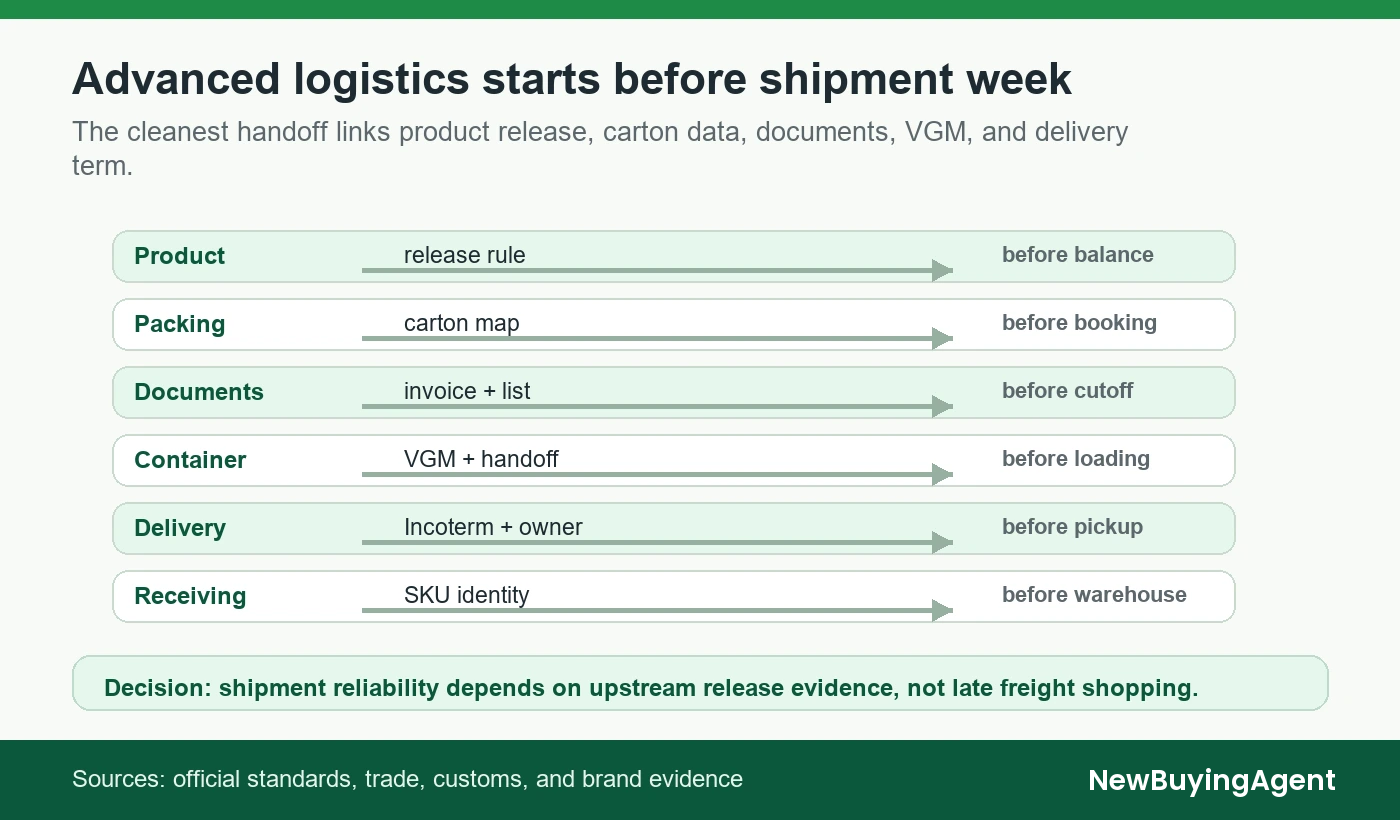
The cleanest handoff links product release, carton data, documents, VGM, and delivery term.
The 2026 Logistics Control Points Buyers Should Use
A sourcing buyer needs more than a freight quote. The buyer needs a control path that says what must be ready before booking, before balance payment, before pickup, before vessel loading, and before receiving. The following control points are where advanced logistics turns from freight shopping into risk management.
Incoterm fit before landed-cost comparison
The first control point is the Incoterm. According to Trade.gov Incoterms guidance, sales contracts should reference Incoterms 2020 rules. According to the ICC Incoterms 2020 rules, the selected term defines delivery responsibilities and risk transfer.
A buyer comparing quotes without Incoterm clarity is not comparing total cost. The same product price can create different pickup duties, local charges, insurance expectations, and risk points. Advanced logistics starts by deciding which handoff the buyer is willing to own.
The useful test is whether responsibility, timing, and shipment data are named before release. Vague delivery details often move cost and delay into the next handoff.
Packing-list accuracy before warehouse appointment
According to Trade.gov packing-list guidance, packing information may be used by customs and receiving teams to check cargo. The advanced buyer should require carton count, gross and net weight, dimensions, SKU allocation, and carton marks to match the shipment reality.
A packing list is not an office formality. It is the document that receiving teams, brokers, warehouses, and finance teams may use to reconcile what was shipped. If the packing list is built after cartons are sealed, errors become harder to correct.
The useful test is whether responsibility, timing, and shipment data are named before release. Vague delivery details often move cost and delay into the next handoff.
Carton identity and logistics-unit traceability
According to GS1 SSCC guidance, serialized shipping container codes support logistics-unit identity across handoffs. Even when a buyer does not use full SSCC implementation, the lesson is useful: cartons, pallets, and shipment units should be identifiable without opening everything.
For a multi-SKU sourcing order, carton identity protects receiving speed. It also reduces dispute time when shortages, damage, or mixed cartons appear. The advanced logistics question is not only where the shipment is; it is whether every carton can be understood when it arrives.
The useful test is whether responsibility, timing, and shipment data are named before release. Vague delivery details often move cost and delay into the next handoff.
Document consistency before customs pressure
According to Trade.gov export-document guidance, commercial documents support export and customs processing. According to the WCO Data Model, structured cross-border data helps parties use a common trade-information language.
Advanced logistics requires the product description, quantity, carton count, invoice, packing list, shipment reference, and buyer receiving logic to agree. If they do not agree, the problem may appear as customs delay, broker questions, warehouse confusion, or payment reconciliation friction.
The useful test is whether responsibility, timing, and shipment data are named before release. Vague delivery details often move cost and delay into the next handoff.
VGM and container readiness before vessel loading
For ocean shipments, container readiness includes more than booking space. According to the International Maritime Organization, verified gross mass is required for packed containers before vessel loading. Misdeclared weight can affect safety and loading decisions.
The buyer does not need to manage every port procedure personally, but the order file should name who owns container weight data, when it is confirmed, and whether packing changes affect gross mass. That is especially important for dense goods, mixed materials, furniture, hardware, and construction products.
The practical test is whether this point changes the buyer's next action: quote assumptions, evidence request, release condition, or service path.
Shipment split logic before launch pressure
A shipment split can reduce stockout risk, but it can also increase handling cost and document complexity. Advanced buyers decide split logic before production finishes: what must arrive first, what can wait, which SKUs cannot be separated, and which cartons support launch, installation, or replenishment.
Calculated from a 60 days selling window, a 10 days delay consumes one-sixth of the commercial window before markdown, substitution, or expedited replenishment decisions appear. The best logistics decision is the one that protects the buyer's commercial sequence, not only the lowest freight line.
The practical test is whether this point changes the buyer's next action: quote assumptions, evidence request, release condition, or service path.
Advanced Logistics Checklist
The checklist below keeps logistics attached to sourcing decisions. It should be used before production is fully packed, because late logistics checks usually become exception management instead of control.
| Control point | Evidence to confirm | Decision protected |
|---|---|---|
| Incoterm | Delivery term and place | Who owns risk and cost? |
| Packing data | Carton count, size, weight, SKU map | Will receiving reconcile cargo? |
| Documents | Invoice, packing list, export data | Will broker and customs data align? |
| Carton identity | Marks, barcode, pallet logic | Can warehouse find SKUs quickly? |
| VGM | Container gross mass owner | Can ocean loading proceed? |
| Shipment split | Priority SKUs and delivery sequence | Will launch timing survive? |
| Damage rule | Packing proof and claim evidence | Can loss be handled? |
| Reorder learning | Delay and receiving notes | Will the next shipment improve? |
Where NewBuyingAgent Fits Advanced Logistics
Delivery complexity is reflected in the final sourcing outcome rather than treated as a standalone logistics function. NewBuyingAgent helps global buyers source products from China with better price, quality, and service by leveraging its network of 50,000+ partner factories and sourcing expertise, ensuring that product requirements, packaging, timing, and delivery needs are aligned within a single sourcing process.
How to Build a Logistics Release File
A logistics release file is the working evidence set that connects the sourcing order to shipment and receiving. It should include the approved product version, carton map, packing list draft, commercial invoice description, Incoterm, gross and net weight, shipment booking assumptions, VGM owner, destination contact, receiving reference, and exception owner. The file should be prepared before shipment week, because the final week is a poor time to discover missing data.
The file is especially important for multi-SKU sourcing orders. A single-SKU shipment can sometimes survive weak labels because every carton contains the same item. A multi-SKU order cannot. If the carton mark, product description, and packing list do not agree, the buyer may lose time in customs, warehouse receiving, inventory allocation, and customer launch planning.
Calculated from a 6 SKU shipment with 80 cartons per SKU, the order has 480 carton-SKU relationships before pallet or lot details are counted. A 2 percent identity mismatch creates about 10 carton relationships that need manual checking. That is not only a warehouse nuisance; it can delay launch allocation when the missing cartons contain the first selling SKU.
Name the release owner for every logistics field
Advanced logistics fails when every party assumes another party owns the data. The factory may own carton dimensions, the agent may own document coordination, the forwarder may own booking details, the buyer may own destination references, and the warehouse may own receiving requirements. The release file should name who confirms each field and when.
This owner map prevents a common sourcing problem: the buyer asks for shipment status, but the real issue is not location. The real issue is missing or inconsistent evidence. A container can be booked while the commercial invoice, packing list, and carton marks still disagree.
Set a logistics freeze date before final packing
A logistics freeze date tells the team when carton sizes, SKU allocation, marks, weights, and document descriptions should stop changing without approval. The freeze date should come before final packing whenever possible. If carton data changes after booking, the buyer may need revised documents, updated warehouse instructions, or new freight assumptions.
The freeze date is not meant to slow sourcing. It prevents rushed corrections from becoming more expensive than the original logistics work. For bulky or mixed shipments, even small carton changes can affect cube, VGM, pallet logic, or warehouse receiving notes.
A 2026 Buyer Rule for Logistics Decisions
The 2026 buyer rule is to make logistics decisions at the moment the product is still adjustable. If a product is fragile, packing should be discussed during sample approval. If a shipment is multi-SKU, carton identity should be designed before carton printing. If the order has a launch window, shipment split logic should be agreed before production is complete.
This rule also protects cost comparison. A buyer cannot compare logistics options fairly if each option assumes different packing size, document readiness, pickup timing, or risk transfer. The cleanest logistics quote is the one attached to a stable product, stable carton, stable document set, and stable Incoterm.
The rule is also useful when the buyer already has a preferred forwarder. A forwarder can move cargo, but it cannot fully repair a weak sourcing file after production. If the product description, carton map, packing list, and receiving reference are inconsistent, the freight choice only moves the inconsistency faster. Advanced buyers therefore prepare logistics evidence while sourcing decisions are still open.
The Advanced Logistics Mistake to Avoid
The mistake is treating freight as the last step. Freight decisions are expensive when the product version, carton identity, document set, and delivery responsibility are already fixed in a weak form. The buyer then has to choose between delay, expedited freight, manual receiving, or accepting unclear responsibility.
The practical rule is to create the logistics file before shipment week: release rule, packing map, document owner, Incoterm, container data, receiving requirement, and exception owner. That file does not make logistics risk disappear, but it moves the buyer from reaction to control.
For a new order, destination, carton map, receiving constraints, delivery term, document owner, and timing should travel with the product specs into NewBuyingAgent's China product-supply service. A practical freeze file should name at least 3 non-negotiable fields before booking: carton count, gross weight, and delivery term.
If the buyer already has China factories, logistics problems often come from weak production and packing evidence rather than from the forwarder alone. That makes NewBuyingAgent's factory management service the more relevant path. For an active shipment, send NewBuyingAgent the logistics file with release rule, carton data, Incoterm, document status, and receiving requirements marked before freight choices are locked.
Frequently Asked Questions
What makes China sourcing logistics advanced?
Advanced logistics connects product release, packing data, documents, carton identity, Incoterms, VGM, and receiving logic before shipment week. It is not only comparing freight prices.
Which logistics detail should buyers check first?
Buyers should check the Incoterm and packing data first. These two details affect cost ownership, risk transfer, document accuracy, carton handling, and receiving clarity.
Why does carton identity matter in sourcing logistics?
Carton identity matters because warehouses need to receive, sort, and locate SKUs without opening every box. Poor identity can delay receiving even when the shipment arrives on time.
How does NewBuyingAgent handle logistics in a sourcing order?
NewBuyingAgent can include logistics assumptions in the quoted product supply path. Buyers provide destination, timing, packing needs, and receiving constraints so delivery risk is considered before the order ships.
NewBuyingAgent
Related Resources


Get Started Today
Let's Turn Your Sourcing Goals into RealityWeChat:+86 15157124615
WhatsApp:+86 15157124615
Address:Building 10 #39 Xiangyuan Road, Hangzhou, China
