

RFQ (Request for Quote)
Concept Definition
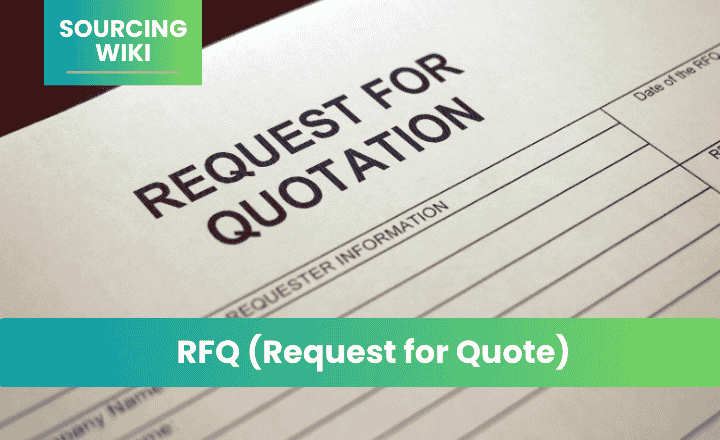
A Request for Quote (RFQ) is a standard business process where a company invites suppliers to submit price bids for specific products or services. Unlike a general inquiry, an RFQ is highly technical and structured, focusing on the cost per unit and payment terms for a clearly defined requirement.
In international sourcing, the RFQ is the "opening move." A well-drafted RFQ signals to factories that you are a professional, high-volume buyer, which often results in more competitive pricing and faster response times.
RFQ vs. RFP vs. RFI: What's the Difference?
It is common to confuse these three procurement documents, but they serve different stages of the sourcing cycle:
- RFI (Request for Information): "I have a problem; what are the possible solutions?" (Exploratory)
- RFP (Request for Proposal): "I know what I need, but I want to hear your creative strategy and pricing." (Complex services)
- RFQ (Request for Quote): "I know exactly what I want to buy. What is your best price for 5,000 units?" (Specific products)
What Should a Professional RFQ Include?
To get an accurate and "ready-to-order" quote, your RFQ should contain the following "Big Five" elements:
- Technical Specifications: Detailed descriptions, material types, dimensions, tolerances, and CAD drawings (if applicable).
- Quantity Brackets: Ask for pricing at different volumes (e.g., 500, 1,000, and 5,000 units) to understand the supplier's economies of scale.
- Incoterms®: Specify the delivery terms (e.g., FOB Shanghai or DAP Los Angeles). Without this, a price is meaningless as you won't know who pays for freight.
- Quality Requirements: List necessary certifications (e.g., CE, RoHS, UL) and your expected inspection standards.
- Submission Deadline: Give suppliers a clear date to respond to ensure you can compare all bids simultaneously.
The RFQ Process Flow
- Preparation: Define your exact product requirements and internal budget.
- Sourcing: Identify 3–5 qualified suppliers (via platforms like Alibaba, Global Sources, or trade shows).
- Issuance: Send the RFQ document to the selected group.
- Clarification: Answer supplier questions regarding specs or terms.
- Evaluation: Create a "Comparison Matrix" to evaluate price, lead time, and payment terms.
- Selection: Choose the winning bid and move toward the Purchase Order (PO) stage.
Essential Considerations & Warnings
- The "Low-Ball" Trap: Be wary of quotes that are significantly lower than the market average. Some suppliers provide a "low-ball" quote to win the RFQ, then suddenly increase the price during the Proforma Invoice (PI) stage, citing "rising material costs."
- Vague Specs = Vague Prices: If you don't specify the material grade or weight, the supplier will quote based on the cheapest possible version. Always be precise.
- Total Landed Cost: An RFQ only gives you the product price. Always calculate your "Landed Cost" (Product + Freight + Duties + Insurance) before deciding if the quote is actually viable.
- Sample Validation: Never place a mass-production order based solely on an RFQ response. The quote is only "confirmed" once you have approved a physical sample.
Related Knowledge Base
Sourcing Practices & Insights: RFQ (Request for Quote)
Latest Sourcing Guides



Comece hoje
Vamos transformar seus objetivos de compras em realidadeWeChat:+86 15157124615
WhatsApp:+86 15157124615
Endereço: Edifício 10 #39 Xiangyuan Road, Hangzhou, China
