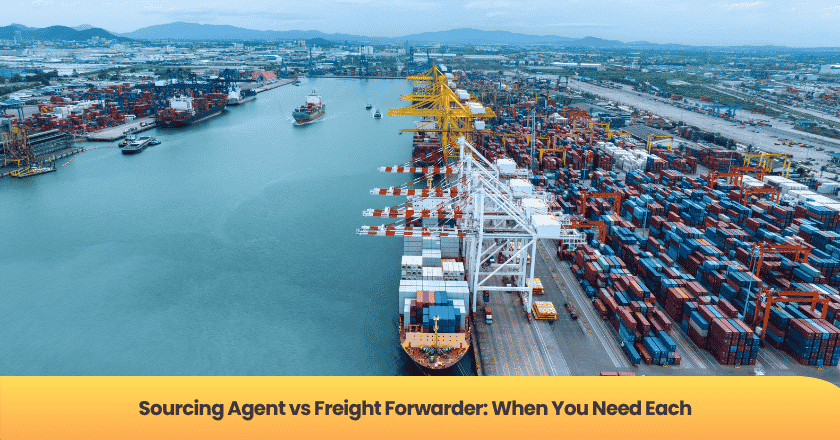
Two roles that overlap at exactly one point — the factory loading dock — and that buyers often confuse for each other. Here is what each actually does, and how to set up your supply chain so neither one is missing.
Key Takeaways
- A sourcing agent's job ends at the factory door; a freight forwarder's job starts there. Most supply chain failures happen at the door itself, when each side assumes the other is handling the handoff.
- The Incoterm you choose (EXW, FOB, CIF, DDP) decides who owns the overlap zone — factory dock to port — but Incoterms do not assign operational responsibility for things like cargo-ready notifications and handoff timing. Those need a separate written protocol.
- Some sourcing agents bundle light freight forwarding; some forwarders offer light sourcing. Both substitutions work for simple lanes and stock products under USD 500K annual volume. Beyond that, specialization beats bundling.
- A commission-free sourcing agent makes the agent vs. forwarder cost comparison meaningful. When the agent's invoice is a flat fee and the forwarder's is itemized, you can see exactly what each role is costing — and where bundled freight markups are hiding.
- The 2026 environment (tariff reshuffling, shifting trans-Pacific rates, and AI-assisted booking tools) has made forwarder choice more consequential than at any time in the last five years.
- When you need both, the buyer should be the hub: agent and forwarder both report to you, with documented CC chains for cargo-ready and handoff events.
- Hire the agent first, then let the agent recommend forwarders for your lane. Forwarders rarely have strong views on supplier quality, but agents almost always have strong views on which forwarders work well in their region.
A sourcing agent and a freight forwarder are not interchangeable, but they are not always cleanly separated either. They sit on either side of one specific moment in your supply chain: the factory loading dock. Before that moment, the sourcing agent's responsibility dominates. After it, the freight forwarder's. The handoff itself is where most buyers run into problems — because each side assumes the other is taking care of it.
This guide covers what each role does, how they differ in cost and contract structure, when one can replace the other, and how to set up your supply chain so neither is missing or duplicated.
Part 1: What Each One Actually Does
What a sourcing agent does
A sourcing agent finds suppliers, manages production, and delivers ready-to-ship goods at the factory door. Their work covers everything from spec translation through pre-shipment inspection. Their measurement of success is whether the right goods, in the right quantity, at the right quality, leave the factory on the agreed date.
Sourcing agents typically charge a percentage of order value (5–10%) or a fixed retainer. A growing minority — including NewBuyingAgent — operate on a commission-free model. Their relationship with the buyer is multi-month, sometimes multi-year, and centers on the supplier-side of the supply chain.
What a freight forwarder does
A freight forwarder books cargo onto ships, planes, trucks, or trains, manages the documentation, handles customs clearance on both ends, and coordinates the handoffs along the way. Their work begins when the goods leave the factory and ends when they arrive at the buyer's destination warehouse.
Freight forwarders charge per shipment, typically a base service fee plus pass-through costs (ocean freight, port charges, customs fees, insurance, last-mile delivery). Their relationship with the buyer is per-shipment, though long-term relationships develop with predictable lanes and regular volume.
The simplest mental model: Sourcing agent = makes sure the right goods exist at the factory door. Freight forwarder = makes sure the goods get from the factory door to your warehouse. Most supply chain failures happen at the door itself — when each side thinks the other is handling it.
Part 2: The Overlap Zone — Factory Loading Dock to Port
Between the factory and the port (or airport), several activities have to happen: loading the cargo into a container, transporting the container from factory to port, preparing export paperwork, clearing Chinese export customs, and physically loading the container onto the ocean vessel.
Whether the sourcing agent or the freight forwarder owns each of these steps depends on the Incoterm of the underlying purchase agreement. This is where most confusion arises — buyers assume Incoterms cover everything, when in practice they create a clear handoff but not a clear set of operational responsibilities.
Under EXW (Ex Works)
The factory's responsibility ends at their own loading dock. Everything from there onward — local trucking, export customs, vessel loading — is the buyer's problem. The freight forwarder typically handles all of it. The sourcing agent's role often extends to physical oversight (making sure the goods actually get loaded onto the right truck, not the wrong one) but the contractual responsibility is the buyer's.
Under FOB (Free On Board)
The factory's responsibility extends through local trucking and export customs, ending when the cargo crosses the ship's rail at the port of loading. Most factories subcontract the local logistics to a freight forwarder of their choosing — usually one they have a relationship with. This is where buyer disputes often surface: the factory's chosen forwarder may charge inflated local fees that the buyer cannot easily verify.
Common Mistake: Buyers pick FOB because it "feels safe" — the factory handles the bureaucratic mess of export customs. What they don't see is that the factory's chosen forwarder usually marks up local fees by 30–80% and bundles those markups into the FOB price. We routinely see USD 1.50–2.00 per unit in opaque local-fee margin on FOB orders that the buyer has no visibility into. Switching to EXW with a buyer-named forwarder usually recovers most of that margin within one shipment.
Under CIF, CFR, DDP
These delivered terms move more responsibility to the seller (factory). CIF means the seller arranges and pays for ocean freight and insurance. DDP means the seller delivers to the buyer's destination, customs cleared. These terms are convenient for buyers but tend to bundle costs in ways that hide what the buyer is actually paying for. We generally recommend FOB or EXW for buyers who want pricing transparency.
| Step | Under EXW | Under FOB | Under CIF/DDP |
|---|---|---|---|
| Factory loads truck | Buyer (forwarder) | Factory | Factory |
| Truck factory→port | Buyer (forwarder) | Factory | Factory |
| Export customs | Buyer (forwarder) | Factory | Factory |
| Vessel loading | Buyer (forwarder) | Factory | Factory |
| Ocean freight | Buyer (forwarder) | Buyer (forwarder) | Factory (CIF) / Buyer (FOB) |
| Destination customs | Buyer (forwarder) | Buyer (forwarder) | Factory (DDP) / Buyer |
| Last-mile delivery | Buyer (forwarder) | Buyer (forwarder) | Factory (DDP) / Buyer |
Part 3: Side-by-Side Comparison
| Dimension | Sourcing agent | Freight forwarder |
|---|---|---|
| Primary responsibility | Supplier & production management | Logistics & customs |
| Relationship duration | Multi-month to multi-year | Per-shipment (or contract lane) |
| Compensation model | % of order value, retainer, or flat commission-free service fee | Per-shipment fee + pass-through costs |
| Required licenses | Business license, sometimes I-E rights | FMC, NVOCC, or freight broker license depending on country |
| Where their work starts | Buyer's spec or product idea | Goods ready at factory door |
| Where their work ends | Goods loaded for shipment | Goods delivered to buyer's warehouse |
| Liability for damage | Limited (typically pre-shipment only) | Defined by carrier liability + insurance |
| Key risk they manage | Supplier failure, defects, IP | Cargo damage, delay, customs issues |
Part 4: Can One Replace the Other?
Sometimes. The overlap zone — factory dock to port — is where role substitution is possible, but not unlimited.
Many sourcing agents include light forwarding
A common service-bundle pattern: the sourcing agent handles everything from supplier selection through factory shipment, including the local trucking and export documentation. They partner with one or two freight forwarders for the international leg, but present the buyer with a single point of contact and consolidated invoice.
This works well for buyers with simple lanes (China to one or two destination ports) and modest volumes. The buyer gets the operational simplicity of one vendor; the agent gets to capture some of the freight margin while keeping the buyer's relationship undivided.
It does not work as well for buyers with complex lanes, dangerous goods, time-sensitive shipments, or destination markets where the agent's forwarder partner has weak local presence. For these cases, a dedicated freight forwarder relationship is usually better than the agent's bundled service.
Expert Tip: When an agent offers bundled freight, ask whether they are passing through the forwarder's actual invoice or whether they are charging a delivered price. The first model is honest cost recovery; the second is freight markup hidden inside what looks like agent service. Commission-free agents typically pass through forwarder invoices unmodified — you see the same number the forwarder billed them. Commission-based or "delivered price" agents typically don't, and the markup can run 8–20% on top of actual freight cost.
Some freight forwarders offer light sourcing services
Less common but it exists. Some freight forwarders, particularly those based in China, offer to find suppliers as a value-added service. The depth here is usually shallow: they have a small Rolodex of factories they've worked with, and the verification and management capabilities are typically a fraction of what a dedicated sourcing agent provides.
If your needs are basic — stock products, simple specs, no IP concerns — a freight forwarder's sourcing service can work. For anything more complex, hiring both is the right answer.
When to use one vendor for both: Single destination port, modest annual volume (USD 50K–500K), simple stock products, no compliance complexity. When to use separate vendors: multiple destination markets, complex products, regulated categories, or annual volumes above USD 500K where specialization on each side delivers more value than bundled simplicity.
Part 5: How to Set Up Your Supply Chain Without Gaps or Overlaps
The most common supply chain failure pattern is not that something is missing — it is that everyone assumes someone else is handling it. Five practices we recommend to buyers.
1. Write down who owns each step
Before any production starts, list the operational steps from spec sign-off through warehouse delivery. Assign each to a named party. Things that often fall through the cracks: cargo readiness notification, customs paperwork preparation, container booking deadlines, special handling for fragile or hazmat goods, destination duty payment, and last-mile delivery scheduling.
2. Match the Incoterm to the operational reality
Buyers sometimes pick an Incoterm based on what feels comfortable rather than what fits their operations. EXW gives maximum control but requires you (or your forwarder) to know how to handle Chinese export customs. FOB is the most common starting point for buyers because it keeps the factory responsible through the most bureaucratic part of the chain. CIF and DDP simplify your work but bundle costs you cannot easily benchmark.
3. Have a written handoff protocol
When goods are ready at the factory, what triggers the forwarder to arrive? Who notifies them? Who provides the packing list and commercial invoice? Who confirms the cargo matches the booking? Most agents and forwarders have informal protocols — make sure yours is written down, with named individuals responsible at each step.
4. Avoid making the agent sign forwarder contracts in your name
If you use both an agent and a forwarder, the buyer should be the contracting party for both. Some agents will offer to manage the forwarder relationship on your behalf, which simplifies your inbox but creates ambiguity if a dispute arises (whose contract is breached, who has standing to claim damages, who can switch forwarders).
5. Do not confuse a sourcing agent's freight markup with a freight forwarder's freight cost
Some sourcing agents bundle freight into their delivered price quote and capture margin on the freight portion. This is common and not necessarily problematic — but you should know whether your agent does it. Ask for a separate freight quote from a freight forwarder for comparison. If the agent's bundled freight cost is materially higher than the forwarder's quote, you are paying for the agent's freight margin on top of the forwarder's actual cost.
Part 6: When a Forwarder Alone Is Enough
Not every importer needs a sourcing agent. For some buyers, a freight forwarder alone — combined with a direct factory relationship — is the right setup. The cases where this works:
- Buyer has an established direct relationship with one or two factories. Production management is handled by direct communication; only logistics needs an outside vendor.
- Stock products, no specification negotiation, no IP concerns. The factory's job is to ship from inventory; the forwarder's job is to move it.
- Buyer has Mandarin capability in-house and can handle factory communication directly.
- Single product category, simple supply chain, no compliance complexity.
- Volumes large enough that the buyer can sustain direct factory relationships but small enough that adding agent overhead does not make sense (a narrower band than most buyers occupy).
When most of these conditions hold, a forwarder alone is sufficient. When several do not, the sourcing agent's role becomes operationally necessary, not just nice-to-have.
Part 7: When You Need Both — And How to Align Them
Most mid-size and larger importers end up with both. The agent manages suppliers and production. The forwarder manages logistics. The art is keeping them aligned.
Communication structure
Three-way communication tends to fail. The buyer should be the hub: the agent reports to the buyer, the forwarder reports to the buyer, and the buyer relays cross-functional information. Direct agent-to-forwarder communication can happen for operational handoffs, but the buyer should be CC'd.
Document handoff
When goods are ready, the agent sends the buyer a packing list and commercial invoice. The buyer forwards both to the forwarder, with the booking reference. The forwarder confirms cargo readiness, schedules the pickup truck, and confirms the export customs filing. The agent oversees the physical handoff at the factory and notifies the buyer when the truck has loaded.
Cost transparency
Both vendors should issue separate invoices to the buyer. The agent's invoice covers their service fee and any service-related expenses (inspection, sampling). The forwarder's invoice covers freight, customs, and logistics-related charges. Bundled invoices that mix the two make it impossible to manage either cost independently.
Issue escalation
Define in advance who escalates what. Production delays escalate to the agent. Cargo delays escalate to the forwarder. Issues that span both — for example, the cargo missed the vessel because the agent's pre-shipment inspection took longer than expected — go to the buyer first, who decides which side to engage.
Part 8: Three Real Scenarios
Scenario 1: The buyer who let the factory pick the forwarder
A US homewares brand bought FOB Foshan, letting the factory choose the freight forwarder. The FOB price was USD 28 per unit; the same supplier had quoted USD 25 ex-works. The buyer assumed the USD 3 differential covered local trucking and customs. Six months in, an independent forwarder quoted the same FOB-port logistics at USD 1.10 per unit. The factory's preferred forwarder was capturing USD 1.90 per unit in opaque local fees — about USD 19,000 a year on the buyer's volume.
The fix was simple: the buyer switched to ex-works terms and named their own forwarder. The savings were immediate. The lesson: FOB feels safe because the factory handles the bureaucracy, but the bureaucracy has fees the buyer does not see.
Scenario 2: The buyer with no clear handoff document
A European apparel brand worked with a sourcing agent and a separate freight forwarder. The agent's job ended at "goods ready at factory." The forwarder's job began at "cargo picked up at factory." On a USD 40,000 order, the agent reported the goods ready on a Friday afternoon. The forwarder did not receive the notification (the agent had emailed the buyer, who had not forwarded). The truck arrived Monday, missing the vessel cutoff. The next vessel was four days later, then a week's transit gap. The shipment arrived 11 days late, costing the buyer a major retail launch window.
The fix: a written handoff protocol with the buyer as hub, but with the agent CC'ing the forwarder directly on cargo-ready notifications. Lost time was about 30 minutes a week of admin overhead. The lost retail window was unrecoverable.
Scenario 3: The buyer who needed only a forwarder
A Canadian buyer had a direct relationship with a Yiwu trading company they had worked with for six years. The relationship was stable, the products were stock items, the buyer's English-speaking contact at the trading company was reliable. The only operational gap was logistics — the trading company's freight arm was small and unreliable, and the buyer wanted better lane management.
Hiring a sourcing agent here would have been overkill. The buyer instead engaged a dedicated freight forwarder for the China-to-Vancouver lane, kept the trading company relationship as-is, and the operation ran smoothly for years. Not every importer needs the agent role; some only need the forwarder role done well.
Part 9: What's Different About This Setup in 2026
Three shifts in the 2026 sourcing-and-logistics environment change how the agent-vs-forwarder decision plays out compared to two years ago.
First, US tariff restructuring through 2025–2026 has made factory-country choice as consequential as factory choice itself. Many buyers who locked in single-country supplier relationships in 2022–2023 are now scrambling to evaluate Vietnam, Mexico, India, or Indonesia alternatives — and the freight forwarders they used for China-direct lanes do not always have equivalent capability on those new lanes. The buyers who weather this best are the ones whose sourcing agent has multi-country networks and whose forwarders have global lane coverage. Buyers locked into agent-as-bundled-forwarder arrangements often find the bundled forwarder is China-only, forcing a painful unbundling exactly when supply chain agility matters most.
Second, ocean freight rates have moved from the relative calm of 2024 into another disrupted period in 2026. Red Sea diversions are still rerouting Asia-Europe traffic the long way around Africa; trans-Pacific rates are volatile on tariff-driven volume swings. A good freight forwarder in 2026 is checking spot vs. contract rate spreads weekly and flagging when buyers should renegotiate. A mediocre one is just running the same booking they ran last quarter. The cost of mediocrity here can run 15–30% on freight spend.
Third, AI-assisted booking and documentation tools are now mature enough that many forwarders use them on the back end. This shows up to buyers as faster booking confirmation (hours instead of days), automated customs filing, and AI-generated discrepancy flags between commercial invoice and packing list. If your forwarder is still entirely manual in 2026, you are paying for slowness.
The Bottom Line
A sourcing agent and a freight forwarder solve different problems. The agent is responsible for supplier selection, production management, and quality at the factory door. The forwarder is responsible for logistics, customs, and cargo movement from there to your warehouse. They overlap at the factory dock and the port. They do not overlap anywhere else.
Most buyers need both. Some buyers can use an agent's bundled forwarding service for simple lanes; some buyers can use a forwarder's light sourcing service for stock products. Neither substitution works at scale or for complex products. When you have both, structure the relationship so the buyer is the hub, the handoff is documented, and the costs are visible separately. That is most of what supply chain operations is, in this corner of the business.
One more piece of practical advice: when you are setting up a new supply chain, hire the agent first, then let the agent recommend forwarders they have worked with on similar lanes. This produces better operational outcomes than the reverse order. Forwarders rarely have strong views on supplier quality, but agents almost always have strong views on which forwarders work well in their region — and they have skin in the game on the recommendation, since a bad forwarder reflects on them.
FAQ
Can my sourcing agent also be my freight forwarder?
Some can, and many do — for simple lanes and modest volumes. The bundled service is convenient and reduces vendor count. For complex lanes, multiple destinations, or regulated cargo, a dedicated forwarder usually delivers better service and pricing. The break-point is usually around USD 500K in annual freight spend, where specialization on each side starts to pay off more than bundling.
Who is responsible if cargo gets damaged during shipping?
It depends on the Incoterm and what coverage was in place. Under FOB, the buyer's risk begins at the port of loading; the buyer's freight insurance (or the forwarder's cargo insurance) covers damage from there. Under CIF, insurance is included up to the destination port. Either way, the sourcing agent is generally not liable for damage in transit — their responsibility ends at factory shipment.
Should the freight forwarder be in China or in my country?
Most large freight forwarders operate globally, with offices on both ends. The relevant question is which office owns your account. China-side ownership often gives better visibility into China-side issues (customs, port congestion). Buyer-side ownership often gives better visibility into destination-side issues (clearance, last-mile, demurrage). For high-volume relationships, ask for both.
How much do freight forwarders charge?
For ocean freight from China, base rates fluctuate dramatically — anywhere from USD 1,500 to USD 8,000+ per 40' container depending on lane and season. The forwarder's service margin on top of that base rate is usually 5–15%, plus per-shipment service fees of USD 100–500 for documentation, customs, and coordination. Compare quotes from multiple forwarders for the same lane; the spread is often surprising.
If I use the factory's freight forwarder under FOB, am I being overcharged?
Often yes, but not always. Factories' chosen forwarders sometimes charge inflated local fees (trucking, port handling, documentation) that get bundled into the FOB price. Always ask the factory to itemize local fees and compare against an independent forwarder quote. The transparency exercise typically saves USD 200–500 per container.
What's the difference between a freight forwarder and an NVOCC?
NVOCC stands for Non-Vessel Operating Common Carrier. They issue their own bills of lading and consolidate cargo from multiple buyers into containers, then book space on actual ocean carriers. A freight forwarder may or may not be an NVOCC; many freight forwarders use NVOCC services rather than booking directly with carriers. For buyers, the practical difference is invisible — both can move your cargo. The legal difference matters mostly for liability and dispute resolution.
Should I worry about port congestion when planning my supply chain?
Yes, especially for major Chinese ports during peak season (August through October, before the Western holiday season). Port congestion at Shanghai, Ningbo, or Shenzhen can add 5–14 days to transit times during peak months. Build buffer into your production and shipping calendar accordingly. A good freight forwarder will warn you when conditions are degrading on your lane and recommend earlier bookings.
How do I tell if my freight forwarder is overcharging me?
Get quotes from at least two other forwarders on the same lane every 6–12 months. The spread is usually 10–25%. If your current forwarder is consistently 25%+ above the alternatives, switch — or use the alternative quotes to renegotiate. Also watch for line items that should not exist: 'document fee' on top of a base service fee, 'handling fee' that duplicates the destination charge. Itemize every invoice and ask about anything that wasn't explicitly quoted.
NewBuyingAgent
Related Resources

Comece hoje
Vamos transformar seus objetivos de compras em realidadeWeChat:+86 15157124615
WhatsApp:+86 15157124615
Endereço: Edifício 10 #39 Xiangyuan Road, Hangzhou, China