

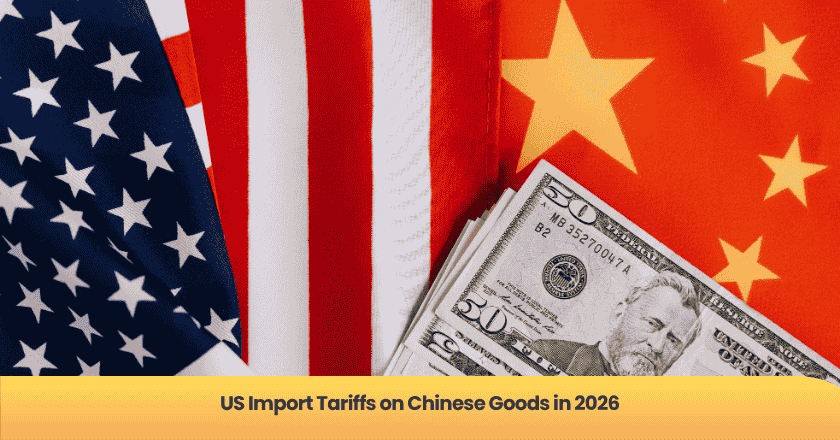
A lot of importers get excited about finding a great product in China — the price is right, the supplier looks solid, and the margins look beautiful on paper. Then the shipment clears customs and the actual landed cost hits. Suddenly the math doesn't work. Nine times out of ten, the culprit is a duty rate nobody bothered to check before placing the order.
Understanding your import duty obligations before you commit to a product is not optional. It is one of the core skills of a competent importer — and in 2026, with the US-China trade relationship continuing to evolve rapidly, this knowledge matters more than ever.
Key Takeaways
Before diving into the details, here is what this guide covers:
- Duty is layered. Your total import cost is not just one tariff — it combines a base duty rate, a Merchandise Processing Fee (MPF), possibly a Harbor Maintenance Fee (HMF), and potentially Section 301 additional tariffs that can add anywhere from 10% to 145% on top.
- HTS codes are your entry point. Every product entering the US must be classified under a 10-digit Harmonized Tariff Schedule (HTS) code. Get this wrong and you either overpay or face an audit.
- HS codes and HTS codes are not interchangeable. Your Chinese supplier's 6-digit HS code is only the first half of the picture. The last 4 digits of a US HTS code are country-specific and determine your actual rate.
- De minimis for Chinese goods is effectively over. The longstanding $800 duty-free threshold has been significantly restructured for shipments from China as of May 2025.
- Legal duty reduction is possible — through correct classification, Free Trade Zone (FTZ) utilization, supply chain restructuring, and tariff exclusion filings.
- Section 301 tariffs remain active and high. As of early 2026, many Chinese goods carry cumulative tariff rates exceeding 100% when all layers are added together.
Why Your Duty Rate Is a Business-Critical Number
Most importers treat duty as a line item they will figure out later. That is a mistake made at the product research stage — the point where it is most costly to get wrong.
Here is a concrete example that illustrates this. Two products look almost identical at first glance: a compact travel umbrella and a patio market umbrella. They both open, they both keep rain off your head. But their HTS classifications are different, and so are their duty rates. One might carry a 0% base duty; the other could carry 6.5% plus a 25% Section 301 tariff. If your unit cost from the factory is $12, that gap represents a $3.78 per-unit difference in landed cost — which, across a container load, amounts to thousands of dollars you either did not budget for or did not pocket.
There is a second dimension to this that goes beyond profit margins: legal liability. As the Importer of Record (IOR) — the entity legally responsible for a shipment entering the United States — you are accountable for declaring the correct HTS code and paying the correct duty. If a supplier undervalues your commercial invoice (a common practice when shipping on DDP terms, where the seller manages customs clearance on your behalf), and CBP audits the shipment, the fine lands on you. Not the supplier. You.
These two reasons — financial accuracy and legal compliance — are why duty classification belongs at the start of your product research, not the end.
Expert Tip: When a supplier quotes you DDP (Delivered Duty Paid), always ask them to provide the declared invoice value and the HTS code they intend to use. Cross-reference it yourself. A supplier's incentive is to clear goods quickly; yours is to stay compliant and avoid penalties that can reach four times the unpaid duty amount.
What You're Actually Paying — Breaking Down the Cost Components
The formula that determines your total customs obligation looks like this:
Total Duty = Base Duty Rate + Merchandise Processing Fee (MPF) + Harbor Maintenance Fee (HMF) + Section 301 Additional Tariffs
Each component has its own logic, and understanding all four is the only way to arrive at an accurate landed cost:
- Base Duty Rate — Determined by your HTS code. Ranges from 0% (duty-free) to 37.5% for products like certain apparel. This is the rate you find when you look up your code in the USITC HTS database.
- Merchandise Processing Fee (MPF) — A flat administrative fee charged on most formal entries, currently set at 0.3464% of the declared customs value, with a floor of $31.67 and a cap of $614.35 per entry. This fee applies to both air and ocean shipments. On small shipments, you will almost always hit the minimum.
- Harbor Maintenance Fee (HMF) — This one only applies to ocean freight shipments arriving at US seaports. The rate is 0.125% of the cargo value. Relatively minor on a percentage basis, but worth including in any landed cost model.
- Section 301 Tariffs — These are the "trade war tariffs" imposed on Chinese goods beginning in 2018 under Section 301 of the Trade Act of 1974. They are layered on top of the base rate and currently range from 10% to 145% depending on the product and which tariff list it falls under. These are the tariffs that can genuinely disrupt your cost model.
Common Mistake to Avoid: Many importers calculate only the base duty rate when quoting landed costs and forget to include MPF, HMF, and any Section 301 tariffs. On a $50,000 ocean shipment from China, the difference between calculating just the base rate versus the full obligation can easily exceed $10,000. Always run the complete formula before committing to a pricing strategy.
HS Code vs. HTS Code — A Distinction That Costs Importers Money
There is a persistent source of confusion among new importers: the difference between an HS code and an HTS code. Your Chinese supplier will give you one; US Customs requires the other. They are related but not the same, and conflating them is a compliance error with real consequences.
The HS code (Harmonized System Code) is a 6-digit number maintained by the World Customs Organization and used by approximately 200 countries covering 98% of global trade. The first 6 digits of every internationally traded product's classification are standardized — a leather handbag is classified as 420221 whether you are importing it into the US, Canada, or Australia.
The HTS code (Harmonized Tariff Schedule Code) is a 10-digit number specific to the United States, maintained by the US International Trade Commission. The first 6 digits match the international HS code exactly. The final 4 digits are US-specific and determine the precise duty rate, statistical reporting category, and eligibility for special tariff programs. This is where the two systems diverge — and where importers get into trouble.
In practice: your Chinese supplier may hand you a 10-digit code from China's own tariff schedule. Those last 4 digits are China's country-specific extension, not the US one. Copying that code directly onto a US customs entry is a misclassification. CBP can issue penalties for this even when the error is unintentional.
Using the leather handbag as a working example: the international HS code is 420221. In the US HTS, the full 10-digit code for a handmade version becomes 4202.21.0010 — and those last four digits, whether 0010 or 0090, can correspond to different duty rates or statistical reporting requirements. Small number, meaningful difference.
Expert Tip: The authoritative source for US HTS codes is the USITC HTS database at hts.usitc.gov. Search by product description rather than relying on your supplier's code. For products that sit on the border between two classifications — common with multi-function or composite items — consider requesting a binding ruling from CBP before your first shipment. A binding ruling is legally enforceable and protects you from reclassification on future entries.
How to Look Up Your HTS Code and Calculate Your Total Duty
The process is more accessible than most people assume, and running through it once on a new product takes under 20 minutes.
Start by going to hts.usitc.gov and searching by product description. The HTS is organized hierarchically: the first 2 digits identify the chapter (broad product category), digits 3 and 4 identify the heading (more specific), and digits 5 and 6 identify the subheading (material, construction, or intended use). Work through that structure until you land on the 10-digit code that most accurately describes your product.
Once you have the code, read the "General" column in the rate schedule. That is your base duty rate. If it shows "Free," your base rate is zero — but do not stop there. A zero base rate does not mean a zero duty obligation when Section 301 tariffs are in play.
Check whether your HTS code carries a Section 301 footnote indicator. These are typically displayed as a superscript symbol or footnote reference in the database. If one is present, go to the USTR's Section 301 search tool at ustr.gov, paste your HTS code, and confirm which tariff list covers your product and at what rate. From there, add the MPF (0.3464% of declared customs value, minimum $31.67) and, for ocean shipments, the HMF (0.125%). Apply all components against your commercial invoice value — that sum is your total duty obligation.
Common Mistake to Avoid: Do not use third-party duty calculators as your only source. They are useful for quick estimates but may not reflect the most current Section 301 rates, which have changed multiple times since 2018 and continue to be updated. Always cross-reference with the official USITC and USTR sources before filing a customs entry.
Section 301 Tariffs in 2026 — The Landscape Has Shifted
Section 301 tariffs have gone through multiple escalations since their introduction in 2018, and the current structure is considerably more complex — and more expensive — than what most introductory trade guides describe. As of early 2026, the four active tariff lists break down as follows:
- List 1: 25% additional tariff, in effect since July 2018, covering approximately $34 billion in Chinese goods including machinery, electronics components, and aerospace parts.
- List 2: 25% additional tariff, in effect since August 2018, covering an additional $16 billion in goods including semiconductors, chemicals, and railcars.
- List 3: 25% additional tariff, in effect since May 2019 (raised from an original 10%), covering $200 billion in consumer goods, apparel, and furniture.
- List 4A: Rate increased to 15% as of February 2025, covering consumer electronics and other high-volume import categories.
- List 4B: Currently suspended with no active additional tariff, though this status is subject to change with minimal advance notice.
Beyond Section 301, successive administrations have introduced sector-specific tariffs targeting solar panels, electric vehicles, steel, and aluminum. When stacked on top of base duties and Section 301 rates, effective tariff rates on certain Chinese goods now exceed 100%. Some EV components from China carry cumulative effective rates above 145% as of early 2026.
The USTR exclusion process — which allows importers to petition for temporary tariff relief on specific products — has operated in cycles and remains an underutilized tool. Checking for an active exclusion on your HTS code before filing an entry costs nothing and can represent meaningful savings on high-volume shipments.
Expert Tip: Monitor the Federal Register and USTR press releases at least quarterly. Tariff rates on Chinese goods have shifted frequently and without long lead times. Building a monitoring habit into your supply chain calendar — rather than doing a one-time lookup — is how professional importers avoid cost increases that blindside their pricing before they hit the P&L.
The End of De Minimis for Chinese Goods — 2025-2026 Update
For years, the de minimis rule — the provision allowing shipments valued at $800 or below to enter the US duty-free without a formal customs entry — was the structural backbone of direct-to-consumer cross-border e-commerce from China. Logistics models, pricing strategies, and entire platform ecosystems were built around it.
As of May 2, 2025, that calculus changed fundamentally. The US restructured de minimis eligibility for shipments originating in China and Hong Kong, subjecting low-value parcels that previously entered duty-free to new fees or duty obligations depending on the shipment method. The policy is explicitly designed to reduce the volume of small commercial packages exploiting the exemption. For importers and e-commerce businesses, the practical effects are significant. Direct-to-consumer shipments from Chinese suppliers that previously relied on de minimis now face duty assessment at each parcel, increasing landed cost per unit. Consolidation strategies — grouping multiple small-parcel orders into formal ocean or air freight entries — have become more economically compelling not despite the new rules but because of them. Businesses that previously had no need for a customs broker on low-value shipments now have a clear financial incentive to establish that relationship before volume scales up.
Common Mistake to Avoid: Assuming that a package marked as a "gift" or assigned a nominal declared value will avoid duties. CBP has significantly increased scrutiny of low-value parcels from China since mid-2025. Intentional undervaluation is customs fraud — a federal offense — regardless of whether it was initiated by the supplier on the commercial invoice rather than the importer directly.
Legal Strategies to Reduce Your Import Duty Burden
Reducing duty is entirely legal when done through proper channels, and experienced importers use a combination of approaches depending on their product, volume, and supply chain structure.
Accurate HTS classification is the most underrated tool in this category. This is not about gaming the system — it is about ensuring you are not misclassified into a higher rate. Two HTS codes can describe similar products but carry meaningfully different duty rates. A product that is borderline between two classifications is worth the cost of a professional ruling to get right. Tariff exclusion petitions represent another avenue: the USTR periodically opens exclusion petition processes for Section 301 tariffs, and if your product is covered by an active exclusion, you can import duty-free from China on that specific HTS code for the duration of the exclusion. Exclusions must be applied for proactively — they are not applied automatically at the border.
Free Trade Zone (FTZ) utilization is a strategy more common among mid-to-large importers but increasingly relevant for growing e-commerce operations. Importing goods into a US FTZ allows you to defer duty payment until the goods leave the zone and enter US commerce. For certain manufacturing operations, goods assembled in an FTZ from foreign components may also qualify for a lower "inverted tariff" rate. Supply chain restructuring — sourcing components or finished goods from countries with lower tariff exposure such as Vietnam, Mexico, or India — has become mainstream, though it carries its own complexity. CBP aggressively audits circumvention claims, and actual manufacturing presence or substantial transformation in the third country is required to establish non-Chinese origin.
For importers with significant export activity, duty drawback programs offer a mechanism to reclaim up to 99% of duties paid on imported goods that are later exported or incorporated into exported products. The documentation burden is real, but for manufacturers and distributors with consistent export volumes, it is worth evaluating. Finally, the choice between FOB and CIF incoterms affects your dutiable value: US customs value is generally assessed on the transaction value of goods under FOB terms, excluding international freight and insurance, which reduces the base against which your duty percentage is calculated.
Expert Tip: Consulting a licensed US customs broker — not just a freight forwarder — before your first significant shipment is worth the cost. Brokers have direct access to binding ruling processes, tariff exclusion filing procedures, and FTZ enrollment. The professional advice fee typically pays back several times over on recurring shipments of any meaningful volume.
Frequently Asked Questions
Q: What is the difference between a tariff and a duty?
In practical usage, the terms are often used interchangeably. Technically, a "tariff" refers to the schedule of rates — the legal framework — while "duty" is the actual payment owed on a specific shipment. When someone says "Section 301 tariffs," they mean the rules; when someone says "I paid $2,000 in duty," they mean the money transferred to CBP at entry.
Q: How do I find the HTS code for my product?
Use the official USITC HTS database at hts.usitc.gov. Search by product description, then navigate through chapters, headings, and subheadings. For products that are difficult to classify — particularly composite or multi-function items — submit a binding ruling request to CBP using Form 177. The ruling is legally binding and protects you from reclassification on future entries.
Q: Do I still owe duty if my supplier says the goods are "samples"?
CBP assesses the actual fair market value of goods regardless of the declared invoice value. Commercial quantities labeled as samples are a known area of enforcement scrutiny, and the "samples" designation does not provide automatic duty relief on goods that are clearly intended for resale.
Q: Are there any Chinese goods still entering the US duty-free in 2026?
Some goods covered by specific humanitarian or educational exemptions — certain informational materials, medical supplies — may still qualify. Products covered by an active Section 301 tariff exclusion are another exception. For the vast majority of commercial goods from China, however, some level of duty obligation applies.
Q: Can I use AI tools to look up duty rates?
AI tools can provide useful starting-point information about tariff structures and classification logic, but they should never be your final source for compliance decisions. Tariff rates update frequently, and a model's training data may be months or years behind the current schedule. Always verify against the official USITC and CBP databases before filing.
Q: What happens if I get the HTS code wrong?
CBP can issue a penalty for misclassification. In unintentional cases, penalties typically range from the unpaid duty amount to double that figure. In cases involving gross negligence or fraud, penalties can reach four times the unpaid duty. Additionally, a poor compliance record can flag your import account for enhanced examination on future shipments, increasing clearance times and costs across the board.
Q: What is the Merchandise Processing Fee and why does it matter?
The MPF is an administrative fee CBP charges on most formal customs entries — think of it as the processing charge for clearing your shipment through the system. At 0.3464% of declared value, it is modest on a percentage basis, but the $31.67 minimum means even small shipments pay it. For high-volume importers filing many entries, MPF accumulates quickly and belongs in every landed cost model.
Final Thoughts
Duty classification is one of those topics that seems dry until the moment it directly affects your bottom line — and then it becomes urgent. The importers who build this knowledge into their standard product research process do not get surprised by landed cost blowouts. They make better sourcing decisions, negotiate from a position of accuracy, and stay out of trouble with CBP.
In 2026, with US-China trade policy remaining volatile and tariff structures more complex than they have ever been, treating duty research as a one-time task is not sufficient. Build it into your quarterly review cycle. Keep a licensed customs broker on your contact list. Know your HTS codes the way you know your supplier's payment terms.
NewBuyingAgent
Related Resources

Comece hoje
Vamos transformar seus objetivos de compras em realidadeWeChat:+86 15157124615
WhatsApp:+86 15157124615
Endereço: Edifício 10 #39 Xiangyuan Road, Hangzhou, China
