

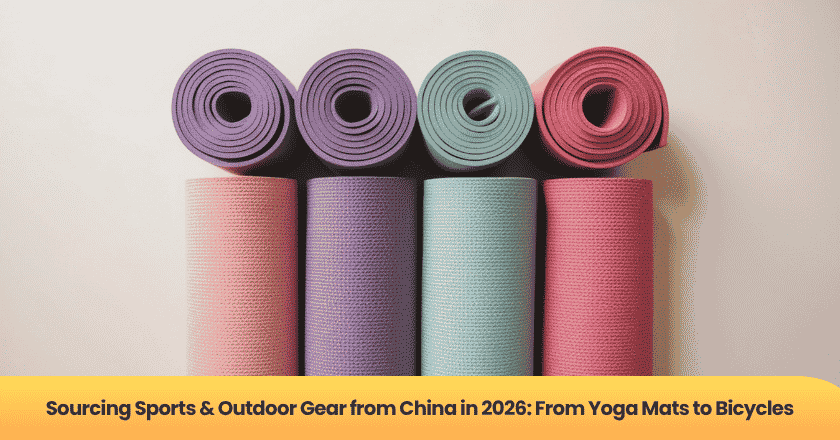
Sports and outdoor gear is a sprawling sourcing category with surprisingly little overlap between subcategories. The factory that makes great yoga mats can't make a tent; the bicycle factory can't make a kayak. Cluster matching matters more here than in almost any other consumer category.
Key Takeaways
- Sports and outdoor gear breaks into six structurally distinct sourcing subcategories: yoga and fitness accessories (Zhejiang/Jiangsu), camping and hiking gear (Zhejiang and Fujian), bicycles (Tianjin and Kunshan), water sports (Guangdong, Shandong), team sports equipment (multiple clusters), and apparel/footwear (Fujian and Vietnam crossover).
- Each subcategory has distinct supplier specialization, MOQ profile, and compliance requirements. Cluster matching is more critical than in most consumer categories — there's almost no overlap between subcategory specialists.
- Bicycles specifically: Tianjin produces the highest volume of mass-market bicycles globally; Kunshan has emerged as the premium e-bike and high-end bicycle cluster.
- US import duties on Chinese sports/outdoor products in 2026: typically 35–45% effective for most categories (varies by subcategory). Bicycles face a complex tariff stack including potential Section 301 List 4B and AD/CVD on certain product types.
- Compliance requirements vary sharply by product: CPSIA for products marketed to children, ASTM safety standards for certain athletic equipment, electrical safety for e-bikes and connected fitness, food contact for water bottles and hydration products.
- Material safety (lead in yoga mats, BPA in water bottles, phthalates in inflatable products) is a recurring compliance issue. Specifying tested materials and verifying with independent labs is essential.
The global sports and outdoor industry generated over $400B in revenue in 2024, with consistent growth driven by rising fitness participation, athletic apparel premiumization, and the lasting impact of pandemic-era outdoor recreation enthusiasm. China dominates the global manufacturing side across most subcategories — bicycles, camping gear, yoga and fitness accessories, team sports equipment, water sports gear. The category's diversity means there's no single "sports and outdoor cluster" in China — instead, half a dozen specialized clusters each dominate a specific subcategory.
For US importers building sports and outdoor product lines, this diversity creates both opportunity and complexity. The opportunity: each subcategory has mature Chinese supplier ecosystems with deep capability. The complexity: a brand spanning multiple subcategories needs supplier relationships across multiple geographic clusters, with different compliance requirements, different MOQ profiles, and different operational rhythms.
This guide walks through the major sports and outdoor sourcing subcategories, where each clusters geographically, what compliance requirements matter, and how the 2026 tariff environment affects each.
Part 1: The Six Sourcing-Distinct Subcategories
Subcategory 1: Yoga and fitness accessories
Yoga mats, yoga blocks, resistance bands, foam rollers, dumbbells (rubber-coated), kettlebells, exercise balls, jump ropes, balance boards, mini-bands, recovery tools.
Geographic concentration: Zhejiang province (especially around Hangzhou and Yiwu) for general fitness accessories; Jiangsu province for yoga and Pilates specialty items.
What's important: material safety (lead in yoga mats and resistance bands has been a recurring issue), durability of repeatedly-used products, custom branding and color matching for brand differentiation, packaging that handles shipping without damage to often-bulky items.
Typical MOQ: 500–2,000 units for OEM with branded packaging; lower for stock products with light customization.
Compliance: California Prop 65 (lead, phthalate warnings), CPSIA if marketed to children. Material testing recommended for premium positioning brands.
Subcategory 2: Camping and hiking gear
Tents, sleeping bags, sleeping pads, backpacks, hiking poles, headlamps, camp stoves, water filters, hydration packs, dry bags, cookware, multi-tools.
Geographic concentration: Zhejiang province for general camping gear (Yiwu trading + factories), Fujian province for technical outdoor gear (overlap with athletic apparel cluster), Guangdong for electronics-integrated gear (headlamps, GPS devices).
What's important: weather resistance and durability testing, technical specifications (waterproof ratings, temperature ratings on sleeping bags), weight optimization for backpacking applications, certification testing for products with specific performance claims.
Typical MOQ: 500–2,000 units for OEM gear; 1,000+ for technical products with custom specifications.
Compliance: flammability standards (especially for tent fabrics), electrical safety for headlamps and electric devices, sometimes ASTM standards for specific product types.
Subcategory 3: Bicycles and cycling
Complete bicycles, e-bikes, frames, components (gears, brakes, wheels), helmets, accessories, child trailers, racks.
Geographic concentration: Tianjin is the world's largest bicycle manufacturing region — produces the highest volume of mass-market bicycles globally. Kunshan (Jiangsu, near Shanghai) has emerged as the premium and e-bike cluster, with significant investment from Taiwanese bicycle companies (Giant, Merida) operating there.
What's important: structural safety (frame welds, brake systems), electrical safety for e-bikes (battery and motor systems), regulatory compliance varies sharply by destination market, packaging optimization for shipping bulky products.
Typical MOQ: 100–500 units for mid-tier OEM bicycles; 1,000+ for custom design programs; lower for accessories.
Compliance: CPSC regulations for US (16 CFR Part 1512 covers bicycle safety standards), CE marking and EN safety standards for EU, electrical safety certification for e-bikes (UL 2849 in US), specific certifications for child seats and trailers.
Tariff complexity: Bicycles face complex tariff stacking. Many bicycle categories are on Section 301 lists (varying tiers); some bicycle parts have AD/CVD orders against China; e-bikes have additional considerations under Section 232 if containing specific components. Verify HTS codes carefully for any bicycle program.
Subcategory 4: Water sports
Kayaks, paddleboards (including inflatable SUPs), life jackets, swim accessories, snorkeling gear, surfboards, swimming pool accessories.
Geographic concentration: Guangdong (Shantou, Dongguan) for inflatable products (paddleboards, pool floats); Shandong (Qingdao) for hard-shell kayaks and larger equipment; mixed clusters for accessories.
What's important: phthalate-free materials (for inflatable products), buoyancy and safety testing for life-saving devices, UV resistance for products with extended sun exposure, durability for repeated water exposure.
Typical MOQ: 500–1,000 units for inflatable products; 200–500 for hard-shell items; lower for accessories.
Compliance: US Coast Guard certification for life jackets; CE marking for EU watersport equipment; phthalate testing required for inflatables (especially products marketed to children).
Subcategory 5: Team sports equipment
Soccer balls, basketballs, baseball/softball equipment, tennis equipment, golf equipment, volleyball, sports nets, training equipment.
Geographic concentration: Distributed across multiple clusters depending on product. Soccer balls historically Pakistan and Vietnam (with Chinese subsidiary production), basketballs and volleyballs in Guangdong, tennis equipment in Jiangsu, golf in Guangdong (Dongguan area for clubs and accessories).
What's important: official sport regulation compliance (size, weight, bounce specifications for balls), durability for competitive use, brand and licensing considerations for products bearing major sport league marks.
Typical MOQ: 500–2,000 units for general products; 5,000+ for branded licensed products.
Compliance: Sport-specific regulations (FIFA approval for soccer balls, USGA for golf), CPSIA for products marketed to youth, sometimes ASTM standards.
Subcategory 6: Athletic apparel and footwear
Performance apparel, athletic shoes, running shoes, training shoes, athletic accessories.
Geographic concentration: This subcategory has substantially shifted to Vietnam and Indonesia. Chinese capability remains for some segments (especially specialty technical apparel) but mass-market athletic apparel and footwear have largely moved out of China since 2018.
What's important: technical fabric performance, fit specification consistency, color matching across orders, durability under athletic use.
For brands sourcing athletic apparel and footwear, Vietnamese factories (Binh Duong, HCMC, Bac Ninh) and Indonesian factories (West Java, Central Java) are typically the right answer in 2026. Chinese sourcing for this subcategory is increasingly limited to specialty technical positioning.
Part 2: Major Cluster Deep Dive — Bicycles
Because bicycles are one of the most distinctive subcategories with unique cluster structure, additional detail is warranted.
Tianjin — mass-market bicycle volume capital
Tianjin and surrounding Hebei province produce the highest volume of bicycles globally. Major export-oriented factories serve volume retailers (Walmart, Target, Decathlon equivalents) and growing brand customers. Capability spans children's bikes, adult comfort bikes, mountain bikes, road bikes, and entry-level e-bikes.
Typical Tianjin price points: $30–80 ex-factory for adult comfort bikes; $50–120 for entry-mid mountain bikes; $80–200 for road bikes; $150–400 for entry-level e-bikes.
MOQ: 200–500 units for OEM with custom branding; 500+ for custom frame designs.
Quality tier: variable. Top-tier Tianjin factories serve major Western brands at consistent quality; lower-tier factories serve domestic Chinese mass market with quality variability.
Kunshan — premium and e-bike cluster
Kunshan has emerged as the premium and e-bike manufacturing cluster in China, with significant Taiwanese bicycle company investment (Giant, Merida) and growing involvement of European premium brands. Capability skews higher-end than Tianjin.
Typical Kunshan price points: $200–500 for premium adult bikes; $500–1,500 for high-end e-bikes; $300–800 for mid-range performance bikes.
MOQ: 100–300 units for OEM; lower for products on existing platforms.
Quality tier: generally higher and more consistent than Tianjin average. Better engineering depth and component supply chain integration.
Bicycle-specific compliance
For US market:
CPSC 16 CFR Part 1512 — federal bicycle safety standard. Covers structural integrity, braking, lighting, reflectors. Required for all bicycles sold in US.
UL 2849 — e-bike battery safety. Increasingly required by retailers for e-bikes.
CPSIA — for bicycles marketed to children, additional testing for lead and phthalates.
For EU:
EN 15194 for e-bikes
EN 14764 for city/trekking bicycles
EN 14781 for racing bicycles
CE marking
Bicycle tariff complexity in 2026
Different bicycle HTS codes face different Section 301 rates and may have additional AD/CVD exposure:
HTS 8712.00 (basic bicycles): typically List 3 at 25%
HTS 8714 (bicycle parts): mixed Lists with rates 7.5–25%
E-bikes (HTS 8711.60): rates vary; some categories face higher Section 301 rates
Specific bicycle components have AD/CVD orders against China that may or may not apply
For brands sourcing bicycles from China, work with a customs broker on HTS classification verification before placing significant orders. The tariff math can vary substantially based on classification.
Common Mistake: Buyers compare total bicycle costs across countries (China vs Vietnam vs Taiwan) without considering AD/CVD exposure. Some bicycle subcategories from China face additional AD/CVD that adds 50–100% to duty cost. The supplier-specific AD/CVD rate matters — some Chinese bicycle manufacturers have been excluded from the orders or have very low rates; others face prohibitive duties. Verify supplier-specific AD/CVD exposure through CBP databases before committing to a China bicycle program.
Part 3: Compliance Across Sports and Outdoor
Five compliance areas affect sports and outdoor gear sourcing.
CPSIA — products marketed to children
Any product marketed to or primarily used by children under 12 requires CPSIA testing: lead content, phthalate restrictions, small parts testing for choking hazards. Cost: USD 500–2,000 per product. Critical for children's bicycles, sports equipment marketed to youth, fitness toys.
ASTM safety standards
Various sports equipment categories have ASTM safety standards. ASTM F963 covers toy safety (relevant for some sports toys). ASTM F1772 for harnesses, ASTM F2200 for swim spas, others for specific equipment. Major retailers often require ASTM compliance regardless of legal requirement.
California Prop 65
Recurring issue for sports/outdoor products. Lead in yoga mats, BPA in water bottles, phthalates in inflatable products, certain dyes in apparel — all have triggered Prop 65 enforcement actions. Required warning labels for products sold in California; non-compliance triggers private litigation.
Material safety testing
Beyond regulatory minimums, market-relevant material testing includes:
- Lead testing for yoga mats and resistance bands
- BPA-free certification for water bottles and food-contact items
- Phthalate-free for inflatables
- Heavy metal testing for products with metal components
Product-specific certifications
US Coast Guard for life jackets, FIFA for soccer balls, UL for e-bike batteries, sport-federation approvals for competitive equipment. Each has specific procedures and costs.
Expert Tip: When evaluating sports/outdoor suppliers, request actual test reports — not summary certificates — for any compliance claims. The five-page "certificate" that says "tested per ASTM/CPSIA/Prop 65" is rarely sufficient evidence. The real test report from an accredited lab runs 30+ pages with specific test methods, equipment used, measured values, and pass/fail thresholds. Commission-free sourcing agents who handle compliance documentation as standard practice typically provide audit-ready test reports; commission-based agents often provide cosmetic certificates that don't withstand scrutiny.
The Bottom Line
Sports and outdoor gear is one of the most diverse Chinese sourcing categories — six structurally distinct subcategories with limited overlap, distributed across multiple geographic clusters. Tianjin and Kunshan dominate bicycles. Zhejiang and Fujian lead in yoga, fitness, and outdoor gear. Guangdong and Shandong handle water sports. Athletic apparel has substantially shifted to Vietnam and Indonesia.
Cluster matching matters more in this category than in most. The factory making great yoga mats can't make a tent; the bicycle factory can't make a kayak. Supplier specialization is deep, and trying to source across subcategories from a single supplier or trading company typically produces inferior outcomes.
FAQ
How does the bicycle AD/CVD situation work?
Several Chinese bicycle subcategories face AD/CVD orders, with rates that vary widely by specific manufacturer. Some Chinese bicycle factories have been excluded from the orders entirely (zero AD/CVD); others face prohibitive rates of 100%+. Before committing to any Chinese bicycle program, verify supplier-specific AD/CVD rates through CBP's AD/CVD database. Working with a customs broker on this analysis is essential.
What's the realistic MOQ for a custom OEM yoga mat?
For a fully custom yoga mat with bespoke materials, branding, and packaging: 1,000–3,000 units typical. Light customization on existing mat platforms (color, branding only): 500–1,000 units. Stock yoga mats with custom packaging only: 200–500 units. Per-unit factory price varies dramatically by material — basic PVC mats $3–6, premium TPE/cork/natural rubber mats $8–25.
Are e-bike sourcing tariff calculations really this complex?
Yes. E-bikes have multiple potential HTS classifications based on motor type, battery integration, and intended use. Different classifications face different Section 301 rates. Some e-bikes also touch Section 232 if certain motor or battery components are subject to those tariffs. Working with a customs broker on HTS classification before placing significant e-bike orders typically saves 5–15 percentage points of duty through proper classification.
What's the timeline for a custom OEM bicycle program?
For a moderate complexity custom bicycle (existing frame design with custom branding and component selection): 6–9 months from spec to first production-ready samples. For full custom frame design: 9–14 months. Add 1–2 months for first production run beyond samples. UL certification for e-bikes adds significant time (4–10 weeks) on top of the bicycle development timeline.
NewBuyingAgent
Related Resources
Comece hoje
Vamos transformar seus objetivos de compras em realidadeWeChat:+86 15157124615
WhatsApp:+86 15157124615
Endereço: Edifício 10 #39 Xiangyuan Road, Hangzhou, China
