

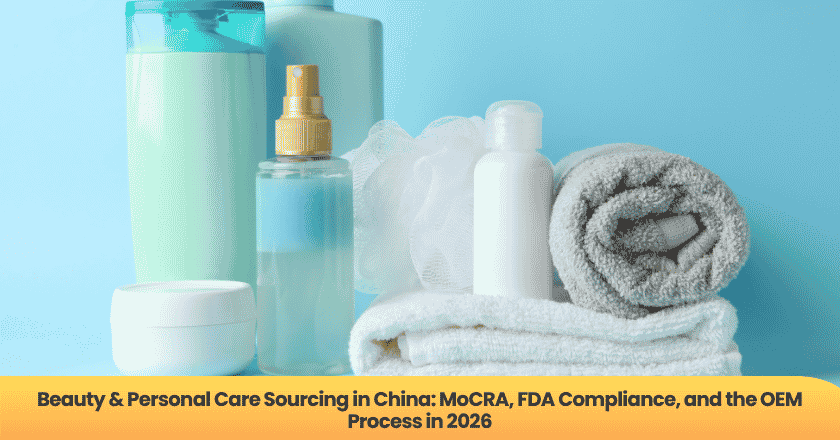
Cosmetics OEM in China was always operationally complex — formula development, batch consistency, packaging integration. MoCRA's 2026 enforcement has added a hard regulatory floor that's eliminating the cheapest factories from the US-bound market.
Key Takeaways
- The 2022 Modernization of Cosmetics Regulation Act (MoCRA) has fundamentally changed the US cosmetics regulatory environment. Effective 2024–2025, all manufacturing facilities producing cosmetics for US distribution — including foreign factories like Chinese OEMs — must register with FDA, designate a US Agent, and renew biennially.
- The Responsible Person (typically the brand owner whose name is on the label) must list every product with FDA, including complete ingredient disclosure, and update annually. Adverse events must be reported within 15 business days. Records retained 6 years.
- China's two major cosmetics OEM clusters: Guangzhou Baiyun district (the largest, dominant for skincare and color cosmetics) and Shanghai Fengxian/Pudong (mid-premium positioning, stronger for haircare and fragrance). Smaller clusters in Suzhou and Hangzhou.
- US import duties on Chinese cosmetics in 2026: typically 35% effective (0% MFN on most cosmetics + 10% Section 122 + 25% Section 301 List 3). Some categories on List 4A at 7.5%.
- EU market requires CPNP (Cosmetic Product Notification Portal) registration before sale, plus PIF (Product Information File) maintained by EU Responsible Person. Different framework from US MoCRA but similar in operational burden.
- China's own NMPA (National Medical Products Administration) cosmetics regulations apply to products sold within China. Most US-bound OEM doesn't engage with NMPA but it affects supplier behavior and capacity.
- Cosmetics OEM development typically runs 6–12 months from concept to first production. Premium and complex formulas can take longer. The right time to engage a manufacturer is 9–12 months before planned launch.
The cosmetics and personal care category is structurally different from most other China sourcing categories in three ways. First, the regulatory environment is exceptionally complex, with MoCRA's 2024–2025 implementation putting Chinese OEM factories directly into the FDA's regulatory perimeter for the first time. Second, the product economics depend heavily on formulation expertise (rather than raw materials or assembly labor), which concentrates capability in a relatively small number of specialized factories. Third, packaging complexity often equals or exceeds product complexity — pumps, sprays, droppers, airless containers, custom decoration — and packaging supply chains are themselves a separate sourcing concern.
For US brands building cosmetics or personal care lines through Chinese OEM, the 2026 environment requires more sophistication than previous years. Factories that haven't registered with FDA under MoCRA can no longer ship products to the US (legally). Factories that haven't built systems for ingredient disclosure, adverse event reporting, and serious product information file maintenance are at compliance risk that flows through to their brand customers. The cheapest cosmetics OEM factories — the ones serving low-end gray-market goods — are largely out of the US-bound market.
This guide walks through what MoCRA actually requires, how Chinese OEM factories are responding, where the major clusters are and what each does well, what the realistic OEM development process looks like, and how to navigate this category in 2026.
Part 1: What MoCRA Requires (and Why It Matters for China Sourcing)
The Modernization of Cosmetics Regulation Act of 2022 — signed December 29, 2022, with phased implementation from 2023 through ongoing rulemaking — is the largest expansion of FDA cosmetics authority since 1938. For US importers, four mandates matter most.
Mandate 1: Facility registration
Every facility that manufactures or processes cosmetics for the US market must register with FDA, including foreign facilities. Registration requires:
- An FDA Establishment Identifier (FEI) number (request via FDA's FEI Search Portal)
- Form FDA 5066 submitted through the Cosmetics Direct portal
- Designation of a US Agent for foreign facilities (a person or entity in the US who serves as the FDA's point of contact)
- Biennial renewal (every 2 years)
For Chinese OEM factories, this means each factory producing US-bound cosmetics must be FDA-registered. Brands sourcing from non-registered factories are technically importing misbranded/adulterated products — subject to border holds and recalls.
Mandate 2: Product listing
The "Responsible Person" — typically the brand owner whose name appears on the product label — must list each marketed product with FDA. Listing requires:
- Form FDA 5067 for each product
- Complete ingredient list (including fragrances, flavors, colors)
- Linkage to the manufacturing facility's FEI
- Annual update to confirm formulation accuracy
The Responsible Person is the brand, not the manufacturer. US importers cannot delegate this responsibility to Chinese OEM factories. The product listing work must be done by the brand's regulatory team or a US-based regulatory consultant.
Mandate 3: Adverse event reporting
Brands must maintain systems for collecting and reporting consumer adverse events related to their products. Serious adverse events (death, life-threatening reactions, hospitalization, persistent disability, congenital anomaly) must be reported to FDA within 15 business days. Records of all adverse events (serious and non-serious) must be retained for 6 years.
For brands sourcing from Chinese OEM, this means establishing a feedback loop: customer complaints feed into the brand's adverse event tracking, which may trigger FDA reporting and which feeds back to the manufacturer for batch investigation.
Mandate 4: GMP compliance (rules being finalized)
MoCRA requires FDA to establish Good Manufacturing Practice (GMP) regulations for cosmetics. As of mid-2026, the final GMP regulations have not been issued, but draft expectations are clear: minimum standards for manufacturing, processing, packing, and holding cosmetics — broadly aligned with existing pharmaceutical GMP frameworks.
The practical implication for Chinese OEM: factories that don't already operate under cGMP standards (typical for top-tier facilities serving major Western brands) face significant infrastructure investment. Many mid-tier and smaller factories will not make this investment and will exit the US-bound cosmetics market.
What this means for Chinese cosmetics sourcing in 2026
The market has bifurcated. Top-tier Chinese cosmetics OEM factories (those serving brands like Sephora private label, Ulta, established US indie brands) have completed FDA facility registration, established US Agent relationships, built adverse event reporting infrastructure, and operate at cGMP-equivalent standards. They are MoCRA-ready.
Mid-tier and smaller factories often have not. Brands sourcing from these factories face real compliance risk that surfaces as FDA enforcement actions, border holds, or — in worst cases — product recalls.
The selection criterion for Chinese cosmetics OEM in 2026 starts with: "Are you FDA-registered under MoCRA? Can you provide your FEI number?" Suppliers who can answer affirmatively with documentation are MoCRA-grade. Suppliers who can't or who provide vague answers are operating in a market that's narrowing.
Common Mistake: Brands assume that "FDA-registered" claims from Chinese factory marketing materials are reliable. Many factories claim FDA registration in marketing materials when they actually have older registrations under different programs (the now-defunct VCRP), or have applied but not received MoCRA registration, or have registration for one product line but not the line they're quoting. Always verify FEI numbers through FDA's FEI Search Portal before committing to a supplier. The verification takes 2 minutes and prevents downstream compliance disasters.
Part 2: Major Cosmetics OEM Clusters in China
Two major clusters dominate Chinese cosmetics OEM, with smaller specialty clusters elsewhere.
Guangzhou Baiyun District — the largest cluster
The Baiyun district of Guangzhou is the largest cosmetics OEM cluster in China and one of the largest globally. Hundreds of cosmetics factories concentrate around the Baiyun chemical industrial area, with adjacent packaging and ingredient supplier ecosystems.
What Baiyun does well:
- Skincare formulations — face creams, serums, masks, lotions, body care. Mature formulation labs and chemists.
- Color cosmetics — lipsticks, eyeshadows, foundations, mascaras, blushes. Large-scale production capability.
- Hair care — shampoos, conditioners, treatments, styling products.
- Volume production — many factories run 24/7 production for major brand orders, with capacity to handle launches of 50,000+ units.
Quality tier: variable. Top-tier Baiyun factories serve major US/EU brands and operate at international cGMP standards. Mid-tier serves growing brands with adequate quality. Lower-tier factories serve domestic Chinese mid-market and gray-market exports — these are MoCRA-risk factories that shouldn't be used for US-bound work.
Typical MOQ: 1,000–5,000 units per SKU at top-tier factories; 500–2,000 at mid-tier; 100–500 at lower-tier (with corresponding compliance risk).
Shanghai Fengxian and Pudong — mid-premium positioning
Shanghai's cosmetics OEM cluster is smaller than Guangzhou's but tends toward higher-end positioning. Fengxian district has a major industrial zone for cosmetics; Pudong has additional capacity.
What Shanghai does well:
- Premium skincare — anti-aging formulations, premium serums, dermatologically-tested products.
- Hair care premium segment — salon-grade products, treatment formulations.
- Fragrance — perfumes and fragranced products (smaller cluster but specialized).
- Brand collaboration — Shanghai factories more commonly work with international brand designers and formulators on collaborative product development.
Quality tier: generally higher and more consistent than the Baiyun average. Premium positioning means higher per-unit costs but stronger compliance infrastructure and formulation expertise.
Typical MOQ: 1,000–3,000 units. Premium factories often have higher MOQs but offer collaborative product development that justifies the commitment.
Smaller clusters: Suzhou, Hangzhou, Yiwu
Suzhou and Hangzhou have growing cosmetics OEM capability, often spillover from broader pharmaceutical and chemical industry presence. Specialty factories in skincare actives, traditional Chinese medicine-influenced formulations, and natural/organic positioning.
Yiwu serves the mass-market trading hub function for cosmetics (similar to its role in other consumer categories) — small-batch finished products and accessories, but generally not appropriate for serious OEM development.
Part 3: The Cosmetics OEM Development Process
A realistic timeline for developing a custom cosmetic product through Chinese OEM, from concept to first production-ready batch.
Stage 1: Concept and brief (Week 1–2)
Brand provides product brief: target product type, key ingredients/claims, packaging direction, target retail price, target market positioning. Manufacturer reviews for feasibility.
Stage 2: Initial formulation (Week 2–8)
Manufacturer's formulation lab develops first iteration of the formula. Iterations involve:
- Ingredient sourcing (some specialty actives require lead time)
- pH and stability testing
- Sensory evaluation (texture, scent, appearance)
- Initial efficacy testing (if making efficacy claims)
Most products require 3–5 formulation iterations before brand approval. Each iteration cycle is typically 2–4 weeks.
Stage 3: Stability testing (Week 8–20)
Approved formulation undergoes accelerated and real-time stability testing:
- 12-week accelerated stability (45°C / 75% humidity)
- 12-month real-time stability (room temperature)
- Light stability (especially for products in clear packaging)
- Compatibility with packaging materials
Some brands launch with accelerated stability data and complete real-time testing post-launch (allowed but commercially risky if stability issues surface later). Premium brands typically wait for full stability before launch.
Stage 4: Packaging selection and customization (Week 8–24, parallel)
Packaging is often the longest pole in cosmetics OEM. Options:
- Stock packaging: select from manufacturer's catalog. Fastest path (2–4 week lead time post-selection) but limited differentiation.
- Decorated stock packaging: stock containers with custom labeling, color, or finish. 4–8 week lead time.
- Custom packaging: bespoke molds, shapes, mechanisms. 12–24 week lead time, USD 5,000–50,000+ in tooling.
Pump and dispenser quality varies enormously and significantly affects perceived product quality. Premium pumps from Yonwoo, Aptar, or other major suppliers are 2–5× the cost of generic alternatives but visibly better.
Stage 5: Pilot production (Week 20–24)
A pilot production run (typically 50–500 units) verifies that the formula behaves the same at production scale as in laboratory batches. Common issues surfaced at pilot stage: viscosity variations, color drift, scent intensity changes, packaging-formula incompatibility.
Stage 6: Regulatory and quality work (parallel from Week 12)
For US market: MoCRA product listing through Cosmetics Direct, ingredient documentation, label compliance review. For EU: CPNP notification, PIF assembly, EU Responsible Person designation. For other markets: applicable regulatory work.
This work is typically done by the brand's regulatory team or a US/EU-based regulatory consultant, not by the Chinese OEM manufacturer.
Stage 7: First production run (Week 24–32)
Full production run at committed volume. Lead time depends on volume — typical first production run for a small brand: 4–6 weeks from production start to ready-to-ship.
Total timeline
For a typical custom OEM product: 6–9 months from concept to first production-ready batch. Premium and complex formulations: 9–12 months. Simple modifications of existing manufacturer formulations (white-labeling): 3–4 months.
Brands planning Q4 2026 launches should be engaging manufacturers in Q1–Q2 2026.
Part 4: The 2026 Tariff Math on Chinese Cosmetics
| Cosmetics category | MFN | Section 122 | Section 301 | Effective rate |
|---|---|---|---|---|
| Skincare formulations (HTS 3304.99) | 0% | 10% | 25% (List 3) | 35% |
| Color cosmetics — lipsticks, eyeshadow (HTS 3304.10/20) | 0% | 10% | 25% (List 3) | 35% |
| Hair care (HTS 3305) | 0% | 10% | 25% (List 3) | 35% |
| Soaps and body wash (HTS 3401) | 0% | 10% | 25% (List 3) | 35% |
| Fragrances (HTS 3303) | 0% | 10% | 25% (List 3) | 35% |
| Empty packaging (separately imported) | 3.4–6.5% | 10% | 25% (List 3) | 38–42% |
Despite the tariff differential, China retains structural advantages in cosmetics OEM that are hard to replicate elsewhere: deep formulation expertise, mature ingredient supply chain, established packaging ecosystem, scaled production capability.
For most US cosmetics brands, the right answer is: continue Chinese sourcing for OEM development and core production, with awareness that the 25-point Section 301 disadvantage is a real margin pressure that needs to be priced into retail strategy.
Expert Tip: When evaluating cosmetics OEM pricing, be careful to compare "delivered formula in chosen packaging" rather than "formula price" or "packaging price" separately. Many manufacturers quote attractive formula prices but mark up packaging significantly; others quote attractive packaging but charge premium for formulas. The relevant comparison is unit cost in final form. A commission-free sourcing agent who can show you the manufacturer's actual invoice (formula + packaging + assembly + decoration as separate line items) gives you the visibility to compare meaningfully across multiple suppliers.
Part 5: EU Market Considerations
For brands selling cosmetics in EU markets, additional regulatory work is required.
CPNP notification
Every cosmetic product sold in EU must be notified to the European Commission's Cosmetic Product Notification Portal (CPNP) before market introduction. The notification includes:
- Product category and frame formulation
- Product label (including all required information in applicable languages)
- Identity and contact of the EU Responsible Person
- Country of origin
- Special precautions or warnings
The notification is free but requires complete documentation. Most brands engage EU-based regulatory consultants for the work (cost: typically EUR 150–500 per product).
EU Responsible Person
Every cosmetic product sold in EU must have an EU Responsible Person — an entity established in the EU that takes responsibility for the product's compliance. For US brands without EU presence, services exist (typically EUR 50–500/year per product) to provide EU Responsible Person services.
Product Information File (PIF)
The EU Responsible Person must maintain a Product Information File for each product, available to competent authorities on request. The PIF includes:
- Product description and complete formulation
- Manufacturing methods and quality assurance
- Safety assessment by qualified safety assessor
- Effects of the cosmetic product
- Adverse effect data
PIF maintenance is significant ongoing work. EU regulatory consultants typically maintain PIFs for their client brands.
Specific ingredient restrictions
EU has more restrictive ingredient lists than US, with specific limits on certain preservatives (parabens), UV filters, fragrance allergens, and other compounds. Products formulated for US market sometimes need reformulation for EU sale.
Part 6: Common Pitfalls in Cosmetics OEM Sourcing
Five recurring patterns that cause problems for brands sourcing cosmetics from China.
Pitfall 1: Underestimating timeline
A brand commits to a Q3 launch in May, expecting Chinese OEM to deliver in 4 months. The realistic timeline is 6–9 months. The launch slips, marketing investments are wasted, and the brand-manufacturer relationship gets strained.
The fix: realistic timeline planning. Engage manufacturers 9–12 months before planned launch. Build buffer for stability testing, regulatory work, and first-production iterations.
Pitfall 2: Selecting on formula price alone
Brand compares formula quotes from three manufacturers: $2.50, $2.80, $3.20 per unit. Selects the $2.50 quote as cheapest. Subsequent issues: lower-quality ingredients, less formulation iteration support, weaker stability testing, lower-quality packaging integration. Total economic outcome is worse than the higher-priced alternative would have been.
The fix: compare on full delivered cost (formula + packaging + decoration + compliance) and on capability beyond price (formulation expertise, regulatory infrastructure, customer service responsiveness).
Pitfall 3: Not verifying MoCRA registration
Brand sources from a Chinese factory whose marketing claims "FDA registered" but has actually only registered under the now-defunct VCRP, not MoCRA. First production order is held at US customs as misbranded/adulterated. Brand discovers compliance gap weeks before launch.
The fix: verify FEI numbers through FDA's FEI Search Portal before committing to a supplier. The 2-minute check prevents major downstream issues.
Pitfall 4: Skipping stability testing
Brand launches with accelerated stability data only, planning to complete real-time testing post-launch. At month 8 of real-time testing, formulation shows separation issue that wasn't apparent in 12-week accelerated data. Brand faces choice between recall and quietly riding out customer complaints.
The fix: complete real-time stability testing before launch, especially for premium brands and for products with long shelf life expectations. Accelerated stability is necessary but not sufficient evidence.
Pitfall 5: Treating packaging as an afterthought
Brand spends 4 months perfecting the formula. Then, with 8 weeks until target launch, asks the manufacturer about custom packaging. Custom packaging takes 12–24 weeks; brand either delays launch or accepts stock packaging that doesn't match brand positioning.
The fix: parallel-track packaging selection and customization with formulation development. Packaging often takes longer than formulation; treating it as last-mile work creates timeline failures.
The Bottom Line
Cosmetics OEM in China remains the structural default for most US and global brands despite the 2026 regulatory and tariff complications. The cluster depth (Guangzhou Baiyun, Shanghai Fengxian), formulation expertise, ingredient supply chain, and packaging ecosystem are unmatched by any single alternative origin.
MoCRA's 2024–2025 implementation has bifurcated the Chinese cosmetics OEM market. Top-tier factories — those with FDA registration, US Agent relationships, cGMP-equivalent operations, and adverse event reporting infrastructure — are MoCRA-ready and serve the US market normally. Mid-tier and smaller factories increasingly cannot serve US brands legally. Selecting MoCRA-compliant suppliers is the foundation of any 2026 cosmetics sourcing program.
The OEM development process realistically runs 6–9 months from concept to first production. Brands planning launches in 2026 H2 should be engaging manufacturers now. Stability testing, packaging selection, and regulatory work are timeline drivers as significant as formulation itself.
Tariff exposure on Chinese cosmetics in 2026 is roughly 35% effective — meaningful margin pressure but rarely enough to justify abandoning Chinese OEM for less-developed alternatives. Vietnam and India have growing cosmetics capability but neither matches Chinese depth on most categories. Most successful cosmetics brands continue Chinese sourcing while building MoCRA compliance infrastructure.
FAQ
Is MoCRA actually being enforced or is it still in transition?
Enforcement is active. Facility registration and product listing requirements have been enforced since late 2024. CBP has held cosmetics shipments from non-registered facilities. The Voluntary Cosmetic Registration Program (VCRP) ceased accepting submissions in March 2023; brands relying on prior VCRP submissions are no longer compliant. GMP regulations have not yet been finalized but draft expectations are clear and FDA is signaling future strict enforcement.
Can I use my Chinese OEM factory's existing FDA registration if they have one?
Verify which registration the factory has. MoCRA facility registration (FEI through Cosmetics Direct, Form 5066) is what's required. Older VCRP registrations don't satisfy MoCRA. Drug establishment registrations (for pharmaceutical products) don't satisfy MoCRA either. Always verify the FEI number directly through FDA's FEI Search Portal.
How much does MoCRA compliance cost a small brand?
Direct FDA fees: zero (registration and listing are free). Operational costs: regulatory consultant for product listing typically $500–2,000 per product; ongoing maintenance $200–500 per product per year; adverse event reporting infrastructure setup $1,000–3,000 one-time; ongoing record-keeping is internal time. For a brand launching 5 SKUs: typical first-year MoCRA compliance cost $5,000–15,000.
Are there small business exemptions under MoCRA?
Yes. Section 612 exempts small businesses (defined as cosmetic businesses with average gross annual sales below $1M, with three years of data) from facility registration, product listing, and GMP requirements. However, the exemption does NOT apply to facilities that manufacture or process — or responsible persons for — products in high-risk categories: products that regularly contact the eye area, products for injection, internal use, or otherwise alter normal body function. Most beauty brands above the $1M threshold and most brands in regulated categories should not rely on the small business exemption.
Should I source cosmetics OEM from Vietnam or India instead of China?
Vietnam has limited cosmetics OEM capability for most categories. India has stronger capability, particularly in haircare and certain skincare segments, but the supply chain for ingredients and packaging is less mature than China's. For most US cosmetics brands, Chinese OEM remains the structural answer despite the 25-point tariff disadvantage. Specific product types (some natural/Ayurvedic positioning) may fit India better.
What's the realistic price point for cosmetics OEM in China?
Highly variable. Basic skincare (lotion, body cream) at standard packaging: $2–6 per unit at MOQ. Premium skincare (serum, anti-aging) at premium packaging: $5–15 per unit. Color cosmetics: lipstick $1.50–4, foundation $3–8, mascara $2–5. Premium fragrance: $5–20. These ranges are very approximate and depend heavily on packaging choice, ingredient quality, and order volume.
Should I attend cosmetics industry trade shows in China?
Yes, particularly Cosmoprof Asia (Hong Kong) and PCHi (Personal Care and Homecare Ingredients, Shanghai). These shows concentrate the major Chinese cosmetics OEM manufacturers and ingredient suppliers in one location. Plan 3–5 days for productive visits. Arrange meetings with shortlisted suppliers in advance.
NewBuyingAgent
Related Resources
Comece hoje
Vamos transformar seus objetivos de compras em realidadeWeChat:+86 15157124615
WhatsApp:+86 15157124615
Endereço: Edifício 10 #39 Xiangyuan Road, Hangzhou, China
