


A shipment update is useful only when it tells a buyer what happened, what record supports it, who owns that record, and what must happen next. A carrier portal, factory email, or forwarder message can all be helpful. None should automatically be treated as proof that cargo has been handed over, loaded, cleared, collected, or delivered.
For China-origin orders, a sourcing agent can make the information flow more usable by collecting local supplier, inspection, packing, and handoff evidence in one record. That coordination is valuable precisely because it does not blur roles: the buyer retains the commercial decision, while the carrier, forwarder, customs broker, and authorities retain their own operational responsibilities.
What Each Shipment Status Can Actually Prove
- Use the same five fields for every update: event, evidence, owner, timestamp, and next action.
- Keep booking confirmation, cargo handoff, carrier movement, documents, and arrival information as separate touchpoints.
- When a record is missing or conflicts with the message, keep the status open and assign a named resolver.
Build a Shared Shipment Status Record Before You Follow Milestones
A buyer-ready shipment update joins the event, evidence, owner, timestamp, and next action. A status touchpoint is that bounded update: it names the event, supporting record, owner, time, and next action. It is a better working unit than a broad label such as “shipped” or “on track,” because those labels often hide whether the message describes a plan, a completed physical event, or an expectation.
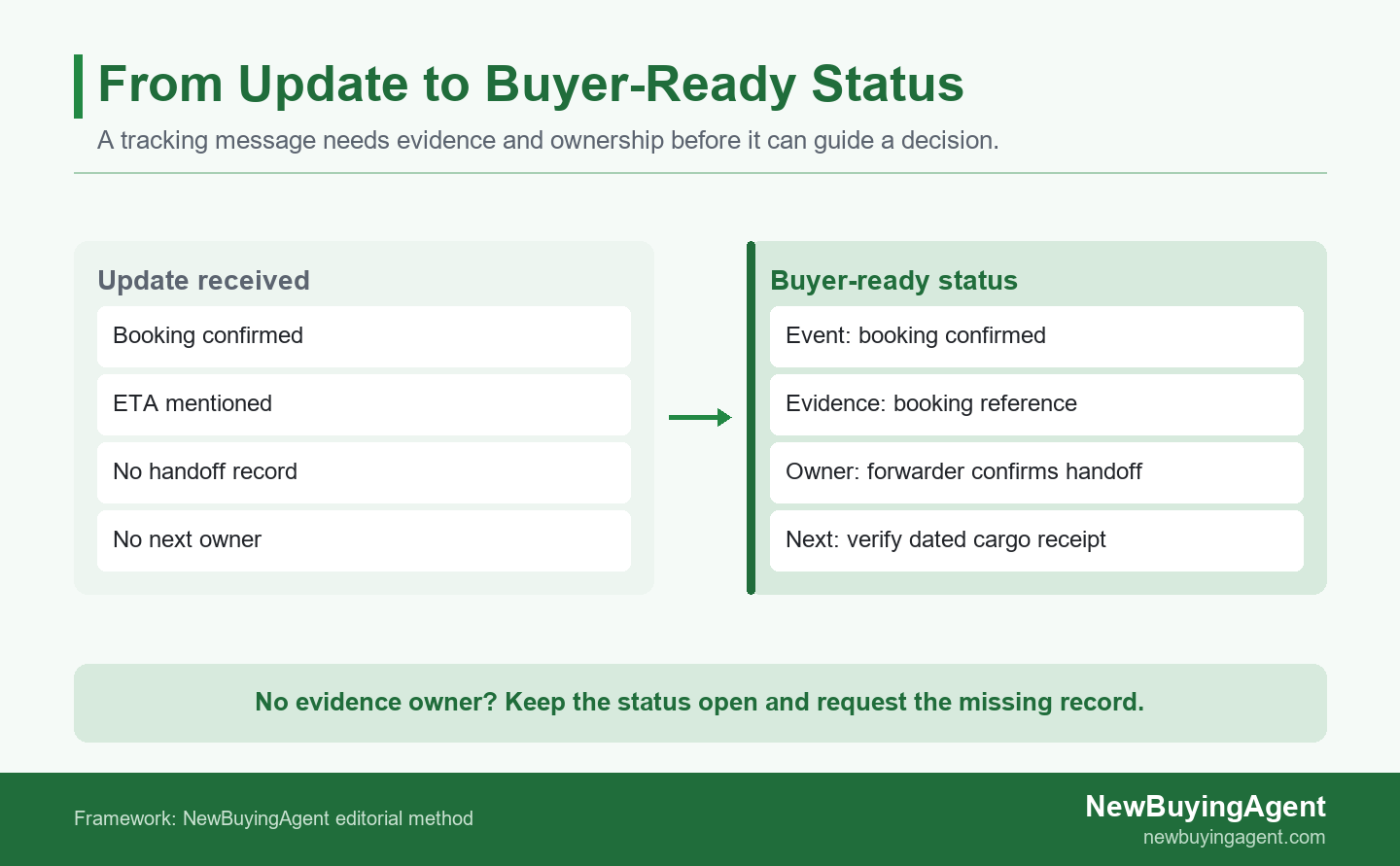
Comparison of a vague shipment update and a buyer-ready status record
Start the record with the purchase-order reference, product and packing identifiers, agreed Incoterms, transport provider contacts, and the latest confirmed event. Then add one line for each new update. The useful question is not “Do we have tracking?” It is “What is the last event that someone can evidence now?” That question protects the buyer from giving a customer a date based on a message that is still only a plan.
A sourcing agent can help set up and maintain this China-side evidence view. Buyers comparing the right level of support can compare NewBuyingAgent sourcing and factory-management options before deciding who should collect which local record.
Classify Every Update by the Event, Evidence, and Owner
DCSA track-and-trace material distinguishes shipment, transport, and equipment event groups. DCSA conformance guidance That distinction is practical for buyers. A shipment event can describe the commercial shipment; a transport event can describe movement of the conveyance; an equipment event can describe a container or other equipment state. A local factory or warehouse record may be important even when it is not a carrier event at all.
A status label should not be upgraded into proof of a separate physical, document, or customs outcome without its own record. For each update, record the evidence owner before you write the buyer-facing status. A factory can confirm cartons finished. A forwarder can confirm receipt or pickup. A terminal or carrier feed can show gate, load, discharge, or transshipment events. A broker may own a destination filing question.
This simple classification also improves escalation. If the uncertainty concerns a physical handoff, ask the forwarder, warehouse, or terminal for a dated receipt. If it concerns a packing fact, ask the supplier for the packing record. If it concerns a carrier milestone, ask for the carrier reference or portal event. The request becomes specific, and the buyer can see what remains unconfirmed.
The 11 Status Touchpoints to Follow Through a Sourcing Agent
Booking, shipping instructions, and transport-document stages are distinct parts of a shipping information flow. DCSA standards roadmap The following touchpoints work as an operating sequence, not a promise that every mode, route, or provider will use the same terms. Booking, documents, and arrival information are different records, not one status.
Use the list below to decide what to ask for next. The “owner” column names the party most likely to provide the evidence; it does not assign legal responsibility or override the shipment contract.
| # | Touchpoint | Evidence to request | Primary evidence owner | Buyer-ready wording |
|---|---|---|---|---|
| 1 | Order released for shipment planning | PO, agreed terms, product and packing identifiers | Buyer and supplier | Shipment planning inputs confirmed |
| 2 | Booking request submitted | Forwarder request or booking instruction | Supplier or forwarder | Booking requested; capacity not yet confirmed |
| 3 | Booking confirmed | Booking reference and planned schedule | Forwarder or carrier | Booking confirmed; cargo handoff still separate |
| 4 | Cargo ready | Packing list, completed-carton count, readiness date | Supplier or warehouse | Cargo reported ready for collection |
| 5 | Pre-shipment inspection disposition | Inspection result and any agreed action | Buyer, inspector, and supplier | Inspection disposition recorded |
| 6 | Cargo handoff or terminal gate-in | Dated warehouse receipt, pickup proof, or gate-in record | Forwarder, warehouse, or terminal | Cargo handoff evidenced |
| 7 | Verified gross mass or comparable loading record | VGM submission or mode-specific loading document | Shipper or appointed forwarder | Loading document status confirmed |
| 8 | Onboard or loaded event | Carrier or terminal event with shipment reference | Carrier, terminal, or forwarder | Onboard event confirmed |
| 9 | Transport-document draft or issue | Draft or issued transport document checked against shipment data | Forwarder, carrier, shipper, or buyer | Document status recorded; check still open if applicable |
| 10 | Departure or in-transit milestone | Carrier event and latest route information | Carrier or forwarder | Carrier departure event recorded |
| 11 | Arrival information and destination handoff | Arrival notice, broker update, or appointed destination record | Carrier, forwarder, broker, or buyer | Arrival information received; clearance and collection tracked separately |
Touchpoints 1–4: Order, Booking, and Cargo Readiness
Booking and cargo-ready status are separate stages that need distinct commercial and operational records. The first four touchpoints protect against a common reporting error: treating a reserved transport plan as physical progress. At touchpoint 1, confirm the order and commercial terms that govern the shipment, including the product requirements agreed before sourcing begins. At touchpoint 2, record that a booking request was sent. At touchpoint 3, record the booking reference and planned schedule. At touchpoint 4, ask whether the supplier has actually completed the cartons, labels, packing list, and pickup-ready handoff details. DCSA’s standards roadmap
“Cargo ready” should describe what the supplier or warehouse can support now. It is not interchangeable with “picked up,” “gated in,” or “on board.” If cartons are still being sealed, a packing-list revision is open, or pickup is scheduled for a later shift, keep that detail in the status line. Doing so gives the buyer a practical warning without claiming that a delay has occurred.
A useful status line at this stage might read: “Booking confirmed for the planned service; 3,200 cartons reported ready; physical handoff record pending after scheduled pickup.” It is more precise than “shipment confirmed,” and it tells the next owner exactly what evidence is still needed.
Touchpoints 5–8: Inspection, Handoff, VGM, and Onboard Status
Physical handoff, verified gross mass, and onboard status each refer to different records and owners in a container shipment. At touchpoint 5, make sure the pre-shipment inspection disposition is visible alongside the shipment status. A passed inspection, an agreed corrective action, or a buyer-approved exception is a different fact from cargo pickup. At touchpoint 6, look for the physical-transfer record: a forwarder receipt, warehouse receipt, pickup proof, or terminal gate-in event that identifies the shipment.
For packed containers under the SOLAS VGM requirement, the shipper provides verified gross mass (VGM), which is the documented weight of the packed container, in the shipping document sufficiently early for the stowage plan, and it is a condition for loading. IMO VGM guidance This is a maritime-container boundary; buyers should confirm their shipment-specific process with the appointed carrier or forwarder.
Track-and-trace standards include milestones such as gate events, load and discharge, transshipment, pickup, and dropoff. DCSA Track & Trace At touchpoint 8, use the carrier or terminal event rather than a hopeful phrase such as “about to sail.” A China-side sourcing agent can gather packing and handoff evidence, then align it with the forwarder or carrier reference. For established factories, buyers can also use China-side factory management for existing suppliers when those local records are scattered across contacts.
The sequence matters. A supplier may confirm that goods are ready, a forwarder may confirm pickup is planned, and a carrier may show a booking. None of those messages alone proves terminal gate-in or an onboard event. Keeping the stages separate prevents a buyer from reporting a vessel departure before the carrier records it.
Touchpoints 9–11: Transport Documents, Departure, and Arrival Information
Transport documents, departure milestones, and arrival information are distinct updates and arrival information is not proof of destination clearance or delivery. DCSA arrival-notice documentation Touchpoint 9 covers the draft or issued transport document. Check names, references, quantities, ports, and any agreed instruction before treating the document as complete. Touchpoint 10 records the carrier departure or subsequent in-transit event. Touchpoint 11 records arrival information and the next destination-side owner.
Arrival-notice information is a distinct data exchange intended to improve accuracy and reduce manual handling. DCSA arrival-notice documentation Treat it as arrival information. The buyer should still confirm the destination broker, the document owner, applicable declarations, collection instructions, and the party who will report the final delivery event.
That separation is especially important when commercial terms allocate different responsibilities to buyer and seller. Incoterms and the shipment contract should identify who appoints the forwarder, who receives documents, and who manages destination clearance. A sourcing agent can help keep the China-side record clear; it should not be described as the destination declarant unless that authority and service have actually been agreed.
Escalate When a Milestone Does Not Match Its Evidence
A missing or contradictory record should create a named exception with an evidence request, owner, and next-update time. An exception owner is the person or organization responsible for obtaining the missing fact or correcting the mismatch. When a milestone is late, absent, or contradictory, open one exception line instead of circulating a vague follow-up.
For example, a booking reference plus a supplier packing photo does not answer whether the forwarder received the goods. The exception line can say: “Cargo handoff unverified; forwarder to provide dated warehouse receipt or pickup confirmation against booking reference; buyer update due after confirmation.” This wording does not accuse the supplier or forwarder. It makes the open question visible and stops an unsupported status from spreading.
For applicable U.S.-bound ocean cargo, CBP says ISF information is generally due no later than twenty-four hours before foreign-port lading. CBP ISF guidance This is a U.S.-bound ocean-cargo example, not a universal deadline. Confirm the applicable market requirement and the named declarant with the appointed broker or qualified adviser.
Illustrative Scenario: A Booking Update Does Not Prove Cargo Handoff
Check the Handoff Record Before Promising an ETD
A confirmed booking can coexist with cargo handoff pending when the physical-transfer record is absent. Consider a composite example, not a client case. A global buyer needs to set a reliable customer-facing expectation for an ocean shipment leaving China. A containerized order is packed at a China factory and has a forwarder booking reference, but the buyer has not received an evidenced cargo-transfer record. The factory reports cartons ready; pickup is scheduled but the physical transfer has not been confirmed. The order is 1 x 40-foot container holding 3,200 cartons.
The buyer receives a booking reference and planned vessel departure date. No dated warehouse receipt, terminal gate-in record, or forwarder handoff confirmation is attached. The forwarder confirms that pickup is scheduled later that day rather than already completed. The buyer’s delivery team cannot use the booking alone to confirm inventory availability. The correct shared status is therefore: “Booking confirmed; cargo handoff pending.”
In the illustrative shipment, the buyer keeps cargo handoff pending until a dated transfer record matches the booking reference. The next request is narrow: ask for the dated transfer record, check that it matches the booking reference, and ask whether its actual time changes the planned departure sequence. If the receipt is not available, keep the status at the last evidenced point.
The exception owner obtains the handoff proof and reconciles the shipment reference. The status moves only when that record supports it. The example does not assure loading, departure, clearance, collection, or delivery because those depend on the relevant third party, route, and destination process.
Where a China-Side Sourcing Agent Adds Leverage
A China-side sourcing agent can consolidate supplier, warehouse, and forwarder records while the buyer, carrier, broker, and contract parties retain their own responsibilities. The useful role is coordination, translation, and follow-through: asking the supplier for a corrected packing record, checking whether cartons are ready for pickup, collecting inspection and handoff evidence, and aligning those facts with a forwarder reference.
The same discipline improves new-product work. Buyers who want requirements and China-side execution connected from the beginning can set product requirements before China sourcing begins. The goal is not more messages. It is fewer unsupported messages, with each open point assigned to the person who can resolve it.
Before a buyer repeats an update to a customer or sales team, the agent can separate what has been reported from what the record proves. A supplier statement may establish that cartons are ready. A dated receipt may establish handoff. A carrier event may establish a movement milestone. Keeping those facts in their own fields prevents one upbeat message from becoming an unsupported delivery promise.
When several participants are involved, ask the agent to maintain one shared status vocabulary. “Reported ready,” “handoff evidenced,” “carrier event recorded,” “document check open,” and “destination action pending” are clearer than a single green or red label. They help the buyer decide whether to monitor, request proof, revise an expectation, or escalate a real exception.
Start With a Clear Shipment Handoff Pack
A shipment handoff pack with commercial terms, product identifiers, logistics contacts, current records, and open questions lets a status review begin from facts. Before asking for China-side shipment coordination, prepare the PO or order reference, agreed Incoterms, supplier and forwarder contacts, booking or transport references, current documents, and the exact unanswered question.
NewBuyingAgent can organize the local evidence and open questions into one buyer-readable status view, while the relevant carrier, forwarder, broker, and buyer retain their own decision and operating roles. If a China shipment already has unclear handoff, packing, inspection, or document status, request a China-side shipment-status review.
Frequently Asked Questions
Can a sourcing agent track a shipment after it leaves China?
A sourcing agent can coordinate China-side evidence and follow carrier updates, but it cannot replace the carrier, forwarder, broker, or buyer in their own roles. The agent can ask local parties for packing, pickup, inspection, or handoff records and make the status easier to interpret. Carrier movement, destination filing, clearance, and final delivery should remain tied to the relevant provider, contract party, or authority.
Does a booking confirmation mean that cargo has been handed over?
A booking confirmation generally reserves planned transport capacity, whereas cargo handoff needs a dated receipt or gate record that shows physical transfer. No booking reference alone proves that a warehouse, forwarder, terminal, or carrier has received the goods. Keep the buyer-facing status at booking confirmed and cargo handoff pending until the supporting record is available and matches the shipment reference.
What should a buyer ask for when a shipment update is late?
Ask for the event being reported, its timestamp, the supporting record, the record owner, and the impact on the next milestone. Then ask who is responsible for resolving the gap and when the next update will be issued. This turns a late message into an exception line that can be followed, rather than an open-ended request for more tracking information.
Who is responsible for import declarations and destination clearance?
Import declarations and destination clearance are assigned by the agreed Incoterms, contract, destination rules, and appointed broker, not a generic shipment update. Buyers should identify the named declarant and document owner before departure, especially where filing deadlines apply. A sourcing agent may coordinate China-side records, but it should not be assumed to act as the destination declarant or customs representative without an explicit arrangement.
NewBuyingAgent
Related Resources


今日始める
あなたの調達目標を現実に変えましょうWeChat:+86 15157124615
WhatsApp:+86 15157124615
住所:中国、杭州、祥園路39号10号館
