The hardest part of a multi-supplier quality issue is usually not finding the defect; it is proving which affected population is tied to it before different factories turn one release decision into several competing stories. A sourcing agent adds value by building one record that connects the agreed requirement, the component and packing identities, the observed finding, the correction, and the evidence needed for a buyer decision.
The Decision Record That Stops Supplier Ping-Pong
A multi-supplier quality issue should begin with one shared decision record rather than separate supplier explanations. A nonconformity is a product or process result that does not meet an agreed requirement. Containment is a temporary control that stops potentially affected goods from moving until the scope is known. Those two definitions give the buyer a common starting point before anyone debates fault.
- Freeze the requirement and the observed failure mode before comparing replies.
- Define the population with identities, not with a broad product name.
- Release only after the corrective evidence matches the original failure mode.
| Supplier-side question | Evidence to align | Buyer decision supported |
|---|---|---|
| What changed? | Component lot, work instruction, assembly setting, or packing event | Whether the issue may cross a supplier interface |
| Which goods share it? | Lot, carton, production date, and finished-goods link | Which units to hold or investigate |
| What proves the fix? | Correction record and repeat check of the original failure mode | Whether a release review is ready |
The record is also a handoff tool. A buyer can read one page and see the current scope, the unproven assumptions, and the next evidence request. Each factory can see the same requirement without gaining permission to redefine it. That keeps a temporary operational hold from becoming a negotiation conducted through fragmented chat messages.
Give Every Supplier the Same Issue Definition
A shared issue definition must align the requirement, affected population, finding, evidence, owner, and disposition before the supplier interface can be investigated. That prevents a bottle factory from answering a seal question, or a packing factory from answering a product-performance question. Buyers who need a China-side coordination scope can compare NewBuyingAgent sourcing and factory-management options before splitting tasks among suppliers.
Record the requirement, population, finding, and disposition
Lot-level and event records can distinguish an affected product population from a generic product label. GS1's global traceability standard identifies the need to connect objects, parties, locations, and tracking events. In a quality record, that means linking the finished carton to the component lot, assembly point, and packing event that could plausibly share the finding.
Start with the identity that is already available, then record the gap instead of inventing precision. A PO number alone is rarely enough. A practical entry may need a supplier lot, a production date or shift, a carton range, a packing date, and the person or system that created the link. If one of those links is absent, the record should say so and the scope should remain provisional.
Assign an owner only after the interface is visible
A corrective-action owner should be identified after the component, assembly, requirement, and handling interface is visible. One supplier may own a defective part; another may need to correct a setting, storage condition, or packing control. The record can therefore assign an investigation owner without pretending that the first plausible explanation has established technical causation.
Assign separate owners when the evidence itself comes from different places: one person can retrieve component history, another can preserve retained samples, and an assembly owner can confirm the actual setting used. The buyer then has a named route for each unanswered question. Ownership becomes a way to close evidence gaps, rather than a premature statement about commercial liability.
Contain the Issue Without Making Every Supplier a Suspect
Contain the documented affected population first and expand the hold when a missing record breaks the population link. This is not a shortcut to a narrow hold: when the component-to-carton connection is incomplete, the safer operational decision is to widen the set until the evidence can separate it. The aim is a defensible scope, not the smallest possible number.
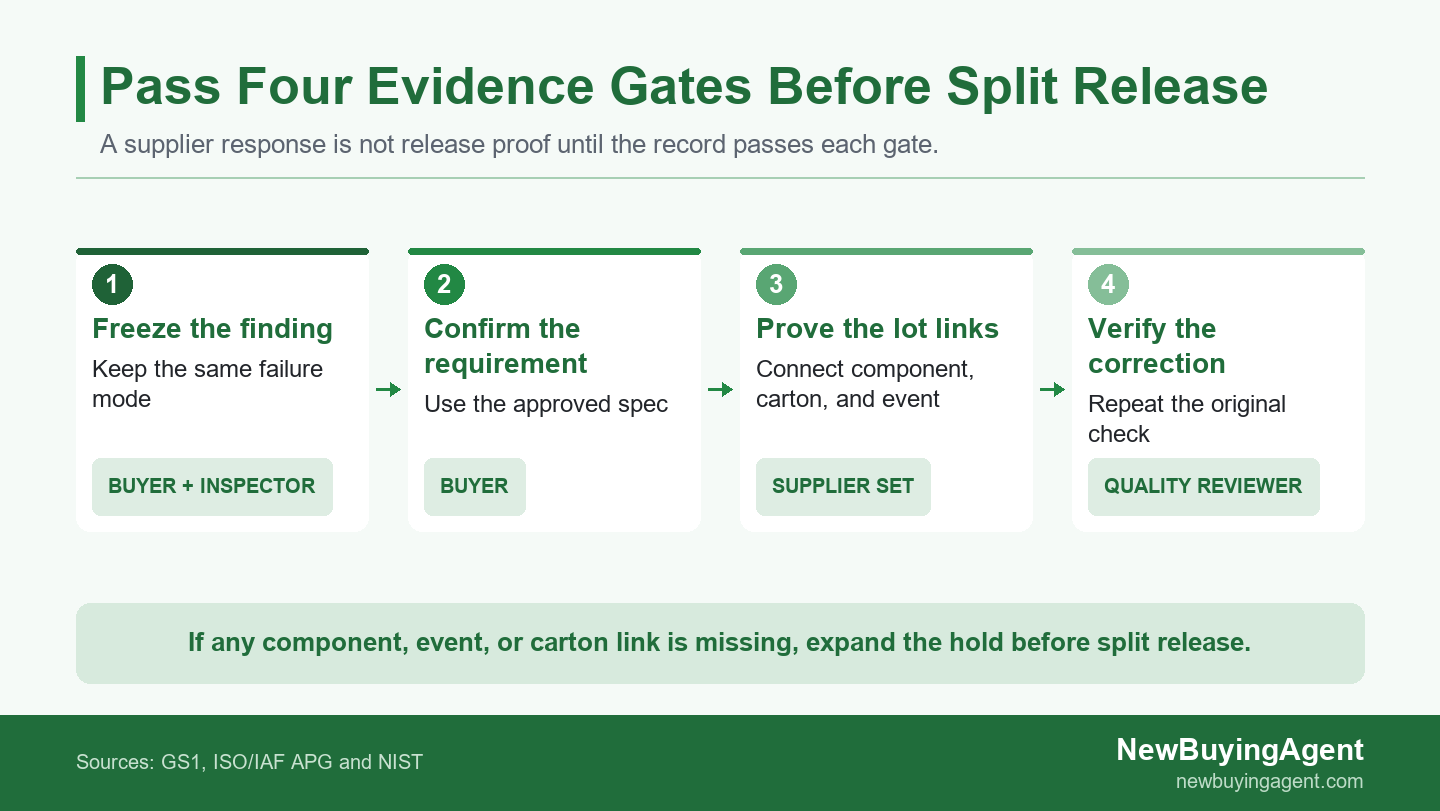
Four release gates showing how missing lot links block split release
Use a simple expansion rule: if a failed unit and an unheld unit share an unbroken component, assembly, or packing link, investigate whether both belong in the same held population. If the link is missing, do not use the absence as evidence of separation. This makes the buyer's scope decision inspectable when a supplier later presents a smaller, more convenient subset.
For products in the European Commission page's stated scope, importer responsibilities include access to required documentation and manufacturer contact. The European Commission importer page provides the market-specific context. Sector and market rules can add stricter duties, so a sourcing workflow does not replace product, legal, or regulatory review. For existing suppliers, a buyer may also use China-side factory management for existing suppliers to collect records and coordinate the local checks the buyer specifies.
Separate a Supplier Defect From a Shared Interface Failure
An agent should distinguish a supplier defect from a shared interface failure before deciding which factory owns the corrective action. Here, a corrective action is an action to address why the condition occurred and reduce the chance of recurrence. A part can meet its stand-alone check and still fail after compression, assembly, transit, or packing. The useful question is therefore not “Which supplier replied first?” but “What condition changed where the approved requirement was actually applied?”
Map the path from approved requirement to finished unit. It may include a material choice, a component revision, a setting on the assembly line, a cure or dwell period, a handling step, and final packing. A defect that begins at the interface can be missed when each supplier supplies only the evidence that makes its own stage look acceptable.
Test the changing factor, not the loudest explanation
A defect visible after assembly may require comparison of the changing component, assembly condition, and approved requirement rather than isolated supplier checks. NIST's discussion of improving supply networks treats root-cause analysis and a corrective plan as linked activities. Apply that logic to the evidence path: compare retained units across lots, isolate the changed factor, and test the original failure mode rather than accepting a broad assurance that the process is now normal.
A useful test compares like with like. Keep the product configuration and test method stable, then vary the factor under review: the seal sub-lot, the compression setting, the assembly date, or the packing condition. If the defect pattern moves with that factor, the investigation becomes more specific. If it does not, the record should keep the cause open instead of assigning it to the nearest supplier.
Require correction, cause analysis, and proof of effectiveness
A sufficient response connects correction, cause analysis, corrective action, and review of effectiveness rather than only promising a fix. ISO/IAF audit guidance on nonconformity separates those activities, while a NIST-hosted Baldrige application summary illustrates documenting root cause together with immediate and longer-term actions. For the buyer, the crucial proof is a repeated check that can show whether the original failure still appears.
Ask for the proof in the order it will be reviewed. First, show what was stopped or segregated. Next, show the suspected cause and the changed condition. Then show the repeat check, including its sample, method, and result. This sequence prevents a correction photo from being mistaken for evidence that the same defect will not recur in finished goods.
Use One Corrective-Action Clock Across the Supplier Set
A shared evidence clock lets the buyer compare supplier progress without assuming each factory has the same cause or remedy. Set milestones for initial containment, record completion, root-cause evidence, correction, and repeat verification. A supplier that finishes a correction early has not necessarily earned a release decision if its proof still does not connect to the affected population.
FDA food-safety material illustrates supplier-specific verification, documented evaluation, corrective action, and follow-up evidence in that sector. The Foreign Supplier Verification Programs overview and the FDA's supplier-evaluation resources provide the sector-specific context. The product sector differs, but the operational lesson is sound: record what was checked, for which supplier and population, and what follow-up result closes that particular issue.
Use the same status labels for every supplier: evidence requested, evidence received, correction documented, repeat check scheduled, repeat check complete, or decision blocked. The labels do not force identical timing. They reveal whether a delay comes from production, missing records, an untested correction, or a decision that needs specialist input. Buyers evaluating the role of local coordination can review NewBuyingAgent sourcing case context.
Illustrative Scenario: A Bundle Fails at the Supplier Interface
This composite example is illustrative, not a NewBuyingAgent client case. In the composite 12,000-unit order, two verified lots create a 4,800-unit initial hold while the separately traceable population requires a separate verification decision. The numbers show why a limited finding is neither an automatic all-goods hold nor an automatic release of everything else.
Release Only the Lots the Record Can Separate
The 4,800-unit held subset is a conservative scenario calculation; 7,200 separately traceable units still require a distinct repeat-verification decision. A global buyer needs one decision for travel-bottle bundles made from bottle bodies at Factory A, silicone seals at Factory B, and final gift-box packing at Factory C. The 12,000 units are packed in five lots of 2,400, and final inspection is still in progress; nothing has been released.
Nine leaks appear in a 60-unit check. Every leaking unit traces to two packed lots that used one seal sub-lot after a line-setting change. That pattern supports an immediate hold of those two lots, not a conclusion that either the bottle factory or the seal factory is solely responsible.
Factory A can show bottle-neck gauge readings and Factory B can show free-state seal dimensions, yet neither stand-alone check explains the assembled leak. The agent compares retained units, the approved compression requirement, and the packing links. The two linked lots equal 4,800 units and remain on hold. The other 7,200 units are separately traceable, but they still need a distinct assembly check before a buyer considers release.
The corrective record identifies the line setting, seal-lot action, reworked or segregated units, and packing dates. Verification repeats the leak-mode check and confirms that the held population remains linked to its component and carton records. Safety, performance, regulatory, and market-specific requirements need the relevant specialist review as well. This illustrative example is a way to structure an evidence decision, not a rule for releasing any particular travel-bottle order.
Where a China-Side Sourcing Agent Adds Leverage
NewBuyingAgent can coordinate China-side factory communication, quality checks, and status evidence across existing suppliers, while the buyer retains release authority. The practical benefit is a single buyer-readable record: who supplied which input, what has been checked, what remains uncertain, and what evidence is due next. When a product is still being developed, buyers can also set product requirements before China sourcing begins, so the later quality record has an approved reference instead of a reconstructed expectation.
That role is most useful when distance makes it hard to compare physical samples, packaging status, and factory explanations in the same working day. It does not turn the agent into the product engineer or the legal release owner. It gives the buyer a clearer local evidence path and a visible list of questions that still require the buyer's technical, contractual, or regulatory decision.
Send One Evidence Pack Before You Ask for a Release Decision
A combined order, specification, identity, finding, action, and status pack makes the release review more specific. Include the approved requirement, purchase-order and lot links, component and carton identities, inspection observations, photographs or test records, each supplier's corrective-action status, and the planned repeat check. Mark missing links plainly; a missing record is a decision condition, not a formatting problem.
- Scope page: the held lots, the lots still under review, and the exact record that separates them.
- Finding page: the approved requirement, failure mode, sample or observation, and supporting images or test record.
- Supplier status page: each open question, named owner, planned correction, repeat check, and unresolved decision.
Before sending the pack, make the release request testable. State the decision to be made, the evidence that would permit it, and the missing evidence that would keep it open. If a defect spans components and packing, name the link between them rather than attaching three separate supplier reports. This makes the buyer's review faster because every attachment answers a defined question.
That pack lets the buyer ask a narrow question: which population is held, what would expand it, and what result would make the next decision possible? If a current order needs that cross-factory evidence path, NewBuyingAgent can coordinate the local record and checks; request a cross-factory quality-status review.
Frequently Asked Questions
Should every supplier be placed on hold after one quality finding?
No; hold the population that the available lot, component, packing, and shipment records actually connect to the finding. Widen the hold when a link is incomplete, when the failure mode could cross an unrecorded interface, or when a technical or regulatory rule requires a broader response. A narrow hold should reflect evidence, not a wish to minimize disruption.
What evidence makes a supplier corrective action credible?
A credible corrective action identifies the affected requirement and population, explains the suspected cause, documents the correction, and shows a verification result that matches the original failure mode. A new photograph, a revised work instruction, or a supplier promise can support the record, but none of them alone proves that the assembled product now meets the requirement.
Can a sourcing agent decide whether goods are safe to release?
A sourcing agent can assemble China-side evidence, coordinate checks, and state what remains unverified, but the buyer and any required technical or regulatory owner retain the release decision. For products involving safety, legal compliance, or specialist performance testing, the agent's record should make the escalation clearer rather than substitute for that expertise.
When should a buyer involve a product-testing specialist?
Involve the appropriate testing, engineering, or regulatory specialist when the finding concerns safety, performance, legal compliance, or a product requirement that a visual or dimensional check cannot resolve. Bring that specialist in before release when the root cause remains uncertain, the failure can recur under use conditions, or the market rule sets a separate verification requirement.
NewBuyingAgent
Related Resources

今日始める
あなたの調達目標を現実に変えましょうWeChat:+86 15157124615
WhatsApp:+86 15157124615
住所:中国、杭州、祥園路39号10号館