


Demand evidence is a record or estimate of a specified customer behavior within a known product, market, channel and period. Its value for sourcing depends on how directly that behavior answers the purchasing question.
Lead a repeat-buy assessment with relevant retained orders for the same offer and channel. Use marketplace evidence to assess a matching channel opportunity, search data to investigate demand language and timing, and social response to explore a product or creative hypothesis. Then identify the evidence still needed before committing to the China order.
Choose evidence that answers the purchasing question
The useful lead changes with the decision. A category manager choosing a new direction needs evidence of a relevant customer problem and a reachable market. A purchasing manager repeating an established offer needs retained sales, current economics and inventory information. Comparing search, marketplace and social findings begins with the behavior each measures and the assumptions required to connect it to that decision.
- Definition. Keep the measured behavior and its scope attached to every finding.
- Best for. Select the leading evidence for the product, channel and purchasing task.
- Risk. Check event definitions, audience relevance, refunds and overlapping attribution.
- Decision. Resolve the gap between a promising signal and a justified order.
Let the buying decision determine the leading evidence
Leading evidence is the observation most directly relevant to the purchasing decision after its scope and reliability have been checked. For replenishment, that often means the buyer’s retained orders for the same product and channel. For an unproven design or sales route, search, marketplace or social findings can lead the next investigation. They support different actions, so choose the question before choosing a preferred data source.
The SBA’s market-research guidance asks about demand, customer location, available alternatives and the prices customers pay. Apply those questions to the actual product proposition. “Which kitchen product should enter the range?” and “How many units of this proven organizer should be reordered?” require different evidence, even when the team has access to the same dashboards.
When a buyer is comparing product directions, NewBuyingAgent’s market-fit product analysis can help frame a buyer-specific hypothesis. Its Trending Products service presents AI-driven analysis and a free Bestseller Market Analysis Report. Match the findings to the intended customer, country, channel and price. The next purchasing decision should use the relevant commercial evidence alongside that analysis, with assumptions about achievable demand kept visible.
Compare what each signal actually measures
The comparison below separates four readings within the three evidence families. Search trends and keyword estimates appear separately because their measures differ. The table compares the behavior observed, the decision it can lead and the question left open. It uses functional distinctions from the relevant tool documentation, with no shared numerical score or claim that one source always outranks the others.
| Reading | Measures | Leads for | Still open |
|---|---|---|---|
| Search trend | Relative interest | Language, timing | Paid demand |
| Keywords | Query estimates | Search test | Your sales |
| Market sales | Channel buying | Channel fit | Offer share |
| Social | Defined response | Idea, creative | Event, buyer fit |
Based on this comparison, lead with the evidence closest to the declared buying question and use the other sources to explain or challenge the finding. Relevant own-order records can provide a closer basis for repeat buying than a category-level report. An unproven offer still needs evidence that its intended customers will buy at workable economics, whichever research source first revealed the opportunity.
Put the evidence on a common market and product basis
Before combining findings, record their country, channel, date range, product definition, price or promotion context, and measured event. Identify whether the number describes a category, a niche, an individual listing or the buyer’s own offer. When those fields differ, state the difference and limit the inference. A useful comparison can identify the next test even when the datasets cannot be ranked numerically.
- Buying question. [Product direction, channel entry, feature choice or repeat quantity.]
- Finding. [Source, extraction date, metric, value and denominator.]
- Scope. [Country, period, audience, channel, product version, price and promotion.]
- Decision relevance. [What the finding establishes and the inference required for this purchase.]
- Open item. [Missing evidence, next observation, responsible person and commitment held.]
A repeat offer, a new channel and a new design can each call for a different leading observation. The remaining purchasing check determines how far the buyer can act on it.
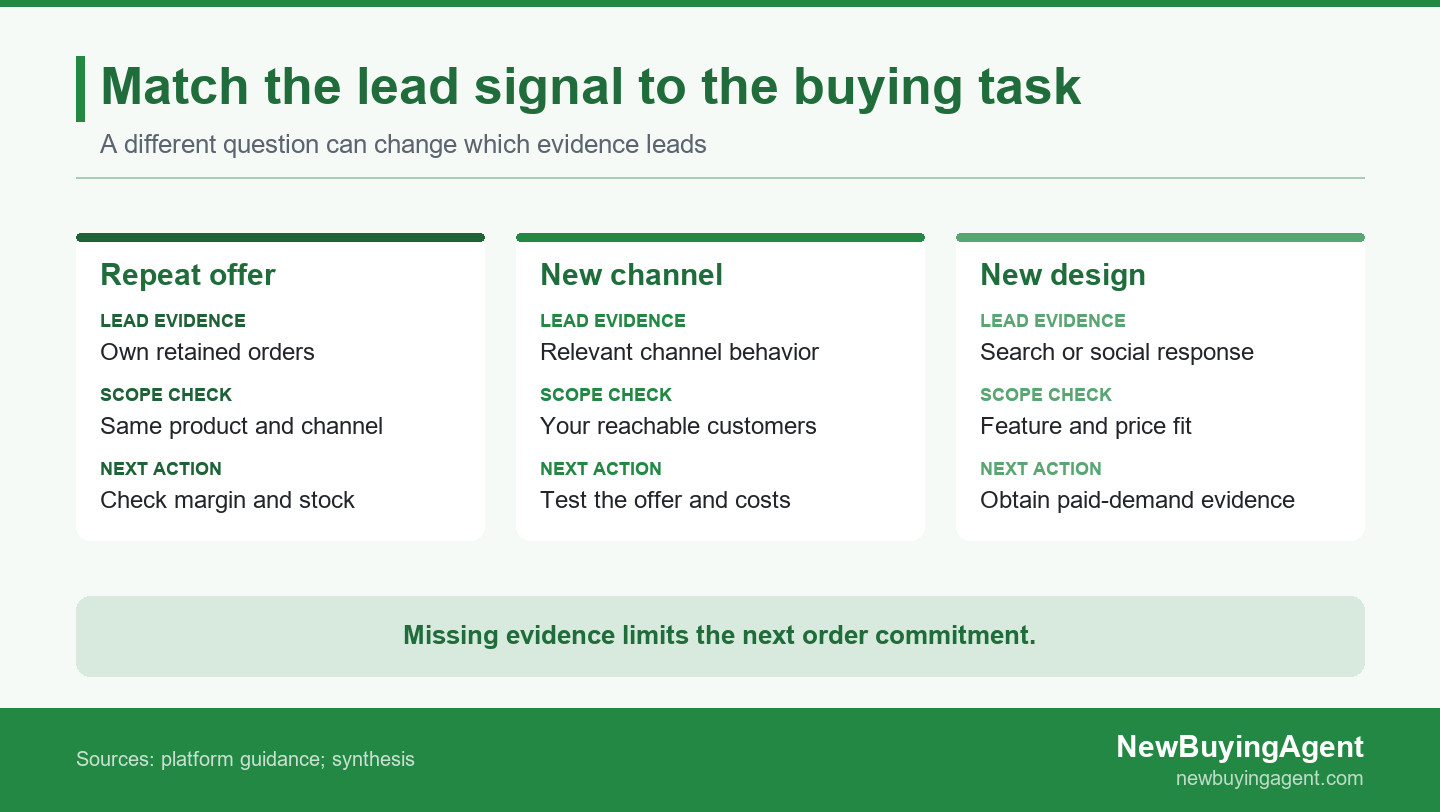
Lead repeat buying with relevant retained orders, use channel evidence for a new route and use search or social to shape an unproven product test.
Use search data to investigate demand language and timing
Search data can lead research when the buyer needs to understand how customers describe a problem, when interest appears and which queries deserve a commercial test. Keep the search geography, period and term or topic definition consistent. Distinguish relative interest from estimated query counts. Both can sharpen a product hypothesis, while the offer’s actual conversion and margin remain questions for the relevant sales route.
Separate relative interest from keyword estimates
Begin with the use the product serves and the alternatives customers consider. Compare relevant phrases over a suitable period and examine whether a short event or recurring season explains the pattern. Record changes in wording and product scope. A broad query may include research, entertainment, repairs or products outside the proposed specification, so inspect the buying intent behind the term before using it in an acquisition test.
Google Trends methodology describes sampled search data normalized by geography and time and scaled from zero to one hundred. Equal relative interest across regions can represent different search volumes. Use the index to investigate patterns within its declared scope. A high point identifies relative popularity in that comparison, leaving the quantity of customers who will buy the proposed China-sourced product unresolved.
Google Keyword Planner provides estimates of searches and targeting costs. Google also identifies bidding, budget, ad quality, location, product and customer behavior among campaign performance factors. Use the estimates to plan a search-led investigation and its spending exposure. Check the actual audience and paid response before assuming that estimated searches will produce a particular number of orders.
Use marketplace sales to assess a channel-specific buying case
Marketplace purchase evidence can lead an opportunity assessment when the intended channel, product need and price context match the data. It shows buying activity closer to the commercial question than general attention does. Separate evidence about a market from evidence about the buyer’s own offer. A new listing still needs a credible reason customers will choose it and a feasible way to reach them.
Distinguish a market opportunity from demand for your offer
Inspect the competing products, pack quantities, price bands, availability and customer problems within the relevant market. Check whether sales are spread across suitable alternatives or concentrated in established offers with advantages the new product lacks. Identify a specific reason to choose the proposed version. The actionable finding might concern a dimension, material, pack format or use problem that changes the sourcing brief.
Amazon Product Opportunity Explorer groups search terms into niches using products customers view or purchase and provides demand, competition, review and return insights. Such evidence can lead an Amazon-channel assessment when the niche fits the proposed offer. It leaves the buyer’s obtainable share open. A regional wholesaler or a brand selling through its own website needs evidence relevant to that route as well.
When the finding points to a specific product improvement, NewBuyingAgent’s complete China product supply and local factory resources and product/QC capability connect the market need to a feasible purchasing path. A narrower organizer, different material or more protective pack requires a defined sample and quality expectation. Local factory resources and product-development and QC capability are relevant to supplying that version within the agreed scope. Confirm the cost and production implications before relying on the proposed benefit.
Use social signals to develop and test a product hypothesis
Social response can lead product or creative exploration when it reveals a relevant use problem, feature preference or way to explain the offer. Its purchasing value depends on who responded and what action they took. Inspect audience location, paid distribution and the event being reported. Move from a promising response to a test of the actual product, price and buying route before using it to justify inventory.
Identify the action behind a social metric
Treat views, reactions, destination visits, inquiries and completed purchases as distinct observations. A comment about a useful feature can improve the product brief, while a destination visit shows a different action. Record what a reported conversion actually represents. For a feature-led product, compare response to the feature demonstration with response to a version showing the real price and delivery conditions.
TikTok Ads Manager’s metric definitions separate impressions, reach, all clicks, destination clicks and conversions. A conversion counts the selected optimization event. Confirm that event before reading the result as paid demand, and keep the conversion-rate denominator attached to the figure. This changes the interpretation of a campaign report that records many interactions but supplies little information about completed, retained orders.
Check audience relevance and the origin of the response
Inspect whether responders resemble the intended customers and whether the content attracted interest in the product or mainly in the creator. Separate paid and organic distribution where the data permits. Read substantive objections alongside positive reactions. When audience location, response origin or purchase behavior is unavailable, keep those fields unknown and limit the commitment until a relevant observation can be obtained.
The FTC’s U.S. consumer-review rule guidance discusses fake indicators of social media influence and distinguishes them from real activities and opinions. It supports checking where visible response comes from, while a large audience by itself establishes no fabrication. For this sourcing decision, document the evidence available about the audience and the action taken. Any campaign-specific legal obligations require the applicable official guidance or qualified advice.
Resolve conflicting signals before increasing the order
Conflicting demand signals should be reconciled by checking scope and asking which uncertainty each observation addresses. Search interest can rise while a particular offer converts poorly, and a creator can attract viewers outside the target market. Choose the next observation that would change the purchasing decision. If a critical demand or cost assumption remains unanswered, hold the larger commitment and use a bounded test where feasible.
Follow a hypothetical product decision as the evidence changes
Consider a hypothetical importer evaluating a compact kitchen organizer for U.S. online customers. Its brief includes a 30-day Google Trends chart with a peak index of 80, an Amazon niche report showing 6,000 purchases over a 90-day period, and a creator video with 120,000 views. The numbers describe different measures, periods and audiences. They do not establish the importer’s expected orders. If the importer plans an Amazon listing, the niche purchase evidence can lead the channel assessment, while the exact dimensions, price, competition and obtainable demand remain to be tested.
Now change the intended route to the importer’s own website. The Amazon report still informs the product hypothesis, while the website needs its own reachable-audience and acquisition evidence. If relevant search queries show buying intent, a bounded search-led offer test can address that gap. If the design solves a problem customers rarely name in search, a social demonstration can lead exploration of the benefit. Neither route supplies a bulk-order forecast from the original counts.
Suppose a later trial of the intended version through that website records 300 completed orders and 30 fully refunded orders by the observation cutoff, leaving 270 retained orders. Those are new hypothetical observations for the same defined offer. They provide a closer input to its repeat-buy decision than the earlier niche or view counts. Assess current margin, acquisition conditions, stock and replenishment timing before deciding the repeat quantity.
If the trial dashboard instead reports 300 conversions without defining the event or reconciling refunds, retained paid demand remains unknown. Obtain the event configuration and order records before choosing the repeat commitment. If those records are unavailable, keep the larger purchase on hold and define a smaller feasible observation. This branch changes the action without filling the missing sales count with an assumed conversion rate.
Keep attribution and retained orders on a consistent basis
Use a reconciled transaction record to determine how many orders occurred, then inspect marketing reports to understand how those orders were attributed. One purchase can appear in several channel reports. Compare attribution windows, time zones and event definitions before combining findings. Keep refunds and cancellations attached to the order set and state the cutoff, particularly when later returns could change the retained-demand result.
Google Analytics ecommerce documentation distinguishes views, cart activity, checkout, purchases and refunds. Use those distinctions when mapping a demand report to actual commercial behavior. Reconcile transaction identifiers and refund records, then calculate the relevant cost per retained sale on the same basis. A marketing attribution claim and a unique completed order answer different questions in the purchasing brief.
Connect the demand case to a feasible China purchase
A useful demand conclusion should change the product requirement, the next commercial test or the justified purchasing exposure. Connect the chosen benefit and target price to dimensions, materials, packaging and quality expectations. Check the actual production minimum, landed cost and replenishment assumptions. Evidence of customer interest becomes actionable when the proposed version can be supplied for the intended market under workable commercial conditions.
The International Trade Administration’s market-research guidance connects destination demand with competition, distribution, landed costs and required product changes. Although written for U.S. exporters, these research questions help structure a destination-specific buying case. Apply them to the actual China product and market. Confirm applicable requirements before sale and include the resulting product, cost and timing implications in the purchasing decision.
For a repeat order, start with the relevant retained-demand history and assess usable stock, confirmed inbound supply and the period the next batch must cover. Check whether the proposed order changes the product version, audience, price or acquisition route. A change can weaken the transfer from earlier results. Record the new assumption and choose a focused test or a bounded commitment that the available evidence can support.
Send the evidence that changes the sourcing requirement
Prepare a concise evidence record showing the purchasing question, the leading finding, its scope and the material uncertainty still open. Attach the product version and sample findings that matter to the promised benefit. State what decision the team can make now and what observation is required before a larger purchase. This keeps the sourcing conversation centered on the product and commercial task.
For a recurring product-line opportunity, share the product and evidence brief with NewBuyingAgent. Include the product specification, intended buyer and channel, quantity, target cost, destination, timing and current sourcing situation. Add the scoped demand findings and the feature or price question they change. NewBuyingAgent’s market-fit analysis and product/QC capability can support a scoped China product-supply discussion around market fit, quality and delivery, with the next commitment tied to the agreed purchasing requirements.
Frequently Asked Questions
Do strong marketplace sales always outweigh search data?
Strong marketplace sales lead when they match the product, channel and buying decision under review. A niche report can establish relevant buying activity while leaving your offer’s share unresolved. For a different channel or an unfamiliar product benefit, search data may better frame the next investigation. Use the most relevant observation alongside the evidence still needed to justify the purchase.
Can social comments justify a new product feature?
Relevant social comments can justify investigating a feature when they identify a specific use problem or buying objection. Convert that observation into a measurable product requirement and inspect a feasible sample. Check whether the intended buyers value the feature at the proposed price. Keep the design decision and the evidence for commercial volume separate in the purchasing record.
Should an importer combine the three signals into one score?
An importer should combine the findings through a common buying question and declared assumptions before considering any scoring model. Search indices, query estimates, purchase counts and views use different units and denominators. A numerical score needs a defensible method and evidence that its weights suit the decision. Without that basis, state the conditional conclusion and the unresolved questions directly.
What should happen when the strongest dataset is unavailable?
When a critical dataset is unavailable, reduce the commitment and identify the smallest observation that could resolve the decision. That might be a reconciled order extract, a relevant customer conversation or a feasible paid-offer test. Name the owner and the purchase held until the answer arrives. Proceed only as far as the available product and commercial evidence supports.
NewBuyingAgent
関連リソース



今日始める
あなたの調達目標を現実に変えましょうWeChat:+86 15157124615
WhatsApp:+86 15157124615
住所:中国、杭州、祥園路39号10号館
