

A recurrence risk review is a structured assessment of whether a known failure mechanism could affect future production or shipments and whether existing controls address it. One defect becomes a warning about the next shipment when its cause remains active, the next order shares the exposure and the controls cannot reliably interrupt that route.
This distinction matters when a factory fixes the item you found and asks to continue with the next order. Replacing that item may resolve the visible problem while leaving the next production run exposed. A useful review identifies what can carry forward, what evidence is missing and which action changes the risk.
Next-shipment recurrence risk: the decisions that matter
A single defect justifies a recurrence review when the cause may persist into production that shares the same exposure. The strength of that warning depends on the evidence for the cause, the next order’s actual conditions and the controls used at the point of failure. Treat unresolved information explicitly; neither a reassuring explanation nor a favorable sample establishes the next shipment’s reliability.
- Interpretation: A finding is evidence of a failure, not a calculated next-shipment probability.
- Exposure: Follow shared materials, equipment and methods across the order boundary.
- Controls: Check prevention, detection and the response to an unacceptable result.
- Action: Match the response to consequence and uncertainty, with evidence needed for reassessment.
When does one defect warn about the next shipment?
One defect warns about the next shipment when evidence points to a failure mechanism that the next production run could repeat. Educational ISO/IAF Auditing Practices Group guidance cautions against treating a systemic failure as an accidental isolated event during an audit review. For a buyer, the practical question is whether the cause, exposure and controls support an isolated explanation or leave a credible route for recurrence.
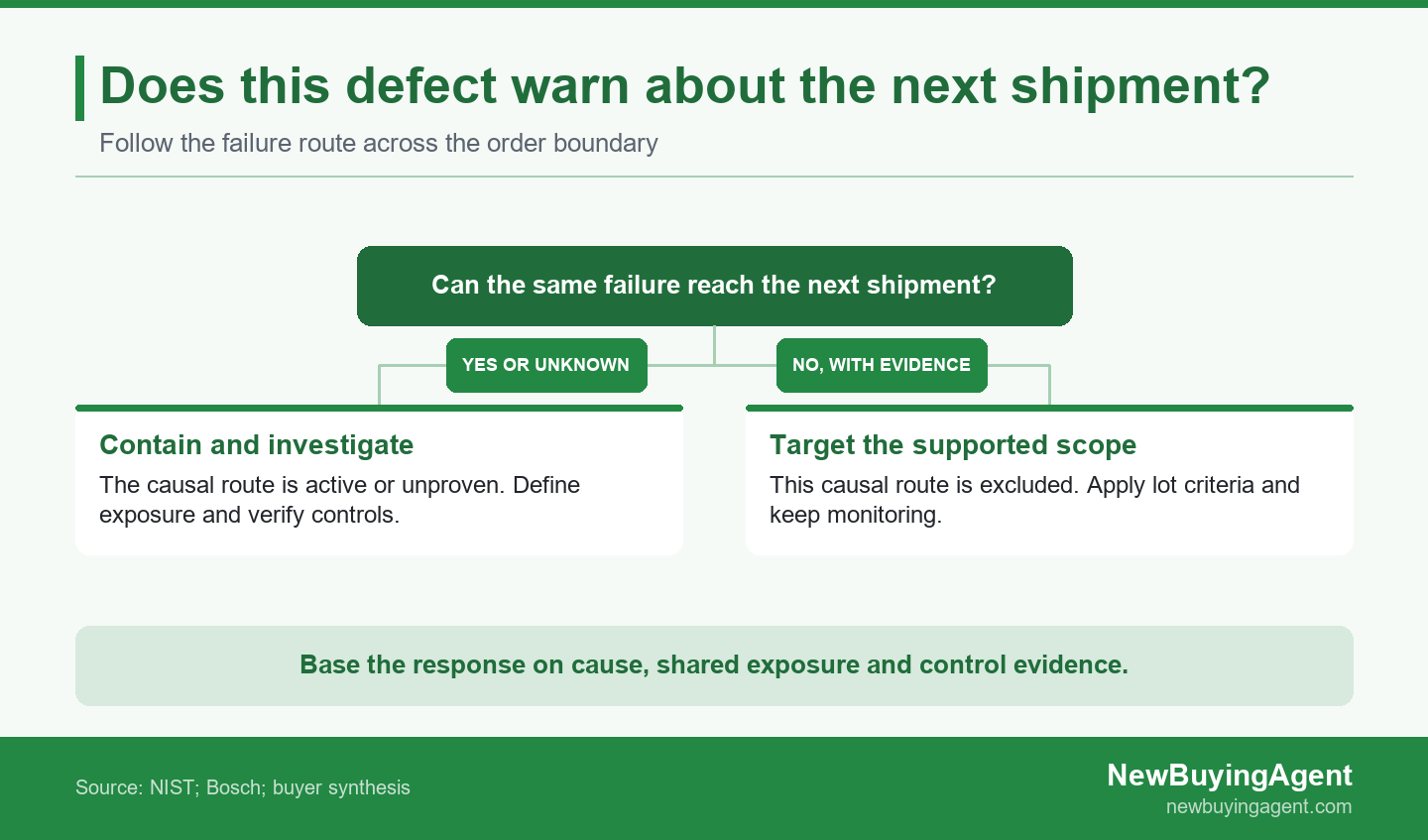
Evidence about shared exposure and controls determines whether a defect signals recurrence risk in the next shipment.
Separate the observed fact from the forward inference. “A handle has a damaged finish” describes an observation; “the same fixture may damage the next run” is a hypothesis to investigate. Record what supports that link and what would disprove it. A cause that has been demonstrated under relevant conditions deserves more weight than an explanation chosen because it is convenient.
Keep the lot decision in its proper scope. NIST’s acceptance-sampling explanation distinguishes deciding the acceptability of the immediate inspected lot from longer-run quality control. A passing acceptance result can support that lot’s disposition under its plan; it does not alone establish that future production has no recurrence risk. Equally, one finding does not prove that every later shipment will fail.
Identify the cause that could carry forward
Identify both what created the defect and why the existing check missed it before deciding how the risk might carry forward. Siemens’ 8D explanation separates the occurrence cause from the escape cause. This distinction matters because stronger final inspection may reduce escapes while the process continues creating defects; a process change may also leave a different detection weakness unresolved.
Use the China manufacturing and product guide for broader product and process context, then ask for evidence from this supplier’s actual operation. If the response is “operator error,” identify the task and the condition that allowed it. If the response is “transport damage,” compare the packaging and damage pattern with what was found before packing. The explanation should account for the observation without ignoring contradictory records.
A useful cause hypothesis explains the location, timing and pattern of the finding. Compare the damaged area with tooling contact points, process records, retained samples or handling steps. A suitably controlled check may help distinguish competing explanations, provided it can be conducted safely and the relevant conditions are preserved. Until evidence supports the cause, label it as a hypothesis rather than writing it into the review as established fact.
Find which next-order production shares the exposure
Map the verified or suspected cause to the next order’s actual production route, rather than assuming that a new purchase order creates a clean boundary. Bosch’s problem-solving guidance calls for checking whether verified causes extend to other products, lines, plants or customers. That manufacturing guidance supports a concrete question: which upcoming goods share the input, equipment or method that could carry this failure forward?
Ask the supplier to connect the next order to shared material batches, fixtures, machine settings, subcontracted processes and relevant shifts. Mark each connection as confirmed, excluded with evidence or unknown. Traceability records should justify the boundary: a different carton number does not establish a different manufacturing exposure. Unknown records warrant further investigation and appropriate protection; they are not evidence that the issue was isolated.
When NewBuyingAgent supplies a future order, buyers can include known failure conditions in the purchasing needs discussed through its product supply service. The service uses a local China factory network and product development and quality-control capability to support product sourcing and supply. Share the specification, intended use, quantity and recurring concern so quality expectations can be considered alongside the product and production requirements.
Check whether current controls interrupt the failure
Assess whether the control actually reaches the failure condition and whether a proposed change creates a different problem. The MDSAP program’s internal corrective-action procedure asks whether action covers affected processes and introduces new risks within that program’s quality management system. This is a useful set of questions for buyer review, rather than a general regulatory obligation imposed on every consumer-goods factory.
Examine prevention, detection and reaction separately. A fixture modification may prevent contact damage; an inspection may detect it; a reaction rule determines what happens when the check fails. For each control, identify the characteristic, the failure condition it covers, where it is used in actual production and who acts on an unacceptable result. A signed instruction does not establish that the method works on the relevant product.
If the supplier submits a control chart, ask what process and characteristic it represents. NIST’s control-chart guidance explains that an out-of-control signal warrants investigation and that a nonrandom pattern can matter even inside the control limits. Those conclusions depend on an appropriate chart and data; a chart assembled from unrelated readings cannot establish that this defect mechanism is controlled.
Look for the gap between a normal check and the condition that produces the defect. A surface may look acceptable before a rack moves, while damage appears after contact. Ask whether the chosen check occurs after the relevant step and whether its method can detect the defect reliably. Improving inspection at the wrong point can leave the next shipment exposed.
Read the history without hiding changes or missing data
Read previous results in time order and preserve the production conditions behind them before calling the next order low risk. NIST’s process-stability guidance assesses behavior over time using observations such as scatter plots or control charts. For a recurrence review, the lesson is to inspect the sequence and relevant conditions, rather than allowing an overall favorable average to hide a changed process or a repeated failure pattern.
Keep production conditions, quantities checked, defects found, selection methods and process changes visible. Results from a different fixture, material or subcontractor may describe a different exposure. Complaint totals and inspection findings also measure different things. If comparable history is missing, say that confidence is limited and define the observation needed; do not translate the absence of records into a low recurrence estimate.
For existing China suppliers, NewBuyingAgent’s factory management service offers local supplier communication, production and quality management, staged inspections and reporting. Its China-side presence and product/QC capability can help buyers discuss observations tied to the relevant production step. Agree on the scope and reporting needed to make the next-order decision, distinguishing what an inspector actually observed from what a supplier reported or a historical summary suggests.
Worked example: a damaged cabinet pull and a shared rack
An illustrative cabinet-pull example shows how a shared equipment condition can make one defect relevant to a future shipment. The following hypothetical case is not a NewBuyingAgent client incident or a prescribed inspection plan. Its purpose is to show how evidence changes the suspected exposure and the next production decision, while keeping the current lot’s acceptability separate from the forward-looking risk review.
The finding changes the suspected exposure
A retailer has a hypothetical order of 9,600 cabinet pulls at a Chinese factory. One pull has a damaged finish where it contacted a finishing rack. Production records trace 2,400 units to that rack, which the supplier plans to reuse for the next order of 6,000 pulls. The supplier initially describes the mark as an isolated handling scratch; the traced quantity is suspect scope, not a finding that every unit is defective.
Retained samples show marks at the same rack contact position, and a controlled contact check supports the worn-pad mechanism. These observations change the review: the rack is a plausible route into the next order, and the existing visual check did not examine the contact area after movement. The buyer asks the factory to protect the traced production and prevent reuse of the damaging contact condition while its scope and controls are reviewed.
The next run needs a different control
In this example, the supplier replaces or protects the rack contact point and revises the check after the relevant movement step. Before the next run, the parties agree on the production conditions, finish reference, inspection method, acceptance criteria and response to a failure. Verification exercises the changed contact condition rather than merely inspecting an undisturbed sample, and records whether the protective change creates another mark or interferes with handling.
If those checks support the change and the exposure boundary is justified, the next run can be considered under its agreed production and lot-acceptance controls. If the cause remains uncertain, the review stays unresolved and the protective action needs reassessment. This hypothetical result neither releases the suspect stock automatically nor guarantees the next shipment. The useful outcome is a changed production decision supported by relevant evidence, not a recurrence percentage based on the first finding.
Use this recurrence risk review record
Use this recurrence risk review record to separate what was observed from what the team believes could happen next. Fill in actual references and decisions rather than checking every row as complete. The record should identify the exposed next-order production, the supporting evidence and the action required for reassessment; adapt the detail to the product, contractual criteria and potential consequence.
| Review item | Evidence and next-order decision |
|---|---|
| Finding and requirement | Check: What failed, against which specification, and where was it found? Record: Finding/reference ____; requirement ____; observed scope ____. |
| Cause confidence | Check: What supports or contradicts the cause and the missed detection control? Record: Confirmed / hypothesis / unresolved ____; evidence ____. |
| Next-order exposure | Check: Which upcoming goods share the relevant material, equipment or method? Record: Exposed / excluded / unknown ____; traceability basis ____. |
| Control coverage | Check: Can the control prevent or detect this failure under relevant conditions, with a defined reaction? Record: Control ____; result ____; gap ____. |
| Consequence and uncertainty | Check: What happens if the failure recurs, and what important evidence remains missing? Record: Consequence ____; uncertainty ____; authorized reviewer ____. |
| Action and reassessment | Check: What changes before the next run, who owns it and what evidence changes the decision? Record: Action ____; owner ____; due point ____; reassessment trigger ____. |
Keep evidence references with the record so another reviewer can reconstruct the decision. An unknown cause or unproven control is a named open issue, not a blank cell to interpret optimistically. Update the review when the missing evidence arrives or when production conditions change.
Match the response to consequence and uncertainty
Match the response to the potential consequence and uncertainty as well as the possibility of recurrence. NASA’s technical risk-management guidance separates a scenario, its likelihood and consequences, including uncertainty. That systems-engineering structure is useful here as a transferable principle: a rare but severe outcome can require stronger protection than a frequent cosmetic issue, without importing NASA program requirements or inventing a probability from one defect.
For a supported shared cause, match protection to the potential consequence and define what change or verification is needed before the next run. For uncertain exposure, obtain the missing traceability or extend the protective scope as the risk warrants. Where evidence supports isolation, document the boundary and retain appropriate monitoring. Keep the current-lot disposition separate from decisions about future production; the review itself is not shipment authorization.
Share the product specification, defect evidence, supplier response and current and next-order production details to discuss an appropriate follow-up scope. NewBuyingAgent can discuss factory communication, production follow-up and inspection reporting through its existing-factory management service. Agree on the work, reporting and technical acceptance authority before relying on the results. Contact NewBuyingAgent about production and quality follow-up.
Frequently Asked Questions
Does moving the order to another factory remove recurrence risk?
Changing factories does not by itself remove a failure mechanism embedded in the design, material requirement or test method. Check which elements transfer to the new factory and which controls will actually differ. A different supplier name is weaker evidence than a demonstrated change in the relevant process. Include known failure conditions in the new production brief and verify the changed arrangement.
What if the supplier cannot reproduce the defect?
Failure to reproduce a defect does not establish that it cannot recur. Preserve the original sample, photographs and production references, then compare the attempted reproduction with actual materials, timing, loading and handling conditions. Ask which important conditions were absent or unknown. Keep competing explanations open until evidence distinguishes them, and set protective measures according to the consequence rather than calling the issue a one-off.
How should delayed customer complaints affect the review?
Account for the delay between production, shipment, use and complaint before treating a recent quiet period as evidence of improvement. Map complaints to production records where possible and distinguish goods not yet used from goods with meaningful exposure. For failures that emerge in service, production checks and later field information may answer different questions; record the remaining observation period and its purpose.
Does a credit note reduce recurrence risk?
A credit note addresses a commercial consequence of the incident; it does not change the failure mechanism or verify a production control. Keep the financial settlement separate from the action needed before the next order. The supplier may resolve both in the same discussion, but the risk review still needs evidence that supports the next production decision and any remaining protective measures.
NewBuyingAgent
Related Resources

今日始める
あなたの調達目標を現実に変えましょうWeChat:+86 15157124615
WhatsApp:+86 15157124615
住所:中国、杭州、祥園路39号10号館
