

Introduction
The price went up eleven percent and the explanation was that material costs had risen. You have no way to verify that, no visibility of what the factory pays for anything, and no basis for negotiating beyond expressing displeasure. The problem is not the increase. It is that you are three steps removed from the only number that would tell you whether it is justified.
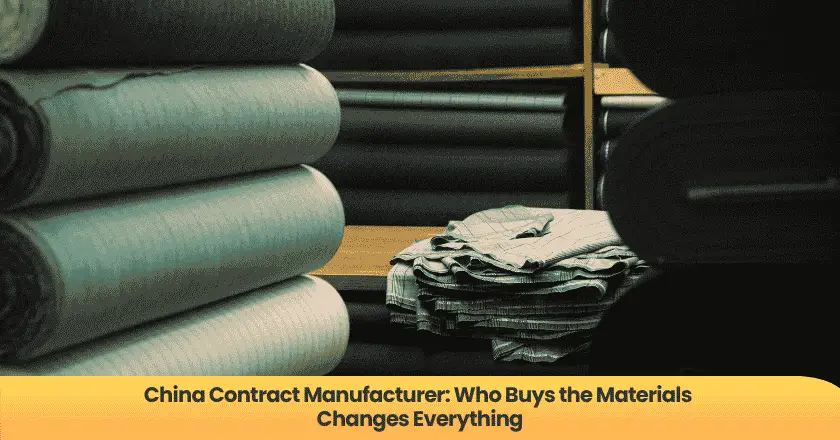
Who purchases the materials is the most consequential structural decision in a contract manufacturing relationship and the one buyers least often make deliberately. It decides price transparency, who carries commodity risk, who is liable when a component fails, whether you can secure a critical part and how much cash you tie up. Most buyers inherit the default without knowing an alternative existed.
The default is almost always turnkey, because it is what a factory quotes when nobody specifies otherwise. That makes it the right starting point for most buyers and a poor permanent answer for anybody whose product depends on one expensive or unreliable input.
Key Takeaways
• Turnkey means the factory buys everything, which is simple, opaque and shifts material risk away from you.
• Consigned means you supply materials, which is transparent, demanding and moves liability toward you.
• Nominating suppliers without buying from them is a middle option most buyers never consider.
• Material purchasing structure determines whether a price increase can be verified or only accepted.
• Quality liability follows the purchasing decision, which matters when a component fails in the field.
The Two Ends and What They Cost
Both structures are legitimate and each solves a different problem, usually at the expense of the thing the other one solves.
Turnkey
The factory sources everything and quotes you a finished unit price. You place one order, receive one invoice and hold no inventory. The factory carries the material risk and the financing, and it prices both into the number. What you lose is visibility: the material cost inside that price is unknown, so any increase is an assertion you can accept or dispute but not check.
Consigned
You buy materials or components and supply them to the factory, which charges for labour and overhead. You see every input price, you control which components go in, and you carry the inventory, the financing and the responsibility for materials arriving on time. A shortage is now your problem, and the factory will charge for idle line time it scheduled around your delivery.
Expert Tip: Ask a turnkey supplier what percentage of the unit price is material, without asking for the itemised costs. Most will answer approximately, and a rough figure is enough to test a future increase against commodity movements you can look up. A factory unwilling to give even a proportion is telling you how the relationship will go when prices move.
The Middle Ground Nobody Uses
Between the two extremes sit two arrangements that capture much of the benefit of each, and both are ordinary requests.
Nominated suppliers
You specify which company supplies a critical component and negotiate the price with that supplier directly, while the factory places the order and pays. You get price transparency and control over the part that matters, and the factory keeps the purchasing, the financing and the responsibility for it arriving. This is standard practice in electronics and rare everywhere else.
The arrangement works because it splits the two things that usually travel together. Choosing the supplier is a technical and commercial decision you may be better placed to make, while placing orders, holding stock and chasing deliveries is operational work best done by whoever is standing in the factory.
Partial consignment
You supply only the components where control or cost genuinely matters, typically one or two items representing a large share of material value, and the factory sources everything else. The purchasing structure does not have to be uniform across the bill of materials, and treating it as a single choice is what makes it feel binary.
A practical version covers one item. The motor, the fabric, the chipset, the fitting that customers notice when it fails. Everything else stays turnkey and the coordination burden stays small enough to be sustainable, which is what determines whether an arrangement survives past the first busy month.
Common Mistake to Avoid: Consigning materials to gain transparency on items that represent very little of the cost. Buyers take on the inventory, freight and coordination burden of supplying minor components while the expensive ones remain invisible. Identify which two or three inputs drive most of the material cost, and apply any control effort exclusively to those.
Who Carries Price Movement
Commodity prices move and the purchasing structure decides who absorbs the movement and who can verify it.
Under turnkey
The factory carries short-term movement and passes through sustained changes, which is reasonable. The difficulty is verification, since you cannot see the input cost and are relying on an assertion. Some factories handle this well by explaining the mechanism, and some treat every commodity headline as a reason to adjust.
Movement runs in both directions and only one of them tends to be raised. A factory that increased prices when a material rose and said nothing when it fell is worth a polite question, since the same mechanism should apply either way and asking establishes that you are tracking it.
Under consignment or nomination
You see the movement directly because you are buying the material, and the factory's conversion charge should stay stable regardless. That clarity is the main commercial argument for the structure, and it comes with the obligation to manage purchasing timing yourself, including deciding when to buy ahead of an expected rise.
Expert Tip: Agree a price adjustment mechanism at the start of a turnkey relationship rather than negotiating each increase as it arrives. Something as simple as material-driven changes being reviewed twice a year against a named reference, with the conversion element fixed, turns a series of arguments into a scheduled conversation. Factories generally prefer this too, since it removes an uncomfortable discussion.
Quality Liability Follows Purchasing
This is the consequence buyers understand least and it becomes important at exactly the wrong moment.
Who is responsible for a failed component
Under turnkey, the factory chose the supplier and sold you a finished product, so a component failure is its responsibility. Under consignment, you chose and supplied the part, and a factory that assembled it correctly has a strong position. That difference can be the entire argument when a batch fails in the field for reasons traceable to one input.
The nominated supplier complication
Nomination sits awkwardly here, because you chose the supplier and the factory bought the part. Worth knowing: this needs stating explicitly in the agreement rather than left for discovery, since both parties have a reasonable argument and neither will volunteer to carry it after the event. A single sentence settles it, and the sentence is easy to write in month one and contentious in month twenty.
Common Mistake to Avoid: Nominating a component supplier without addressing liability in writing. Buyers gain price transparency on a critical part and unknowingly weaken their position on any failure traceable to it. One sentence stating who carries responsibility for nominated parts, agreed while everybody is relaxed, prevents an argument that is otherwise genuinely difficult to resolve.
Cash and Lead Time Effects
The structure moves money and time as well as risk, and both effects are larger than buyers expect.
What consignment does to cash
You pay for materials before production begins rather than paying for finished goods after it, which moves a substantial outflow several weeks earlier in the cycle. For a business already funding a long import cycle, that shift alone can make the structure impractical regardless of its other merits.
Lead time in both directions
Consignment can shorten lead time, because materials are already available when the order is placed. It can also lengthen it badly when a material you were responsible for arrives late, since the factory will have moved your slot. Turnkey keeps both the risk and the coordination with the party best placed to manage them.
Expert Tip: Model the cash impact before choosing consignment, not after. Buying materials two months before you would have paid for finished goods changes your working capital requirement noticeably, and the transparency gained is worth little to a business that cannot fund the next order. The structure that suits a well-capitalised buyer is frequently wrong for a growing one.
Choosing the Structure
The right answer follows from a small number of facts about your product and your business rather than from a general preference.
When turnkey is correct
Commodity materials with many suppliers, no single input dominating the cost, a buyer without purchasing capability in China, and a business that values simplicity over visibility. This covers most small and medium importers most of the time, and choosing it deliberately is different from defaulting into it.
When to take control of something
One component representing a large share of material cost. A part where quality has caused repeated problems. A supply-constrained item worth securing in advance. A brand claim resting on a specific named material. Through 2026 component availability has remained uneven enough in several categories that securing a critical part has been worth the administrative cost.
Common Mistake to Avoid: Switching structure mid-relationship without renegotiating the price. Moving from turnkey to consignment removes material cost, financing and risk from the factory, and the conversion price should reflect that rather than simply deducting the material figure the factory quotes you. Agree the new basis before supplying anything, since afterwards the comparison becomes impossible to make cleanly.
Choosing a Structure That Holds: NewBuyingAgent
Whichever structure suits a product, it has to be operated by somebody who can see what is arriving at the factory gate. NewBuyingAgent is your perfect partner for global sourcing from China, backed by 30 years of expertise in trade, manufacturing and quality control.
Material prices are only checkable against alternatives, which requires knowing what else is available. Its wide factory network lets it pick low-cost, high-cooperation suppliers. Even with its margin included, NewBuyingAgent cuts your costs by 5%-10%.
Verifying that the specified material actually went into the product is a production question rather than a commercial one. 20,000+ product development & QC experts ensure your products match market needs and stay high-quality. Arrangements like nomination also depend on how the account is regarded. Its local reputation gets you full factory cooperation.
Frequently Asked Questions
Should I let a china contract manufacturer buy all materials?
For most small and medium importers, yes, because it removes purchasing, financing and shortage risk from a buyer poorly placed to manage any of them. The trade-off is that material cost becomes invisible and price increases cannot be verified. Take control only of the one or two components that dominate cost or quality.
What is a nominated supplier arrangement?
You choose the company supplying a critical component and agree its price directly, while the factory places the order and pays for it. You gain transparency and control on the part that matters without taking on inventory or financing. Address liability for that component explicitly, since nomination splits responsibility in a way neither party will want to own later.
Does supplying materials myself save money?
It saves the factory's margin on materials and adds your purchasing, freight, inventory and coordination costs, plus an earlier cash outflow. On a component representing most of the material value it frequently nets out positive. On minor inputs it rarely does, and the administrative burden lands regardless of the value involved.
Can NewBuyingAgent manage material sourcing separately?
Sourcing and verifying inputs is part of the coordination that moves off a buyer's desk, whichever structure is in use. NewBuyingAgent handles all factory communication—perfect for multi-category buyers. Free up your time to focus on expanding your local market sales. It applies across categories rather than one product, since it can supply products from China across all categories to you at better price, quality and service.
Conclusion
Decide the purchasing structure deliberately rather than inheriting the default. Identify the two or three inputs that drive material cost, and apply control only there through nomination or partial consignment. Ask a turnkey supplier what proportion of the price is material and agree a review mechanism before any increase arrives. Address liability in writing wherever you chose the supplier and somebody else bought the part. If operating any of this from the factory gate rather than from a spreadsheet is the gap, NewBuyingAgent is worth a conversation.
Partial Sources
1. CE Marking: Manufacturers – European Commission — https://single-market-economy.ec.europa.eu/single-market/goods/ce-marking/manufacturers_en
2. ISO 9001 Quality Management Systems: Requirements – ISO — https://www.iso.org/standard/9001
3. New Buying Agent in China | NewBuyingAgent — https://www.newbuyingagent.com/
4. We Manage Your Factories | NewBuyingAgent — https://www.newbuyingagent.com/what-we-do/we-manage-your-supply-chain
5. We Supply Products To You | NewBuyingAgent — https://www.newbuyingagent.com/what-we-do/we-supply
6. Trending Products | NewBuyingAgent — https://www.newbuyingagent.com/trending-products
NewBuyingAgent
Related Resources


今日始める
あなたの調達目標を現実に変えましょうWeChat:+86 15157124615
WhatsApp:+86 15157124615
住所:中国、杭州、祥園路39号10号館
