

A quality wall is temporary extra screening for a defined defect. A process fix is a change to the conditions producing that defect. When sorting invoices keep arriving, buyers usually need both: protection for the current order and evidence that the factory has stopped creating the problem. The spending decision is therefore about what the wall covers, what improvement is being verified, and what will permit the extra inspection to end.
Contain now, but approve a way out
Authorize a quality wall with a defined purpose, a cost boundary, and a review date while the factory investigates and corrects the cause. Treat screened-product results and process-improvement results as separate records: a clean shipment may show that sorting worked without showing that production improved. An extension should buy a specific next piece of evidence, rather than merely another week of the same activity.
- Risk: Define the defect and confirm that the proposed check can detect it.
- How it works: Trace suspect stock separately from output made after the process change.
- Decision: Assign cause-removal work alongside the sorting operation.
- Cost comparison: Agree on exit evidence and authorization before accepting repeat charges.
What a quality wall changes—and what a process fix changes
A quality wall can protect an order while the production cause remains unresolved, provided its screening method is suitable for the defect. In Challenge Manufacturing’s supplier manual, controlled shipping adds a separate, redundant inspection alongside corrective action. This is a requirement within that supplier system, not a universal rule for China imports; the useful distinction is that containment and correction run together rather than replace each other.
For the comparison below, hold the defect, affected product scope, and acceptance criteria constant. “Process fix” means an implemented change supported by verification, not simply a promised machine adjustment. The final column identifies what a buyer would need to examine. It is a decision aid, not a vendor rating or a declaration that either response guarantees conformity.
| Decision dimension | Temporary quality wall | Verified process fix | Evidence to examine |
|---|---|---|---|
| Main purpose | Screen affected output for the named defect | Change the conditions generating the defect | Checking instruction versus cause-and-change evidence |
| Product coverage | Suspect stock and defined new output | Output made under the changed process | Batch boundaries and the change point |
| What success shows | The screen is separating the agreed defect | The implemented change is effective under assessed conditions | Separate sorting and normal-production records |
| Cost pattern | Repeated labor, setup, handling and possible delays | Investigation, modification, validation and continuing control | Actual charges, avoided recurring work and remaining checks |
| End condition | Agreed exit criteria and authorized withdrawal | An effective control maintained in normal operation | Evidence review, updated documents and responsible sign-off |
Based on this comparison, the practical choice is usually a qualified wall now and a verified process fix alongside it. Keep the extra screen while its agreed purpose remains necessary; withdraw it only after the relevant evidence supports the exit decision. If the screen cannot reliably find the defect, adding more sorting hours does not make it suitable. Change the containment method or hold the affected stock while the gap is resolved.
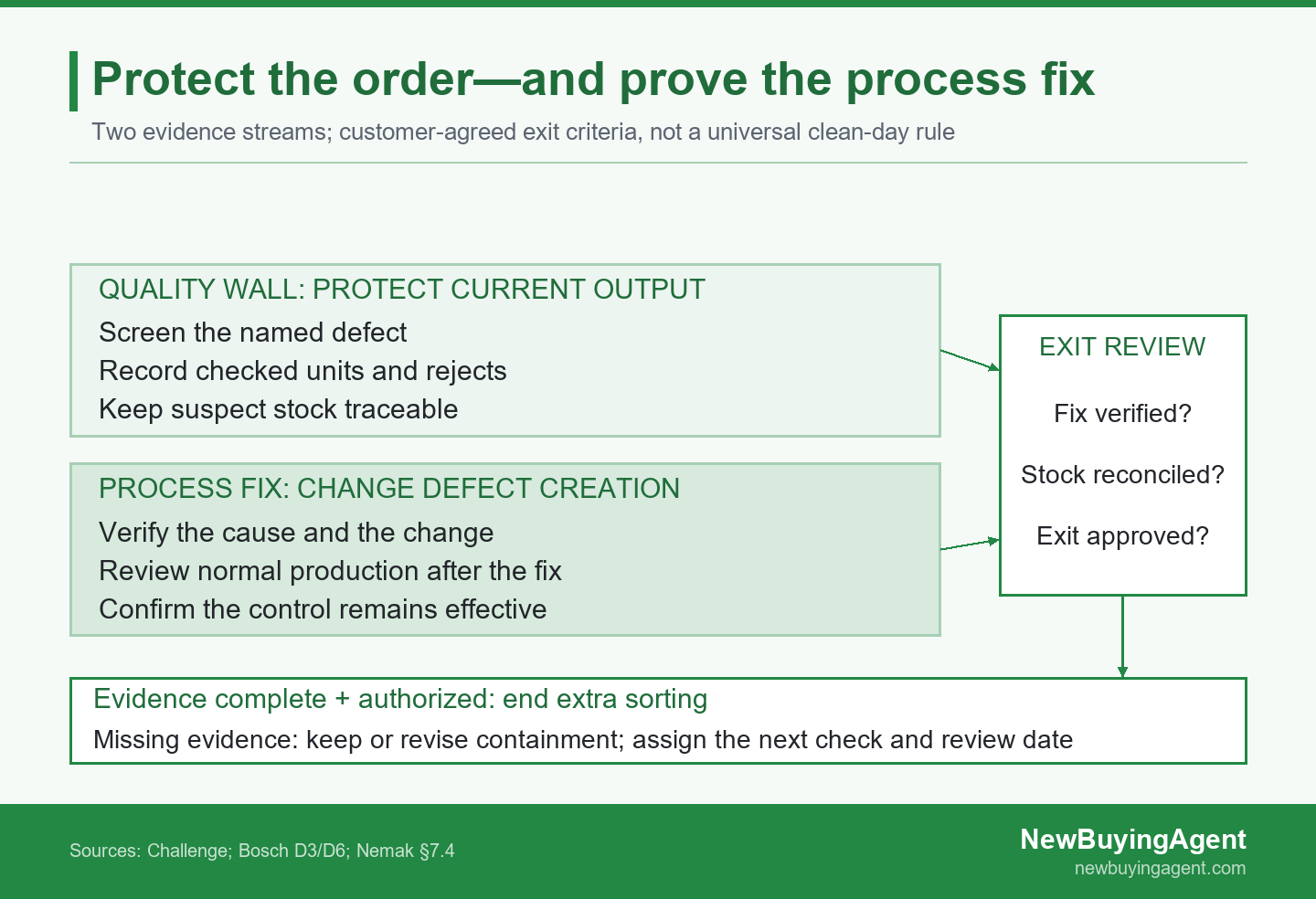
Keep temporary screening separate from process correction, and end extra sorting only after the agreed evidence and authorization.
Fund the cause investigation alongside the quality wall
Fund an investigation that can connect the observed defect to a change in the way the product is made. NIST’s description of process control distinguishes active process changes based on monitoring from monitoring alone. Applied to a recurring factory defect, the question is what setting, tool condition, material, handling step, or instruction must change—and how the team will demonstrate that the change affected the problem.
Ask the factory to state a testable explanation rather than stop at “operator carelessness.” A missing part could arise because the assembly sequence allows an omission, because the component supply is inconsistent, or because a later check does not detect the omission. Those explanations call for different actions. Training may be relevant, but the proposal should explain the mechanism it addresses and the evidence that will distinguish improvement from coincidence.
A usable corrective-action proposal names the cause owner, the proposed change, the implementation point, and the method for checking effectiveness. Record which product versions, lines, shifts, or material changes need assessment because they could affect the result. Make the revised instruction and equipment available where the work happens. If the explanation remains uncertain, record the uncertainty and the next test; do not convert an untested hypothesis into a completed action merely to close the report.
Compare the recurring bill with the cost of a verified fix
Compare the full recurring cost of containment with the incremental cost and expected benefit of the proposed fix. Start with the actual checked volume and agreed charging basis, then separate setup, inspection, rework, handling, freight, and delay. This proposed purchasing ledger helps expose the repeat bill without assigning every cost to the factory or promising that a process change will remove all inspection expense.
For each extension, ask the approver to record the following figures and their basis. Leave uncertain amounts as estimates or unknowns rather than treating a preliminary quote as a final saving:
- Screening: units or hours authorized, unit or hourly rate, minimum call-out and setup charges.
- Handling: unpacking, repacking, relabeling and any separate transport to the sorting location.
- Defect consequences: rework, scrap, replacement quantity and credible schedule impact.
- Process change: investigation, tooling or fixture work, trial production and validation expense.
- Remaining controls: routine inspection and any temporary checks still needed after the change.
For a planning comparison, calculate recurring screening cost as authorized quantity multiplied by the agreed rate, adding only charges that are not already included. Compare the avoidable portion across realistic future orders with the added cost of implementing and verifying the fix. Avoid double-counting labor included in a sorting price or treating a delayed shipment as a saving. Where future demand is uncertain, show a shorter and a longer order horizon rather than one confident payback date.
A bracket order shows why clean shipments can mislead
A clean shipment can demonstrate successful sorting while the production problem continues. Bosch’s problem-solving guidance separates containment from corrective action and calls for effectiveness checks after implementation. The bracket example below applies that distinction to an importer’s decision; it is an illustration, not a NewBuyingAgent customer case or an engineering prescription. Its order quantity supplies context, not a recommended inspection sample size.
Illustrative example: clean cartons, recurring burrs
Consider an illustrative order for 10,000 metal brackets from an existing Chinese supplier. A burr around a mounting slot prevents some brackets from seating properly. The suspect stock can be traced to production window 1, and an agreed checking method separates affected pieces before packing. The importer allows that containment while the factory investigates; the authorization covers the known defect, not every possible product problem.
Sorted-good shipments subsequently show no reported burr complaints, but the factory’s fresh-production records still show burr rejects. The supplier proposes a deburring fixture change and identifies where the changed process begins. These observations answer different questions: the wall appears to be catching the defect, while the recurring rejects show why the importer still needs evidence about the process. The fixture proposal is a candidate correction whose mechanism and effectiveness remain to be verified.
The importer keeps qualified containment for suspect stock, asks the factory to confirm the burr mechanism, and agrees how to assess output after the fixture change. Records must distinguish old stock, reworked units, and normal production made after the change. The exit decision waits for the agreed effectiveness evidence and authorization; an initial successful trial alone does not clear every batch. This example assumes traceable stock and a suitable checking method. Lost traceability or unreliable detection would require reassessing containment, and the fixture itself needs product-specific engineering review.
Check new production before withdrawing the extra screen
After the change, examine the factory’s normal-production results before sorting as well as what the wall finds afterward. Record the quantities checked in each stream, the production conditions covered, and any repeat defect. A lower reject count after inspecting fewer units is not evidence of improvement by itself. If the burr returns, investigate whether the cause explanation was incomplete, the change was not maintained, or a different production condition was missed. Do not erase the failed verification from the record.
For an importer retaining its Chinese bracket supplier, local follow-up can connect the change point with what is happening on the production line. NewBuyingAgent’s factory-management service covers existing-factory production follow-up, staged quality inspections, reporting, and logistics. Its product and quality-control capability is relevant to the delivered order as a whole. The buyer should establish the required scope rather than assume that this includes a specialist sorting team, independent engineering validation, or authority to waive acceptance criteria.
Agree on evidence for exit before extending the wall
Agree on exit evidence while the wall is being established, and confirm who can authorize its removal. Nemak’s controlled-shipping criteria require evidence addressing the cause and non-detection, with written authorization to exit its supplier program. For other buyers, the transferable lesson is to define the evidence and decision owner explicitly; Nemak’s requirements do not automatically become terms of an unrelated purchasing contract.
Use the following review questions to decide whether the extra wall is still needed. These are proposed agreement points, to be adapted to the product risk and the actual customer requirements:
- Was the change implemented? Identify the approved revision, equipment or setting change and its production breakpoint.
- Did it work in normal production? Review records covering the agreed operating conditions, quantities, and period after implementation.
- Is the suspect stock controlled? Reconcile held, screened, reworked, rejected, and shipped quantities without mixing their status.
- Will the control remain in use? Check the current instruction, responsible owner, relevant training, maintenance and response to recurrence.
- Who approves exit? Record the evidence reviewed, the decision date, continuing normal controls and what will trigger renewed containment.
Do not copy a clean-day number out of a supplier manual and apply it automatically. For example, Pace’s published default exit criteria call for twenty working days of containment data from implementation of permanent corrective action, together with supporting documentation. That is a specific customer requirement. For the current order, confirm the applicable agreement and whether the observation covers the conditions associated with the original defect; elapsed time alone cannot answer that question.
Put the next sorting extension in writing
Approve the next extension as a bounded piece of work with a named objective, rather than an open-ended instruction to “keep sorting.” The following record can be copied into an order review or supplier meeting note. Complete it with the factory and whoever approves expenditure, then use the review date to make an actual decision: continue with reasons, revise the method, escalate the unresolved cause, or authorize exit.
- Defect and scope: product/revision ___; characteristic and limit ___; affected batches/location ___.
- Authorized work: screening method ___; quantity or hours ___; rate and cost ceiling ___; expense approval ___.
- Process action: cause to verify ___; proposed change ___; factory owner ___; implementation point ___.
- Evidence due: normal-production results ___; sorting results ___; stock reconciliation ___; responsible reviewer ___.
- Next decision: review date ___; agreed exit criteria ___; exit authority ___; escalation if evidence is missing or the defect recurs ___.
For a future order, recurring sorting may expose a wider product or factory-capability problem. Evaluate whether the sourcing partner has resources suited to the material, finish, and production method involved. NewBuyingAgent’s factory-resource and product-QC background explains its local factory resources and development/QC capability. Those resources are relevant to a new sourcing discussion; they are not proof that a particular corrective action has already succeeded.
If the next purchase needs a new product-supply route, prepare the product specification, quantity, target price, destination, timing, and the known failure feature, then request a China product-supply quote. NewBuyingAgent uses local China factory resources and product/QC capability to quote and supply products around the purchasing need. Include the lesson from the sorting problem in that brief so the offer can account for the required product outcome, rather than budget for indefinite additional screening.
Questions about ending repeated sorting
Can an AQL sampling pass replace the quality wall?
No: a sampling pass does not automatically satisfy an agreed containment requirement or demonstrate that the production cause has been removed. NIST explains acceptance sampling as a decision about lot acceptance, rather than an estimate of lot quality. Whether to change from additional screening to sampling depends on the actual customer agreement, product risk, and verified control performance. Obtain the required authorization before changing the agreed method.
How many defect-free days are enough to remove a quality wall?
Use the agreed customer-specific criteria rather than borrowing a fixed period from another supplier manual or counting calendar days without examining production. The observation should cover the relevant conditions, with its checked quantities and results recorded. A week when the affected product was not made provides different evidence from a week of representative production. Confirm how the agreement treats a repeated defect or a change in the process being assessed.
Who should pay for repeated sorting of defective products?
Payment responsibility depends on the purchase terms and the containment work separately authorized by the parties, rather than a universal allocation rule. Before work starts, record the rate, included activities, cost ceiling, and person who can approve an extension. Keep product disposition and commercial cost discussions separate enough that a disputed invoice does not become implied permission to ship. Resolve uncertain responsibility through the applicable agreement and the parties’ commercial process.
What if the defect cannot be checked on every unit?
A quality wall is unsuitable when its method cannot reliably detect the relevant defect on the units being cleared for shipment. Destructive tests, latent failures, or defects requiring different equipment may call for another containment and verification plan. Identify the limitation before accepting a claim of full inspection. Ask the responsible technical team to define an appropriate approach for the product and affected scope; repeating an inadequate visual check does not resolve the gap.
NewBuyingAgent
Related Resources

今日始める
あなたの調達目標を現実に変えましょうWeChat:+86 15157124615
WhatsApp:+86 15157124615
住所:中国、杭州、祥園路39号10号館
