

A packaging bill of materials is a controlled list of the components needed for a defined pack, including their specifications, revisions and quantities. Its practical value comes from connecting that definition to the order being packed. A list of “box, bag and label” cannot tell a factory which artwork, insert or carton configuration belongs in the next shipment.
For buyers importing products from China, packaging control becomes especially important when artwork changes, materials are substituted or repeat orders overlap. Build the record around identifiable parts and a named packaging level, then release it with clear applicability. The factory should be able to reproduce the approved combination without interpreting a chain of emails.
Keep the packaging BOM tied to the order being packed
A usable packaging BOM connects component identity, quantity basis and revision status to the actual production order. Define the parent pack, reference the exact component documents and state when the released combination applies. Check that the packing line uses those materials and instructions, because an approved file can coexist with obsolete stock or an uncontrolled printout at the workstation.
- Definition: quantities belong to a named parent, such as one unit pack or one shipping case.
- Common mistake: the latest component file is treated as automatically applicable to every open order.
- How it works: release the packaging configuration, control the stock cutover and retain order-linked packing evidence.
Start with the packaging hierarchy and quantity basis
A packaging BOM should identify what is being packed and the parent level to which each quantity belongs. One product unit, one retail pack, one shipping case and one pallet are different counting bases. Define the relationships between them before adding material quantities, so purchasing can calculate demand and inspectors can distinguish a missing component from an incorrect pack count.
Microsoft’s BOM documentation describes uniquely identified single-level BOMs whose components can have their own BOMs, forming a hierarchy. It also describes version applicability constrained by period, quantity, site or product dimensions. This provides a useful model for packaging records: identify each parent and its contents, then define where that version applies without assuming every system uses identical controls.
Consider an illustrative kitchen-organizer pack. One unit pack contains one pouch, two end pads and one leaflet; one shipping case contains six unit packs, one carton, one label and two metres of tape. The finished organizer is referenced by its product SKU, while this packaging-only BOM lists the materials surrounding it. A broader manufacturing BOM could include the product itself, but its boundary should be explicit.
Six unit packs in one case therefore require six pouches, twelve end pads and six leaflets. Add the case-level carton, label and tape once. Do not multiply the unit-pack contents and then add the same contents again as extra case inputs; the unit-pack line is a parent relationship, not an additional physical pouch or insert.
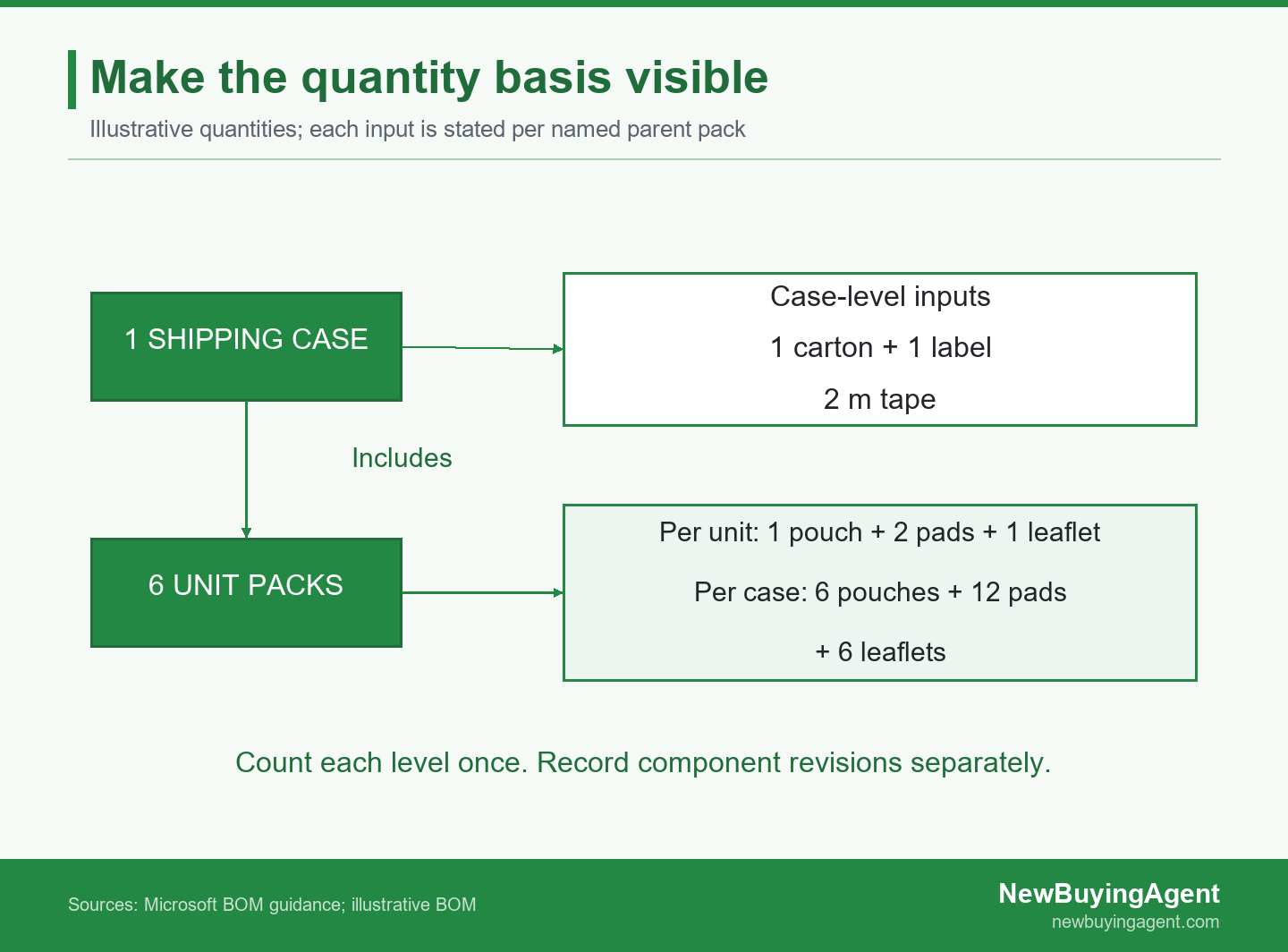
The illustrative shipping case contains six unit packs plus case-level materials; unit-pack components roll up by six and are not added twice.
Build a BOM record that purchasing and packing can both use
A packaging BOM record needs enough detail to identify the exact component, its quantity per parent and the documents that define it. Record the parent identity, component ID, specification or artwork revision, unit of measure, approved source and release applicability. Keep approval ownership visible, and link the packing-instruction revision separately so a material list does not become an ambiguous substitute for assembly directions.
| Record area | Copyable field set | What it resolves |
|---|---|---|
| Header | Product SKU; parent pack ID; parent BOM revision; status; applicable PO/lot; approver/date | Which configuration is released for this order |
| Component line | Component ID; description; component revision; specification/drawing or artwork ID and revision | Exactly which part purchasing and packing should use |
| Consumption | Quantity; unit; named parent basis; conversion reference; separate allowance | How much is used and how demand is calculated |
| Execution links | Approved source reference; packing instruction ID/revision; change/deviation reference; verification record | Who supplies it, how it is assembled and what exceptions apply |
The following small BOM is illustrative. Product SKU KO-01 uses unit pack UNIT-K01 Rev A; shipping case CASE-K01 Rev B contains six such packs. Assume both parent records are released for illustrative PO EX-01, packing lot L1, with buyer approval recorded as AP-01. Each specification below is an example reference, not an attached production drawing.
| Parent | Component / revision | Defining document | Quantity per parent |
|---|---|---|---|
| UNIT-K01 / A | POUCH-P01 / A | SP-P01 / A | 1 each |
| UNIT-K01 / A | ENDPAD-E01 / A | DR-E01 / A | 2 each |
| UNIT-K01 / A | LEAFLET-F01 / B | ART-F01 / B | 1 each |
| CASE-K01 / B | UNIT-K01 / A | Unit-pack BOM A | 6 each |
| CASE-K01 / B | CARTON-C01 / B | DR-C01 / B | 1 each |
| CASE-K01 / B | LABEL-L01 / C | ART-L01 / C | 1 each |
| CASE-K01 / B | TAPE-T01 / A | SP-T01 / A | 2 m |
Link these records to packing instruction PI-K01 Rev B, covering pad orientation, leaflet placement and the closure method. SAP’s packaging-specification lesson distinguishes contents, packing levels, materials and work steps. The buyer’s corresponding distinction is practical: the BOM identifies what is consumed, while controlled instructions explain how those components form the required pack.
Microsoft’s material-consumption guidance distinguishes constant and variable consumption and quantity rounding. Keep the example’s net tape usage separate from roll purchasing units and any approved setup or scrap allowance. A roll conversion needs its stated usable length; an allowance should not silently change the quantity that belongs on the finished case.
When a China product purchase combines several packaging materials, the buyer needs product fit and factory feasibility considered together. NewBuyingAgent’s local factory resources and product/QC capability provide relevant context for incorporating those requirements into the supplied product. That connection is broader than maintaining a packaging spreadsheet and does not establish specialist laboratory or certification authority.
Separate component revisions from assembly release and effectivity
Packaging revision control needs both a defined configuration and a clear statement of where it applies. Effectivity means the order, lot, date or unit range for which a released configuration applies. Oracle’s BOM guide documents component effectivity and revision dates, illustrating why a revision identifier alone cannot tell the packing team whether a change belongs in today’s order or a later one.
Keep component and assembly identities distinct
A component revision identifies a changed component definition; an assembly BOM revision identifies the released combination. If the end pad changes, retain the exact identity of the new pad and update the parent record that uses it. Unaffected pouch or leaflet definitions do not need new revisions merely because the assembly changes, but the released parent must still reference their correct versions.
In the example, a proposed ENDPAD-E01 Rev B would require a reviewed unit-pack configuration. If approved as UNIT-K01 Rev B, the shipping-case BOM would also need an explicit reference to that unit-pack revision under the buyer’s release rules. Calling every file “Rev B” would hide these different relationships. Maintain a change description and approval reference so someone investigating an older shipment can reconstruct the configuration used.
Define the cutover and bound every temporary deviation
State the last order or lot using the old configuration and the first using the new one, including any site or destination limitation. A calendar date can support that boundary, but overlapping production may still require a PO, lot or serial-range reference. “Use the latest version” leaves the factory to decide which open orders should change.
Keep a permanent BOM change separate from a temporary deviation. A deviation record should identify the allowed difference, affected order or lot, approval owner, expiry or quantity limit and return to the released configuration. Approval of that exception does not automatically rewrite the master BOM or authorize the same substitution on the next order.
Before the cutover, assign a disposition for old stock, work in progress and open packaging purchase orders. Options might include retaining material for a compatible order, approved rework, return or scrap. Mark and segregate the materials according to that disposition, withdraw obsolete workstation copies and reconcile what remains. Otherwise the documents may change while the physical packing operation continues unchanged.
Review what the change can affect before release
A packaging change review should cover the functions and requirements that the changed component can affect. Check product fit, restraint, cushioning, closure, printed information, pack count, handling and the intended distribution route, then identify what evidence is needed. A complete BOM establishes a controlled definition; it does not establish protective performance, legal conformity or permission to ship the product.
Identification consequences depend on the change. Under the GS1 GTIN Management Standard, changing the number of trade items in a case, or the case count on a predefined pallet, requires a new GTIN for the affected higher packaging levels. That rule applies within the GS1 identification system; an internal component revision alone does not automatically require a new GTIN. Review the actual change and its identification consequences rather than equating every artwork edit with a new trade item.
Protection evidence also belongs to a defined configuration. The published ISTA 3A overview considers the package and product together and calls for damage and functional criteria before testing. Use the current procedure appropriate to the actual route and packaged product, with qualified testing support where needed. The overview itself is not the full procedure or an approval of the proposed pack.
Record commercial and operational effects alongside that review: component cost, tooling, minimum purchase quantities, obsolete inventory, packing labor, outside dimensions and gross weight where relevant. Assign an owner and evidence reference to each affected issue. An unchanged carton drawing cannot establish that a revised insert fits or protects the product, and a lower material quote cannot settle those questions.
Work through a packaging revision without mixing old and new stock
A packaging revision should be reviewed against the complete pack and then assigned to a defined production scope. The following illustrative China purchase of kitchen organizers uses the unit-pack and shipping-case structure above. It shows the proposed control steps and missing evidence, rather than an actual client case, successful changeover or passing test; the buyer’s release decision remains conditional on verification.
Illustrative example: identify the affected packs and material
For an illustrative order of 1,200 product units packed six per case, the order requires 200 cases and 2,400 end pads at two pads per unit. Proposed end-pad Rev B has not yet been approved. A global importer buying kitchen organizers from China faces a factory proposal to replace insufficient old stock, but has no evidence that the revised geometry performs acceptably in the complete pack.
The quantity calculation identifies demand; it does not prove equivalence. Compare DR-E01 Rev B with the released pad drawing and build the proposed unit pack with its actual pouch, leaflet and product. Keep proposed Rev B material separate from Rev A, identify any packs already assembled and record which quantities could be affected. Until the review closes, a material shortage is a planning problem rather than permission to substitute.
Release the new configuration only after the packing evidence matches
Hold the proposed end-pad change until the identified full pack meets agreed criteria. If the evidence supports adoption, release the new parent configuration to a named order or lot, segregate old material and confirm production packing against it. Assemble the proposed pack from identified components and obtain the necessary review before authorizing its use.
An approved configuration could be UNIT-K01 Rev B and a corresponding CASE-K01 revision applicable to illustrative PO EX-02, lot L2, with the actual approval reference recorded at release. Check the first completed unit and case against those records, including pad identity, orientation, component count, artwork and closure. Retain order-linked photographs and inspection references, continue the agreed production checks and reconcile issued material.
This remains an illustrative decision sequence, not a passed test or successful client changeover. A first-off match supports that setup rather than every later pack. If evidence fails, retain the hold and choose an approved alternative.
Put the released BOM into the factory order and inspection record
The factory order should carry the released packaging BOM together with its component specifications, artwork, packing instructions and applicability. Include approved deviations and the evidence references needed for first-off approval and production inspection. The aim is one reproducible configuration at purchasing, material issue and packing, with deviations visible before goods move further through production or toward shipment.
For a buyer keeping an existing China factory, NewBuyingAgent’s existing-factory management service describes production follow-up, staged QC, reporting and logistics coordination. In a packaging cutover, that can help connect the agreed product requirements to factory records and physical checks. Define the order scope and approval responsibilities, including who supplies specialist validation evidence and who decides the disposition of a deviation.
Use this implementation checklist as an order record. Enter an owner, evidence reference and open/closed status against each item:
- Parent pack IDs and BOM revisions match the product SKU, destination and applicable PO/lot.
- Every component line has a defining document, revision, quantity and unit per named parent.
- Artwork, packing instructions and approved-source references match the released combination.
- Change impact and required validation are reviewed; approval authority and record are identified.
- Old stock, work in progress and open purchase orders have an approved disposition.
- Workstation copies and material locations identify the correct configuration and bounded deviations.
- First-off and production checks retain order-linked evidence; unresolved differences have a hold or disposition.
If the product purchase is still being defined, prepare the product specification, quantity, target price, destination and delivery timing, plus the packaging BOM, artwork and revision needs, to request a China product-supply offer from NewBuyingAgent. Its local factory resources and product/QC capability can support an offer that incorporates the agreed packaging requirements into the supplied product. Use that defined configuration when comparing the offer and preparing the purchase order.
Questions about packaging BOM control
Can a spreadsheet be used instead of a packaging BOM system?
A spreadsheet can work when its release and use are controlled. Give the BOM a stable identity, manage editing access and retain revision history, approval evidence and order applicability. Control issued copies so purchasing and packing can identify the version they should use. Software can simplify those tasks, but neither a spreadsheet nor an ERP system automatically proves that the factory used the released configuration.
Does changing the packaging supplier always require a new component revision?
Review the change against the specification and approved-source rules rather than deciding from the supplier name alone. The same material description does not establish equivalence in dimensions, formulation, print or performance. Depending on the change, approval may require an updated source record, revised component definition and verification evidence. Retain the supplier and lot traceability needed to investigate which material entered production.
Should prices be part of the technical packaging BOM?
Keep a dated purchasing cost reference linked to the technical BOM. This allows the buyer to cost the released configuration while preserving the difference between commercial terms and a component’s technical definition. A price movement alone need not create a new technical revision. If a lower price comes from changed material, tooling or source, review that underlying change through the appropriate approval process.
Can the factory use up old packaging after a revision?
Use old material only under an approved disposition for identified orders or lots. Some stock may remain suitable for an unchanged destination or configuration, while obsolete information or incompatible geometry may prevent reuse. Record the permitted scope and keep that stock distinguishable from material intended for the new configuration. “Use it up” is insufficient when the factory cannot show which finished packs received it.
NewBuyingAgent
Related Resources
今日始める
あなたの調達目標を現実に変えましょうWeChat:+86 15157124615
WhatsApp:+86 15157124615
住所:中国、杭州、祥園路39号10号館
