

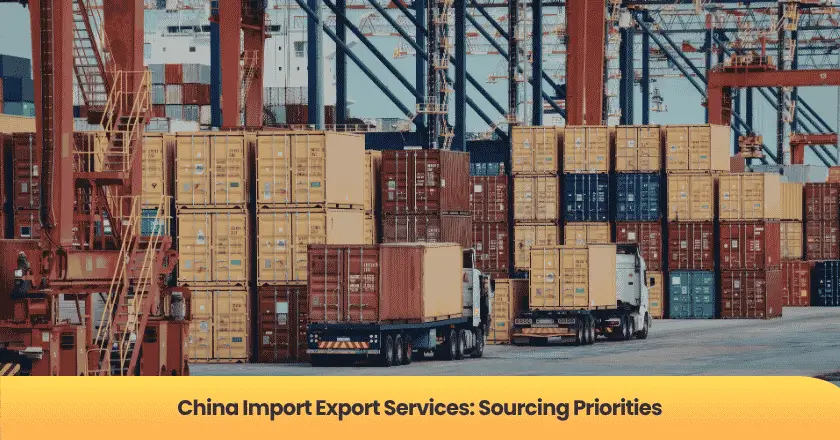
Introduction
The proposal lists eleven services for one monthly figure. Supplier search, negotiation, inspection, declaration, documents, booking, insurance, consolidation, payment handling, compliance review, after-sales. You need perhaps four of them. The other seven are priced into a number you cannot break apart, and you will be paying for them every month.
Providers of china import export services bundle deliberately, because bundles are harder to compare than line items. The way out is to rank what actually matters for your goods before reading anyone's proposal. A buyer whose priority is landed cost needs a different package from one whose priority is clearing a seasonal deadline, and no single bundle serves both well.
Key Takeaways
• Rank price, speed, compliance and cash before reading proposals, since the ranking decides which services you need.
• Confirm who acts as exporter of record, because that party carries the declaration and its consequences.
• HS code classification is your responsibility in practice, whoever types it into the declaration form.
• Payment structure moves risk more than any contract clause, so treat deposit terms as a negotiation item.
• Keep supplier contacts, specifications and test reports in your own files whatever you outsource.
What These Services Actually Bundle
The phrase covers two distinct sides of a single transaction, and providers rarely make clear where one ends.
The export side and the import side
The export side happens in China: securing the goods, arranging the declaration, preparing documents and handing cargo to a carrier. The import side happens at your end: customs entry, duty payment and delivery. A provider strong on one is not automatically capable on the other, and many quote both while subcontracting half of it.
Who is the exporter of record
Every shipment leaving China is declared by a legal entity holding export rights. That party is the exporter of record, and it signs for the accuracy of the declaration. Small factories often lack export rights and use an agent's licence, which is legal and routine. What matters is that you know which entity appears on the paperwork, because the commercial invoice, the origin certificate and any future claim all trace back to it.
Export rights also shape the price you are quoted. Exporters in China can reclaim value-added tax on goods leaving the country, and whether that refund stays with the factory or with the party handling the declaration is invisible in most quotations. Asking how the refund is treated is a fair question, and the answer tells you how the number in front of you was built.
Expert Tip: Ask a prospective provider to name the exporting entity on your first shipment before you sign anything. A direct answer with a company name takes ten seconds. Vagueness here usually means the shipment will be declared under whichever licence is convenient that week, which is workable until a customer, an auditor or a marketplace asks you to prove the chain from factory to carton.
Setting Your Sourcing Priorities First
Four things compete on every order and you cannot hold all of them at once. Deciding the order in advance is what turns a service proposal into a comparable quote.
Rank price, speed, compliance and cash
Price-first buyers want consolidation, aggressive negotiation and slow shipping lanes. Speed-first buyers want dedicated coordination and pay for it. Compliance-first buyers, common in regulated categories, want testing and documentation depth. Cash-first buyers want smaller runs and later payment, and will accept a worse unit price to get them. Most buyers sit somewhere between two of these.
Rankings shift within a single year as well. The same buyer is compliance-first when entering a new market, speed-first in the ten weeks before a seasonal peak, and cash-first every January. Reviewing the order each quarter takes twenty minutes and stops a package chosen in one situation from quietly governing the next three.
How the ranking changes what you buy
A compliance-first buyer should pay for laboratory coordination and document control, then decline the consolidation service. A cash-first buyer should negotiate payment structure hard and skip the premium coordination tier. Let's be honest: the priority ranking most buyers use in practice is whatever went wrong on the last order, which is a poor substitute for deciding deliberately.
Common Mistake to Avoid: Buying the full bundle on the first engagement because it looks like insurance. Services you do not use still shape the relationship, since the provider staffs and prices around the whole package. Start with the two or three functions tied to your top priority, then add more once you have seen how the team performs. Expanding a working arrangement is easy. Unwinding an oversized one is not.
Documentation and Declaration
Paperwork errors are the most common cause of a shipment sitting still, and almost all of them are avoidable at the preparation stage.
HS classification is yours to verify
The HS code (harmonised system code — the international number that classifies your product for customs) determines how your goods are treated on entry. Suppliers and agents will suggest one, usually the code they have used before for something similar. The declaration is made in your commercial interest, so verify the code against your actual product rather than accepting a convenient neighbour.
The document set and who prepares each piece
Five documents travel with most shipments, and each has a natural owner. Assign them explicitly rather than assuming the provider handles everything.
•The commercial invoice comes from the exporting entity and must match the declared value exactly.
• The packing list comes from the factory and should reflect the cartons as actually packed.
• The bill of lading comes from the carrier or forwarder and controls who can collect the goods.
• The certificate of origin is issued in China and may be required for preferential treatment at entry.
• Product test reports and declarations come from the laboratory and should name your company.
Expert Tip: Ask for draft documents forty-eight hours before the declaration is filed, and read the description field rather than the numbers. Descriptions written loosely, or copied from a previous shipment, are the single most common reason a container is held for inspection. Correcting a draft costs an email. Amending a filed declaration costs days and sometimes a fee at both ends of the journey.
Payment Structure and the Cash Cycle
Payment terms move more risk than any clause in a service agreement, and they are negotiable more often than buyers assume.
Deposit structures and what they signal
The common arrangement is a deposit by T/T (telegraphic transfer — a direct bank-to-bank payment) with the balance against shipping documents. Thirty percent up front and seventy on copy of the bill of lading is a standard starting point. A supplier insisting on full payment before production on a repeat order is telling you something about its own cash position.
When a letter of credit earns its cost
An L/C (letter of credit — a bank undertaking to pay once specified documents are presented) shifts performance risk onto documents rather than trust. It costs bank fees and administrative time, and it only protects you if the document conditions are written carefully. For large first orders with an unfamiliar supplier it is frequently worth the friction, and for routine repeat orders it rarely is.
Currency sits underneath both arrangements. Most China contracts are priced in dollars, and a factory quoting in renminbi has moved the exchange risk onto your side of the table. Neither is wrong, and on orders settled within sixty days the difference is usually small. On a development project spanning months, agree which currency governs and whether either party may reprice.
Expert Tip: Tie a slice of the balance to the inspection result rather than to the shipping date. Something like sixty percent on a passed pre-shipment inspection and ten percent on document handover keeps everyone's attention on quality at the moment it can still be fixed. Suppliers accustomed to export work agree to this more readily than buyers expect, particularly once a first order has gone smoothly.
Compliance Checks Before the Goods Leave
Fixing a compliance problem in China is inconvenient. Fixing it after the goods have arrived is a write-off, since returning them is rarely economic.
Product requirements sit with the destination market
Labelling language, safety marks, material declarations, packaging rules and battery documentation are all set by where you sell rather than where you buy. Chinese suppliers work to whatever standard their last customer needed. Assume nothing carries over, and confirm the requirement list in writing before production rather than during inspection.
What a pre-export inspection does and does not cover
A pre-shipment inspection checks the goods against your specification and sampling standard. It does not verify that your labels satisfy a foreign regulator, and it does not confirm your HS code. Those are separate exercises that buyers frequently assume are included. Ask what the inspection scope covers in one sentence, then ask what it excludes.
Compliance documentation also behaves differently from customs documentation. A safety report is a technical record you may be asked to produce years later, while a declaration is a record of one transaction. Keep the two files apart, and hold the compliance set in your own systems rather than on a provider portal you may lose access to.
Common Mistake to Avoid: Treating a supplier's existing certificate as coverage for your product. Reports are issued against a specific model, material set and construction, and a nearly identical item is still a different item. Marketplace reviews and customs checks both compare the document to the goods rather than to the intention. Match the model number and component list line by line before the container is loaded.
Bundled or Unbundled: How to Buy
One provider for everything is simpler to manage and harder to leave. The right answer depends on volume, category count and how replaceable you need each function to be.
When a single provider makes sense
Buyers running several categories at modest volume usually do better with one coordinated team, because the coordination cost of three specialists exceeds whatever each saves. Through 2026 electronic declaration and digital origin certificates have shortened document turnaround at most Chinese ports, which makes a single well-organised provider noticeably faster than a chain of handoffs. Volume changes the calculation too, since a buyer shipping weekly can support specialists that a quarterly shipper cannot.
What to keep in your own hands regardless
Keep the factory contact details, the signed specification, the test reports in your company name and the tooling records. These cost nothing to hold and they are the difference between changing provider in a fortnight and rebuilding a supply chain from memory.
Expert Tip: Request a quarterly file export of everything held on your account: supplier details, specifications, inspection reports, declaration copies. Frame it as internal record-keeping rather than as distrust, and most providers oblige without comment. The request costs you an hour a quarter, and it quietly removes the dependency that makes switching providers expensive at exactly the moment you most want to.
Putting the Sourcing Half in One Pair of Hands With NewBuyingAgent
Service bundles are easier to judge once the sourcing side is genuinely under control, because that is where most of the recurring work actually sits.NewBuyingAgent is your perfect partner for global sourcing from China, backed by 30 years of expertise in trade, manufacturing and quality control.
The cost buyers account for least is the one that never appears on an invoice. Time-Consuming Coordination: Draining hours in direct factory communication. Handing that function over is the point of the arrangement. NewBuyingAgent handles all factory communication—perfect for multi-category buyers. Free up your time to focus on expanding your local market sales.
Priority rankings also depend on how much room you have to move between suppliers in the first place. 100% Access to China's Factories. Use its 50,000+ cooperated partner factories—no language/region/time zone barriers.Room to move is what produces the price position. Even with its margin included, NewBuyingAgent cuts your costs by 5%-10%.
Frequently Asked Questions
Do I need a licence to import from China myself?
Requirements differ by country, and most allow a registered business to import without a special trading licence, though some product categories require registration or a permit. What you always need is a customs identifier at your end and a broker or in-house capability to file the entry. Confirm the category rules in your own market before committing to a first order.
What do china import export services usually cost?
Charging is either a percentage of goods value, a monthly retainer, or a per-shipment fee for document and declaration work. Providers frequently mix all three, which is why comparing bundles is difficult. Ask for the same three shipments priced under each structure, and the cheapest arrangement for your volume pattern becomes visible quickly. Watch particularly for charges levied per shipment rather than per month, since those scale directly with your activity.
Can my supplier handle the export paperwork instead?
The short answer is that many factories can, particularly larger ones holding their own export rights. The trade-off is that the party preparing your documents is also the party whose goods are being declared. For routine repeat orders that is usually fine. For a first order, or in a category where documentation carries weight, an independent set of eyes is worth the cost.
Where does NewBuyingAgent fit against a services bundle?
Its work concentrates on the sourcing side rather than on declaration and brokerage. You just need to tell NewBuyingAgent your purchasing needs, and it can supply products from China across all categories to you at better price, quality and service. Quality capacity sits alongside that rather than being purchased separately per shipment. 20,000+ product development & QC experts ensure your products match market needs and stay high-quality.
Conclusion
Rank your four priorities, buy only the services that serve the top two, and keep your supplier records, specifications and test reports under your own roof whatever else you outsource. That combination gives you a provider you can judge and replace, which is worth more than any bundle discount. If the sourcing half is the part you would rather hand over, NewBuyingAgent is worth a conversation.
Sources
1. Nomenclature and Classification of Goods – World Customs Organization —https://www.wcoomd.org/en/topics/nomenclature/overview.aspx
2. Basic Importing and Exporting – U.S. Customs and Border Protection —https://www.cbp.gov/trade/basic-import-export
3. Incoterms 2020 – International Chamber of Commerce —https://iccwbo.org/business-solutions/incoterms-rules/incoterms-2020/
4. We Manage Your Factories | NewBuyingAgent —https://www.newbuyingagent.com/what-we-do/we-manage-your-supply-chain
5. New Buying Agent in China | NewBuyingAgent —https://www.newbuyingagent.com/
NewBuyingAgent
Related Resources
今日始める
あなたの調達目標を現実に変えましょうWeChat:+86 15157124615
WhatsApp:+86 15157124615
住所:中国、杭州、祥園路39号10号館
