

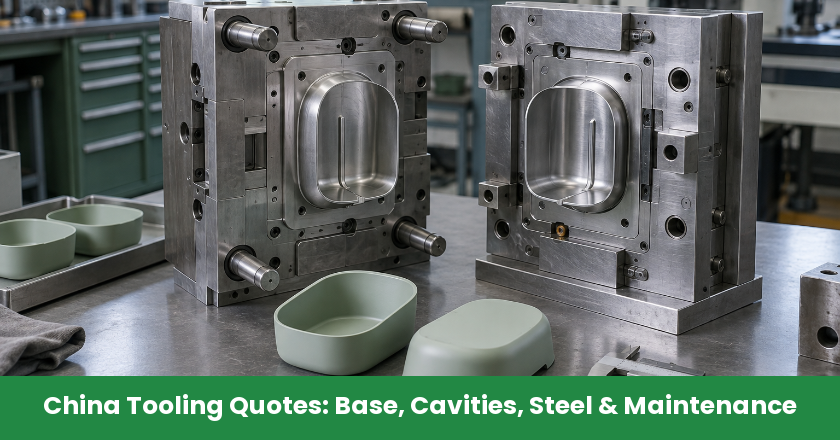
A lower tooling price can be a genuine saving, or simply a quote for less work. Before awarding a China molding project, compare what the mold must produce, which build and trial costs are included, and who pays to keep it producing acceptable parts.
An injection-molding tooling quote is an offer to design and build a specified mold, with defined components, trial work and acceptance conditions. It is separate from the price of production parts unless the offer explicitly combines them.
The useful comparison is not steel grade against steel grade. It is the cost of technically suitable alternatives over a credible production program.
Choose the Tooling Scope Before Comparing the Price
Two tooling quotes are comparable only when they address the same product, required output, acceptance criteria and maintenance boundary. Reject an option that cannot meet those requirements before comparing its price, then separate committed demand from an optimistic forecast. This prevents a cheap build from winning on omitted work, or an expensive high-output tool from winning on volume the buyer may never order.
- Mold base: identify the supplied assembly, machining and press interfaces.
- Cavities: evaluate saleable output and demand, not cavity count alone.
- Steel: specify the working material and its condition, not just a trade name.
- Maintenance: price the included work, exclusions and production interruption.
Separate the Mold Build From Production and Upkeep
A tooling quote should separate the mold build, trial and correction allowance, production part price and ongoing maintenance. Steel and cavity choices affect both construction expense and recurring production cost, while maintenance determines what remains payable after acceptance. Comparing these categories on the same basis reveals whether a lower total reflects efficient manufacture, a different technical solution or missing work.
The public scope of ISO 16916 describes injection mold specification data for tender and ordering, including machine-specific data, operation and warranty. That breadth is useful when preparing a purchasing brief; it does not make every provision a mandatory requirement for every project.
| Quote line | Confirm before comparing | Potential omission |
|---|---|---|
| Mold base | Complete assembly or inserts; machining and interfaces | Finishing, adapters or required components |
| Cavities | Layout, runner design and qualified output | A larger press or unproven cycle assumption |
| Steel | Grade, supplier, condition and treatment | Heat treatment, surface work or evidence |
| Maintenance | Tasks, period, replacement parts and responsibility | Wear items, repair, storage or downtime |
Ask for an inclusion list even if the supplier will not disclose its internal machining hours or margin. Commercial transparency means knowing the deliverable and exclusions, not necessarily obtaining a factory's confidential cost accounting. Record the drawing revision, resin, finish and volume assumptions beside the offer so a later price revision can be traced to an actual change.
A discount without a scope change reduces price. A discount achieved by removing a trial, reducing output or changing the steel changes the purchase itself. Keep these proposals separate during negotiation.
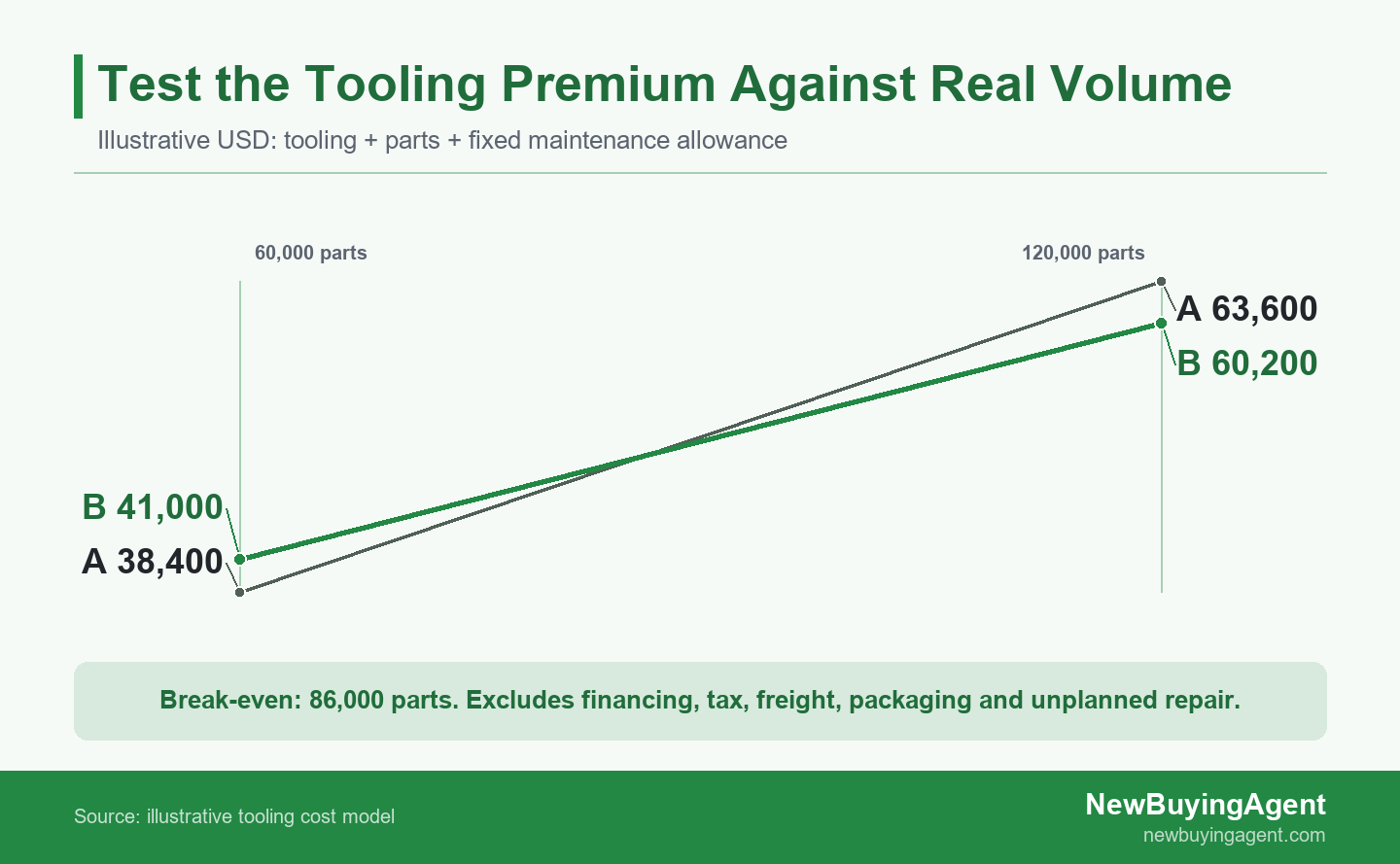
Illustrative tooling options change cost order between 60,000 and 120,000 parts, with break-even at 86,000 parts
Mold Base: Confirm What Is Supplied and What Fits the Press
The mold base is the supporting plate assembly and structural hardware around the working inserts, and its quoted scope must be explicit. Confirm whether the buyer is purchasing a complete base or an insert set for an existing system, then identify required machining and machine interfaces. Two offers with similar outside dimensions can still include different finishing, cooling, ejection or mounting work.
A useful manufacturer-specific example appears in DME's mold-base FAQ: its MoldBasics offering has simplified features, and the mold maker must finish-grind the parting-line surfaces. This is not a rule for all standard bases. It shows why a component label alone cannot establish how much work remains before the mold is ready.
Request the proposed base series or design, plate materials and dimensions, plus the interface information required by the intended molding machine. The toolmaker and molder should confirm mounting, daylight, ejector arrangement and connections, rather than leaving the buyer to infer compatibility from a photograph. If an insert-only offer relies on a factory-owned base, ask whether that base's use is included in the production price.
Custom features need a reason: the part may need side actions to release an undercut, extra support, or a cooling layout that cannot be accommodated by a simpler assembly. Ask which product or process requirement each addition solves. Conversely, do not remove a feature merely to make the tooling line cheaper if the resulting design cannot release, cool or hold the part consistently.
Cavities: Pay for Usable Output, Not Just More Impressions
More cavities are worth paying for when their qualified output serves credible demand at an acceptable total cost. A cavity is an impression that produces a part during a molding cycle, but additional impressions do not guarantee proportional savings. The proposed layout must work with the part geometry, molding machine, cycle time and acceptable-part yield, while remaining practical to maintain.
Protolabs' multi-cavity guidance explains the higher initial tooling cost and the need for a balanced runner system so cavities fill evenly. A runner carries molten plastic toward the cavities; a hot runner is a heated melt-delivery system. Its components, controls and maintenance requirements should be named if included in the proposed tool.
Ask the supplier to show the assumptions behind the quoted part price: active cavities, cycle time, acceptable-part yield, machine size and available production hours. Saleable output depends on all of them. A nominally faster tool can lose its advantage if difficult filling or cooling increases rejects, or if it requires a machine that is not available when the order must run.
Separate technical capability from reserved capacity. A successful trial demonstrates what the setup can do under the tested conditions; it does not prove that the factory has allocated enough production time for the buyer's delivery schedule. Obtain a production plan as well as the technical estimate before treating a higher-cavity proposal as a delivery solution.
For a brand developing a molded household accessory range, NewBuyingAgent's local factory resources and product-development capability connect these requirements to a practical product-supply service. The purchasing objective is a competitively priced product that meets quality and delivery needs, with tooling choices tied to the delivered product rather than the mold invoice alone.
Steel: Specify the Grade, Condition and Evidence
Specify the mold-base material separately from the working cavity and core inserts, then state the supplied condition, required treatment and supporting evidence. A single steel name beside a lump-sum price leaves too much unresolved for meaningful comparison. Selection must fit the product and process, while the quoted treatment route must explain how the specified material becomes the finished working tool.
Match the Steel to Resin, Finish and Wear
Choose steel properties around the actual resin, surface finish and wear conditions. A grade label is not a guarantee of mold life: the tool design, processing conditions and maintenance still matter. Ask the toolmaker to explain its selection for the working inserts and identify any different materials used for high-wear or replaceable features.
Uddeholm's plastic-molding guidance identifies corrosion, temperature changes and wear as steel-selection challenges. These are distinct concerns, so the buyer should not reduce the decision to whether one quoted steel sounds harder or more expensive.
Provide the exact resin and filler specification, cosmetic requirements and relevant product tolerances. Request the steel producer or agreed equivalent, certificate traceability and any specified hardness evidence. If an alternative material is proposed, require an explained technical substitution instead of silently accepting a similar-looking trade name.
Price the Supplied Condition and Treatment Route
The supplied condition determines which treatment steps remain necessary and therefore which costs belong in the offer. Identify any required heat treatment, stress relief, surface treatment, polishing or texture work, with the responsible supplier and acceptance evidence.
For example, Uddeholm describes Impax Supreme as a prehardened mold steel. That specific supply condition illustrates why two treatment routes should not be priced as if they were identical; it does not mean every prehardened tool needs no further processing.
Match each charged operation to the specified route. This catches both omitted work and vague treatment allowances that cannot be connected to the delivered inserts.
Maintenance: Define the Work Behind the Promise
“Free maintenance” is useful only when the quotation defines the tasks, coverage period and exclusions. Separate routine cleaning and inspection from wear-part replacement, accidental damage, major repair and changes to the product design. Identify who authorizes paid work and how production is managed while the mold is unavailable, because an unpriced interruption can matter more than a modest service fee.
Maintenance can affect production economics before a tool visibly fails. DME's cooling-channel guidance explains that scale and corrosion can lengthen cycles and increase scrap. This supports asking how cooling performance is checked, not assuming that an externally clean mold retains its original output.
Request the toolmaker's maintenance recommendations for the actual mold and resin, rather than imposing a universal shot interval. The commercial agreement should say whether maintenance is already included in the part price, charged per service, or covered within a defined production program. Do not add an allowance again when the same work is already included elsewhere.
For replaceable components, identify the items, availability and estimated lead times. Ask what evidence follows service: a dated work record, replaced-part list, relevant condition photographs and production checks appropriate to the work. A service record shows that work occurred; acceptable parts and stable operation show whether the mold can return to the required job.
When a buyer keeps an established Chinese factory but sees changing finish or recurring rejects, NewBuyingAgent's existing-factory management service connects local follow-up with product quality control and delivery coordination. The factory remains responsible for technical mold servicing; the buyer needs the resulting production condition reflected in the wider supply plan.
Test the Tooling Premium Against Committed Volume
When choosing on cost alone between technically acceptable options, the tooling premium must be recovered through credible savings over the production program. Calculate the break-even volume—the number of parts at which the compared totals match—using the same cost boundary for both offers. A quality or delivery requirement can justify another choice, but a technically inadequate low-cost mold is not a valid alternative in the calculation.
Illustrative Example: A Lower Part Price Does Not Settle the Award
Consider an illustrative example involving a consumer brand sourcing a molded household accessory from China: 60,000 parts are committed, while the possible program totals 120,000 parts. The drawing and resin are fixed, but two tooling options still await qualified-output confirmation. The buyer is comparing investment choices, not reported market prices or a completed customer project.
Option A has a $12,000 tooling price, a $0.42 part price and a $1,200 maintenance allowance for the modeled program. Option B has $20,000 tooling, a $0.32 part price and $1,800 maintenance. These maintenance allowances are held fixed in both volume cases for illustration; real changes in maintenance cost would shift the threshold. Both part prices cover the same acceptable product without the separately listed maintenance, but the proposed cycle, yield and available capacity remain to be demonstrated.
B requires $8,000 more tooling plus $600 more maintenance, against a $0.10 saving per part: ($8,000 + $600) / $0.10 = 86,000 parts to break even. At 60,000 parts, A totals $38,400 and B $41,000; at 120,000 parts, A totals $63,600 and B $60,200. On cost alone, retain A for the committed order if it meets capacity and acceptance requirements; reassess B when credible demand exceeds the threshold.
The buyer therefore replaces the headline part-price comparison with these same-scope totals. Before the tooling order, confirm the resin, drawing, engineering basis for the quoted output and trial acceptance plan; after the mold is built, verify cycle time, yield and acceptance results before production approval. This illustrative example excludes financing, tax, freight, packaging and unplanned repair from both alternatives; evaluate any differential separately rather than assuming those costs are equal. The result is a conditional economic choice, not a guarantee of production performance.
Approve the Tooling Quote With a Testable Acceptance Plan
Release the tooling order against a controlled drawing revision, a complete priced scope and an acceptance plan that can test the promised product and output. Name the required measurements, functional checks, cosmetic criteria and production conditions before the trial. A visually attractive sample is not enough if the quote depends on a cycle, yield or cavity arrangement that has not been demonstrated.
The public scope of ISO 20457:2026 addresses tolerances and acceptance conditions for molded plastic parts. Decide with the responsible engineering team which requirements and standards apply to the product; merely adding a standard number to an order does not replace an agreed drawing and inspection method.
Before approval, resolve exclusions that could change the award: trial material, included corrections, texture approval, spare components, storage and the maintenance boundary. Keep unresolved technical assumptions visible rather than converting them into apparently firm savings. The final decision should identify both the selected offer and the conditions that must be demonstrated before production acceptance.
For a molded-product sourcing project, NewBuyingAgent's local factory resources and product/QC capability support a supply quotation aligned with the required product quality and delivery plan, with tooling assumptions included in that purchasing discussion. Prepare the product drawing, resin and finish requirements, quantity and forecast, target price, destination and delivery timing, then request a product quote from NewBuyingAgent.
Frequently Asked Questions
Can one family mold replace separate tools for a lid and a base?
Only if the different components can be molded together reliably and their demand stays compatible. A family mold produces different parts in one tool, unlike repeated cavities for the same part. Ask the toolmaker to assess material, filling and cycle compatibility. Also check reorder ratios: producing an unwanted component whenever the other is needed can offset the initial saving from avoiding a separate tool.
What if the part drawing changes after the tooling quote?
Request a revised scope before treating the original price as current. Identify the changed revision and ask whether the change affects inserts, side actions, cooling, finish or trials. Separate work already completed from new work, and confirm the schedule and acceptance implications. A revised quotation should explain the delta; it should not silently replace the technical assumptions behind the original award.
Does paying for the mold include all trial samples?
Only the written trial allowance defines what is included. Confirm the trial resin, sample quantity, measurement reports, sample transport and any permitted correction rounds. Distinguish corrections needed to meet the agreed specification from buyer-requested product changes. Also ask whether additional production-like runs are needed for acceptance, because a small initial sample set may not establish sustained output under the proposed manufacturing conditions.
Should the tooling payment schedule follow calendar dates?
Tie meaningful payments to agreed deliverables as well as dates. The commercial parties can define evidence for design approval, build progress, trials and acceptance, then specify how unresolved deviations affect the next milestone. Avoid making a shipment photograph stand in for product acceptance. Payment terms still need agreement with the supplier and appropriate commercial review; the objective is a clear connection between progress and the purchased result.
NewBuyingAgent
Related Resources

今日始める
あなたの調達目標を現実に変えましょうWeChat:+86 15157124615
WhatsApp:+86 15157124615
住所:中国、杭州、祥園路39号10号館
