

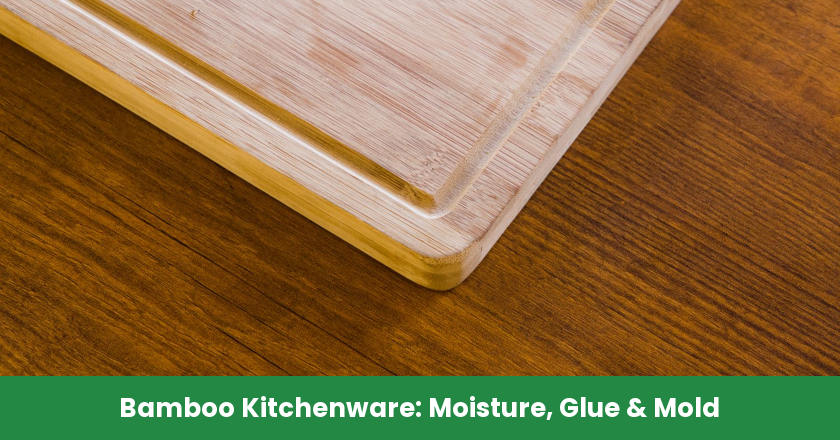
A bamboo kitchen product specification should tell the factory how to measure moisture before bonding and before packing, which adhesive and finish it can use, and what evidence releases the goods. Start with the actual construction. A one-piece utensil, a board made from bonded bamboo strips and a molded plastic bowl with bamboo filler need different checks. Then define how the finished lot and its packaging will be protected from moisture on the way to your warehouse.
Specify the Board, the Bond, and the Pack
A buyer can approve a bamboo kitchen product when the specification identifies the construction, sets measurable moisture limits by stage, and names the adhesive and evidence for its intended use. The specification also describes how the goods will stay dry through packaging and transit. Each requirement needs a defined point of inspection and a decision when the result falls outside the agreed limits.
- How it works: Measure at the material stage and again on finished goods before packing under a validated method.
- Risk: Wet stock, unidentified adhesives or damp packing materials can undermine a sample that looked acceptable.
- Decision: Hold affected or untraceable goods until the buyer can verify the correction and release the defined lot.
Use the intended retail claims as an input. A chopping board for repeated food preparation, a utensil intended for hot liquids and an organizer for dry storage present different contact and care conditions. Record the destination, foods or conditions of use, expected cleaning, and the handling the actual product will need. These choices affect what the supplier has to document and what a lab can reasonably test.
Identify the Construction Before Choosing Tests
Construction determines which evidence belongs in a bamboo kitchen product file. A one-piece item is cut or shaped from bamboo, a laminated item joins strips at glue lines, and a plastic composite has ground bamboo or fiber in a polymer matrix. Ask for a drawing or cross-section and a component list before deciding which tests or declarations apply. Trade descriptions alone leave the product's composition uncertain.
For a board, request a section showing the layer or strip orientation, glue lines, any insert and exposed edges. Mark every reasonably foreseeable food-contact area, including a rim or edge used during handling or serving. For a spoon, ask whether the bowl and handle are one piece or assembled. Capture the finish and any separate parts in both cases, with the current supplier and revision for each.
For plastic food-contact articles, the European Commission guidance on bamboo additives says articles containing unauthorized bamboo additives cannot be placed on the EU market. A visible grain pattern or the word 'bamboo' on the package leaves the construction unresolved. If an EU-bound molded article contains bamboo filler, hold approval until the compliance lead can establish the composition and its legal basis. A board made from bamboo strips has its own assessment, including the finished surfaces and any exposed adhesive.
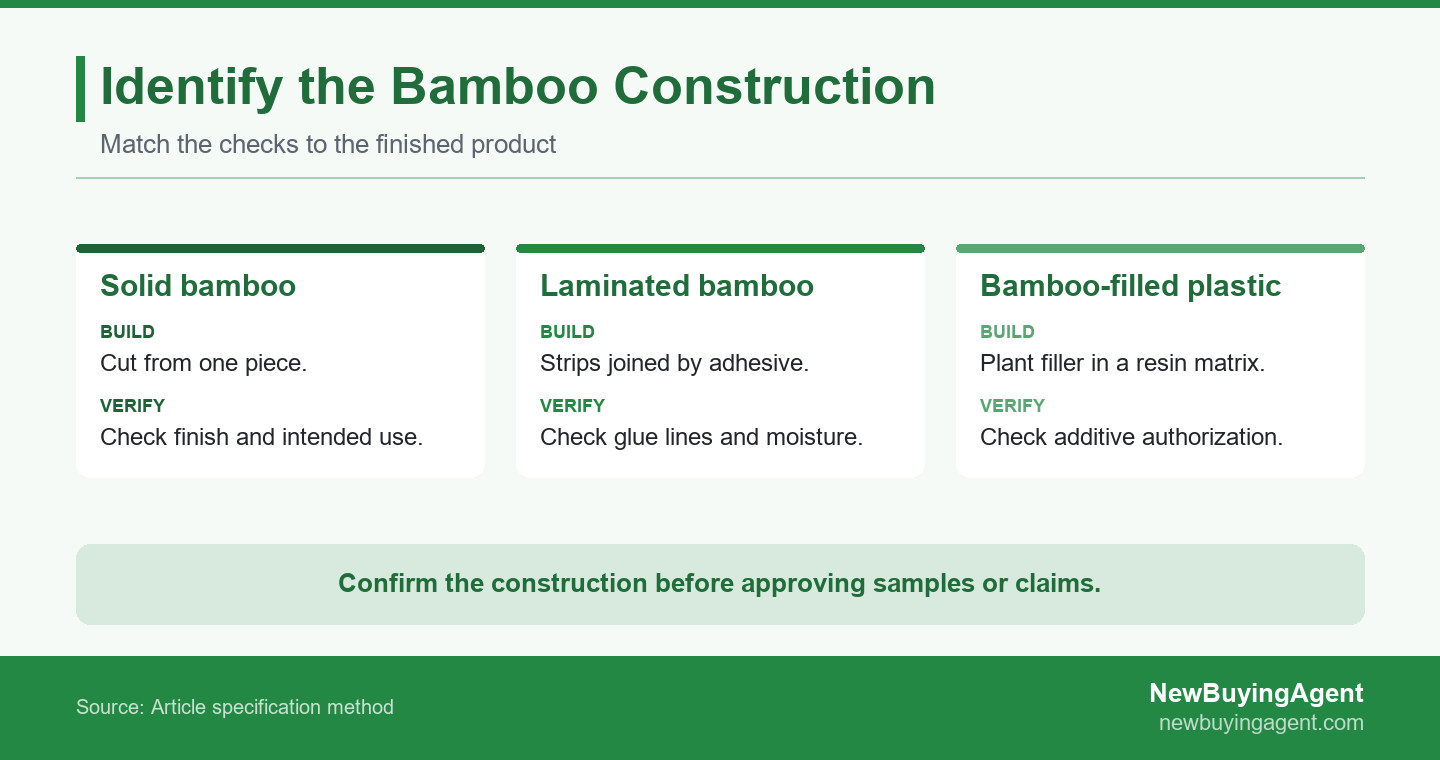
Bamboo construction determines the moisture checks, glue-line evidence and food-contact review the buyer needs
Identify decorative hardware, feet and the finish even when the core is simple. Ask the supplier to disclose treatments used on the bamboo and which treatments can remain in the finished article. If a supplier proposes switching from bonded strips to a formed material to hit a price, obtain a fresh quotation with its own bill of materials and intended-use evidence. Keep the alternate separate in the purchase file.
Measure Moisture Before Bonding and Packing
A moisture limit needs a stage, measurement method, sampling plan and acceptance rule. For laminated goods, set separate requirements for strips before bonding and finished goods before packing. A dry basis percentage expresses the mass of water relative to the dry specimen mass. Record that basis with every limit, and agree how the inspector will measure at the named points and handle out-of-range readings.
The US Forest Service handbook on moisture control describes how the water remaining in dried wood tends toward equilibrium with surrounding humidity and how handling and storage can limit later changes. Use that principle to plan a second check on bamboo after conditioning and storage. Set actual limits and test settings from evidence for the bamboo species, construction, factory process and expected use and transport conditions.
The ITTO technical manual on processing bamboo also links excess moisture in woven bamboo mats to mold during storage and discusses drying to meet later processing requirements. The example concerns mats for manufacture. A buyer of laminated boards should ask the factory to show its validated moisture range at bonding and why that range suits the adhesive and press process for the actual board.
| Stage | Agree the method and location | Hold trigger |
|---|---|---|
| Before bonding | Check representative conditioned strips from the named drying lots and stack positions. | A point or lot falls outside the approved bonding rule. |
| Before packing | Check finished pieces after the agreed conditioning time. Include thicker sections and preselected carton groups. | A verified reading exceeds the packing limit or the lot cannot be traced. |
| On arrival | Record the carton position and condition. Use the agreed receiving method where readings are needed. | Damp packaging, suspected growth, joint damage or a failed receiving check. |
Choose a method the buyer can reproduce. A handheld meter can be useful after its readings have been checked against an appropriate reference method for that product. Record the instrument, settings, verification date and measurement depth or location. With a laminated or coated product, validate what the instrument detects in the presence of layers, adhesive and finish. Have a qualified lab or authorized quality team resolve disputed or near-limit results using the agreed reference procedure and specimen handling.
Ask for individual readings and their locations, together with the count and range. Sample across the traceable lot according to the written plan, which may cover different loads, stacks or carton positions. A record with only a shift average is difficult to use when the criterion applies to each checked point.
For a multi-SKU board or utensil program, NewBuyingAgent's China product sourcing and supply uses cooperating factories and covers sourcing, quality control and logistics. Give the team the finished construction and separate bonding and packing checks upfront. Those requirements help the buyer compare feasible builds and agree which inspector records should follow each lot.
Qualify the Adhesive and the Finished Glue Line
Adhesive approval needs the exact formulation identity, the process used at the glue line, and evidence for the finished product's intended food-contact conditions. A glue line is the joint where adhesive bonds two pieces. Identify where it can be exposed during ordinary use or wear. Bond durability under expected care conditions and food-contact suitability both affect approval, and each needs its own evidence.
Record the supplier, commercial name or formulation code, lot, intended substrate, and approved production process. The factory's instructions should control the applicable preparation, application, press and cure conditions. Ask for trial and production records that tie those conditions to the boards actually made. If composition is confidential, have the supplier provide the necessary information directly to the responsible lab or compliance reviewer under appropriate confidentiality terms.
Specify the outcome after use and cleaning. For example, a hand-wash board may be evaluated after a representative wet-and-dry sequence, with limits for visible separation, cracking or unacceptable deformation and a stated method for checking flatness. Choose sample conditioning, method and pass criteria with the quality team. Where the product is sold as dishwasher safe, use a test that supports that exact claim and the marketed construction.
For the United States, the FDA guidance on food-contact components describes determining the applicable basis for substances reasonably expected to migrate to food under the intended use. Ask for documentation that names the adhesive and the use conditions for which that basis is relied on. If a supplier refers to a food-packaging adhesive rule, verify that the rule's scope and restrictions cover the proposed use, including whether the joint can contact food.
The European Commission food-contact framework summary describes EU principles that limit release that could harm health or lead to unacceptable changes in food. For the finished article, have a qualified reviewer determine applicable requirements, including material-specific or national measures where relevant. Confirm what finished product evidence is needed based on the surfaces, foods, duration, temperatures and repeat use for your market.
Review report identity before comparing results. Match the SKU, drawing revision, adhesive and finish codes, lab specimen, method and contact conditions. Treat any different adhesive or finish as a change to assess. A supplier technical sheet and safety data sheet can inform that assessment. Ask the responsible reviewer to identify any missing basis, supporting documentation or tests before approving the marketed use.
Control Moisture From the Packing Line to Arrival
Mold control begins with dry goods and packaging at the packing line and continues through storage, loading and receiving. Define what the supplier measures, what the loading team documents, and what the warehouse must isolate at arrival. Product moisture and air humidity describe different things. A spot check of the carton air alone cannot establish how much water is in a board.
After the approved drying and conditioning steps, separate lots by status and protect them from rewetting. Check cartons, liners, pads, pallets and other packing materials before use. Specify where finished goods may sit before sealing and which checks must be repeated if storage conditions or the waiting period exceed the agreed controls. Include the lot and packing date on the carton so a later complaint can be traced.
The joint CTU Code on cargo packing discusses moisture entering the load through cargo and materials and cautions that desiccants generally cannot compensate for hygroscopic cargo packed too wet. Agree a pack suited to the route and seasonal exposure. Where the design uses a liner or desiccant, specify how it was qualified, how the pack closes, and how the items are kept secure and away from direct food contact.
At loading, check that the container and packing area are dry and record any signs of leakage, wet flooring or damaged cartons before stowing the goods. Decide how to document the container ID, where carton groups are placed, and what happens if the load is exposed during loading. For a pilot shipment, use the agreed arrival inspection and any approved temperature or humidity logging to check the selected pack on the intended route.
At receipt, record water marks, damaged packaging, odor and any suspected surface growth with carton IDs and photos. Isolate affected and potentially related goods until quality and the responsible product-safety team determine the scope and disposition. The warehouse should preserve samples and records and follow the approved handling procedure. A photo may support a hold while the cause remains under investigation.
Hold a Packing Batch That Misses the Moisture Limit
A per-point moisture maximum controls the decision even when the batch average looks acceptable. In a hypothetical board lot the signed maximum is 12% at each checked point and readings are 9%, 10%, and 14%, so one point fails even though the mean is 11%. The inspector holds the affected group while the result and lot scope are checked.
First, check the meter, method and marked location, then confirm the result using the agreed procedure. Trace the board to the drying load, staged pallet and carton group. If records identify a separate affected group, hold that group and apply the approved inspection plan to adjacent or related stock. If the boundaries cannot be established, broaden the hold until records and testing support a defensible disposition.
Ask the factory to investigate whether the failure reflects residual moisture, rewetting in storage or a measurement problem. Redrying or reconditioning a finished board needs an approved plan that checks warping, finish and glue lines as applicable. Recheck the individual points and any other affected criteria before repacking. Record who approved the disposition, which cartons were cleared, and what must change before the next load.
Put the Checks Into the Purchase Specification
A purchase-ready specification turns material, moisture, adhesive and packing requirements into instructions by SKU and lot. It identifies what must be shown at prototype, pilot, shipment and arrival. Each stage needs a responsible party, a versioned record and a release rule. The buyer can then check whether the goods match the sample and whether the supplier controlled the intervening storage and packing steps.
| Copyable field | Fill in for each SKU or lot |
|---|---|
| Use and destination | [Food-contact surfaces, intended foods, time and temperatures, cleaning, markets and claims] |
| Construction | [Species where required, strip or layer drawing, exposed surfaces, finish and revision] |
| Moisture checks | [Stages, method, basis, locations, sampling, limits and hold rule] |
| Adhesive and finish | [Supplier and codes, process and lots, bond checks and intended-use evidence] |
| Pack and loading | [Dry stock and materials checks, cartons and liner, route, loading and lot evidence] |
| Change and release | [Test reports and sample IDs, receiving checks, deviation owner and shipment authority] |
Require a revised sample or other appropriate evidence when a material or handling change can affect the approved article. Link the decision to the first affected lot. At shipment, review the finished-goods moisture readings taken before packing, lot records, unresolved deviations and loading evidence. Receiving then checks arrival condition against the separately stated instructions.
For an assortment moving from a sample to regular production, NewBuyingAgent's manufacturing and quality-control background and local cooperating factory resources can support product sourcing against consistent buyer requirements. A shared construction record and lot-based moisture and packing checks give the supplier and quality team a basis for comparing repeat runs.
To discuss an order from China, send the bamboo kitchenware specification to NewBuyingAgent with the product drawing, quantities, destination, cost target, schedule and key checks. Identify the approved finish and intended use, along with any variants the factory may quote. That makes the supply and verification scope specific enough for a useful conversation.
Frequently Asked Questions
What moisture percentage should I specify for bamboo kitchenware?
Set a product-specific target and limits against a validated method and intended conditions. For laminated goods, start with separate requirements before bonding and before packing. Use supplier process evidence and product trials, then record the basis, points, sampling and how to confirm doubtful readings. Recheck the limits when the construction or shipping exposure changes.
Is the adhesive safety data sheet enough for approval?
An adhesive safety data sheet is insufficient for food-contact approval. It supplies hazard and handling information. Ask for the regulatory basis and any needed testing or documentation for the exact adhesive, finished article and intended market. Confirm that the evidence covers the contact surfaces and use conditions shown in the purchase specification.
Can extra desiccant fix boards that are already too wet?
Extra desiccant cannot substitute for meeting the board's specified moisture limit before packing. Hold the affected group and confirm the result under the agreed method. Any approved reconditioning needs verification of the resulting boards. Use desiccants only as part of a qualified pack for dry goods and the conditions expected on the planned route.
What changes should trigger a new approval for bamboo kitchenware?
Changes that can affect the finished article or transport exposure should trigger a review of the qualification scope. That can include a different adhesive, finish, board thickness, liner or carton configuration. Decide which checks need to be repeated and revise the approval and lot records before shipping the changed build.
NewBuyingAgent
関連リソース
今日始める
あなたの調達目標を現実に変えましょうWeChat:+86 15157124615
WhatsApp:+86 15157124615
住所:中国、杭州、祥園路39号10号館
