

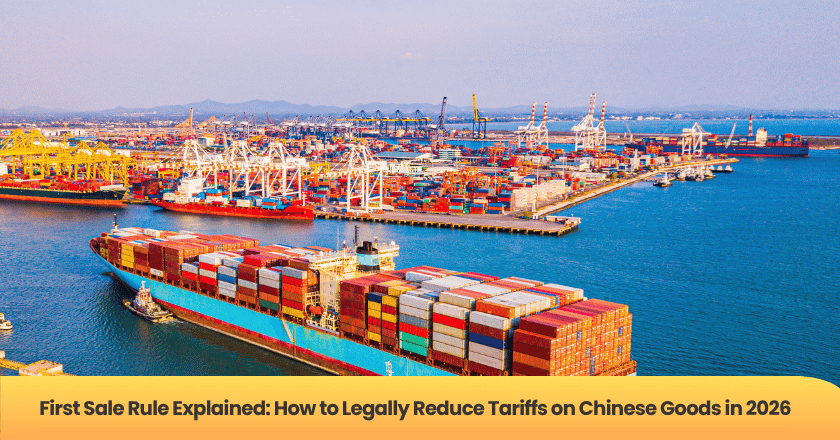
A 30-year-old US customs doctrine quietly cuts the dutiable value of Chinese imports by 15–25% — and most small importers don't know it exists. Here's how it works, who qualifies, and what documentation CBP actually wants.
Key Takeaways
• The First Sale doctrine — established by Nissho Iwai American Corp. v. United States (CAFC, 1992) — allows US importers to declare the factory-to-middleman price as the dutiable value, rather than the higher middleman-to-importer price, in qualifying multi-tier transactions.
• The savings apply to every ad valorem duty layer: MFN base rate, Section 301, Section 122, and Section 232. On a typical Chinese-sourced product with a 35% effective duty stack and 20% middleman markup, First Sale cuts duty by ~7 percentage points of the final landed cost.
• Three legal conditions must hold: (1) the first sale is a bona fide arms-length transaction, (2) the goods are clearly destined for the US at the time of the first sale, and (3) the middleman bears the risks of ownership rather than acting as a mere purchasing agent.
• CBP requires a complete paper trail: factory invoice, factory's purchase order from middleman, middleman's purchase order from US importer, payment records along the chain, shipping documents showing US destination, and contracts establishing the legal relationships.
• For related-party transactions (factory and middleman owned by the same group), CBP scrutiny is higher — transfer pricing studies and income statements may be required to prove arms-length pricing.
• The economics work for orders above roughly USD 30,000 in dutiable value. Below that, documentation costs (legal review, audit-ready paper trail) often exceed the duty savings.
• Commission-free sourcing agents — those charging a flat service fee with the factory invoice passed through unchanged — make First Sale documentation easier because the underlying factory invoice is already visible and unmarked-up. Commission-based agents create First Sale problems by their structure: hidden margin in the factory invoice contradicts the arms-length requirement.
The First Sale doctrine is one of those tools in international trade that exists in plain sight but is invisible to most importers because no one tells them about it. CBP doesn't volunteer it. Most customs brokers don't proactively flag eligibility. Suppliers and middlemen often resist it because it requires them to disclose pricing they prefer to keep opaque. But for any US importer buying Chinese goods through a multi-tier supply chain — manufacturer → trading company → US buyer — First Sale can legitimately cut tariff exposure by 15–25% without changing anything about the goods themselves.
In 2026, with Section 301 still permanent at 25% on most categories and Section 122 adding another 10% on top, the duty savings from a successful First Sale claim are larger than they have ever been. A buyer paying a $100 unit price (where the factory's first sale to the middleman was $80) declares the $80 as the customs value. Every ad valorem duty — MFN, Section 301, Section 122 — is calculated on $80 instead of $100. On a 35% effective rate, that's $7 per unit in saved duty.
This guide walks through what First Sale is, who qualifies, what documentation CBP requires, where the math works (and where it doesn't), and how to set up a supply chain that supports First Sale claims without creating other compliance problems.
Part 1: What First Sale Is, in One Paragraph
In a multi-tier international transaction — for example, a Chinese factory selling to a Hong Kong trading company, which then resells to a US importer — the legal "transaction value" used for US customs duty calculation is normally the price paid by the US importer to the immediate seller (the trading company). That's the "last sale" price. The First Sale doctrine, established by the US Court of Appeals for the Federal Circuit in Nissho Iwai American Corp. v. United States (1992), permits the US importer to use an earlier sale in the chain — the factory-to-middleman sale — as the dutiable transaction value, provided certain conditions are met.
The economic intuition is straightforward. The middleman's markup over the factory price represents the middleman's profit, not the underlying value of the goods. CBP allows the importer to be assessed duty on the underlying value, not on the markup, so long as the structure of the transaction satisfies legal arms-length conditions.
Part 2: The Three Legal Conditions
CBP and the courts have articulated three core conditions that a transaction must satisfy for the first sale price to qualify as the customs value.
Condition 1: Bona fide arms-length sale
The first sale (factory to middleman) must be a real commercial transaction negotiated at arm's length, not a sham, an internal transfer, or an arrangement designed solely to manipulate customs valuation. CBP examines the circumstances of the sale: whether the price was negotiated, whether risk was actually transferred, whether the middleman has independent business reasons to participate.
For unrelated parties, there is a strong presumption that arms-length conditions are satisfied. The factory and the middleman have separate ownership, separate management, separate financial interests; their transaction is presumed to be at arms-length unless evidence shows otherwise.
For related parties — for example, a factory and a Hong Kong trading subsidiary owned by the same group — the presumption flips. CBP applies a heightened standard, often requiring transfer pricing studies, income statements showing the middleman has a genuine profit margin, and documentation that the inter-company price approximates what unrelated parties would have agreed to.
Condition 2: Goods clearly destined for the US
At the time of the first sale, the goods must be clearly destined for export to the United States. This is essential. The first sale doctrine doesn't apply if the factory simply sells to the middleman who then decides later to ship to the US — the goods must be intended for US importation at the time the factory transaction occurs.
CBP looks for documentary evidence of US destination at the first-sale stage: purchase orders specifying the US buyer, shipping marks indicating US destination, packaging and labeling intended for the US market, US-specific certifications (FCC, FDA, etc.) being arranged at the factory level. If the factory could plausibly have sold the same goods to a buyer in another country, the US-destination requirement may not be satisfied.
Condition 3: Middleman bears risks of ownership
The middleman must be a real principal in the transaction — taking title to the goods, bearing financial risk, having control over the goods at some point — rather than a mere purchasing agent acting on the US importer's behalf.
The distinction matters. A purchasing agent who buys goods on behalf of the US importer (and is compensated by commission) is functionally an arm of the US importer; the "first sale" in that structure is really the factory's sale to the US importer with the agent in the middle. A trading company that buys goods on its own account, takes ownership, then resells to the US importer is a separate principal — and its purchase price from the factory is a legitimate first sale.
Tests CBP applies: Who pays the factory? Who bears the risk of supplier failure or quality defects? Who legally owns the goods between factory and US importer? Who insures them in transit? Who decides where they go? A middleman who answers "the US importer" to all of these is functionally an agent and the structure does not support First Sale.
Common Mistake: Buyers assume that any supply chain with a Chinese factory and a Hong Kong or Singapore trading company automatically qualifies for First Sale. It doesn't. Many of these structures are pure agency arrangements where the trading company never actually takes ownership of the goods — they're just a billing intermediary or a banking convenience. CBP audits look at the substance of the relationship, not the form. If the trading company's name appears on invoices but the US buyer is the one bearing all risks and making all decisions, the First Sale claim fails.
Part 3: How Much Duty First Sale Actually Saves
The savings depend on the middleman's markup and the duty rate stack. A worked example clarifies the math.
A US importer buys 1,000 units of consumer electronics through a Hong Kong trading company. The trading company buys from a Shenzhen factory at $80 per unit; the trading company sells to the US importer at $100 per unit (a 25% markup). HTS code: 8517.13 (smartphones-related, 0% MFN base, 25% Section 301).
| Calculation basis | Last sale ($100/unit) | First sale ($80/unit) |
|---|---|---|
| Goods value | $100,000 | $80,000 |
| MFN duty (0%) | $0 | $0 |
| Section 122 (10%) | $10,000 | $8,000 |
| Section 301 (25%) | $25,000 | $20,000 |
| MPF (0.3464%) | $346 | $277 |
| Total duty | $35,346 | $28,277 |
| Savings | $7,069 (20% reduction) |
On this representative order, First Sale saves $7,069 — about 7% of the total invoice value, or 20% of the duty otherwise owed. For a buyer placing 4 such orders per year, annual duty savings are around $28,000.
Where the savings are larger:
• High-tariff categories. Apparel (HTS 6109.10 at 16.5% MFN + 25% Section 301 + 10% Section 122 = 51.5%) sees larger absolute savings because each percentage point of saved value compounds across more layers.
• Larger middleman markups. A 30% markup saves more than a 15% markup. Trading companies that historically operated on thin margins create less First Sale opportunity than those with substantial markup.
• Larger order sizes. Documentation costs are mostly fixed; savings scale with order volume.
Where the savings are smaller or negative:
• Direct factory sourcing. No middleman, no first sale to declare. First Sale doesn't apply when there's only one sale in the chain.
• Low-tariff categories. A product with 0% MFN and exclusion-protected Section 301 has very little ad valorem duty for First Sale to reduce.
• Small orders. Below USD 30,000 in dutiable value, the legal review and documentation overhead often exceeds the duty savings.
Part 4: What Documentation CBP Requires
CBP can audit any First Sale claim, and audits do happen. The importer bears the burden of proving the first sale price is acceptable. A complete documentation package includes:
The factory's commercial invoice to the middleman. This is the primary evidence of the first sale price. The invoice must clearly identify the factory, the middleman as buyer, the goods, the unit prices, and the total value.
The factory's purchase order from the middleman. The order document showing the middleman ordered the goods, with quantities, specifications, prices, and delivery terms.
The middleman's purchase order from the US importer. Showing the US importer ordered goods that the middleman then procured.
Payment records along the chain. Bank wire confirmations, letters of credit, or other proof showing money flowed factory ← middleman ← US importer. Mismatched payment chains (e.g., US importer paying the factory directly) are a major audit red flag.
Shipping documents showing US destination. Bills of lading, packing lists, and other transit documents indicating goods were destined for the US from origin.
Contracts establishing the relationships. Master purchase agreements, distribution contracts, or other documentation showing the legal nature of the factory-middleman and middleman-importer relationships.
For related parties: transfer pricing study. If the factory and middleman are owned by the same group, an economic study showing the inter-company price approximates what unrelated parties would have agreed to. This is typically prepared by an international tax firm and costs $5,000–$25,000.
Importer's First Sale entry filing. When the entry is filed, the customs broker indicates First Sale valuation and is prepared to substantiate it on audit.
The documentation burden is real. Most successful First Sale programs involve an upfront legal review (often $3,000–$10,000) to set up a defensible structure, followed by ongoing documentation discipline at the operational level.
Expert Tip: When negotiating with a middleman or trading company about adopting a First Sale-eligible structure, expect resistance. Middlemen typically prefer the opacity of last-sale pricing because it hides their margin from the US importer. They may claim First Sale "isn't possible" or "won't work for our category." Both claims are usually false — what they mean is "we don't want to disclose our buy price to you." The right counter is to frame First Sale as a partnership: the duty savings can be split between the importer and the middleman through pricing adjustments, making it a positive-sum change rather than transparency forced on the middleman. If a middleman categorically refuses any First Sale-supportive documentation, that's a signal to either renegotiate the relationship or move to a different middleman who will participate.
Part 5: Common Structural Problems That Disqualify First Sale
Five recurring patterns that we see disqualify otherwise-promising First Sale opportunities.
Problem 1: Middleman is functionally an agent
The trading company doesn't take real ownership. They invoice the US buyer but use the buyer's instructions for everything: which factory to use, what specifications, what price. Buyer pays the factory effectively (sometimes through a routing arrangement that puts the trading company's name on the wire transfer but the funds come from the buyer's account). The trading company receives a fixed commission rather than capturing markup risk.
This structure is a pure agency arrangement. The "first sale" — factory to trading company — isn't a real sale because the trading company never owned the goods. CBP audit will catch this and the claim fails.
Problem 2: Goods aren't clearly destined for US at first sale
The factory ships goods to the trading company's warehouse. The trading company holds inventory and decides later who to sell to. Sometimes US, sometimes Europe, sometimes Australia. At the time the factory sold to the trading company, the US destination wasn't established.
This structure fails Condition 2. The first sale wasn't a sale of US-destined goods; it was a sale of generic export-market inventory. The US importer must declare the last-sale (trading-company-to-importer) price as the customs value.
Problem 3: Related-party pricing isn't arms-length
The trading company is a Hong Kong subsidiary of the US importer's parent group. The intercompany price is set by transfer pricing policy, not by genuine commercial negotiation. Depending on the policy, the inter-company price may be set artificially low (to reduce US duty) or artificially high (for tax-efficiency in another jurisdiction).
If CBP determines the related-party price doesn't approximate arms-length pricing, they may reject the first sale claim and assess duty on the last-sale value (or, in some cases, on a CBP-determined fair value). Defensive structures require contemporaneous transfer pricing studies that meet the OECD arms-length standard.
Problem 4: Documentation gaps
The factory's invoice exists. The middleman's invoice exists. The payment records are partial. The purchase orders show inconsistent prices. Some shipments have shipping marks indicating US destination, others don't.
Imperfect documentation is the most common reason First Sale claims get challenged on audit. The remedy is operational discipline: every transaction in the chain must be documented contemporaneously, with consistent terms, and held in audit-ready files.
Problem 5: Sourcing agent compensation creates ambiguity
The buyer uses a sourcing agent based in China. The agent invoices the buyer for "factory price + service fee" but the factory price line includes hidden margin captured by the agent. When First Sale documentation is assembled, the "factory invoice" doesn't match the actual factory's books.
This structure is incompatible with First Sale. The first sale price must be the genuine factory price, not an agent-marked-up price. Buyers using commission-based agents who embed margin in factory pricing cannot run First Sale without restructuring the agent relationship.
Part 6: Setting Up a First Sale-Compatible Supply Chain
Three structural patterns that work for First Sale, in increasing order of complexity.
Pattern A: Independent trading company
The simplest workable structure. A Hong Kong, Singapore, or Taiwan-based trading company that operates as a real principal — owns inventory, bears risk, makes independent purchasing decisions — sells to the US importer. The factory invoices the trading company; the trading company invoices the US importer. Documentation is straightforward because the parties are unrelated and arms-length is presumed.
This structure works well for buyers who already use established trading companies (common in apparel, footwear, hardware, and traditional consumer goods categories where Hong Kong and Taiwan trading houses have decades of operating history).
Pattern B: Captive trading subsidiary with proper transfer pricing
A US-owned Hong Kong or Singapore trading subsidiary, set up specifically to support First Sale on the importer's volume. The subsidiary buys from Chinese factories at arms-length-comparable prices, takes title, then sells to the US parent at a transparent markup.
Setup requires: (1) genuine commercial substance in the trading subsidiary (employees, office, decision-making authority), (2) transfer pricing study supporting the inter-company markup, (3) proper accounting that shows the subsidiary earning real profit. Annual operating cost: typically $50,000–$200,000 for a small captive subsidiary, justified only when annual import volume exceeds $5–10 million in dutiable value.
Pattern C: Multi-step supply chain with verified arms-length transactions
For complex products where multiple stages of value-add happen across multiple jurisdictions, the supply chain may include factory → component supplier → assembly contractor → trading company → US importer. Each link in the chain can potentially be the basis for a First Sale claim, depending on which represents the "earliest sale destined for export to the United States."
This pattern requires careful legal analysis. Most importers in this category work with specialized customs counsel to structure the transaction flow and identify which sale qualifies as the first sale for valuation purposes.
Expert Tip: When evaluating sourcing agent structures for First Sale compatibility, ask one direct question: "Will the factory invoice you pass through to me reflect the actual price the factory charged you, with no markup on top?" Commission-free agents — those charging a flat service fee, factory invoice passed through unchanged — answer yes; the factory invoice is the real one. Commission-based agents typically can't honestly answer yes because their compensation depends on hidden margin in the invoice. The structural cleanliness of commission-free models makes them First Sale-compatible by default; commission-based models often require restructuring before any First Sale claim is defensible.
Part 7: When First Sale Doesn't Make Sense
Three scenarios where First Sale is the wrong tool.
Scenario 1: Direct factory sourcing
If you buy directly from the Chinese factory, there is no first sale to declare — your purchase is the only sale, and its price is necessarily the customs value. First Sale only exists in multi-tier structures.
Scenario 2: Total annual dutiable value below ~$200,000
The fixed costs of First Sale (legal setup, transfer pricing study if applicable, ongoing documentation discipline) typically run $5,000–$25,000 per year. At low volumes, the absolute duty savings don't justify the fixed costs. The break-even depends on your specific markup and duty rate but generally falls around $200,000 per year in dutiable value.
Scenario 3: Categories with low ad valorem duty
For products with 0% MFN and a Section 301 exclusion in place (or 0% Section 301 because the HTS code isn't on any list), the ad valorem duty is small, and First Sale offers limited savings. Categories like books and certain pharmaceuticals fall into this bucket.
The Bottom Line
First Sale is a legitimate, well-established US customs doctrine that can cut duty exposure on Chinese imports by 15–25% in qualifying multi-tier transactions. The conditions are clear (arms-length first sale, US-destined goods, middleman as principal not agent), but the documentation requirements are real, and the structural setup costs money.
For importers with annual Chinese-import dutiable value above ~$200,000 who buy through trading companies or middlemen, First Sale is usually worth the setup. The savings compound across MFN, Section 122, and Section 301 layers — making 2026's elevated duty stack the best environment for First Sale economics in years.
For direct-factory importers, low-volume buyers, or those in low-duty categories, First Sale doesn't apply or doesn't pay back. The first question to ask is structural: do you have a multi-tier supply chain where a real middleman takes ownership of the goods? If yes, First Sale is worth investigating. If no, the cheaper duty reduction levers are HTS reclassification, Section 301 exclusion claims, and country diversification — covered separately in our 2026 China Tariff Update guide.
FAQ
Is First Sale legal? Some sources say it's a "loophole."
First Sale is not a loophole. It is a recognized US customs valuation doctrine established by the US Court of Appeals for the Federal Circuit in 1992 (Nissho Iwai American Corp. v. United States) and incorporated into CBP's standard valuation practice. The legal authority is well-established. What gets called "loophole" coverage is usually inaccurate — First Sale is a normal alternative to last-sale valuation, not an exception or carve-out.
Can I claim First Sale retroactively on past entries?
Generally no. First Sale must be declared at the time of entry filing. If you've been declaring last-sale value for years and want to switch to First Sale, the change applies prospectively from the next entry. Past entries can only be amended in narrow circumstances (typically within 180 days of liquidation, and only with strong legal grounds). For practical purposes, treat First Sale as a forward-looking strategy.
Does First Sale work on all Chinese-origin goods?
It works on any Chinese-origin goods imported through a multi-tier transaction structure that satisfies the three legal conditions. Product category doesn't matter for legal eligibility. What varies by category is whether the savings justify the setup costs — high-duty categories (apparel, electronics, furniture) and categories with high middleman markups make better economic candidates than commodity inputs with thin margins.
Will my customs broker handle First Sale documentation?
A licensed customs broker files the entry and indicates First Sale valuation, but they typically do not assemble the underlying documentation themselves. The importer is responsible for maintaining the audit-ready package. Specialized trade attorneys or customs consultants help with the initial structure setup; the customs broker handles ongoing entry filings.
How does First Sale interact with the November 10, 2026 Section 301 exclusion expiration?
If your HTS code is currently covered by an active exclusion, you're not paying Section 301 duty on those goods — and First Sale's reduction of dutiable value matters less for Section 301 specifically (because there's no Section 301 to reduce). After November 10, when most exclusions expire, First Sale becomes more valuable on those same goods. Importers planning for the post-November environment should consider First Sale setup as part of their broader response.
What if my middleman refuses to disclose their factory price?
That's a structural problem that disqualifies First Sale. The first sale price is the factory-to-middleman price, and CBP requires the importer to substantiate it. A middleman who refuses to disclose factory pricing is essentially refusing to participate in First Sale. The remedy is usually to renegotiate the relationship — many middlemen will participate when the duty savings are explained and partially shared — or to switch to a different middleman who will support First Sale documentation.
Is First Sale at risk if Section 301 is changed or repealed?
First Sale is not specific to Section 301; it's a general US customs valuation doctrine that affects all ad valorem duties (MFN, Section 122, Section 232, antidumping/countervailing). Even if Section 301 were eliminated entirely (which is not the policy direction in 2026), First Sale would still apply to MFN and other duty layers. The doctrine pre-dates Section 301 by 26 years and is independent of it.
NewBuyingAgent
Related Resources
Commencer aujourd'hui
Transformons vos objectifs d'approvisionnement en réalitéWeChat:+86 15157124615
WhatsApp:+86 15157124615
Adresse : Bâtiment 10 #39 Xiangyuan Road, Hangzhou, Chine
