

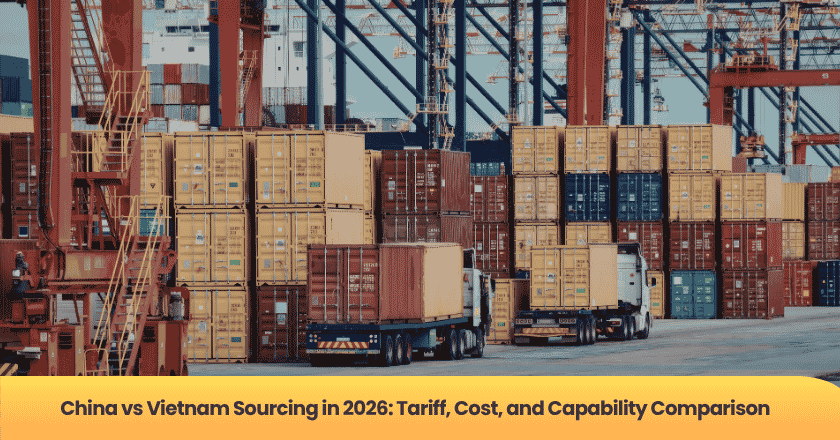
Vietnam's tariff advantage over China widened sharply after the SCOTUS ruling in February — from 1 point to roughly 25 points on most categories. The decision now is which SKUs to move, not whether China + 1 makes sense.
Key Takeaways
• Vietnam currently faces 10% Section 122 + MFN (no Section 301), making the typical effective duty 10–20% on consumer goods. China faces 35–45% on the same categories. The 20–25 point spread is the widest it has ever been.
• The SCOTUS ruling on February 20, 2026 erased Vietnam's IEEPA-era 46% reciprocal tariff. The 90-day-suspended "Liberation Day" rate and the 20% post-negotiation rate both went away with IEEPA. Vietnam now sits at the same 10% Section 122 floor as nearly all other countries.
• Vietnamese factory unit costs are typically 10–25% above comparable Chinese factories, partly offsetting the duty advantage. Net landed cost still favors Vietnam in most consumer categories — apparel, footwear, furniture, electronics assembly — but margins vary.
• Transshipment enforcement is the #1 compliance risk. Goods made in China and merely re-labeled or lightly processed in Vietnam are not Vietnam-origin and remain subject to Section 301. CBP is actively auditing.
• Vietnam's manufacturing depth varies sharply by category: strong in textiles, footwear, furniture, basic electronics assembly; weaker in injection molding, complex hardware, semiconductors, and most chemicals.
• US imports from Vietnam reached $136.6B in 2024, a 19% increase from 2023. Vietnam is the dominant China + 1 destination but creates capacity constraints — the best Vietnamese factories are increasingly booked.
• Two near-term risks: Section 122 sunset on July 24, 2026 (would drop Vietnam from 10% to MFN-only — a further benefit) and the new Section 301 investigation launched March 11, 2026 covering 16 economies including Vietnam (could reduce or eliminate the China-Vietnam tariff gap by late 2027).
• Commission-free sourcing agents (flat service fee, factory invoice passed through unchanged) make the China-Vietnam comparison meaningful because you can verify true factory unit costs across both origins. Bundled "delivered price" quotes hide which side absorbs the cost difference.
For the past five years, "China + 1" has been the standard advice for US importers worried about tariff exposure or supply chain concentration. Vietnam was the most common +1 destination, with Foxconn, Samsung, Nike, and thousands of smaller brands shifting production from southern China to Bac Ninh, Binh Duong, and Ho Chi Minh City. Through 2024 and most of 2025, the math was uncertain — Vietnamese factory prices ran higher than Chinese, and the IEEPA-era reciprocal tariff threats temporarily pushed Vietnam's effective rate close to China's.
That uncertainty resolved on February 20, 2026. The Supreme Court invalidated the IEEPA tariffs, eliminating Vietnam's 46% reciprocal rate (which had been temporarily reduced to 20% under a July 2025 negotiated deal but was still well above Vietnam's pre-2025 levels). What remained: 10% Section 122, no Section 301. Vietnam's effective duty on most consumer goods dropped from the 30–46% range back to 10–20% — while China stayed at 35–45%. The China-Vietnam tariff gap is now the widest it has ever been at roughly 20–25 percentage points.
This guide walks through the current numbers, the categories where Vietnam wins outright, the categories where China still makes sense despite the duty disadvantage, and the operational and compliance considerations that determine whether a Vietnam shift actually delivers the expected savings.
Part 1: The 2026 Tariff Math, Side by Side
The single most important variable in any China vs Vietnam comparison is the duty stack. As of May 2026:
| Tariff layer | China | Vietnam |
|---|---|---|
| Base MFN duty | 0–32% (HTS-specific) | 0–32% (same MFN schedule) |
| Section 122 (until July 24, 2026 sunset) | 10% | 10% |
| Section 301 | 7.5–100% (China-specific) | None |
| Section 232 (steel/aluminum) | 50% (where applicable) | 50% (where applicable) |
| Typical effective rate, consumer goods | 35–45% | 10–20% |
The 25-point gap is dominated by Section 301, which only applies to Chinese-origin goods. That gap survives all the policy changes of late 2025 and early 2026 because Section 301 itself is permanent and was unaffected by the SCOTUS ruling.
Category-specific examples
Apparel (cotton t-shirts, HTS 6109.10.00). China: 16.5% MFN + 10% S122 + 25% S301 = 51.5%. Vietnam: 16.5% MFN + 10% S122 + 0 S301 = 26.5%. Vietnam advantage: 25 points.
Furniture (HTS 9403.60.80). China: 0% MFN + 10% S122 + 25% S301 = 35%. Vietnam: 0% MFN + 10% S122 + 0 S301 = 10%. Vietnam advantage: 25 points.
Athletic footwear (HTS 6404.11). China: 20% MFN + 10% S122 + 25% S301 = 55%. Vietnam: 20% MFN + 10% S122 + 0 S301 = 30%. Vietnam advantage: 25 points.
Smartphones (HTS 8517.13). China: 0% MFN + 10% S122 + 25% S301 = 35%. Vietnam: 0% MFN + 10% S122 + 0 S301 = 10%. Vietnam advantage: 25 points.
Lithium-ion non-EV batteries (HTS 8507). China: 3.4% MFN + 10% S122 + 25% S301 = 38.4%. Vietnam: 3.4% MFN + 10% S122 + 0 S301 = 13.4%. Vietnam advantage: 25 points.
The pattern is consistent across categories: a 25-percentage-point swing in duty stack favoring Vietnam, almost entirely driven by Section 301's absence. For high-rate Section 301 categories (EVs at 100%, solar at 50%, semiconductors at 50%), the gap widens further.
Worked landed cost example
A US importer ordering $80,000 FOB of furniture, comparing identical-spec orders from a Foshan supplier and a Binh Duong supplier:
| Cost line | China (Foshan) | Vietnam (Binh Duong) |
|---|---|---|
| Factory FOB | $80,000 | $90,000 (12.5% higher unit cost) |
| Ocean freight (40' to LA) | $2,800 | $3,500 (longer transit, less mature lane) |
| MFN duty (0%) | $0 | $0 |
| Section 122 (10%) | $8,000 | $9,000 |
| Section 301 (25%) | $20,000 | $0 |
| MPF + HMF | $310 | $349 |
| Customs broker + drayage | $900 | $900 |
| Total landed | $112,010 | $103,749 |
| Vietnam saves | $8,261 (7.4%) |
The Vietnamese factory's higher unit cost partially offsets the duty advantage, but Vietnam still wins by roughly 7% landed. On a standard 60% gross margin retail price, that 7% landed cost reduction translates to a meaningful margin improvement.
The analysis flips for categories where Vietnamese factory pricing is significantly higher (some custom electronics, niche industrial products) or where China retains a structural cost advantage that exceeds the 25-point duty differential.
Part 2: Where Vietnam Wins, Where China Still Wins
The duty math creates a clear advantage for Vietnam, but the full sourcing decision involves five other variables: factory unit cost, manufacturing capability, supply chain maturity, lead time, and operational risk. The right answer varies by category.
Vietnam wins clearly
Wood furniture. Significant capacity built since 2018 trade war. Quality matches China for mass-market segments. Vietnam advantage: strong.
Consumer electronics assembly. Final assembly of laptops, smartphones, network equipment moved heavily to Vietnam over 2018–2025 (Foxconn, Samsung, Apple suppliers). Component supply still depends on China but final-assembly origin shift gives Vietnam-origin classification. Vietnam advantage: strong, but transshipment compliance critical.
Basic outdoor equipment, sporting goods, bags, accessories. Mature ecosystem, competitive unit costs, no Section 301. Vietnam wins clearly.
China still wins
Complex hardware with deep component sourcing. Products requiring tight integration with Chinese component suppliers (motors, sensors, custom ICs, precision metal parts) often cost more in Vietnam than the duty savings warrant, because Vietnam imports Chinese components and adds duty + freight + assembly cost on top.
Injection molding at scale. China has 5–10x Vietnam's mold-making and injection capacity, with much deeper expertise in complex tooling. For any product with custom plastic parts, China's tooling costs are typically 30–50% lower and lead times 30–60% shorter.
Niche or specialty manufacturing. Anything where the supplier base is genuinely concentrated in China — specialty chemicals, certain optics, precision medical components, advanced materials — has no Vietnamese equivalent. The duty cost is irrelevant if the product can't be made elsewhere.
Very small batch or fast turnaround. Yiwu's small-batch ecosystem has no Vietnamese equivalent. For test orders, sample programs, and quick-turn assortment work, China remains far ahead.
Categories under active Section 301 high-rate exposure where Vietnam alternative also doesn't exist. EVs and solar panels have Vietnam-specific issues (anti-dumping investigations, lower capability), so the China alternative is often Korea, Japan, or Mexico rather than Vietnam.
The category-by-category framework
Decision logic for each SKU under consideration:
1. What's the Section 301 rate on this HTS? If 7.5%, Vietnam advantage is small (10 points after MFN equality). If 25–100%, Vietnam advantage is large (20–100 points).
2. Does Vietnam have real capacity in this category? If yes (apparel, furniture, electronics assembly), Vietnam is viable. If no (specialty chemicals, complex tooling), China is forced.
3. What's the Vietnamese factory unit cost vs Chinese? Get quotes from both sides on identical specs.
4. Does the duty saving exceed the unit cost increase? Run the landed cost math.
5. Is supply chain maturity adequate? Vietnamese freight infrastructure, customs efficiency, and supplier sophistication have improved sharply but still trail China in some lanes.
Common Mistake: Buyers assume the 25-point duty advantage automatically makes Vietnam the right answer. It doesn't always. We've seen cases where Vietnamese factory pricing was 35% above Chinese for the same custom product (because the Vietnamese supplier imported Chinese components and added duty + transport on top), making the China origin cheaper landed despite the higher tariff. The math has to be done at the SKU level. For mature Vietnamese categories (apparel, furniture, basic electronics), the answer is almost always Vietnam. For complex products with deep Chinese supply chain integration, the answer is sometimes still China.
Part 3: The Transshipment Compliance Trap
The single largest operational risk in moving from China to Vietnam is transshipment — Chinese-origin goods routed through Vietnam, lightly processed or repackaged, and exported to the US claiming Vietnam origin to avoid Section 301. CBP is actively investigating this and the consequences for the importer are severe.
What CBP looks for
The legal standard is "substantial transformation." Goods made in China and merely re-labeled, repackaged, or lightly assembled in Vietnam don't qualify as Vietnam-origin. To claim Vietnam origin and avoid Section 301:
• Major manufacturing operations must occur in Vietnam (cutting and sewing for apparel; assembly + significant component integration for electronics; complete fabrication for furniture).
• Raw materials and components can come from China, but the transformation in Vietnam must produce a new article with a different commercial identity.
• Mere assembly of Chinese-made parts is generally insufficient. CBP applies a fact-specific analysis on what counts as substantial transformation.
What documentation supports Vietnam-origin claims
A defensible Vietnam-origin claim is supported by:
• Bill of materials showing what was sourced where.
• Production records from the Vietnamese factory (work orders, time-stamped photos, quality control records).
• Raw material invoices (showing inputs purchased by the Vietnamese factory, not just transshipped through it).
• Vietnam Chamber of Commerce and Industry (VCCI) Certificate of Origin — necessary but not sufficient by itself.
• Factory audit reports confirming actual production capability matches claimed origin.
Why this matters in 2026
CBP enforcement of transshipment increased sharply through 2024–2025 as Vietnam's import surge attracted scrutiny. The legal liability falls on the US importer of record, not on the Vietnamese supplier. Importers caught with transshipped goods face: retroactive Section 301 duty assessment + interest + penalties (potentially up to 4x the underpaid duty), shipment seizures, and possible civil or criminal charges in egregious cases.
Expert Tip: When evaluating a Vietnamese supplier as a China alternative, do an on-site factory audit before placing the first production order. The audit's explicit goal is to verify the supplier has actual production capability in Vietnam — not just office space, sample storage, or repackaging operations. Look for: production lines running with Vietnamese workers, in-process WIP visible on the floor, raw material storage with Vietnamese supplier invoices, finished goods staging. A factory that has all three falls under genuine Vietnam-origin manufacturing. A factory whose "production" turns out to be three QC inspectors and a forklift moving Chinese-made cartons is a transshipment liability waiting to happen. Commission-free sourcing agents who handle this audit work as a standard part of their service make the verification much more reliable than relying on the supplier's own documentation. Their fee structure doesn't depend on whether you place the order, so the audit findings are honest.
Part 4: Capacity Constraints in Vietnam
The China + 1 trend has been running for half a decade, and the best Vietnamese factories are now near capacity. This creates real constraints on what new buyers can access.
The capacity squeeze in numbers
US imports from Vietnam reached $136.6 billion in 2024, a 19% increase from 2023. Production in Vietnam grew at the fastest pace in over a year and a half through early 2026, according to S&P Global Vietnam Manufacturing PMI data. The trade flow change is real and ongoing.
The constraint: top-tier Vietnamese factories — those with mature export operations, English-speaking staff, established compliance documentation, and capacity to take new buyers — have multi-month wait lists for new accounts. The well-run Foxconn, Samsung, and major Western brand suppliers are not generally available to new mid-market buyers.
What's actually available
Three tiers of Vietnamese supplier:
Tier 1: Established export factories. Multi-decade operating history, mature compliance, often subsidiaries or close partners of Korean/Taiwanese/Japanese parent companies. Limited availability for new buyers. Pricing comparable to or slightly above Chinese equivalents.
Tier 2: Mid-market Vietnamese-owned factories. 10–20 years operating history, growing English capability, more variable compliance and quality control. More available than Tier 1, but require careful vetting. Pricing typically 5–15% below Tier 1.
Tier 3: New or emerging factories. Limited operating history, often built specifically to capture China + 1 demand. Highest availability but highest risk on quality, compliance, and supply chain reliability. Lowest pricing but the cost-quality trade-off is real.
For most new entrants to Vietnamese sourcing in 2026, Tier 2 is the practical target. Working with a sourcing agent who has established Tier 2 relationships shortcuts what would otherwise be a 6–12 month supplier discovery process.
Part 5: Operational Differences That Matter
Five operational dimensions where China and Vietnam diverge in ways that affect the practical sourcing experience.
Lead times
Vietnam manufacturing lead times for established categories (apparel, footwear, furniture) are now comparable to China — typically 45–75 days from PO to shipment-ready. For categories where Vietnam imports significant Chinese components (electronics, hardware), add 10–20 days for component lead time. For new product development with Vietnamese tooling, expect 4–6 months vs 3–5 months in China.
Communication
English fluency in Vietnamese export factories has improved significantly but still trails major Chinese export hubs. Vietnamese factory sales staff often have decent English; technical engineering discussions can be harder to conduct in English than with Chinese counterparts. Mandarin is sometimes more useful than English in Vietnamese factories with Chinese ownership.
Freight
Vietnam-US ocean lanes have expanded substantially since 2020 but remain less mature than China-US. Container capacity and frequency are good on Ho Chi Minh-LA but more limited on Hai Phong-East Coast. Freight rates from Vietnam typically run 10–25% above comparable China rates. Air freight similar.
Customs and documentation
Vietnamese export customs is more bureaucratic than Chinese export customs in our experience — documentation requirements are stricter and processing times longer. Plan for 3–7 days from cargo-ready to vessel loading vs 1–3 days in major Chinese ports.
Quality control infrastructure
Third-party inspection firms (SGS, QIMA, BV) operate in Vietnam but with smaller field teams than in China. Inspection costs are similar; scheduling is more constrained, especially for inland factories. Plan inspection windows further in advance than you would for China.
Part 6: How to Run a Practical China + Vietnam Dual Sourcing Strategy
Most mature buyers don't choose between China and Vietnam — they run dual sourcing. Five practices we recommend.
1. Move SKUs by category, not by supplier
Don't try to move an entire supplier relationship from China to Vietnam in one go. Instead, evaluate each SKU on its own merits — duty rate, Vietnamese capability, unit cost differential. Some SKUs in a portfolio belong in Vietnam; others belong in China. The composite portfolio is rarely optimized by a binary choice.
2. Build the second-source relationship before you need it
The capacity squeeze in Vietnam means new supplier relationships take time. Brands that wait until tariff pressure forces a move find that the good Vietnamese factories are full. Brands that started building Vietnamese supplier relationships in 2023–2024 — even at small initial volume — have options now that latecomers don't.
3. Document substantial transformation defensibly from day one
Don't rely on supplier-provided origin claims alone. Build the documentation infrastructure that supports a defensible Vietnam-origin claim: bill of materials, production records, raw material traceability, factory audit reports. The cost of doing this preventively is small; the cost of doing it reactively after a CBP audit is much larger.
4. Run quality benchmarks across both sources
Vietnamese supplier quality is variable. Established factories match Chinese quality; newer ones often don't. Run regular quality benchmarks comparing your Vietnamese supplier's output against your Chinese baseline. Drift either direction is operationally significant.
5. Plan for the policy variables
Two near-term policy events will move the math: Section 122 sunset (July 24, 2026) and the Section 301 investigation results into Vietnamese excess capacity (late 2026 / early 2027). Build flexibility into Vietnamese supply contracts that allow volume adjustment if either event changes the duty stack.
Expert Tip: When negotiating Vietnamese supplier contracts in 2026, include a clause allowing volume reduction (without penalty) if US tariff on Vietnam-origin goods rises above a specified threshold — say, 20% effective. This protects you against the downside of the March 2026 Section 301 investigation outcome while keeping the upside of current 10% rates. Suppliers may resist initially but most will accept a pricing collar tied to tariff conditions, especially in exchange for a multi-year volume commitment at current rates.
Part 7: What's Different About the Vietnam Decision in 2026
Three forces have reshaped the China-Vietnam decision compared to even 12 months ago.
First, the SCOTUS ruling on February 20, 2026 restored Vietnam's tariff advantage. The IEEPA-era 46% threatened rate (briefly negotiated to 20%) is gone. Vietnam now sits at the same 10% baseline as nearly every other country, while China retains its 25% Section 301 surcharge. The China-Vietnam gap is the widest it has been since 2018.
Second, the US-Vietnam trade deficit hit $178.2 billion in 2025, up 44% from 2024. This rapid growth has attracted political attention. The Trump administration's March 11, 2026 Section 301 investigation explicitly named Vietnam among 16 economies under review for "excess manufacturing capacity." The standard timeline from investigation to tariff action is 12–18 months — putting potential Vietnam-specific tariff increases in late 2026 or early 2027.
Third, Vietnamese capacity is genuinely tight. The China + 1 wave that began in 2018 has filled the best Vietnamese factories. New buyers entering in 2026 face longer waits, more limited factory choice, and more pressure to accept Tier 2 suppliers without the operational maturity of Tier 1. The window of "easy" Vietnam expansion may be closing, particularly for higher-volume buyers requiring established export operations.
The Bottom Line
Vietnam's tariff advantage over China in 2026 is the largest it has been in seven years — roughly 25 percentage points on most consumer goods, after the SCOTUS ruling eliminated IEEPA. For mature Vietnamese categories (apparel, footwear, furniture, electronics assembly), the math strongly favors Vietnam even after accounting for higher unit costs and longer freight. For categories where Vietnam lacks capability or where Chinese component sourcing dominates the cost stack, China still makes sense despite the tariff disadvantage.
The decision is increasingly category-by-category and SKU-by-SKU rather than a binary China-or-Vietnam choice. Most mature buyers run dual sourcing — Vietnam for SKUs where the math favors it, China for SKUs where capability or unit cost dominates. The work in 2026 is portfolio rebalancing, not wholesale migration.
The two near-term policy variables to watch: the July 24, 2026 Section 122 sunset (which would lower both China and Vietnam rates by 10 points, preserving the gap) and the March 2026 Section 301 investigation outcome (which could narrow or eliminate Vietnam's advantage by mid-2027 if it produces tariff actions). Plan for both scenarios.
FAQ
Is Vietnam still a good China alternative after the IEEPA reversal?
Yes — better than at any time since 2018, in fact. The IEEPA reversal eliminated the temporary 20–46% reciprocal tariff that had been threatening Vietnam's advantage. Current effective rate on Vietnamese goods is 10% Section 122 + MFN (typically 10–20% all-in), versus China's 35–45% on the same categories. The 25-point gap is the widest it has been.
What's the typical Vietnamese factory price compared to Chinese?
Varies by category. For mature export categories (apparel, footwear, basic furniture), Vietnamese unit costs typically run 10–20% above Chinese. For categories where Vietnam imports Chinese components (some electronics, hardware), the differential can be 25–40%. For commodity products with mature Vietnamese supply chains, sometimes Vietnam matches or beats China. Get specific quotes; the categorical generalization is unreliable.
Can I avoid Section 301 by shipping Chinese goods through Vietnam?
No. Goods made in China and merely transshipped through Vietnam are still Chinese-origin under CBP rules. To claim Vietnam origin, the goods must undergo substantial transformation in Vietnam — which means major manufacturing operations, not just repackaging or light assembly. CBP is actively investigating transshipment cases and the legal liability falls on the US importer, not the Vietnamese supplier or shipper.
How long does it take to set up a Vietnamese supplier from scratch?
For a buyer working through an experienced sourcing agent: 8–14 weeks from supplier identification to first production order. For a buyer doing it themselves without prior Vietnam relationships: typically 4–9 months. The supplier selection and vetting work is the long pole; production lead times are comparable to China once the relationship is established.
Are Vietnamese factory audits more important than Chinese audits?
Yes, on origin verification specifically. The audit's primary additional purpose in Vietnam is to confirm actual production capability — that the factory actually manufactures the claimed product in Vietnam, not just receives Chinese-made goods for re-export. This step is critical for substantial-transformation defense if CBP audits the import.
What's the freight situation Vietnam to US?
Better than 2020 but still less mature than China. Ho Chi Minh and Cat Lai port have good capacity to LA/Long Beach. Hai Phong port is more limited and primarily serves East Coast lanes. Vietnam-US ocean rates typically run 10–25% above comparable China rates due to lane density. Air freight is comparable.
Should I be worried about the new Section 301 investigation into Vietnam?
Worth monitoring, not panicking. The March 11, 2026 USTR investigation into excess manufacturing capacity covers 16 economies including Vietnam. Standard timeline from investigation to tariff action is 12–18 months, putting potential Vietnam-specific Section 301 rates in late 2026 / early 2027. The base case is that any new Vietnam Section 301 would be product-targeted (steel, aluminum, certain electronics) rather than across-the-board. Build flexibility into 2026 sourcing contracts to allow adjustment if rates change.
NewBuyingAgent
Related Resources

Commencer aujourd'hui
Transformons vos objectifs d'approvisionnement en réalitéWeChat:+86 15157124615
WhatsApp:+86 15157124615
Adresse : Bâtiment 10 #39 Xiangyuan Road, Hangzhou, Chine
