

Customs Broker vs. Freight Forwarder
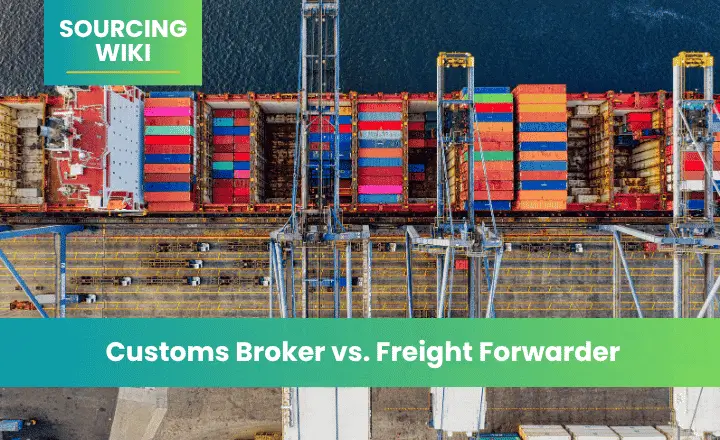
A customs broker and a freight forwarder both help businesses move goods across international borders, but they focus on different parts of the process.
A customs broker specializes in customs procedures, including customs entry, tariff classification, customs valuation, and the payment of applicable duties and taxes. In the United States, customs brokers conducting customs business on behalf of others must be licensed by U.S. Customs and Border Protection (CBP). [1]
A freight forwarder primarily arranges and coordinates the transportation of goods from the origin to the destination. Depending on the service agreement, a freight forwarder may arrange ocean or air freight, inland transportation, cargo consolidation, shipping documents, warehousing, and cargo insurance. [2]
The key distinction is simple: a customs broker focuses on customs clearance, while a freight forwarder focuses on transportation arrangements. Some companies offer both services, so their actual responsibilities should be confirmed before shipment.
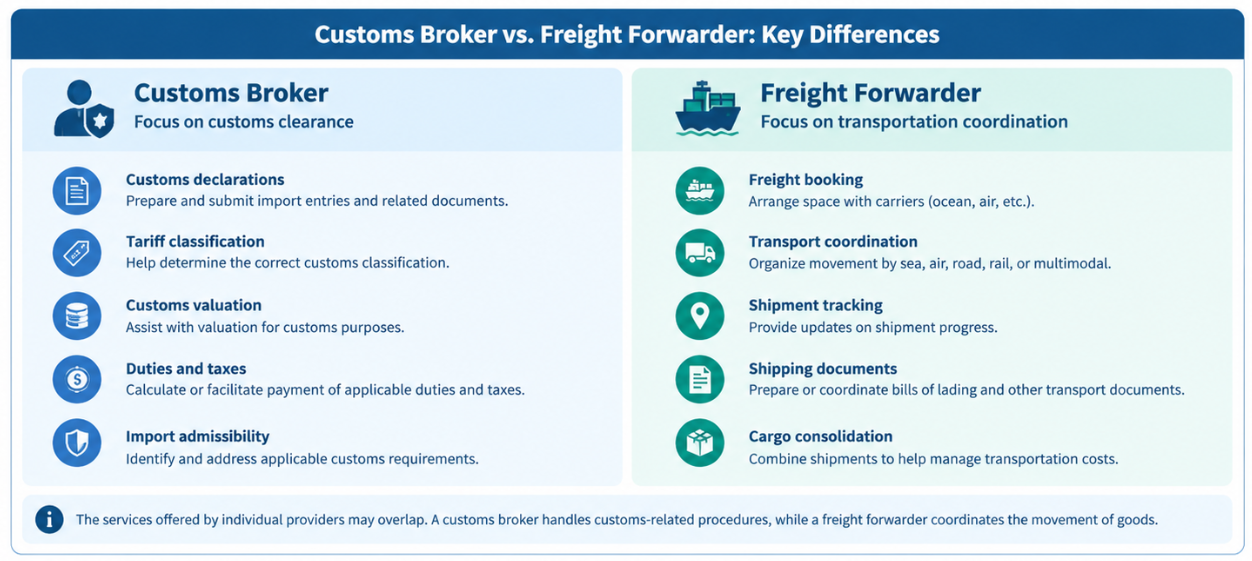
Image caption: Customs brokers handle customs-related procedures, while freight forwarders coordinate the movement of goods. The services offered by individual providers may overlap.
What Does a Customs Broker Do?
A customs broker helps importers navigate the customs requirements of the destination country. The exact scope depends on local regulations, the shipment, and the services agreed upon.
Typical responsibilities may include:
- Preparing and submitting customs entries: Filing the required import information with the relevant customs authority.
- Tariff classification: Helping determine the appropriate customs classification for imported products.
- Customs valuation: Assisting with the determination and declaration of the value used for customs purposes.
- Duty and tax processing: Calculating or facilitating the payment of applicable duties, taxes, and customs fees.
- Import admissibility: Identifying applicable customs requirements and helping address documentation or entry issues.
- Communication with customs authorities: Responding to customs queries and helping resolve entry-related issues.
These activities are part of the customs business described by CBP and the U.S. Department of Commerce. [1][2]
However, hiring a customs broker does not automatically transfer every compliance responsibility to the broker. In the United States, the importer remains responsible for understanding applicable requirements and ensuring that its imports comply with federal rules. [3]
What Does a Freight Forwarder Do?
A freight forwarder helps organize the transportation of goods between locations, often across multiple countries and transport modes.
Depending on the agreement, services may include:
- Freight booking: Arranging space with shipping lines, airlines, or other carriers.
- Transportation coordination: Organizing the movement of cargo by sea, air, road, rail, or a combination of modes.
- Shipment tracking: Providing updates on shipment progress and transport milestones.
- Shipping documentation: Preparing or coordinating documents such as bills of lading and other transport-related paperwork.
- Cargo consolidation: Combining shipments where appropriate to help manage transportation costs.
- Warehousing and inland transport: Arranging storage, pickup, delivery, and other supporting services.
- Cargo insurance arrangements: Helping arrange insurance when requested.
The exact services vary by provider and shipment. A freight forwarder may also arrange customs clearance through its own customs brokerage operation or an external broker. [2][4]
A freight forwarder should not automatically be assumed to be the customs broker responsible for filing a particular customs entry. Ask who will perform the customs work, which entity will submit the entry, and what fees are included.
Customs Broker vs. Freight Forwarder: Key Differences
The following comparison summarizes their typical roles.
| Area | Customs Broker | Freight Forwarder |
|---|---|---|
| Primary role | Customs clearance | Transportation coordination |
| Main focus | Customs requirements and import entry | Moving goods from origin to destination |
| Tariff classification | Typically assists with customs classification | May coordinate information but is not necessarily responsible for customs classification |
| Customs valuation | Assists with customs valuation and declaration | May transmit commercial information supplied by the parties |
| Duties and taxes | Helps calculate or process applicable payments | May communicate estimated charges or arrange payments under the agreement |
| Freight booking | Not the primary responsibility unless separately offered | Typically arranges transport |
| Shipment tracking | May provide customs-status updates | Typically coordinates transport tracking |
| Transport documents | May review documents relevant to customs entry | Typically prepares or coordinates transport documents |
| Licensing or authorization | U.S. customs brokers must hold the required CBP license to conduct customs business on behalf of others | Requirements depend on the services, transport mode, and jurisdiction |
| Can one company offer both? | Yes | Yes |
Note: This is a general comparison, not a universal allocation of legal responsibility. Services and regulatory requirements vary by country, transport mode, and contract. [1][2][4]
How Do Customs Brokers and Freight Forwarders Work Together?
For many international shipments, the two service providers work together. The freight forwarder coordinates transportation, while the customs broker handles the relevant customs entry and clearance work.
For example, a U.S. retailer importing stainless-steel tumblers from China may use a freight forwarder to arrange ocean freight and inland delivery, and a U.S. customs broker to handle the import entry.
A typical arrangement may follow these steps:
- Prepare the shipment information. The seller and buyer confirm product descriptions, quantities, prices, packaging details, and other required information.
- Arrange transportation. The freight forwarder books the shipment and coordinates pickup, export transportation, and the main international journey.
- Prepare for import clearance. The importer supplies the required documents and product information to the customs broker.
- Complete customs procedures. The broker handles the agreed customs entry tasks and communicates any issues that require attention.
- Coordinate cargo release and delivery. Once the applicable release and transport requirements are met, the forwarder coordinates the next stage of transportation under the agreed service arrangement.
The exact sequence may differ depending on the destination, transport mode, shipment terms, and customs procedures. Customs release and physical delivery are separate milestones, and one does not automatically guarantee the other. [2][4]
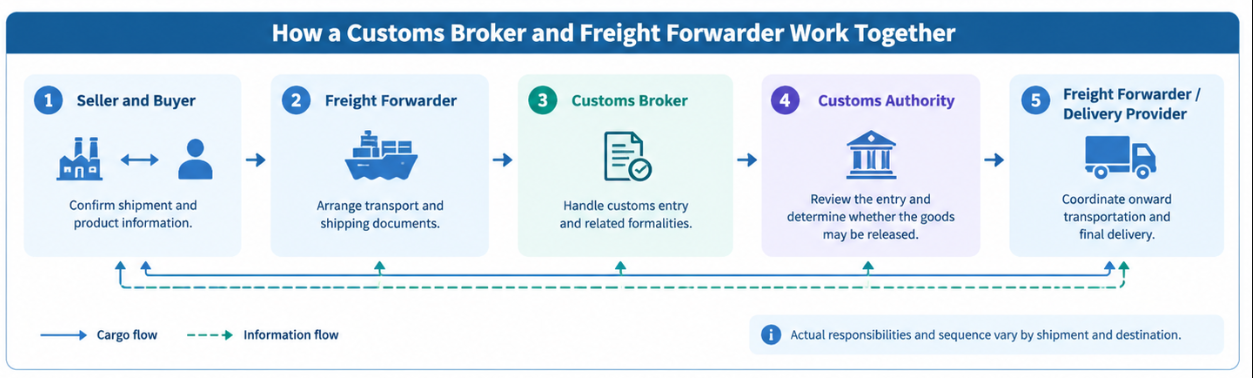
Image caption: A typical import shipment involves coordination between the buyer, freight forwarder, customs broker, and customs authority.
Do You Need a Customs Broker, a Freight Forwarder, or Both?
The answer depends on what your business needs help with.
You may need a customs broker when:
- You need professional assistance with customs entry and clearance.
- You are unfamiliar with the destination country's customs procedures.
- Your products require careful tariff classification, valuation, or admissibility review.
- You need help responding to customs questions or resolving entry-related issues.
In the United States, hiring a customs broker is generally optional, but many importers use one for convenience and professional assistance. [3]
You may need a freight forwarder when:
- You need to arrange international shipping from a supplier.
- You need to coordinate multiple transport stages or shipping modes.
- You want assistance with freight booking, shipping documents, tracking, or inland delivery.
- You need to coordinate cargo movement across different carriers or locations.
You may need both when:
- You are managing a shipment from an overseas supplier to your destination market.
- You need both transportation arrangements and customs entry assistance.
- You want different specialists to handle the transport and customs aspects of the shipment.
Before engaging either provider, ask for a written breakdown of services, responsibilities, and fees. Confirm whether customs brokerage, duties and taxes, port or terminal charges, storage, and final delivery are included or billed separately.
Common Misunderstandings
1. A freight forwarder automatically handles customs clearance
Not necessarily. A freight forwarder may offer customs brokerage directly or arrange it through a partner, but this should be confirmed. Ask which company will handle the entry and whether the service is included in the quotation. [2]
2. A customs broker is responsible for the entire shipment
A customs broker's core role is customs-related. Unless additional services are agreed upon, the broker does not automatically manage freight booking, international transportation, warehousing, or final delivery.
3. Hiring a customs broker removes the importer's responsibility
No. In the United States, the importer remains responsible for ensuring that the import complies with applicable federal requirements, even when a broker is used. [3]
4. The lowest freight quotation is necessarily the lowest total shipping cost
A freight quotation may exclude brokerage fees, duties, taxes, destination charges, storage, or final delivery. Compare the service scope and the total expected cost, not only the headline freight rate.
5. Every shipment needs separate companies for the two roles
Not always. Some providers offer freight forwarding and customs brokerage under one organization. The important point is to confirm which entity performs each service and whether it has the necessary authorization for the relevant activity and jurisdiction.
Frequently Asked Questions
Is a customs broker the same as a freight forwarder?
No. A customs broker specializes in customs entry and related procedures, while a freight forwarder primarily arranges and coordinates cargo transportation. Some companies offer both services.
Can a freight forwarder clear customs?
A freight forwarder may provide customs brokerage services itself if properly authorized, or arrange for a separate customs broker to handle the entry. Do not assume that every forwarder provides this service.
Do I need a customs broker to import goods into the United States?
U.S. law does not generally require every importer to hire a customs broker. Importers may handle their own customs entry when permitted, but they remain responsible for complying with applicable requirements. Many businesses choose a licensed broker for assistance. [3]
Who pays customs duties and taxes?
The party responsible depends on the transaction, applicable law, and agreed sale and delivery terms. Importers should confirm who is responsible for duties, taxes, and related charges before shipping. A broker may facilitate payment, but that does not by itself determine who ultimately bears the cost.
Can I use one company for freight forwarding and customs brokerage?
Yes, if the company offers both services and meets the applicable regulatory requirements. Request an itemized quotation and clarify which entity will handle customs entry, transportation, and any additional services.
What should I provide before requesting a quotation?
Prepare the product description, quantity, origin and destination, shipment dimensions and weight, expected shipping date, and available commercial documents. Also explain whether you need transportation only, customs clearance, or both. Requirements vary by product and destination, so the provider may request additional information.
Final Thoughts
Customs brokers and freight forwarders perform different but complementary roles in international trade. A customs broker focuses on customs procedures, while a freight forwarder coordinates the movement of goods.
Understanding the distinction helps importers choose the right services, compare quotations accurately, and clarify responsibilities before a shipment leaves the supplier.
For businesses sourcing products from China, clear product information, consistent shipping documents, and early coordination with the relevant service providers can help make the import process easier to manage.
NewBuyingAgent helps global buyers source products from China according to their purchasing needs. Buyers should confirm their own freight forwarding and customs brokerage arrangements based on the shipment, destination, and services required.
References
[1] U.S. Customs and Border Protection (CBP). Customs Brokers. https://www.cbp.gov/trade/programs-administration/customs-brokers
[2] U.S. Department of Commerce, International Trade Administration. Customs Brokers and Freight Forwarders. https://www.trade.gov/customs-brokers-and-freight-forwarders
[3] U.S. Customs and Border Protection (CBP). Do I need a Customs Broker to clear my goods through U.S. Customs and Border Protection? https://www.help.cbp.gov/s/article/Article-1169?language=en_US
[4] U.S. Department of Commerce, International Trade Administration. Shipping Options. https://www.trade.gov/shipping-options
Related Knowledge Base
Sourcing Practices & Insights: Customs Broker vs. Freight Forwarder
Latest Sourcing Guides

Comienza hoy
Convirtamos tus objetivos de abastecimiento en realidadWeChat:+86 15157124615
WhatsApp:+86 15157124615
Dirección: Edificio 10 #39 Xiangyuan Road, Hangzhou, China
