

A production delay usually becomes visible before a supplier changes the ship date. The early warning is not a vague feeling about progress; it is a missing or contradictory record behind material arrival, approved specifications, line time, measured output, release requirements, or cargo handoff. Buyers who test those dependencies can ask for a recovery decision while options still exist, rather than discover the problem when cartons were expected to leave.
What the Earliest Delay Signals Tell Buyers
Early delay signals are evidence gaps in dependencies that must close before an order can ship. A material is either tied to a dated receipt or it is not; a line is either assigned to a window or merely described as available. That distinction matters because the buyer does not need another status label. The buyer needs enough evidence to decide whether the target date can remain open, whether one fact needs clarification, or whether the factory must produce a dated recovery plan.
- Check the physical or controlled record behind the update, not just the update itself.
- Separate one isolated proof gap from two gaps that block the same production path.
- Keep a ship date provisional until remaining work, release requirements, and handoff ownership still align.
- Ask for a corrective sequence with dates, owners, and proof—not a broader assurance that production is “on track.”
Why a Promised Ship Date Is a Lagging Indicator
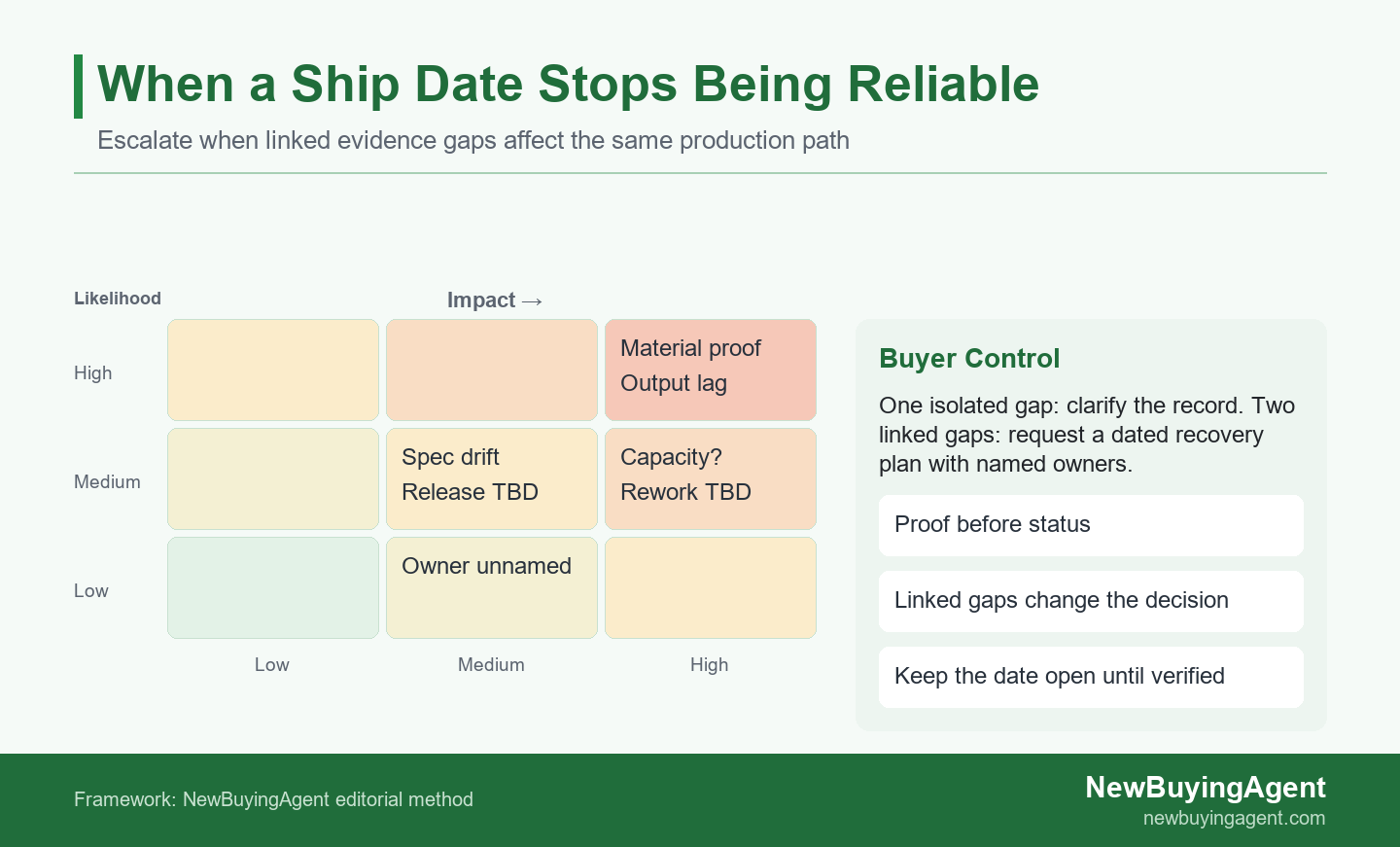
Risk heatmap showing how linked production evidence gaps increase the chance that a stated ship date will move
A date is credible only when its upstream production and release dependencies are evidenced. It is the last statement in a chain that begins with inputs, controlled references, available capacity, actual work, acceptable output, and a release path. A supplier may honestly expect the chain to close, yet the expectation remains fragile when one upstream record is absent. The practical question is not “Has the date changed?” but “What record makes this date possible today?”
ISO's explanation of ISO 9001 places monitoring, measurement, analysis, and evaluation inside a quality-management system. That does not prescribe a buyer's schedule review, but it supports a useful discipline: treat a production statement as something that should be measured and evaluated against a real condition. A date with no supporting condition is a planning assumption, not a buyer-ready commitment.
The Seven Signals to Check Before the Date Moves
Seven signal areas expose the most useful upstream evidence gaps in a China production order. They are not a universal factory scorecard: a simple product may need fewer checks, while a regulated or multi-component item may need more. Used together, they turn “please update us” into a small set of records that can either protect the date or explain why it must be reconsidered.
| Signal | What to ask for | Buyer decision |
|---|---|---|
| Material proof missing | Dated receipt, lot reference, or traceable proof | Hold the next dependent step open |
| Approved reference drift | Current controlled sample, artwork, specification, or version record | Confirm which version governs production |
| Capacity not committed | Named line window and expected output sequence | Test whether remaining work fits the date |
| Output misses the path | Measured completed quantity and remaining dependent work | Check the earliest realistic completion path |
| Correction scope missing | Affected quantity, correction method, and verification plan | Assess the true time exposure |
| Release remains assumed | Applicable test, certificate, label, packing, or release evidence | Keep completion distinct from release |
| Handoff owner unnamed | Transfer record, timing, and accountable party | Do not call packed goods ready to leave |
1. Material Status Has No Traceable Proof
A material-status statement without a dated receipt, lot reference, or other traceable proof is an early delay signal. “Materials are ready” can mean a supplier has placed an order, expects an arrival, or has some stock on hand. Those are different states when a component, trim, carton, or coating starts the next operation. Ask which input is physically available, how it is identified, and which operation waits for it. The aim is not paperwork for its own sake; it is to expose whether the required input can actually support the planned start.
Use the factory record that best distinguishes a received input from an expected one. A buyer does not need to audit a measurement system to apply this discipline: the record should identify the input, show when it became available, and connect it to the next operation. If it is not available, leave the dependent start date open and ask who will provide it by when.
2. The Approved Reference Has Drifted
A change between the approved reference and current production evidence creates correction or release uncertainty. The drift may be a revised artwork file, an alternate component, a changed carton marking, or a sample that no longer matches what the line is making. The question is not whether a change is automatically wrong. It is whether the current version is controlled, accepted where needed, and linked to the units now being made. If that trail is unclear, the reported production count may overstate what is truly ready to release.
ISO 10005 covers the establishment, review, application, and revision of quality plans. Its scope is broader than an approval file, yet it reinforces a practical control: a reference change should have a current version, a decision owner, and a clear application point. If approval and current production use different versions, keep the units in the affected scope separate until the governing reference is clear.
3. Line Capacity Is Described but Not Committed
General statements about capacity are weaker than a dated production window tied to the required output. A factory may have the machines, people, and historical capability for an order, but those resources are not automatically reserved for this order during the remaining days. Ask for the intended line or work area, the start and finish window, the expected output by day or shift, and the dependency that could displace it. This distinguishes available capacity in theory from capacity the order can actually use.
Capacity needs to be read with the work still ahead. A line window that begins after a component arrives may be workable; the same window becomes weak if the component has no receipt and packing still needs a release. When the two items are linked, request one revised sequence that shows what starts first, what can run in parallel, and which owner will close each constraint. For an established supplier relationship, buyers can see how NewBuyingAgent manages existing China factories.
4. Actual Output Is Falling Behind the Schedule Path
Actual output must support the critical path, the linked activities that determine the completion date. A reported completion percentage can look reassuring while the remaining work contains the slowest or most dependency-heavy operation. Separate units that are physically complete from units awaiting inspection, correction, packing, or another controlled step. Then compare the remaining quantity with the output that the assigned line can realistically produce before the next dependency closes. This keeps the discussion on work that still determines delivery rather than on a headline percentage.
ISO 10012's focus on valid and reliable measurement results is relevant here because an output number needs a known basis. Ask what was counted, when it was counted, and which remaining step the count excludes. A buyer can then decide whether the recovery question concerns rate, release, or an upstream input—three problems that need different owners.
5. Corrections Started Without a Defined Scope
Rework without a defined affected scope, correction method, and verification step leaves completion time uncertain. Here, rework means work done to correct a product or process after it fails a requirement. Ask which units, lots, cartons, or production window are affected; whether the correction can occur alongside normal output; and what check will prove that corrected units meet the current reference. Without those answers, “the issue is being fixed” provides no basis for estimating remaining work or release risk.
For relevant children's products, the CPSC's third-party testing guidance shows that a material change after certification can require further testing before import or distribution. The rule is not universal, yet it illustrates the scheduling point: a correction may create a second dependency beyond factory rework. Treat the affected scope, correction sequence, and any required verification as one linked question before keeping the original completion date.
6. Compliance or Packing Release Is Still an Assumption
Unresolved testing, certification, labeling, or packing requirements can block release even when units appear complete. The requirement may sit with the destination market, product category, packaging format, or shipment arrangement, so it should be identified before the final production window. Ask which release condition applies, whose evidence is needed, when it will be available, and whether units, labels, cartons, and documents describe the same approved product. Completion on the factory floor and readiness to release are separate states.
Trade.gov's China standards guide notes that certain regulated products require China Compulsory Certification and that the process can take months.
For a different market boundary, CPSC's testing and certification guidance describes product-specific obligations in the United States. These sources do not create one global checklist; they show why buyers should put the applicable release requirement into the critical path rather than assume it will resolve after units are counted.
When a buyer needs the complete product requirement translated into a China supply path before production reaches this point, they can use NewBuyingAgent's product-supply service with a complete delay-risk brief.
7. Cargo Handoff Readiness Has No Named Owner
A packed order remains at risk when cargo handoff readiness lacks a named owner and a complete transfer record. Finished cartons may be in a factory, a warehouse, or a staging area, but none proves that the next party can accept the cargo. Identify who confirms packing completion, who arranges or accepts the handoff, which reference connects goods to the collection plan, and what record shows the transfer time. The objective is not to make the sourcing team a carrier; it is to make the handoff boundary visible before the buyer calls the order ready to leave.
For applicable packed containers, the International Maritime Organization's packed-container weight guidance treats VGM as a condition for loading and says it must be supplied early enough for stowage planning. In ocean shipping, verified gross mass (VGM) means the documented weight of a packed container. That is a shipping requirement, not a promise that every packed order will move on time, but it demonstrates why packing completion and a handoff-ready record are different facts.
Use a Hold–Clarify–Escalate Threshold, Not a Generic Chase-Up
The buyer response should change when proof gaps become linked production constraints. One missing record does not always justify a formal recovery plan: it may be an administrative delay with no effect on the next operation. Two gaps that block the same path are different. No confirmed component receipt and no committed line window make each other more serious because neither final assembly nor catch-up output can be tested. This threshold is an editorial decision method, not a factory scheduling standard.
- Monitor: the record is present, current, and consistent with the next operation.
- Clarify: one proof gap exists, but it is not yet linked to another constraint; name the record owner and response time.
- Escalate: two linked gaps affect the same production path; request a dated recovery sequence, owners, and verification points.
- Reset the external commitment: a required release or handoff condition cannot close in time, or the recovery sequence lacks evidence.
The method avoids two mistakes: treating every incomplete update as a crisis, or allowing polite reassurance to preserve a date after dependencies have changed. The buyer is not demanding certainty that no factory can give. The buyer is deciding what evidence is sufficient to keep a commercial promise open.
Illustrative Scenario: Two Small Gaps Become One Delivery Risk
Check the Linked Recovery Plan Before Keeping the Ship Date
Two individually small evidence gaps can create a delivery risk when they block the same production path. Consider an illustrative 12,000-unit seasonal home-goods order with a target ship date in 24 days. The order uses a printed carton and a purchased accessory, both needed before final packing. The supplier repeats the original date, yet no dated accessory receipt is available and the proposed line allocation is only described as available. These 2 linked upstream dependencies mean neither update proves that final assembly can begin or that a line will be reserved once it does.
A recovery date deserves confidence only when each corrective action has a date, owner, and verification record. The buyer should request the accessory receipt, the assigned line window, the expected output sequence, and the person responsible for each missing record. Those facts reveal whether the two gaps can close in parallel or whether one will delay the other.
Keep the date open until the receipt and line window are evidenced and the revised sequence reaches the required daily output. That may mean communicating delivery risk earlier, but it avoids building sales, launch, or freight decisions on an unsupported date. This is an illustrative example, not a client case or a prediction of a specific factory's performance. Buyers can review NewBuyingAgent success stories across product categories.
Where China-Side Evidence Changes the Decision
China-side evidence can help a buyer make an earlier decision when it is tied to the complete product requirement and the responsible factory record. NewBuyingAgent works from the buyer's product requirement to quote and supply China-sourced products; its local factory resources, industrial-cluster access, and product/QC capability help turn a vague production question into specific records. When a buyer is already working with a China factory, the context is different: the buyer may need local factory-management support to make current evidence visible, not a substitute for the factory's responsibility.
NewBuyingAgent's role does not create authority over a factory, regulator, carrier, or buyer decision. It makes the relevant China-side evidence easier to organize against the complete requirement, so the buyer can see which fact is verified, which dependency remains open, and which decision still requires buyer approval.
Prepare an Evidence Brief Before You Ask for a Recovery Date
A complete evidence brief gives the buyer and China-side team a defined basis for the next decision. Start with the product requirement, PO or order reference, approved reference, target ship date, current production evidence, and the exact gap that remains unresolved. Add the relevant material record, line window, output count, rework scope, release requirement, or handoff reference instead of sending a broad request for an update. The conversation can then focus on the dependency that changes the date.
Include the buyer's product requirement and current records so the next review can separate verified facts, open dependencies, and the decision that remains with the buyer. If the order needs a complete China sourcing discussion rather than another unstructured chase-up, send a production-delay brief to NewBuyingAgent.
FAQ
What is the earliest warning sign of a production delay?
The earliest warning sign today is usually an upstream dependency with no traceable proof, even if the supplier repeats the original date. Look first for a dated material record, current approved reference, committed line window, or measured output. A missing proof does not automatically mean the order will be late, but it tells the buyer which fact must be clarified before the date can be treated as reliable.
Should a buyer accept a revised ship date without a recovery plan?
No, a buyer should not accept a revised date unless dated actions, accountable owners, and evidence support the blocked dependency. The plan should show what will change, when the correction or input becomes available, and how the buyer can verify that the revised sequence supports the date. Without those links, the new date is simply a different assumption.
Can a sourcing agent prevent every production delay?
No, a sourcing agent cannot prevent every factory, regulatory, or transport risk, but local evidence can make a buyer's decision earlier and clearer. The useful role is to connect product requirements and China-side factory facts to the decision at hand, while the factory remains responsible for production, authorities set regulatory requirements, and the buyer retains commercial authority.
What should be in a production-delay brief?
Include the product requirement, PO reference, approved reference, target date, latest proof, and the exact evidence gap. Attach the record that matters most—for example, a material receipt, production window, output count, rework scope, release document, or handoff reference. State who supplied the record and when it was issued so the next reviewer can test whether it still supports the date.
NewBuyingAgent
Related Resources



Comienza hoy
Convirtamos tus objetivos de abastecimiento en realidadWeChat:+86 15157124615
WhatsApp:+86 15157124615
Dirección: Edificio 10 #39 Xiangyuan Road, Hangzhou, China