

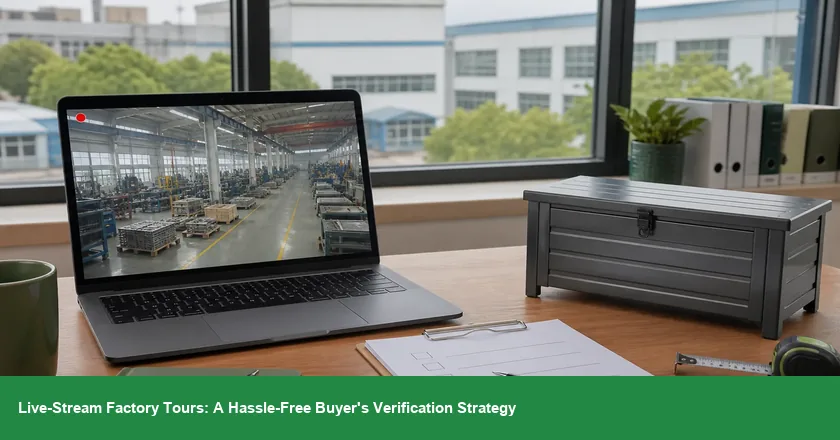
A live-stream factory tour is a useful first verification step when travel is impractical or the buyer needs a current look at a supplier before moving an order forward. Its value is not the footage itself. It is the buyer's ability to direct the camera toward a specific question, compare what appears on screen with another record, and state what will happen if the two do not match.
That distinction matters in China sourcing. A tidy workshop, a familiar machine, or a supplier-hosted route can support an observation, but none automatically proves the contracting entity, reserved capacity, product compliance, or control of every process. Treat the tour as a decision input—not a factory approval, compliance certificate, or replacement for an independent audit when the purchase risk calls for one.
A Live Tour Works When It Tests a Specific Buyer Question
A live factory tour is useful as a buyer-directed current observation that is matched with another evidence source and a stated next step. It supplies directed evidence: a current observation made in response to the buyer's request, then matched with a second source of evidence. A directed tour means a live session led by the buyer's specific requests rather than a supplier's prepared route. Before the call, decide which claim the camera may support, what record must agree with it, and which unanswered question triggers escalation.
This is what makes the approach relatively hassle-free without making it careless. The buyer does not try to recreate every part of an audit on video. Instead, the buyer uses the call to close a narrow uncertainty—such as whether the named location is operating, whether the requested product is actually being handled there, or whether a stated process is visible—and leaves other questions in the correct evidence lane.
- Use the call to test one defined supplier, product, or process claim.
- Match each live observation with a document, sample, or other retained record.
- Escalate any material question that live video cannot validate.
| Buyer question | What a live tour can support | What still needs another record | Decision after the call |
|---|---|---|---|
| Is this the supplier location we are discussing? | Visible signage, address cues, attendees, and a spontaneous route | Contracting entity, registration details, and authority to contract | Match or clarify identity |
| Is our product or process relevant to this site? | Sample, materials, equipment, work in progress, and packing flow | Capacity commitment, every upstream process, and consistency over time | Match or request a focused check |
| Does the supplier appear to control the claimed process? | Current records, operator explanation, and linked physical activity | Document validity, test basis, and process ownership outside the camera view | Record the gap and assign follow-up |
| Can we rely on the claim for this order? | A current observation that reduces a defined uncertainty | Any material compliance, payment, capacity, or hidden-subcontracting risk | Proceed, pause, or escalate |
The practical rule is simple: a live tour can earn a limited “supported” result, never a blanket “verified” label. If a material claim cannot be matched to live video and a separate record, the next step is not a longer call. It is a different verification method.
Build the Tour Around Four Evidence Matches
Separating identity, product/process, records, and risk boundary gives the buyer a way to define what the tour can and cannot support. An evidence match is a visible observation that agrees with a separate supplier, product, or document fact. Build four matches into the tour brief: entity, product/process, control record, and risk boundary. This is not an audit standard. It is a concise way to stop a broad factory walk-through from becoming the sole basis for a purchasing decision.
Start with a one-page brief shared only with the people who need to act. List the supplier's legal name and claimed factory address; the product, drawing, approved sample, or material requirement to be shown; the evidence already held; and the decision that remains open. Then add one line beside each item: “If this does not match, who owns the next check and does the order pause?” Buyers who need help turning that brief into a broader sourcing workflow can see the China-side sourcing and factory-management support NewBuyingAgent provides.
Start With the Entity, Address, and Camera Control
Trade.gov treats foreign-company due diligence as a distinct business-risk activity, so an identity check should not depend on a live camera view alone. Read Trade.gov's due-diligence guidance. Treat the first minutes as an alignment check, not a reception-room introduction. Ask the supplier to confirm the company name used on the quotation and contract, show the location from outside to inside where practical, introduce the people answering operational questions, and move to a relevant area without following a fully scripted sequence.
A reasonable spontaneous request is useful because it tests whether the call can follow the buyer's evidence question. It is not a “gotcha.” Respect safety, confidentiality, and production constraints. If the supplier cannot show an area, ask why, record the reason, and decide whether the limitation is acceptable for the order stage or requires an alternate check.
Then Match Equipment and Work in Progress to Your Actual Product
A relevant process observation can support a product-specific question, but it does not by itself prove reserved capacity, consistent output, or every upstream process. Generic factory footage has weak decision value. Ask to see the product sample next to the relevant material, drawing, label, packaging requirement, or process step. If the order concerns a finish, ask about the finish. If it concerns a specific assembly, ask to see that assembly.
Use plain, testable questions: “Which operation is shown here?” “Which specification does this sample follow?” “Who performs the next step?” “Can you show a current record that connects this batch or sample to the order?” The buyer is not looking for perfect production on camera. The buyer is looking for a defensible match between what the supplier says will happen and what can be observed now.
Run a Live Tour Like a Directed Evidence Session
ISO/IAF and IAF remote-auditing materials recognize live video as a possible remote method while identifying control, integrity, and appreciation-of-evidence considerations. The ISO/IAF Auditing Practices Group guidance on remote audits and IAF guidance on information and communication technology are written for management-system and certification audit contexts, not for buying approval. Their useful lesson here is that a live view has to be managed around evidence limits rather than trusted because it is live.
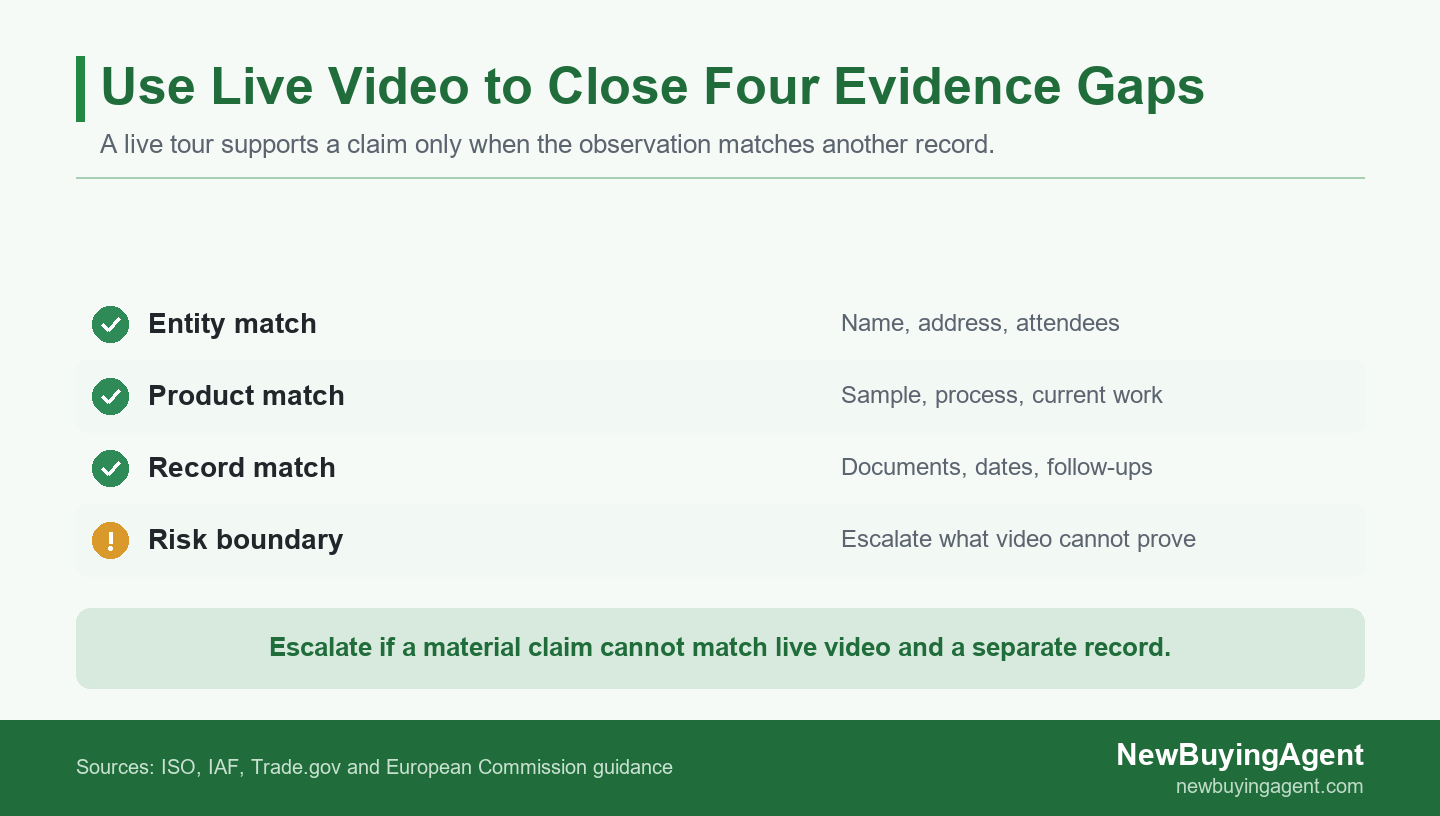
Four evidence matches for a buyer-directed live factory tour
Send the brief in advance, but keep part of the route open. Ask the supplier to prepare the legal-name and address context, the relevant product or sample, and the records that answer the stated question. During the call, begin with identity and location, move to the product-linked process, then ask a few unplanned follow-ups. Capture timestamps when a claim is made, an item is shown, or a limitation appears. A recording is helpful if permitted by the parties, but a time-stamped evidence log is still needed because the future decision may depend on one specific answer rather than the whole video.
Keep the request proportionate. A buyer deciding whether to engage a prospective supplier may need a directed orientation and document match. A buyer about to release a substantial deposit, approve a regulated product, or rely on a capacity claim may need a more formal, independent step. If the need is to turn a new product requirement into a sourceable China plan before arranging a tour, turn a complete product brief into a China-supply plan first, so the camera request is tied to the order rather than a generic supplier presentation.
Know What Live Video Cannot Verify Alone
ISO/IAF remote-auditing guidance identifies camera control, image quality, authentication, and the ability to fully appreciate evidence as limits that must be considered when live video is used. Review the ISO/IAF remote-auditing guidance. Live video can show that a particular scene appeared at a particular time, but it cannot establish every fact behind the scene. Keep claims such as “this factory owns every process,” “this product will meet a named requirement,” or “this line has the promised capacity” separate from a single video observation.
Official EU guidance illustrates that some product and compliance questions depend on technical documentation and records that a factory camera view cannot establish. European Commission guidance for importers describes responsibilities around conformity procedures and technical documentation, while its guidance on technical documentation illustrates how facility, product, material, standard, and risk information may live in records. Those EU examples do not create a universal rule for all products. They do show why a video tour should not be treated as compliance evidence.
The same boundary applies to supplier due diligence, laboratory reports, certifications, bank details, factory ownership, subcontracting arrangements, and ongoing capacity. A tour can tell the buyer which document or independent check to request next. It cannot validate the document merely because a person holds it to the camera. Keep source documents in the order file, check who issued them and what product or facility they cover, and use the verification method that matches the decision.
Escalate When the Decision Depends on Evidence the Camera Cannot Validate
A mismatch or material unobservable risk should trigger a named next method before the buyer relies on the supplier claim. Escalation means adding an audit, inspection, document review, testing step, or other check when a material question remains open. It is not a punishment for a supplier or an automatic sign that the supplier has failed. Escalate when the remaining uncertainty could change the deposit decision, product safety or compliance exposure, approved process, shipment release, or the buyer's ability to rely on the supplier's claim.
The added method should be named. An entity concern may need a background or document check. A question about a current line or workmanship may need an on-site inspection. A product-performance or regulated-market question may need the appropriate technical documentation and testing route. The FDA's food-import verification guidance is a sector-specific example of risk-based activities that can include audits, sampling or testing, and record review; it is not a general sourcing rule, but it illustrates why one evidence type does not fit every risk.
Convert the Tour Into a Verification Record Before You Decide
Technical documentation examples show that product evidence often includes facility, product, standard, material, and record details beyond a visual observation. European Commission technical-documentation guidance illustrates that distinction. Write the record immediately after the call, while the questions and timestamps are clear. Use four columns: the claim, what was observed, the matching record, and the unresolved point or owner. Attach the recording reference if available, plus screenshots only where they help locate a moment in the video. The point is not to create a large file. It is to make the reasoning visible when a colleague later asks why the order moved forward, paused, or changed scope.
Include the supplier legal name, shown location, attendees, product or sample reference, process steps observed, documents shown or requested, date, and next deadline. Then classify each item as supported, mismatch, unobserved, or not applicable. A “supported” entry should still say what it supports. “Sample and packaging match” is more useful than “factory verified.” This record complements the kinds of facility and product details that formal technical documentation may contain; it does not replace those documents.
For an existing supplier, the record can also shape the next local management action: production follow-up, a focused factory visit, a quality-control checkpoint, or a document chase. Buyers who need that closer visibility can use China-side factory-management support when an existing supplier needs closer visibility.
Illustrative Scenario: A Live Tour Reveals a Process Gap
To see how local factory evidence can shape real sourcing decisions, buyers can review sourcing situations where local factory evidence informed a decision.
Correct the Process Map Before You Rely on the Claim
A live-tour process mismatch can change the evidence route without proving supplier misconduct or automatically disqualifying the supplier. Consider an illustrative USD 94,500 order for 2,100 private-label outdoor storage benches. A global buyer is evaluating a private-label outdoor furniture supplier in China before paying the first deposit. The supplier quotation describes powder-coated panels as an in-house process. The buyer has a product sample, a supplier quotation, and a live-tour invitation, but has not yet matched the claimed process map to the factory that will perform it.
On the live call, the supplier shows bench assembly and packed cartons on a live call. The buyer does not see the claimed coating line and learns coated panels arrive from a named upstream provider. The product sample and pack label match, but the stated process map needs correction. That fact does not establish misconduct, and it does not automatically disqualify the supplier.
The proportionate response is to correct the process map, identify the actual process owner, and request the evidence that the revised risk requires. The assembly view supports a limited observation about the product and packing, but it does not substantiate the claimed in-house coating process. The discrepancy is a verification gap, not evidence of misconduct. The buyer needs the actual process owner, the corrected process map, and the records that address coating responsibility before relying on the statement in the commercial decision. The buyer keeps the supplier under consideration, pauses the assumption that coating is in-house, and requests the named coating provider, corrected process responsibility, and relevant quality-control evidence before changing the order commitment.
For the next supplier brief, the buyer separates assembly, coating, and packing into named process owners and gives each a live-observation and document-match request. Before the buyer treats the bench supplier as ready for the next commitment, the corrected process map, sample, supplier entity, and required control evidence must align. This illustrative commercial scenario is not a client case, audit finding, or supplier-performance claim.
Make the Next Verification Step Match the Purchase Risk
A buyer can prepare a supplier, product, evidence, and risk brief for China-side sourcing coordination without presenting that coordination as factory certification. Before arranging a live factory tour, assemble the supplier's legal name and address, the product brief or approved sample, the exact question the buyer needs answered, the records already held, and the order stage. After the call, decide whether the result supports proceeding, needs clarification, or requires a different method. That small discipline prevents the tour from becoming a substitute for the evidence it never produced.
NewBuyingAgent can help buyers turn those inputs into a scoped China-side sourcing and verification brief, including factory-side questions and the practical next step for a prospective or existing supplier. The service is not supplier certification and does not replace product-specific compliance, audit, inspection, or testing decisions.
When the supplier, product, and unanswered verification question are clear, a concise brief can make the next check easier to scope. Buyers can share your supplier, product, and verification questions with NewBuyingAgent.
Frequently Asked Questions
Can a live factory tour confirm that a supplier is a real factory?
A live tour can support an identity check, but it cannot by itself prove that the contracting entity owns or controls every process you see. Match the visible location, people, and operations to the supplier's legal name, address, contract party, and supporting records. If the entity or process owner is material to the order, add the appropriate due-diligence or on-site step.
Should buyers accept a supplier-hosted video tour?
A supplier-hosted tour is useful for orientation, but it should be treated as a lower-control evidence source than a buyer-directed live session. Accept it as a starting point, then ask a few product-linked, spontaneous follow-ups and compare the answers with records. A supplier's production or confidentiality limits may be reasonable; log the limit rather than assuming the question is closed.
When should a buyer escalate to an on-site audit?
Escalate when the deposit, product risk, compliance exposure, capacity claim, or unresolved mismatch is too material to decide from live video and documents. An on-site audit is one option, not the only one. The right next method can also be an inspection, document review, supplier background check, laboratory work, or a focused visit tied to the remaining claim.
What should be saved after a live factory tour?
Save the recording, timestamps, attendee list, questions asked, document images, and a short list of mismatches, follow-ups, and decision owners. Link each item to the supplier, product, and order stage. A concise record that explains what the live view supported and what it did not support is more useful than a video file with no decision trail.
NewBuyingAgent
Related Resources
Comienza hoy
Convirtamos tus objetivos de abastecimiento en realidadWeChat:+86 15157124615
WhatsApp:+86 15157124615
Dirección: Edificio 10 #39 Xiangyuan Road, Hangzhou, China
