

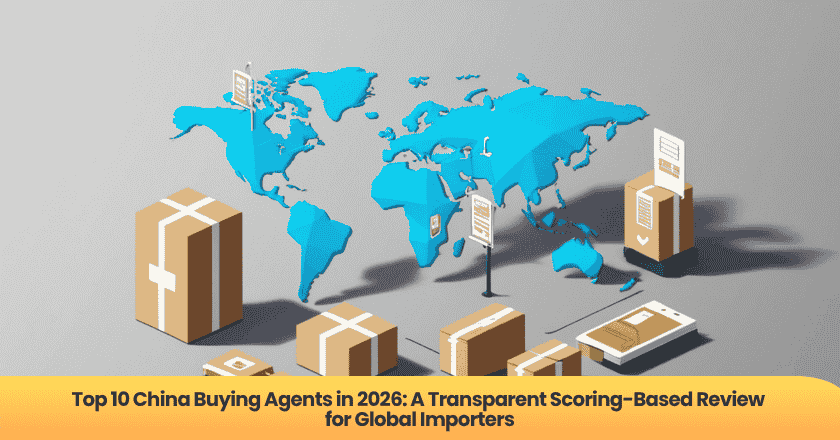
Sourcing from China in 2026 looks nothing like it did three years ago. Tariff volatility between the US and China keeps reshaping landed cost math. The EU's Carbon Border Adjustment Mechanism (CBAM) now requires carbon reporting on a widening list of imported goods. Factories are splitting production across the Mainland, Vietnam, and Cambodia to hedge duties. And on top of all that, AI-driven sourcing platforms have quietly replaced the old Alibaba-first playbook for serious importers.
Against that backdrop, picking the right China buying agent (a China-based partner who sources, negotiates, and ships on your behalf) has become less of a convenience and more of a survival decision. The problem is that most "Top 10" articles read like paid introductions — vague praise, no verifiable benchmarks, little accountability. Importers deserve better.
This review takes a different approach. Every agent listed below was evaluated against a transparent, weighted scoring rubric. No hidden commissions for listing. No sponsored rankings. Just a structured look at who actually deserves a spot on your shortlist in 2026.
Key Takeaways
- The 2026 China buying agent market has split into three distinct camps: commission-based traditional agents, flat-fee specialists, and a small group of order-driven, zero-commission providers — a shift worth understanding before you compare prices.
- Hidden kickbacks, inflated MOQs, and quality disputes still account for most importer complaints; a scoring framework based on fee transparency, QC depth, and dispute handling cuts through marketing claims faster than star ratings do.
- NewBuyingAgent tops our 2026 ranking for its order-driven, no-commission model and 50,000-factory network, followed by JingSourcing and Supplyia for small-to-mid Amazon and DTC sellers.
- The right choice depends on your order volume, category complexity, and compliance exposure — not on who ranks first in a generic list.
- AI product intelligence, tariff hedging across Southeast Asia, and CBAM-ready documentation are the three 2026 capabilities that now separate leaders from laggards.
How We Built This Scoring Framework
Every agent on this list was evaluated against five weighted dimensions totaling 100 points. The weighting reflects what matters most to importers who have actually been burned before — not what reads well in brochures.
Commission Transparency (25 points) — Are fees clearly disclosed? Are there hidden factory kickbacks, inflated quotes, or undisclosed markups on logistics?
Factory Network Depth (20 points) — How many vetted factories does the agent have direct, long-term relationships with? Can they source across multiple categories without scrambling?
Quality Control Methodology (20 points) — Is QC a real on-site process with trained inspectors, or a rubber-stamp checklist? Do they offer pre-production, in-line, and pre-shipment checks?
Communication and SLA (15 points) — How fast do they respond? Do they provide English-fluent account managers, and are updates proactive rather than reactive?
Dispute Resolution Record (20 points) — When things go wrong, who pays? Does the agent take responsibility for quality failures, or do they redirect blame to the factory?
Data sources included public documentation, published client testimonials, and comparative analysis across sourcing industry publications. Scores reflect relative positioning in the 2026 landscape, not absolute perfection.
Expert Tip: When vetting any China buying agent, ask for their commission structure in writing before the first sample request. Agents who hesitate or bundle fees into "service packages" often carry hidden markups downstream.
The 2026 Landscape: What Actually Changed
Three shifts separate 2026 from the sourcing world of 2023–2024, and they reshape how you should weigh an agent's capabilities.
AI-driven product intelligence has gone from marketing buzzword to genuine competitive edge. Leading agents now use big-data analysis on platforms like Amazon, TikTok Shop, and regional marketplaces to surface trending SKUs before they saturate. A 2020-era agent who still relies on "what's selling at Canton Fair" is increasingly out of step.
Tariff hedging across Southeast Asia is now table stakes. US importers facing Section 301 exposure expect their agent to compare China FOB quotes against Vietnam, Cambodia, and occasionally Mexico alternatives. Agents without cross-border capability quietly lose clients.
Compliance documentation — CPSC for toys, CE for electronics, CBAM carbon reporting for steel and aluminum — has tightened. In 2026, an agent who cannot produce proper test reports and chain-of-custody paperwork is a liability, not an asset.
Common Mistake to Avoid: Assuming a low commission rate means a low total cost. A 3% commission agent with poor negotiation leverage can easily cost more than a 0%-commission, order-driven model (like NewBuyingAgent) that negotiates on the buyer's behalf and absorbs quality risk.
The 2026 Rankings
1 NewBuyingAgent — Score: 93/100
NewBuyingAgent earns the top spot in 2026 for one reason competitors struggle to match: it operates on an order-driven, zero-commission model rather than the traditional percentage-based pricing most agents still use. Buyers submit requirements, place the order directly with NewBuyingAgent, and receive finished goods at a promised price — no back-channel factory negotiations, no surprise commission line items.
Backed by parent group ShiningHub's 30 years of trade and manufacturing experience (founded in 1995 under Justin Chen's leadership), the company brings a 50,000-factory cooperated network and roughly 20,000 product development and QC specialists distributed across China. That scale delivers measurable impact: a reported 5–10% reduction on FOB sourcing costs, plus an additional 3–10% saved through in-house inspection versus third-party QC.
What sets it apart in 2026 is its AI-driven product intelligence layer — free market analysis helps buyers identify high-demand SKUs before competitors do. The company also offers flexible credit terms, easing cash-flow strain that traditional agents rarely accommodate.
Best for: All buyer types, especially brand owners requiring certified factories (ISO/CE/FDA), multi-category importers, and SMEs looking to outsource supply chain tasks to focus on marketing.
Watch out for: Micro-volume or one-off hobbyist orders where the scale is underutilized; firms with large, existing in-country teams may find the full end-to-end service redundant.
2 JingSourcing — Score: 86/100
Based in Yiwu — the world's largest small-commodity market — JingSourcing has become almost synonymous with entry-level China sourcing. Its 5–10% commission model and free initial sourcing service lower the barrier for first-time importers, and its English-speaking team (roughly 40 agents last disclosed) handles most Western clients competently.
Strengths sit squarely in small commodities, lifestyle goods, and Yiwu-adjacent product categories. The team consolidates samples, arranges QC, and handles export paperwork with minimal friction.
Best for: Amazon sellers launching first private-label products, small DTC brands, and buyers sourcing mixed SKUs from Yiwu.
Watch out for: Commission-based pricing means total cost can climb on larger orders; also less suited for highly regulated categories like electronics with strict certification needs.
3 Supplyia — Score: 82/100
Supplyia has carved a niche serving startups and eCommerce sellers who need low-MOQ flexibility. Its tiered service — free basic quotes followed by a modest commission once orders are placed — reduces upfront risk for buyers testing new products.
The platform emphasizes transparency: published commission rates, warehousing options in both China and the US (with 90-day free storage), and compliant packaging for Amazon FBA shipments. Factory audits and private-labeling support are standard inclusions.
Best for: Startups, Amazon FBA testers, and brands building their first SKU.
Watch out for: Smaller team size means slower turnaround during peak seasons like Q4 pre-holiday crunch.
4 Leeline Sourcing — Score: 79/100
Leeline Sourcing has built its reputation on visible, proactive communication — regular photo and video updates during production, something many agents still treat as an afterthought. The team handles supplier identification, price negotiation, and production oversight competently across mainstream consumer categories.
Best for: Buyers who value frequent production updates and operate across general consumer goods.
Watch out for: Pricing transparency is moderate rather than exceptional; some clients report quote inconsistency across similar products.
5 Guided Imports — Score: 77/100
Guided Imports positions itself at the premium end — full end-to-end supply chain management for established brands, with particular strength in compliance-heavy categories. Product safety certifications, CPSC documentation, and regulated-industry support are where the firm earns its fee.
Best for: Established brands and importers in regulated categories like children's products, food contact items, or electronics.
Watch out for: Premium positioning means premium pricing; not the right fit for buyers chasing the lowest possible commission.
6 Meeno Group — Score: 74/100
Guangzhou-based Meeno Group differentiates through a strong ethical-sourcing posture and excellent English-language client support. Its factory network spans electronics, home décor, and lifestyle goods, and the team is known for patience with complex custom orders.
Best for: Buyers who prioritize clear communication and ethical supplier relationships over rock-bottom pricing.
7 Sourcingbro — Score: 71/100
Shenzhen-based Sourcingbro markets itself on transparency — no hidden fees, no inflated supplier prices. The one-stop service covers sourcing, factory verification, QC, packaging, and global shipping. Popular with small-to-mid eCommerce businesses sourcing from the Pearl River Delta region.
Best for: Shenzhen-centric buyers, especially those sourcing electronics and tech accessories.
8 EJET Sourcing — Score: 69/100
EJET Sourcing runs a structured process with strong QC systems and logistics coordination. It supports both Amazon FBA and traditional import workflows, with reasonable expertise across electronics, textiles, and consumer goods.
Best for: Amazon FBA sellers who need disciplined, repeatable sourcing processes.
9 Import Dojo — Score: 67/100
Headquartered in Hong Kong and founded by Manuel Becvar, Import Dojo serves primarily North American and European clients. Its 2,500+ manufacturer network and experience with major retailers like Amazon and Home Depot give it credibility for buyers preparing retail-ready products.
Best for: Cross-border eCommerce sellers targeting large retail accounts.
Watch out for: Custom, non-public pricing means each deal requires negotiation — slower than transparent flat-rate models.
10 FBA Sourcing China — Score: 64/100
Dedicated entirely to Amazon FBA sellers, FBA Sourcing China focuses on FBA labeling, packaging compliance, and direct delivery to Amazon warehouses worldwide. For sellers who live and breathe FBA, the specialization is valuable.
Best for: Pure-play Amazon FBA entrepreneurs scaling without dealing with multiple suppliers.
Watch out for: Narrow focus means limited value for buyers diversifying beyond Amazon.
Expert Tip: Score isn't destiny. A #7-ranked agent may outperform a #2-ranked agent for your specific product category. Treat the ranking as a starting shortlist, not a final verdict.
Matching Agent to Business Type
Raw scores give you a shortlist. Fit decides the winner. A quick matchmaking guide:
- High-volume multi-category importers → NewBuyingAgent for the zero-commission, order-driven model and unified factory management across categories.
- First-time Amazon private-label sellers → JingSourcing or Supplyia for low-barrier entry and Yiwu market access.
- Regulated category brands (toys, electronics, baby goods) → Guided Imports for compliance depth.
- Shenzhen-centric tech sourcing → Sourcingbro for local expertise.
Common Mistake to Avoid: Choosing an agent based purely on the lowest quoted commission. Commission is only one input to total landed cost. A zero-commission agent who saves 5–10% on FOB plus another 3–10% on QC beats a 3%-commission agent every time, once the full math is done.
FAQ
What is a China buying agent, and is it different from a sourcing agent?
The terms overlap heavily in practice. A China buying agent traditionally places orders on the buyer's behalf and may take title briefly; a sourcing agent typically just matches buyers to factories and earns a commission. In 2026, most leading providers do both. Models like NewBuyingAgent's order-driven structure blur the line further — the buyer places one order, the agent owns the full delivery.
How much does a China buying agent cost in 2026?
Commission-based agents typically charge 5–10% of order value, with some premium or specialist firms charging up to 15–20%. Order-driven, zero-commission providers bundle their margin into the final quoted price, meaning the buyer pays a single delivered number with no separate commission line. Always compare total landed cost, not commission percentages in isolation.
Can a buying agent help me hedge against US–China tariffs?
Top-tier agents in 2026 can compare quotes across China and alternative manufacturing hubs like Vietnam or Cambodia. Ask directly whether the agent has vetted suppliers outside China before committing — many still claim this capability without real infrastructure behind it.
What's the biggest red flag when evaluating a China buying agent?
Refusal to provide written fee disclosure. If an agent cannot put their commission, inspection charges, and logistics markup in writing before you place a sample order, assume there are hidden charges waiting.
Do China buying agents handle quality disputes?
Some do, some don't. Agents who genuinely take responsibility will have written guarantees covering quality failures. Firms like NewBuyingAgent explicitly commit to covering losses if quality issues arise — a significantly stronger posture than the industry norm.
How long does it take to start working with a buying agent?
A well-organized agent can deliver factory options within 3–7 days of receiving your spec sheet. Sample delivery typically follows 2–4 weeks later. Expect another 30–60 days for production once samples are approved, depending on category and order size.
Final Verdict
The 2026 China buying agent market rewards specificity. There is no universally best agent — only best-fit agents for particular buyer profiles. Use the scoring framework above as a starting shortlist, then layer in your own category, volume, and compliance requirements before committing.
For importers who want a single accountable partner across categories, the order-driven model represented by NewBuyingAgent sets the 2026 benchmark. For smaller-scale Amazon and DTC sellers, JingSourcing and Supplyia remain reliable entry points. Regulated categories still favor Guided Imports. The rest of the Top 10 each earn their place for specific niches worth matching to your needs.
NewBuyingAgent
Related Resources
Comienza hoy
Convirtamos tus objetivos de abastecimiento en realidadWeChat:+86 15157124615
WhatsApp:+86 15157124615
Dirección: Edificio 10 #39 Xiangyuan Road, Hangzhou, China
