


An inspection report photo standard is an agreed specification for capturing, identifying, and presenting photographs that support a particular inspection finding.
A clear picture can still leave a remote buyer unable to decide. A scratch close-up may hide which unit was inspected; a gauge display may omit the measurement setup. Useful inspection report photo standards connect the image to the product, requirement and written observation, then make clear what remains unverified.
For importers, retailers and brands managing production in China, the practical starting point is a photo brief agreed before the visit. Use the checklist below to define the evidence you need and the corrections to request while the inspected goods are still available.
Make every inspection photo answer a buyer’s question
- Identify the item. Connect the product, order, lot and inspected unit to the finding; a file name alone may be insufficient.
- Show the condition. Pair a context view with readable detail, keeping the relevant requirement beside the observation.
- Explain the method. A photographed result needs its setup, units and supporting record where measurement or testing matters.
- Keep conclusions bounded. Accept a usable evidence set separately from deciding what happens to the goods.
What a usable inspection photo must establish
A usable inspection photo set establishes identity, shows the relevant condition and connects it to a written finding. The buyer should be able to move from the report entry to the inspected unit and back without guessing which photograph belongs to which observation. This requires a relationship between images and records, rather than a large gallery or an impressive camera specification.
Ask the inspector to identify the product version, order or lot, and inspected unit using the system agreed for the visit. A context view should show where the finding sits on the product. The detail view should make the feature readable. The report then states the applicable requirement and what was observed. For a damaged bookend, that means distinguishing a scratch on its front face from damage to the protective packaging.
Keep unit identity stable when the product is turned over or moved. If the identifying card cannot remain visible in the detail view without hiding the feature, connect that image to an identified context view through the image index. Where visible identity is missing, treat the association as unresolved until the inspection team supplies the connection.
Photos also need a clear sampling boundary. NIST’s acceptance sampling guidance distinguishes deciding whether a lot is acceptable from estimating its quality. Selected photographs do not supply the inspection sample selection, recorded counts or acceptance decision by themselves. Ask for those records when the report makes a lot-level conclusion; do not infer that an unpictured unit passed, or count photographs as though each represented a different defective unit.
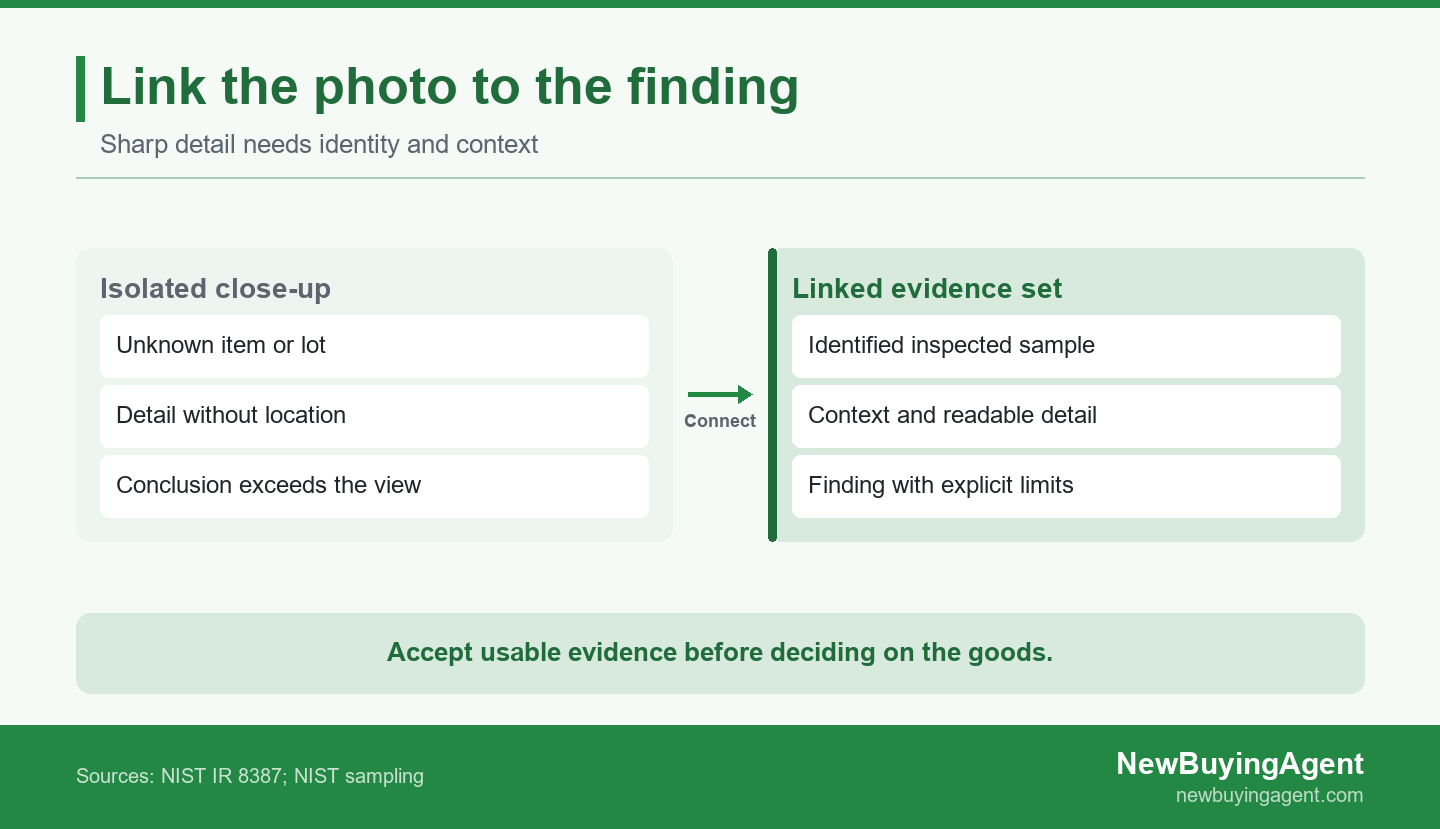
A linked photo set identifies the sample, shows the finding, and states its limits.
Specify the shots before the inspector arrives
Specify the context and detail views needed for each finding before the inspection begins. A context view establishes location; a detail view shows the feature that matters, with identification and a scale where relevant. Set the acceptance test around what the buyer can actually read in the delivered report, because a large original image is little help if its embedded version hides the defect.
Focus and distance matter more than moving the camera as close as possible. Nikon’s close-up guidance explains that a lens has a minimum focusing distance and that lighting affects close-up photography. If the edge or marking will not focus, move back and check the result instead of accepting a blurry enlargement. For shiny surfaces, adjust the light or angle to reveal the feature without letting glare hide it. Inspect the exported report image as well as the camera preview.
Color needs a separate agreement when it is an acceptance criterion. The International Color Consortium’s display guidance explains how viewing conditions affect perceived image color, especially on mobile displays used in variable environments. Consequently, an uncontrolled phone image should not be the sole basis for approving a tight color tolerance. Use the agreed physical reference or controlled assessment method, and describe the photograph as supporting context. Avoid editing the image until its color merely looks closer to the buyer’s expectation.
Tailor the shot list to the product: stitching alignment, a plated edge and a printed carton need different views. For size-related findings, place an appropriate scale beside the feature in the same plane where practical; a ruler far behind it can mislead. Start product research with NewBuyingAgent’s China Manufacturing and Product Guide, then turn the actual drawing, approved sample and packaging requirements into the inspection brief. General product guidance does not replace the order-specific acceptance criteria.
Show the method behind measurements and test results
A measurement photo should connect the identified unit, measurement setup, instrument reading and units to the written result. For a functional test, show the relevant setup and retain the method and result record needed to interpret it. A still image captures a moment; it cannot establish that a whole test sequence or required duration was completed, even when the displayed result appears clear.
A calibration sticker in the frame is useful context, but it is not the calibration chain. NIST’s metrological traceability guidance describes a documented, unbroken chain of calibrations, each contributing to measurement uncertainty. If the acceptance decision depends on a measured value, request the relevant instrument identification and supporting calibration record under the agreed measurement procedure. Also check how the instrument contacted or aligned with the product; a readable display can accompany an unsuitable setup.
The same distinction applies to printed codes. GS1’s barcode verification guidelines address barcode quality and the integrity of encoded data. A label photograph can document its placement, visible damage or human-readable text; it is not a verifier grade or a substitute for the encoded-data result. If barcode performance is specified, connect the photographed label to the actual verification record. State which finding the image supports so that a visually neat label is not mistaken for a completed technical check.
For an existing China factory, photo requirements belong in the inspection and reporting arrangements. NewBuyingAgent describes supplier communication, staged inspections and real-time reporting within its management of existing China factories. Give the team the relevant product requirement and the unresolved finding so these can inform the agreed reporting scope. This helps the buyer request evidence from the right production stage rather than receive a generic set of factory pictures after the inspected units have moved on.
Preserve original files and label every derivative
Keep the original image files and make report exports from them, rather than repeatedly editing an already compressed copy. GIMP’s JPEG export documentation explains that JPEG is lossy and that repeatedly altering and saving JPEG images loses more detail. For inspection reporting, check whether small markings, defect edges and instrument readings survive the chosen export. Do not assume that a convenient messaging-app preview preserves everything visible in the original.
Record where the files came from, who supplied them and how they relate to the inspection. NIST’s digital evidence preservation guidance discusses documenting file origins and using hashes to help preserve digital-file integrity. Its context is forensic evidence handling; the transferable lesson here is limited to preserving original files and documenting transformations, not imposing a forensic procedure on commercial inspections. A hash is a digital fingerprint used to check whether file contents have changed. Use it where the evidence-handling arrangement calls for that control.
Keep cropped or annotated copies distinguishable from the originals. An arrow can direct attention to an existing scratch, but should not obscure its edges or replace the uncropped context image. Record the relationship between the derivative and its source file in the image index. A matching hash supports file integrity after the chosen reference point; it does not prove that the photographed event occurred as described or that the claimed lot was inspected. Questions about capture identity still require the associated records.
Copy this photo acceptance checklist into your inspection brief
Use this checklist to agree photo identity, readability and evidence limits before the visit, then apply it to the delivered report. Replace generic terms with the product’s actual requirements and assign an owner for missing evidence. The acceptance conditions below concern whether the photographs can support remote review; product acceptance still follows the inspection plan and the buyer’s decision process.
| Check | Record | Accept or correct |
|---|---|---|
| Identity | Product/version, lot and inspected-unit reference | Image index connects the view to the report entry; otherwise identify or retake. |
| Finding linkage | Requirement and observed condition | Reader can distinguish the requirement from the observation. |
| Views | Context plus relevant detail | Location and feature are both understandable; retake missing views. |
| Readability | Focus, lighting and scale where needed | Required feature remains readable in the delivered file. |
| Method support | Setup, units and associated result record | Image and written measurement/test result refer to the same unit. |
| File handling | Original plus labeled derivatives | Original is retained; crops and annotations can be traced back. |
| Conclusion limits | Inspected scope and unresolved points | Caption does not turn a view into an unsupported lot-level conclusion. |
Pair the checklist with a caption or image-index record using these fields: image ID; product and version; order/lot; inspected unit; requirement/reference; observation; view or method; result or unresolved question; original/derivative relationship; follow-up owner. For example: “IMG-A-DETAIL; steel bookend, approved version; lot reference in inspection log; Unit A; front-face finish requirement; visible scratch; close-up linked to IMG-A-CONTEXT; disposition pending buyer review; original retained; inspector to confirm location.” This is an illustrative record, not an actual inspection result.
For a new product order, build these reporting needs into the supply brief rather than add them after production. NewBuyingAgent’s product sourcing and supply service combines local factory resources with product development and quality-control capability. The buyer’s priority remains receiving products that meet the agreed needs; photo requirements help communicate which features need evidence before release. Keep the brief focused on those product outcomes instead of requesting a large collection of pictures without a defined use.
When four close-ups do not establish four defective units
A photo count is not a defective-unit count, because several views can show the same defect on the same product. The following hypothetical bookend review shows how that distinction changes the buyer’s next action. The immediate task is to resolve which inspected units the findings belong to, so that later product decisions use the inspection log rather than assumptions drawn from the gallery.
The report leaves the unit count unresolved
In this hypothetical example, a retailer places a 2,400-unit order for steel bookends with a China factory. The remote buyer receives photographs relating to 12 inspected units, but has not accepted the evidence or decided the product disposition. Those quantities describe the example only; the selected units are not presented as a recommended statistical sample.
Four close-ups arrive without visible unit identity or a context view. Repeated edge details suggest that several scratch pictures may show the same unit, while another picture shows a dent. The written count cannot be verified from this set. Rather than translate four photos into four defective units, the buyer asks for mapped reshoots and the underlying inspection log before deciding what happens to the goods.
Retake the evidence and reconcile the inspection log
The inspector captures identified context and detail views, then corrects the image-to-unit index. The scratch views map to Unit A; the separate dent maps to Unit B. The buyer can now compare each finding with the unit record instead of guessing from similar-looking edges. The original close-ups remain available, with their corrected associations documented rather than silently overwritten.
The verification step is to reconcile the revised photo index with the inspection log: both identify two affected units among the 12 reviewed units. In this hypothetical example, the correction resolves the evidence-count ambiguity. It does not establish acceptance of the full order or prove that either product was repaired. Any repair and subsequent inspection would need a separate record; the buyer has improved the basis for a decision, without treating better documentation as a physical correction.
Reject an unusable photo set before making the product decision
Reject an unusable inspection photo set by naming the missing evidence and the specific reshoot or record needed. Keep evidence acceptance separate from product disposition: an unclear scratch image does not establish either a pass or a defect classification. Make the request while the relevant units remain accessible, and assign responsibility for supplying and reviewing the correction before the next order decision.
Replace “send better photos” with an instruction such as “identify the unit, show the front face, then photograph the scratch under lighting that reveals its edges.” If the problem is an unsupported measurement, ask for the setup and associated reading record rather than another isolated display image. If the goods have already moved, record that constraint and agree how the missing evidence will be obtained; do not let an unavailable reshoot turn into an assumed pass.
The inspector supplies the corrected material; the buyer or designated technical reviewer checks whether it answers the finding. Record unresolved points in the report and apply the agreed release authority. Keep a request to repair a product distinct from a request to clarify its documentation, so neither side treats a replacement photograph as proof of completed rework.
If a China order needs clearer inspection reporting, share the product and inspection brief, a sample report or photo set, the order stage and supplier situation. NewBuyingAgent can discuss local factory communication, staged inspections and the reporting scope needed for a usable evidence handoff, while the buyer retains the applicable product approval decision. Contact NewBuyingAgent about inspection reporting.
Frequently asked questions
Can a phone take acceptable inspection report photos?
A phone can be suitable if the delivered evidence meets the agreed readability, identification and handling requirements. Test it on the actual feature before the visit: a reflective edge or small marking may expose a focus or lighting problem that a general product shot will not. Agree an alternative capture method for details the phone cannot show reliably.
How many photos should an inspection report contain?
Use enough photographs to document the required findings and views within the agreed inspection scope. A fixed photo total can encourage duplicate pictures while leaving important requirements uncovered. Define required views by finding type, add views where the observation needs explanation, and reconcile the image index with inspected-unit records. Keep photo quantity separate from the inspection sample size.
Is a timestamp enough to prove when a photo was taken?
No. A timestamp is supporting context, not independent proof of when or where the image was captured. Ask the inspection team to explain how capture information connects to the visit, identified units and report records when timing matters. If those records conflict, retain the discrepancy for review instead of treating the date printed on an image as conclusive.
Can AI sharpen or fill gaps in inspection evidence?
Do not use generative edits to create missing inspection evidence. A reconstructed edge or invented marking cannot establish what the camera originally captured. Retain the original, label any processing, and request a reshoot when the acceptance-relevant feature is unreadable. Annotation may point to visible detail; it should not manufacture detail that the reviewer needs to judge.
NewBuyingAgent
Related Resources


Comienza hoy
Convirtamos tus objetivos de abastecimiento en realidadWeChat:+86 15157124615
WhatsApp:+86 15157124615
Dirección: Edificio 10 #39 Xiangyuan Road, Hangzhou, China
