


Incoming material inspection is a receiving-stage check that determines whether delivered materials meet specified requirements before they are used in production. For buyers using Chinese factories, the instruction should identify the material and lot, properties to check, methods and sampling rules, acceptance criteria, and authority to hold or release stock.
A receiving checklist marked “pass” can leave an important product requirement unverified. If the factory checks appearance while the buyer expects confirmation of composition or dimensions, both parties may believe incoming quality control is complete. The buyer's task is to make the inspection plan specific enough that the same delivery produces an understandable, evidence-based decision.
The Receiving Requirements Worth Agreeing Before Production
- Decision: Specify the material properties that matter to the finished product, not simply “perform incoming QC.”
- How it works: Tie the specification, inspection method and sampling decision to a clearly defined received lot.
- Risk: Sampling can support a lot decision without proving that every unit meets every requirement.
- Common mistake: Allowing production to consume material while its identity, report coverage or release status is unresolved.
What Incoming Inspection Should Establish Before Material Is Used
Incoming inspection should establish whether the received material meets the requirements assigned to that stage and whether any unresolved issue prevents use. It can identify the wrong material, damaged stock or a measured property outside its acceptance criterion before production consumes the delivery. Its value depends on the properties actually checked, the evidence obtained and the scope of the release decision.
Where acceptance sampling is used, the decision concerns the lot represented by the sample. NIST's explanation of acceptance sampling describes selecting a random sample to decide whether to accept or reject a lot. It distinguishes that purpose from estimating the lot's overall quality. A passed sample therefore should not be described as proof that all received material is defect-free.
Start by separating checks that answer different questions. Is this the ordered grade and version? Has transport or storage damaged it? Do the measured properties meet the agreed limits? Does the report cover the material being received? A visual result may answer the damage question while leaving composition or performance unresolved.
For a new purchasing arrangement, read the China sourcing guide to place receiving controls alongside the product brief and production agreement. Specify which checks occur at receipt and which remain for processing or finished product testing. This gives the factory a workable division of responsibilities without asking a receiving inspector to prove properties outside the assigned method.
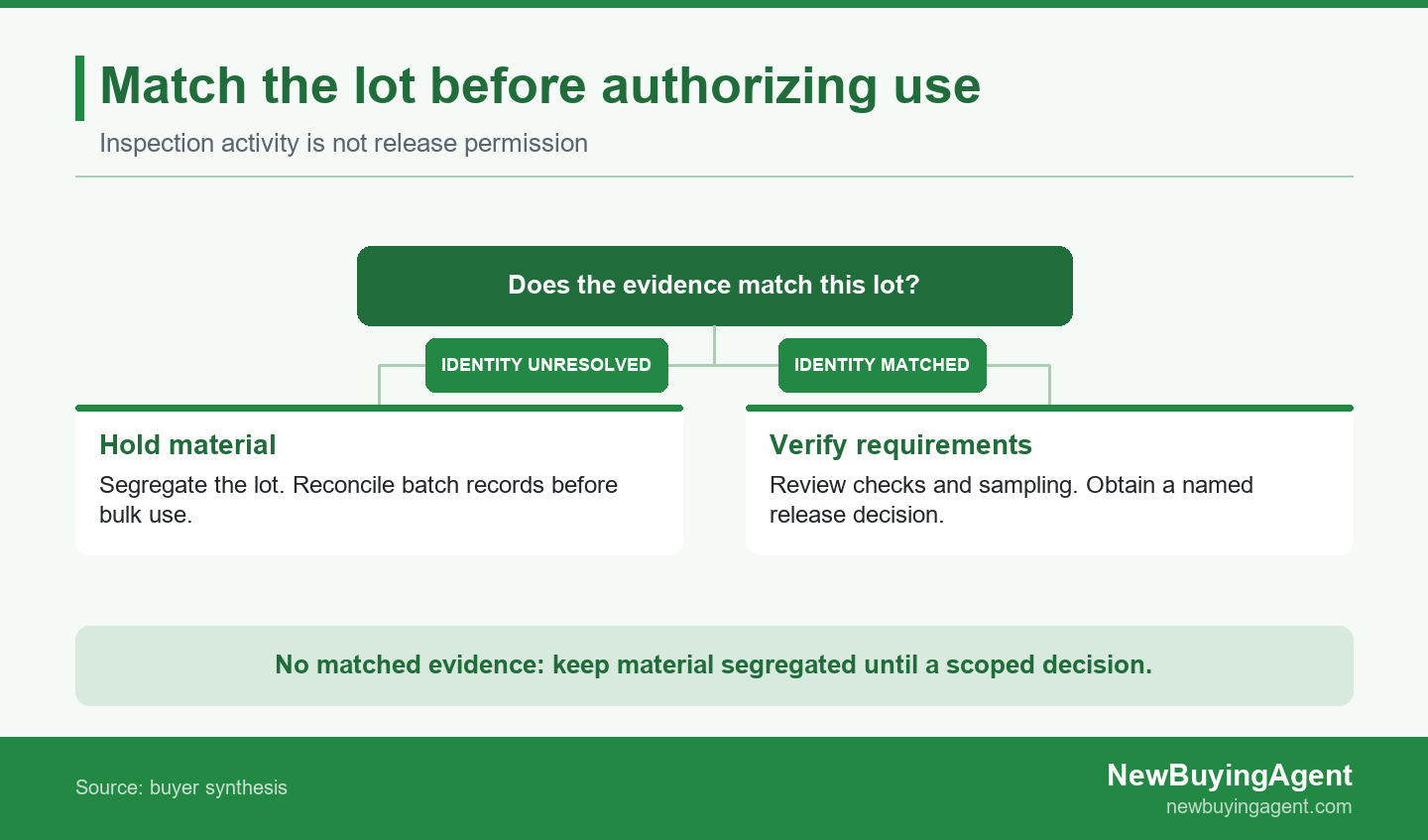
Matched material evidence supports a defined receiving decision; unresolved identity stays on hold.
The Material Inspection Requirements Buyers Should Put in Writing
Write the receiving requirements for each material that could materially affect the supplied product. Identify the specification revision, critical properties, inspection method, sampling approach and acceptance criteria, then define the records and decision authority. The result should allow receiving staff to carry out the check and allow a quality manager to understand why the lot was accepted, held or rejected.
| Requirement | What the buyer should specify | What it prevents |
|---|---|---|
| Material identity | Material code, grade, specification revision and relevant source identifiers | Accepting a similar-looking substitute as the ordered material |
| Inspection lot | Which batch, delivery or defined group the decision covers | Using one result to release unrelated batches |
| Properties and methods | Required characteristics, measurement or test method, and preparation conditions | Recording “checked” without testing the required property |
| Sampling and criteria | Selection procedure, applicable plan, limits and decision rules | Choosing convenient samples or changing acceptance after results arrive |
| Disposition | Hold arrangements, escalation contact and authorized release decision | Production consuming stock before the issue is resolved |
| Evidence | Batch-linked records, actual results, photographs and signed disposition | A pass label that cannot support a later investigation |
Define the inspection lot before drawing samples. A truck delivery can contain several manufacturing batches, and material from separate deliveries can be combined in storage. The agreed grouping should reflect the relevant production and traceability information. If the factory cannot distinguish batches after unloading, a sample result may be difficult to apply to the stock that production intends to use.
A sampling plan needs both a selection procedure and a decision rule. NIST's overview of lot acceptance plans explains different approaches, including plans where an initial sample can lead to a further sample before a final decision. Agree on the applicable procedure in advance; repeated testing of convenient pieces until something passes is not the same as following a planned sampling system.
When buying a new finished product, NewBuyingAgent's product supply from China can connect material-sensitive requirements with local factory resources and product/QC capability. Include those requirements in the purchasing brief so they inform the supplied product offer and production arrangements. The receiving plan should support the product outcome the buyer needs, rather than become an isolated paperwork exercise.
Which Checks Belong at the Receiving Stage?
Choose checks according to what could go wrong with the material and what evidence would reveal that problem. Receiving may need identity and document checks, physical inspection, dimensional measurement or specified testing. A single general checklist rarely explains all of these adequately, so give each required property its own method and acceptance criterion without treating every material as equally critical.
For a metal blank, surface condition and dimensions may be visible or measurable at receipt. Confirmation of the required grade may depend on other evidence or a suitable test. For fabric, shade comparison and damage checks answer different questions from composition or performance testing. The specification should identify which answers are needed before use.
Check Material Identity and Report Coverage
Match delivery labels, material codes and batch identifiers to the order and supporting records. A certificate of analysis reports analytical results for identified material; its value depends on whether the received material and required properties are covered. In the specific context of US drug component controls, reliance on supplier analysis includes manufacturer identity testing and validation of supplier results' reliability at appropriate intervals. These are drug manufacturing requirements, not a universal inspection rule for ordinary consumer product materials.
For other categories, agree what evidence is appropriate rather than borrowing the drug procedure. If the report names a different batch, identify the mismatch and request evidence tied to the delivery. Do not infer material failure solely from missing paperwork, but do not let that uncertainty disappear under a general “supplier approved” status either.
Specify the Measurement Method, Not Just the Instrument
State where a dimension is measured, how the material is prepared and which conditions affect the result. Naming a caliper or scale alone may leave operators measuring different locations or comparing different conditions. Where a reading lies near an acceptance limit, the plan should explain how the result is evaluated and when the quality authority needs further evidence.
A calibration claim does not automatically make a measurement suitable for a particular tolerance. NIST's metrological traceability guidance explains that traceability alone does not guarantee fitness for purpose and that uncertainty must suit the measurement need. Metrological traceability concerns the measurement's connection to references; batch traceability concerns which physical material a record describes. The receiving plan needs the relevant form of each.
How to Set Sampling Rules Without Promising Zero Defects
Set sampling rules for the property and lot decision, with a clear selection procedure and acceptance criteria. Explain whether the inspection classifies defects or measures a characteristic, and which procedure applies when a result is inconclusive. The plan should make the accepted risk understandable, rather than use a familiar inspection label as a guarantee about every unit.
A sampling plan can reject a lot of acceptable quality or accept one of unacceptable quality. NIST's discussion of operating characteristic curves relates a plan's acceptance behavior to producer and consumer risks. An operating characteristic curve describes the probability of acceptance at different lot quality levels. The buyer and factory should choose a plan with the relevant consequences in mind, not assume that increasing the sample slightly eliminates uncertainty.
Agree how the inspector reaches the material to be sampled. Pieces taken only from the top of one container may miss conditions elsewhere in the lot. Record the selection method and selected locations or identifiers as appropriate, and identify any portion that was inaccessible. If the planned selection cannot be carried out, escalate that limitation rather than reporting an unqualified pass.
Appearance checks, dimensional checks and destructive tests may require different procedures. Do not automatically reuse a finished product inspection plan for raw material properties. Where a safety or regulated characteristic is involved, confirm the current official product and destination requirements with qualified advice as needed; a general sampling plan cannot replace a required compliance test.
What Should Happen When Incoming Material Does Not Pass?
The plan should distinguish confirmed nonconformity, missing evidence and inconclusive results, then assign an appropriate response to each. Keep affected material identifiable while the issue is assessed, notify the responsible people and record the authorized disposition. ISO and IAF guidance on external providers emphasizes communicating purchasing requirements and verifying conformity; it is educational guidance rather than a product-specific mandatory release procedure.
A hold must work on the factory floor. Specify how the warehouse separates or marks affected stock and how its inventory status prevents issue to production. This is often called quarantine: material remains controlled until a decision is made. A note in a remote buyer's email does little if the cutting or forming operator sees ordinary usable stock.
Name the people authorized to release, reject, return or approve a defined exception. Purchasing can obtain replacement material, QC can evaluate evidence and production can explain schedule consequences, but those actions should not become informal release permissions. If a limited trial is authorized, define the quantity or scope and intended purpose separately from bulk production approval.
Example: Batch Evidence Is Missing Before Bottle Forming
In this illustrative scenario, an importer has ordered 12000 units of stainless steel water bottles from an existing China factory. Metal blanks have arrived for forming, but their identity is pending verification and there is no bulk release. The order uses an agreed material specification. This is a hypothetical example, not a reported client case.
Receiving staff find that the batch identifier on the supplier report does not match the packaging labels. Surface checks reveal no obvious issue, and production wants to start forming. The observation establishes a gap in report coverage; it does not prove that the blanks contain the wrong grade. Nevertheless, the appearance result cannot resolve the required identity question.
The quality manager holds the affected blanks and has the warehouse preserve the batch labels and storage separation. The factory requests the correct batch-linked evidence from its supplier, while QC identifies any additional checks needed against the specification. Production revises its start assumption. A narrowly authorized forming trial, if useful, addresses processing behavior without releasing the bulk material.
Once the source records and relevant checks are available, the named approver reviews them and records the material disposition. If identity remains unresolved, the hold continues; if the evidence supports use within the specified scope, release can be recorded. Local follow-up can obtain documents and coordinate the factory response, while final authority follows the agreed arrangement. No test success or schedule recovery is assumed.
What Evidence Should a Remote Buyer Receive?
Ask for records that connect the received lot, specification, method, actual findings and final disposition. A useful report states what was checked and what was not, identifies the sampled material and preserves unresolved issues. Photographs support identification and observed condition, while numerical results or test records support the properties examined; neither should be replaced by a single green pass label.
Report reuse needs a justified connection to the material being supplied. For example, US consumer product component testing rules address conditions for relying on component results, including material identity, traceability and due care. Those requirements belong to their specific compliance context. The broader purchasing lesson is to ask why an existing report applies to this material and intended use, rather than accept an unrelated document because its title looks relevant.
For buyers maintaining an established China supplier, NewBuyingAgent's management of existing China factories is relevant to production follow-up and quality management. Its China-side execution team and product/QC capability can help keep receiving findings connected to actual factory activity. Agree which inspection evidence will be reported and who makes material disposition decisions so remote communication supports the buyer's production requirements.
Keep the receiving result connected to subsequent use. If the material is split among production runs, preserve the identifiers needed to determine which finished products used it. When a requirement, source or method changes, identify the affected records and review the inspection instruction. Updating a report template without changing the factory's working instruction leaves the operational gap intact.
How to Agree on the Plan With Your Chinese Factory
Review one current material with the factory before expanding the plan across the product. Ask receiving staff to show how they identify its lot, apply the specified checks and recognize held stock. Then ask the quality manager to show the evidence behind a release. Any disagreement about method, coverage or authority is a requirement to resolve before routine production relies on the plan.
To discuss an existing factory arrangement or a new product purchase with NewBuyingAgent, include product and material specifications, quantity, target price, destination and timing, plus the current factory context and any receiving concern. As a one-stop China sourcing agent for global buyers, it combines local factory resources with product/QC capability; discuss a supplied product offer for new purchasing or production and quality management for an existing factory. To start that discussion, send the purchasing requirements.
Frequently Asked Questions
Should accepted material be checked again after storage?
Yes, when storage conditions or elapsed time could affect a required property or its usable status. Define relevant reinspection triggers for the material rather than setting an arbitrary universal interval. Preserve the original acceptance record and document the new condition, assessment and disposition before the material is used.
Can production start while a laboratory result is pending?
Only if an authorized decision permits the defined activity and the applicable requirements allow it. Identify what the pending result could change, what material may be consumed and what restrictions apply. A trial permission is different from bulk release, and schedule pressure does not establish that a required material property is acceptable.
What if the delivery contains mixed or unidentifiable batches?
Establish the grouping and traceability before applying a result to the stock. Separate identifiable batches where feasible and record any unresolved portion. If the material cannot be linked to the planned inspection lot, obtain a quality decision on further identification, verification or rejection; do not extend one batch's acceptance to the whole delivery by assumption.
How should the plan handle destructive testing?
Agree on the test purpose, selection procedure and treatment of consumed samples before testing begins. The test results support the properties examined under the applicable plan; they do not cover untested requirements automatically. Record the sampled batch and make the remaining stock's disposition explicit, including any need for further evidence.
NewBuyingAgent
Related Resources


Comienza hoy
Convirtamos tus objetivos de abastecimiento en realidadWeChat:+86 15157124615
WhatsApp:+86 15157124615
Dirección: Edificio 10 #39 Xiangyuan Road, Hangzhou, China
