

Introduction
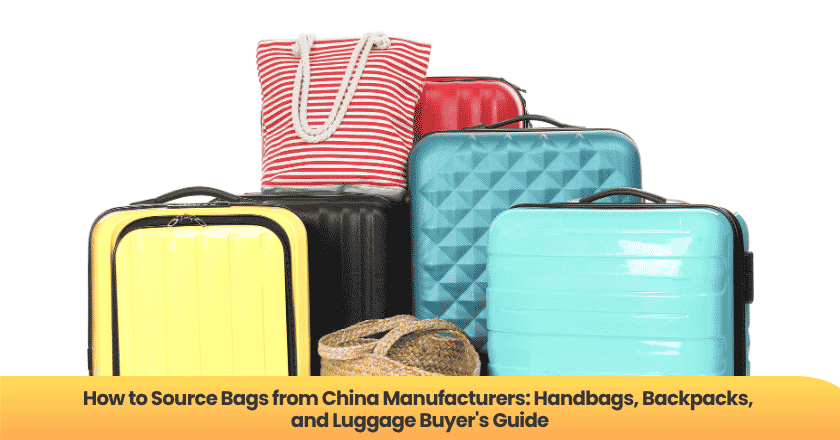
A factory that makes beautiful structured handbags quoted you a great price on a hiking backpack, and the sample came back looking like a handbag's idea of a backpack — soft where it should be rigid, with straps that won't survive a loaded trail. "Bags" is not one category to a Chinese manufacturer. A handbag, a backpack, and a hardshell suitcase are made by different factories, on different equipment, by differently skilled teams, and treating them as interchangeable is the fastest way to a disappointing first order.
Sourcing bags from China works well once you stop thinking "bag factory" and start thinking about your specific bag type and what it demands. Each type has its own specialization, its own MOQ logic, and its own quality failure points. Buyers who lump these together pay for it, when matching the bag to the right kind of factory up front would have saved the trouble.
Key Takeaways
• Handbags, backpacks, and luggage are made by specialized factories — match your product to the right one.
• Each bag type fails in different places, so quality checks differ by category.
• MOQs vary widely; structured and hardware-heavy bags carry higher minimums than simple ones.
• Verify materials physically, especially leather grade and hardware quality, rather than trusting the listing.
• A pre-production sample in your exact materials is the only reliable quality reference for any bag type.
Why Bag Type Determines the Factory
Specialization is real and narrow
A structured leather handbag demands skilled hand-finishing, precise edge painting, and quality hardware — a craft operation. A technical backpack needs heavy-duty fabric handling, bartack reinforcement, webbing and buckle assembly, and stress-tested seams — closer to technical sewing. Hardshell luggage involves molded shells, telescoping handle mechanisms, and wheel assemblies — part bag-making, part light manufacturing. These are genuinely different industries that happen to share the word "bag."
A factory invests in equipment and skill for its core type, so it excels there and struggles elsewhere. Sending your product to the wrong specialist gets you a quote, an order, and a result that misses. The first sourcing decision, before price or MOQ, is identifying which kind of factory your specific bag needs.
Finding the right specialist
Reaching the right factory is harder than searching a platform suggests, because the best specialists often don't market in English — their order books fill through domestic relationships and agents. The visible, English-facing suppliers are a self-selected fraction, not necessarily the best fit for your bag, so the factory truly built for your product may never surface in a platform search at all.
Expert Tip: Ask a factory what percentage of its output is your specific bag type, then ask to see recent production of that type leaving the line — not the showroom, which may include bags they merely traded. A backpack factory where 80% of the floor is making backpacks has the skill and material suppliers your product needs. One showing you a handful of backpack samples among mostly handbags is learning your product on your money. Production share, not catalog range, reveals real specialization.
Sourcing by Bag Type
Handbags
Handbag quality lives in materials and finishing. The leather grade is the biggest variable — full-grain, top-grain, genuine (a lower grade than it sounds), bonded, and PU (polyurethane, synthetic) differ enormously in price and durability, and the terms get used loosely. Verify grade with a physical sample and, for true leather, a burn or lab test. Then check finishing: edge painting or folding, stitch straightness, hardware plating that won't tarnish, and strap-anchor strength. Structured handbags carry higher MOQs and more hardware minimums than soft, simple styles.
Handbags also attract trading companies more than other bag types, because leather is easy to misrepresent and the buyers are often newer to sourcing. A company calling itself a manufacturer may be reselling from a factory you'll never see, adding margin while removing your control over the leather and the construction. Ask a specific production question — what tannery supplies the leather, how the edges are finished — and a real factory answers in seconds while a reseller hedges. Knowing whether you're dealing with the maker or a middleman matters most in this category, where the gap between a quality bag and a substandard one is wide and hidden in details a photo won't show.
Backpacks
Backpack quality is about durability under load. The failure points are seams, straps, and stress junctions — the places weight concentrates. Check bartack reinforcement at strap anchors, zipper quality (a cheap zipper is the most common backpack failure), fabric denier and coating for water resistance, and the comfort and stitching of shoulder straps and back panels. A backpack should be stress-tested, not just inspected by eye, because a seam that looks fine can pull apart under a full load.
The technical end of the backpack market raises the bar further. Hiking, camping, and tactical packs involve load-bearing frames, ventilated back systems, compression straps, and weatherproofing that demand a factory experienced in technical sewing and the right materials. A factory that makes simple promotional or school backpacks well may be out of its depth on a 40-liter hiking pack. The denier rating of the fabric, the type of coating, and the quality of buckles and webbing all matter more as the pack gets more technical, and they're exactly the specs a less-capable factory will quietly downgrade. Specify these precisely and confirm the factory's recent output includes packs of similar technical complexity, not just similar appearance.
Luggage
Luggage is the most manufacturing-like of the three. For hardshell, check shell material and impact resistance; for both hard and soft, scrutinize the wheels, the telescoping handle, and the zippers, since these mechanical parts fail first. Luggage often carries higher MOQs because of molds and mechanical components, and lead times run longer. Compliance and weight matter too, as luggage faces airline handling and sometimes destination-market testing.
The mechanical complexity also means more component suppliers behind each piece — wheel makers, handle-mechanism makers, zipper suppliers — and a luggage factory is really assembling parts as much as making them. That has two consequences for you. First, the MOQ reflects those component minimums, so custom wheels or a custom handle can push the floor up sharply. Second, quality depends on the grade of bought-in components, which a factory can quietly downgrade to hit a price. Specify the key mechanical parts by quality or brand where you can, and have your pre-production sample function-tested — wheels rolled, handle cycled, zippers run — before bulk. A suitcase that looks identical to your sample but uses cheaper wheels will generate returns the moment customers drag it through an airport.
Common Mistake to Avoid: Applying the same quality check to every bag type. Inspecting a backpack the way you'd inspect a handbag — judging it on appearance and leather feel — misses the load-bearing seams and zipper stress points where backpacks actually fail. Buyers approve a good-looking sample, then face returns when straps tear or zippers split in use. Match the inspection to the bag: finishing and materials for handbags, stress and load for backpacks, mechanical parts for luggage.
Materials, MOQ, and Placing the Order
Verify materials physically
Across all bag types, the listing's wording is not evidence. "Genuine leather," "ballistic nylon," "aircraft-grade aluminum" — these phrases protect the seller, not you, and a price well below the market rate for the claimed material usually means a cheaper substitute. Specify materials precisely by grade, denier, thickness, or composition, and require a physical material sample before bulk. A dedicated quality layer pays off here, since a material confirmed only by email is confirmed by no one — verifying on the ground is exactly what an inspection team does.
MOQ and payment terms
MOQs vary by type and complexity, commonly 300–1,000 pieces, higher for hardware-heavy or molded products. The minimum reflects the highest component minimum among materials and hardware, not just labor. Standard payment terms are a 30% deposit and 70% balance against a passing pre-shipment inspection. Resist higher deposits from a first-time supplier, since the balance is your real pressure to get defects fixed. Through 2026, more buyers route payments through escrow or agent-held accounts rather than direct wires, adding a recoverable layer if a shipment fails inspection.
The cost picture
Going direct feels cheapest until failed samples, wrong-specialist orders, and material surprises get counted. Across three different bag types needing three different factories, the coordination involved is real work, and getting any one of those matches wrong can cost more than the whole exercise was meant to save.
The hidden costs in bag sourcing are easy to underestimate. A wrong-specialist order that has to be remade, a leather grade that turns out cheaper than promised, a backpack that fails stress testing after the deposit is paid — each of these dwarfs the few percent a careless direct purchase might save. Pricing the full cost of getting it wrong, not just the unit quote, is what makes verified sourcing pay for itself in bags, a category where the visible product and the actual quality can diverge so easily. The buyers who treat the lowest quote as the cheapest option often end up paying the most once returns and remakes are counted.
Expert Tip: For any bag with moving or load-bearing parts, ask for a function-tested sample, not just a visual one. Have the factory cycle the zippers, load the straps, or roll the luggage and report back — or commission a short third-party test before bulk. A handbag clasp opened a thousand times, a backpack strap loaded to capacity, or a suitcase wheel rolled over a test course tells you what a photo never will. Factories that build real bags take this in stride.
How NewBuyingAgent Helps You Source Bags
Handbags, backpacks, and luggage come from three separate kinds of specialist factory, and lining up the right one for each — then checking materials and quality category by category — is easy to fumble when you're running it all remotely, which is why many buyers hand it to a sourcing partner. NewBuyingAgent is your perfect partner for global sourcing from China, backed by 30 years of expertise in trade, manufacturing and quality control.
Connecting each bag type to a factory that genuinely excels at it is the first hurdle: with 100% Access to China's Factories, you use their 50,000+ cooperated partner factories—no language/region/time zone barriers. Their local reputation gets you full factory cooperation. Coordinating three bag types across three factories also pencils out on price: with Lower Prices Than Direct Sourcing, their wide factory network lets them pick low-cost, high-cooperation suppliers. Even with their margin included, they can cut your costs by 5%-10%. And since every bag type has its own failure point, the quality has to be held category by category: NewBuyingAgent's 20,000+ product development & QC experts ensure your products match market needs and stay high-quality. Contact now.
Frequently Asked Questions
Can one factory make handbags, backpacks, and luggage?
Rarely well. Each type needs different equipment and skills — fine finishing for handbags, heavy-duty technical sewing for backpacks, molded shells and mechanical assembly for luggage. A factory invests in its core type and struggles outside it. Match each product to a factory specialized in that bag type for the best result.
How do I check quality differently for each bag type?
Inspect handbags for materials and finishing — leather grade, edge work, hardware plating, stitch quality. Inspect backpacks for load durability — strap anchors, seams, zippers, fabric strength under stress. Inspect luggage for mechanical parts — wheels, handles, zippers, and shell integrity. Each type fails in different places, so the check must match the product.
What's a typical MOQ for bags from China?
Commonly 300–1,000 pieces per style, higher for hardware-heavy or molded products like structured handbags and luggage. The minimum reflects the highest component minimum among materials and hardware, not just labor. Simpler, softer bags tend to carry lower minimums.
How do I verify the materials are what's claimed?
Specify materials precisely — leather grade, fabric denier, composition — and require a physical material sample before bulk. For true leather, use a burn or lab test. The listing's wording protects the seller; only a physical, verified sample protects you, and a price far below market for the claimed material is a red flag.
Should I use a sourcing agent when sourcing different bag types?
It can help, since different bag types need different specialist factories, and coordinating across several is exactly where buyers struggle. A channel that matches each product to a factory built for it and applies category-specific quality checks removes much of that burden, which is often worth more than handling three separate factory relationships yourself.
Conclusion
Sourcing bags from China starts with rejecting the idea that "bags" is one thing. Identify your specific type, match it to a factory built for that construction, inspect it where it actually fails, and verify every material physically rather than trusting the listing. Handbags reward attention to finishing, backpacks to load durability, luggage to mechanical parts — and getting the factory match right is most of the battle. When lining up the right specialist for each product and verifying quality from a distance is more than you want to manage, it's worth having a partner match each bag to the right maker and put category-specific QC behind your order.
NewBuyingAgent
Related Resources

Comienza hoy
Convirtamos tus objetivos de abastecimiento en realidadWeChat:+86 15157124615
WhatsApp:+86 15157124615
Dirección: Edificio 10 #39 Xiangyuan Road, Hangzhou, China
