


Container charges are not simply “port delay fees.” Separate clocks can start when cargo remains at the terminal or when carrier equipment stays out beyond its agreed period. For a China-origin shipment, the useful question is not “How many days do we have?” in isolation. It is: which term applies to this unit, what event starts the count, what event stops it, and who holds proof of the next handoff? A dated operational entry answers those questions before a routine delay becomes an invoice-review problem.
Where Demurrage and Detention Actually Begin
Demurrage concerns terminal dwell, while detention concerns carrier equipment used outside the terminal. Carrier guidance for buyers uses the same practical distinction: first ask where the container is, then identify the relevant event history.
A D&D charge depends on the container event and the free time applicable to that movement. The applicable D&D terms are the starting point, but the shipment’s booking, tariff, port, and local operating conditions can still change the practical answer.
Do not manage a China shipment with one general countdown. Manage a separate charge clock for each container, its location, and its next required handoff.
- Terminal first: confirm whether the immediate risk is terminal dwell or equipment use.
- Terms second: record the exact source of the free-time rule.
- Proof third: retain the time-stamped document or gate event that closes the handoff.
- Owner always: name one party responsible for the next action.
That distinction also makes the article’s later steps easier to apply. A delay in customs processing, a missing delivery authorization, an unavailable pickup gate, and a missed empty return may all create pressure on a delivery plan, but they do not automatically create the same charge or call for the same evidence. For broader context on the purchasing steps that precede a shipment, see this China sourcing guide.
Read the Applicable Terms Before You Count Days
The applicable carrier terms define the relevant free-time basis and event logic for a movement. Check the carrier’s D&D terms before someone converts an ETA into a deadline. Save the term source, the booking or shipment reference, the relevant location, and the wording that identifies the start and stop event. The same carrier may publish different conditions by country or terminal, and a quotation can include a different commercial arrangement. A previous shipment’s allowance is therefore a poor substitute for the record attached to the current movement.
Use a simple check: if the team cannot point to the term source and name the event that begins the clock, treat the date as provisional. Ask the forwarder or carrier contact for the applicable record while there is still time to act. This is especially important when a container moves through a transshipment port, is delivered inland, or has an empty-return instruction that is separate from the original pickup plan.
Treat Free Time as a Dated Operating Record
Free time must be checked against the applicable local terms rather than assumed from a generic shipping rule. Maersk’s standard-free-time guidance, for example, says that the allowance varies with local country guidance. The operative date therefore belongs to the current shipment record, not to a remembered free-day number or charge amount.
The prevention tool is a per-container free-time record that names the charge basis, events, evidence, and owner before the clock expires. A charge clock record is one per-container entry of the applicable terms, events, proof, and owner. It is an editorial operating method, not a carrier rule or legal test. Its value is practical: when a container appears on a daily exception list, the buyer can see whether the next action is to obtain release evidence, confirm a pickup appointment, verify an empty-return location, or review an invoice.
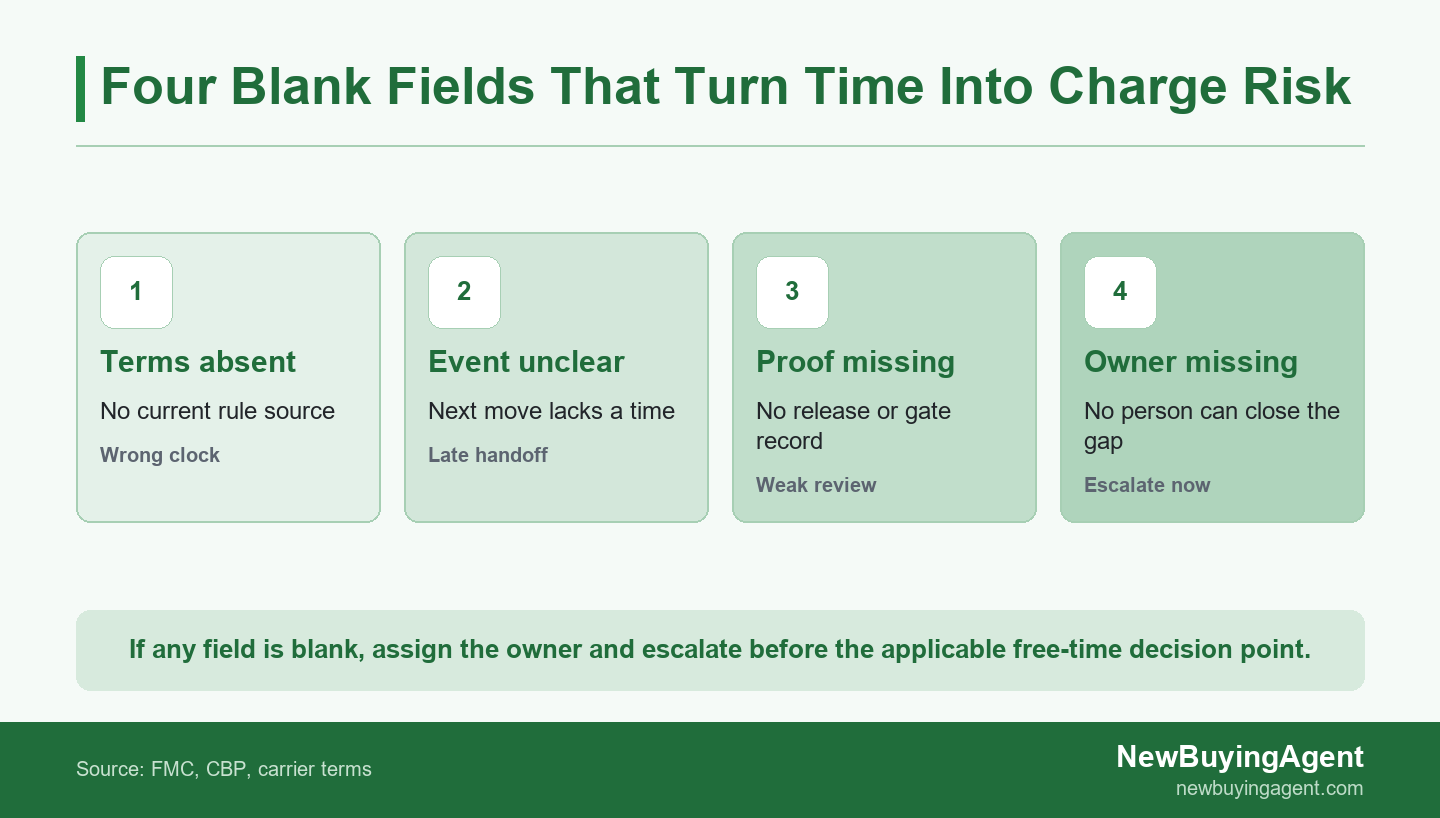
Four-stage risk ladder from missing terms to an unowned China shipment handoff
Keep the record at container level, even when several containers share one bill of lading. They can gate out on different days, return through different facilities, or have different proof gaps. The purpose is not to create a larger spreadsheet. It is to turn a vague “please keep an eye on it” instruction into a timestamped decision record.
The Eight Fields That Keep the Clock Auditable
An eight-field record makes the applicable term, event, location, owner, proof, and escalation point visible for one container. The table is deliberately operational: it shows what needs to be available when the next handoff is due, rather than trying to calculate a universal fee.
| Field | Record for this container | Why it changes the next action |
|---|---|---|
| Charge type | Demurrage, detention, storage, or a combined local label | Prevents the wrong clock being managed |
| Term source | Carrier terms, booking, tariff, or written agreement | Shows which rule needs checking |
| Start event | The event and timestamp that may begin free time | Sets the real decision point |
| Stop event | Gate-out, empty gate-in, or another applicable event | Shows what evidence must be retained |
| Location | Terminal, depot, inland point, or return facility | Connects the rule to the physical container |
| Named owner | Buyer, broker, carrier contact, trucker, or consignee team | Avoids an unowned handoff |
| Proof link | Release notice, appointment, interchange, or gate record | Supports an early check or later review |
| Escalation point | The earliest point at which a blank field needs attention | Moves the team before the clock becomes a charge |
Make the escalation point earlier than the last possible movement date. For example, if the team still lacks a confirmed return location or appointment, the right escalation is to verify the applicable instructions now—not to wait for the empty container to become overdue. The free-time record should contain links or references to the evidence, rather than asking a later reviewer to reconstruct the chain from email inboxes.
Prevent Charges Through Two Critical Handoffs
A customs release request is only one handoff; pickup still depends on the applicable carrier, terminal, and delivery records. In the United States, CBP’s explanation of Form 3461 describes a cargo-release request, not a complete terminal pickup workflow. Other destinations have their own customs and release processes, so check the local sequence rather than assuming a familiar document has closed every step.
Terminal and empty-return gate availability should be recorded because local gate conditions can affect the practical free-time handoff. ONE’s U.S. guidance is a useful reminder that gate availability and local D&D terms must be read together, not as separate status notes.
NewBuyingAgent approaches this kind of issue as part of the wider China sourcing and supply-management outcome: the useful input is the product and delivery context, the current handoff, and the decision that the buyer needs to make. That keeps operational coordination connected to the commercial outcome rather than reducing it to a generic status-chasing exercise.
The two handoffs below are connected but not interchangeable. The first gets a loaded container out. The second gets the empty equipment back under the applicable instructions. When the record assigns both to one generic “logistics” owner, the second handoff is often discovered too late. A coordinated supply-chain management approach should make the owner and proof requirement visible at each point.
Close the Release-to-Pickup Handoff
A pickup handoff is not complete until the applicable release, delivery, terminal-access, and appointment records align. CBP’s cargo-release overview helps distinguish the customs step from the rest of the pickup chain. For the person managing the exception list, that means checking more than whether clearance is “in progress” or “released.” Keep the relevant release notice, delivery authorization or order where applicable, terminal availability confirmation, appointment reference, and the trucker’s pickup plan tied to the container number.
There may be genuine reasons why an event cannot move: a document is incomplete, an inspection is pending, the terminal has no appointment capacity, or the consignee has not accepted delivery. Recording the reason matters because it tells the buyer whether to escalate a document issue, capacity issue, or ownership issue. It also prevents a later discussion from collapsing several distinct delays into one unsupported claim that the terminal “held the container.”
Close the Empty-Return Handoff
A return handoff needs the applicable return location, gate condition, appointment rule, and empty gate-in proof. ONE’s gate-availability guidance illustrates why local operating conditions belong in that check. The return instruction should be treated as an active operational item, not an assumption carried over from the pickup. Confirm the depot or terminal named for that equipment, its latest operating condition, whether an appointment is required, and the evidence the trucker will provide after gate-in.
Ask for a confirmation that can be saved in the record: a return reference, appointment identifier, gate transaction, or written instruction. If the instructed location changes, capture the time of the notice and the next feasible action. That does not decide liability, but it preserves the sequence needed to assess whether a delay was preventable and where escalation should go. A missing empty gate-in record is a reason to investigate immediately, not a reason to mark the whole shipment complete.
Review a Charge Against Events and Evidence
For covered U.S. bills, the FMC rule sets timing for bill issuance and a mitigation, refund, or waiver request. The FMC’s final-rule summary states that a bill must be issued within 30 calendar days after the last charge is incurred and provides at least 30 calendar days for the request it describes. Those are U.S. regulatory details, not a universal dispute timetable.
The FMC says the court set aside only 46 CFR 541.4 while other rule provisions remain applicable. Its current court-decision notice is important context for a U.S. review, but a live dispute may need qualified local advice.
Accessible terms and clear invoice, cargo-notification, and dispute information make a charge record easier to review. The FMC’s VOCC audit guidance highlights these as useful practice areas. Start a review by aligning the invoice with the applicable terms, container number, billed date range, actual movement events, notices received, and documentary gaps. Do not begin with an assumption that every unexpected charge is invalid.
Illustrative Scenario: Two Containers, One Missing Handoff
In the illustrative two-container scenario, a missing empty-return appointment handoff changes a controlled pickup into a detention-risk review. The example is not a customer case, a charge calculation, or a prediction of an outcome. It simply shows why one shipment status cannot safely stand in for two individual container records.
What Changed When the Return Record Stayed Open
The illustrated return gap is a missing proof-and-owner field, so the buyer escalates the record before treating the container as closed.
A home-goods importer is coordinating 2 40-foot containers from Ningbo to 1 U.S. destination port, with 2 individual equipment-return records. Both containers are discharged, but the shared shipment dashboard only shows a general delivery status. One container has a complete pickup appointment and gates out. The other has a late-recorded delivery authorization and no confirmed empty-return appointment after delivery.
The buyer first checks the applicable terms rather than assuming the same allowance used on an earlier lane. The return record has no verified location, appointment reference, named owner, or eventual empty gate-in proof. That is the meaningful gap. Treating both containers as “delivered” would hide a separate equipment-return decision and make later review harder.
The buyer places the unconfirmed return record in an operating hold, asks the responsible party to confirm the return instruction and gate condition, and saves the response in the container record. Before shipment closeout, the team checks that each container has a term source, dated event, proof link, and named owner. This is illustrative only; it does not state a carrier commitment, a charge amount, or a legal conclusion.
Where NewBuyingAgent Fits in a China Sourcing Request
NewBuyingAgent can support a defined China sourcing and supply-management request when the buyer brings the complete product, delivery, and outcome requirements. Its what NewBuyingAgent does page is relevant when a buyer needs China-side coordination as part of a wider sourcing outcome—not as a promise to reverse a charge or run a stand-alone claims service.
A productive discussion starts with the product, quantity, destination, delivery timing, current supplier or shipment context, and the decision that needs to be made. That gives the team enough context to consider the complete supply chain rather than trying to solve one disconnected invoice line. Buyers who want to review broader sourcing experience can see the company’s client cases.
A Prevention Checklist Before the Clock Expires
Before the next decision point, confirm the term, event, proof, and owner for every active container. Use this checklist on the exception list rather than treating it as a one-time pre-shipment exercise:
- Open the applicable term source for the container’s current location.
- Write the next required movement or handoff with its timestamp.
- Assign one named owner and the evidence they must return.
- Escalate any blank field before the operational decision point.
If the delivery issue is part of a broader China sourcing or supply-management need, prepare the product, quantity, destination, timing, and current handoff context before you discuss the full sourcing requirement. That keeps the conversation focused on a workable outcome rather than an isolated status update.
Related Guides
Shipment charge prevention works best when the delivery record is connected to the buyer's wider China sourcing process. Use the same per-container discipline when setting delivery requirements, documenting China-side coordination, and reviewing future shipment exceptions.
Frequently Asked Questions
What is the difference between demurrage and detention?
Demurrage usually concerns terminal dwell, while detention usually concerns carrier equipment used outside the terminal under the relevant terms. A carrier explanation for buyers gives the same operating distinction. The exact labels and start events can vary by carrier, port, and agreement. Read the current movement record before deciding which clock is active, then preserve the event proof that will show when the relevant movement actually occurred.
How many free days do I get for a container from China?
There is no reliable universal number because free time depends on the applicable carrier, location, booking, and local terms for that movement. Record the term source for the individual container and confirm its start event before the operating date becomes urgent. A free-time number remembered from another lane can create a false deadline and send the team to the wrong escalation path.
Does customs release mean the container can be picked up?
No, a customs release step does not by itself prove that every carrier, terminal, delivery, and appointment handoff is complete for pickup. It can be an essential step, but pickup readiness still depends on the applicable local process and records. Keep release evidence alongside delivery and appointment confirmations, then ask the named owner to confirm the next physical movement.
What should I keep when disputing a demurrage or detention invoice?
Keep the applicable terms, invoice, event timestamps, release and appointment records, gate evidence, and the communications that show each handoff clearly. Organize them by container number and billed date range so the event sequence can be checked without reconstruction. This supports a factual review, but it does not guarantee that a carrier will waive, refund, or reverse a charge.
NewBuyingAgent
Related Resources


Comienza hoy
Convirtamos tus objetivos de abastecimiento en realidadWeChat:+86 15157124615
WhatsApp:+86 15157124615
Dirección: Edificio 10 #39 Xiangyuan Road, Hangzhou, China
