

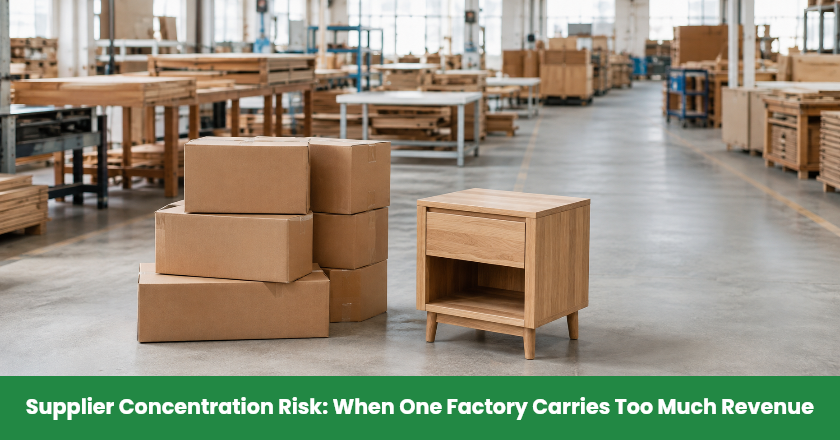
Supplier concentration risk is the possibility that dependence on a small number of suppliers interrupts the products a business needs to sell. A factory can account for a modest share of purchasing costs yet support several of a buyer's most important product lines. The danger is not the percentage alone: it is the sales the buyer cannot fulfill before usable supply returns.
For importers sourcing from China, the useful question is therefore not simply “How many factories do we use?” It is “If this production site stopped, which customer orders would become impossible to complete, for how long, and with what commercial consequence?”
Judge Concentration by the Sales You Could Miss
Concentration becomes a priority when dependent sales cannot be served before usable supply returns. Supplier spend helps identify purchasing leverage, but recovery time and usable stock reveal the interruption a buyer would actually face. Shared production dependencies can hide behind separate invoices, so the decision should focus on closing an unacceptable sales gap rather than reaching an arbitrary supplier count.
- Common mistake: Treating the largest invoice vendor as the largest sales risk.
- Risk: Several finished products can depend on one inexpensive component or finishing process.
- Timeline: Compare usable inventory with replacement products arriving where orders must be fulfilled.
- Decision: Set an acceptable impact, then fund the measure that reduces the remaining gap.
Measure Revenue Dependency, Not Just Supplier Spend
Map the sales that require a factory or critical component separately from the amount spent with that supplier. Revenue dependency means the sales attached to products that cannot be supplied without a particular production source. Use the buyer's selling revenue, not the factory's revenue, and keep the numerator and denominator within the same period, currency and product scope.
A purchasing report answers where money went. It does not show which finished products would become unavailable. A packaging insert may be easy to replace without changing the product, while a custom hinge may stop an entire furniture collection. The invoice value of the hinge does not set the value of the collection's customer orders.
The OECD's discussion of trade dependencies combines disruption risk, economic importance and limited substitution. Its analysis concerns trade flows, not a universal company-level supplier limit. Applied to a buyer review, that distinction is useful: concentration deserves closer attention when the affected products matter commercially and a timely substitute is difficult.
Keep the following measures separate so a percentage does not silently change meaning during the discussion.
| Measure | Calculation or basis | Decision it informs | What it misses |
|---|---|---|---|
| Supplier spend share | Supplier purchases / total purchases | Commercial leverage | Sales supported by cheap parts |
| Revenue dependency share | Dependent product sales / total sales | Business importance | Inventory and recovery timing |
| Unserved days | Replacement time minus usable cover, floored at zero | Timing of the shortage | Variable demand and partial recovery |
| Gross sales exposure | Unserved demand valued at selling prices | Scale of the disruption scenario | Permanent loss and profit impact |
For a shared component, count each dependent finished product once within that interruption scenario. Do not add separate factory exposure totals if they include the same sales: the combined result would double-count customer demand. Retain the original product-level rows so finance and procurement can reconcile every total.
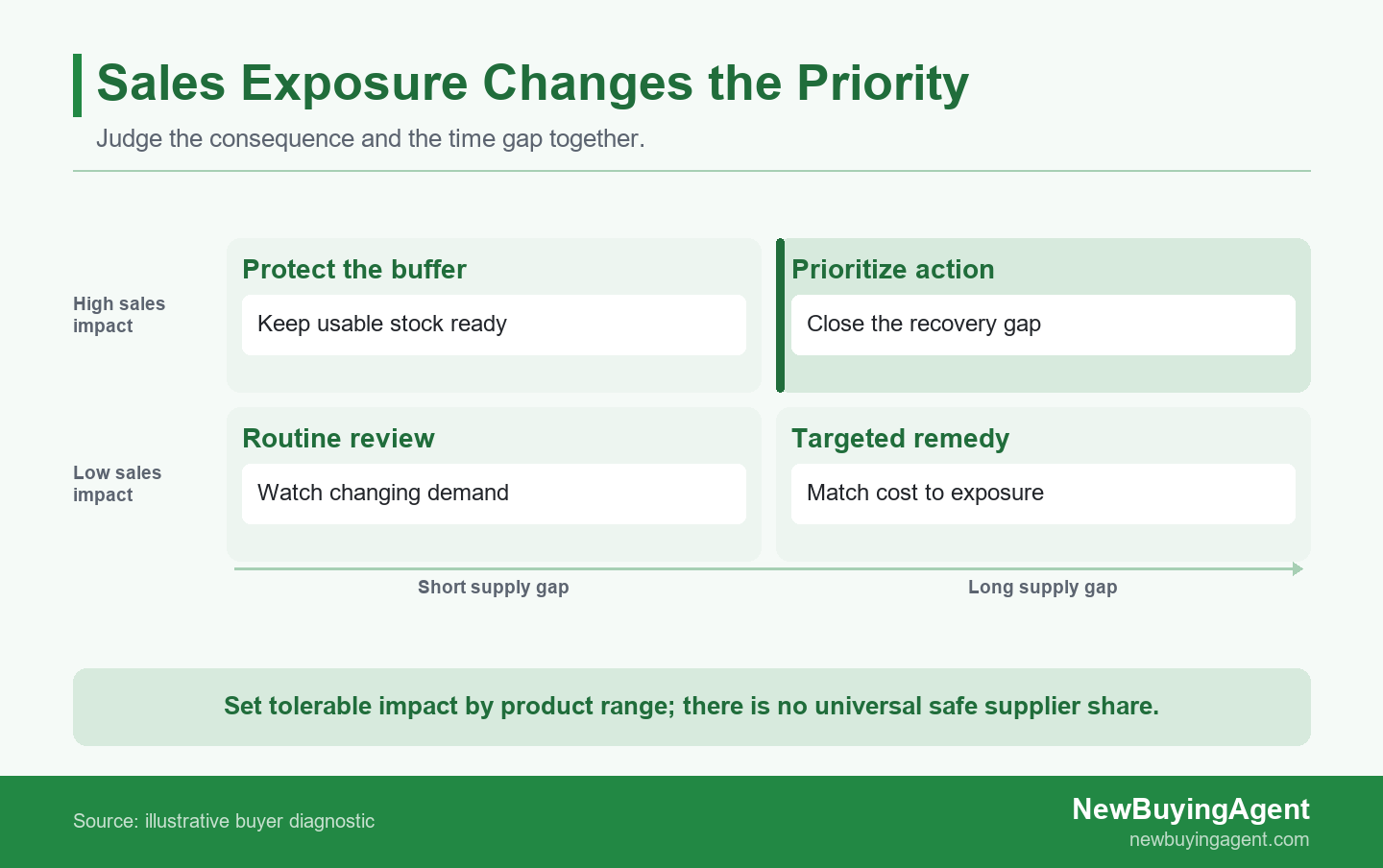
Dependent sales and the recovery gap determine which supplier exposure needs action first
Find the Shared Factory Behind Separate Orders
Separate invoices do not remove a shared production-site, tooling or upstream dependency. Two trading companies may place orders with the same workshop, and two assembly factories may obtain a critical part from one producer. Start with the products whose interruption would hurt most, then trace the operations that must remain available for those products to reach customers.
NIST's supply-chain mapping guidance includes suppliers' suppliers, critical materials and geographic concentrations. This supports looking beyond the business named on a purchase order. For a China-sourced metal product, for example, separate assembly locations may still share the same coating facility; losing that process can stop both routes.
Record the actual production site, critical bought-in components, subcontracted processes, tooling location and shipping route. Ask what would be different during the specific interruption being tested. A second site on the same electrical network may help with a machine breakdown but offer little protection against a wider power outage. Independence is specific to the hazard, not an all-purpose supplier label.
Where a buyer already uses Chinese factories, NewBuyingAgent's factory-management service provides local production follow-up and staged quality-control support. Those capabilities are relevant when the continuity estimate rests on uncertain completion dates or goods still awaiting QC. Prepare current POs, production status and open quality issues; the resulting progress and inspection information helps distinguish stock that is genuinely becoming available from quantities that remain promises.
Compare Recovery Time With Usable Stock Cover
A recovery estimate only protects sales if usable products reach the required destination before stock runs out. Put inventory coverage and replacement timing on the same calendar, starting from the assumed disruption date. A short factory shutdown can still create a longer customer shortage when transport, quality approval or the next available production slot delays the return of sellable products.
The comparison should name the interruption: loss of one machine, one site or a shared input. Changing that assumption changes which inventory, alternative routes and recovery dates remain credible. Keep an estimate range when the evidence does not justify a single date.
Count Stock That Can Actually Fulfill Demand
Only usable stock and credible alternative output can cover demand during the tested interruption. Remove quarantined units, obsolete revisions and quantities already committed to other customers. Goods in transit count only when their arrival and release fit the fulfillment schedule; units still inside the disrupted site may not be accessible at all.
Calculate coverage at the product or interchangeable-product group level. Dividing total warehouse value by average sales can hide a shortage of the exact size, color or fitting customers need. A stocked tabletop is not a complete table if its proprietary bracket is missing. Likewise, stock in the wrong market cannot be treated as immediately available without transfer time and cost.
Use forecast daily or weekly demand where seasonality matters. An average drawn from quiet months can exaggerate cover during a launch. Document permitted substitutions with the commercial team rather than assuming that customers will accept another design or wait indefinitely.
Date the First Usable Replacement Delivery
Recovery must include production, approval and delivery constraints rather than a factory restart date alone. Ask when the alternate route can provide the required quantity at the agreed quality and destination. Check materials, tooling access, reserved capacity, product approval, packing and transit; a quotation or a successful sample does not establish all of these conditions.
MIT's account of supply-chain risk research distinguishes time-to-recover, when a disrupted node returns to full function, from time-to-survive, while the network can still match demand. For an importer's operational estimate, translate those concepts into the arrival of usable replacement goods and the demand the current network can cover. That is a practical adaptation, not a full reproduction of MIT's model.
Where output returns gradually, model the weekly shortfall instead of assuming that the first carton restores full supply. Also confirm whether the backup's other customers could need the same spare capacity during the same event.
Calculate the Sales Exposure Before Moving Orders
Estimate the unserved sales window before choosing a concentration remedy, and separate exposure from permanent loss. Under steady demand with no partial replenishment, dependent daily sales multiplied by the positive gap between stock exhaustion and replacement gives a simple gross exposure estimate. It identifies the size of a scenario, but it does not say how many customers will cancel or how much profit will disappear.
The Ready.gov business impact worksheet separates lost sales, cash-flow effects from delayed sales and additional expenses. Preserve that separation in the review: delayed orders, canceled orders and emergency freight should not be combined into a single unsupported “revenue loss” figure.
Illustrative Scenario: Three Collections Share One Bracket
In this illustrative example, a 12,000-unit furniture plan contains 4,800 units dependent on one bracket supplier. The importer buys from China for a 90-day selling period and forecasts total revenue of USD 1,200,000. Its purchasing report treats separate assembly orders as separate supply routes, but a component review shows that three collections depend on the same bracket factory. The example is hypothetical, not a NewBuyingAgent client result.
Bracket purchases account for only 4% of supplier spend. Yet the dependent products represent USD 480,000, or 40% of forecast period revenue. Assume usable finished-goods cover lasts 18 days and replacement delivery takes 45 days from the interruption, with no interim replenishment. The gap is 27 days; at uniform daily sales, USD 480,000 / 90 × 27 gives USD 144,000 in gross sales exposure. The invoice-based ranking had understated the commercial importance of the shared part.
The buyer prioritizes this common dependency before moving orders away from its largest invoice vendor. While an independent bracket route is developed, it investigates additional released inventory that could extend cover to 36 days. If that stock is genuinely usable and available before the assumed interruption, the gap falls to 9 days and the same calculation gives USD 48,000 of gross exposure. The difference is a scenario comparison, not proven savings from a completed intervention.
Before accepting the lower estimate, operations must verify the count, condition, product revision and destination availability of the extra stock. The alternative route remains uncounted until product acceptance, production quantity and arrival timing are supported. If those checks fail, the buyer retains the original exposure estimate and revises the action. Peak-season demand, customer substitutions, canceled orders and later recovery of delayed sales would require a more detailed calculation; none of the example percentages is a universal trigger.
Choose the Remedy That Closes the Supply Gap
Choose inventory, alternative capacity or product changes according to the constraint that prevents timely fulfillment. A supplier-share cap may be a useful internal alert, but it cannot replace the diagnosis. Concentration is too high for the current plan when the credible interruption exceeds the business's tolerance for missed deliveries, cash tied up, lost contribution or a critical customer commitment.
A sound decision can retain a concentrated supplier when the product is replaceable, verified stock covers recovery and the residual consequences are acceptable. Conversely, a low spend share can justify immediate action when a unique component stops a commercially important range. Reliability history matters, but it does not prove that a rare site-level failure is recoverable.
- Build a targeted buffer when the gap is finite, shelf life and product revisions allow storage, and stock can be positioned outside the affected location. Include financing, storage, damage and obsolescence in its cost.
- Develop independent capacity when recovery is long or uncertain and repeat demand justifies maintaining another route. Confirm the critical process is actually independent and the supplier has a commercially credible reason to keep capacity available.
- Change a component or design when proprietary tooling or a unique input is the bottleneck. Budget engineering validation and any market-specific compliance work before assuming substitution is usable.
- Retain and monitor the current arrangement when the tested impact is tolerable. Record why, what evidence supports the decision and what change would make it unacceptable.
ASQ's supplier-evaluation guidance includes quality-system assessment and prototype or sample testing. These checks matter because additional supplier names do not create usable stock: an alternative that cannot meet the product requirement merely exchanges a supply shortage for a quality problem.
For a furniture range needing a new China-sourced product route, NewBuyingAgent's product-supply service connects the requirement with its local China factory resources and product development and quality-control capability. The buyer should specify which features must remain unchanged and when sellable products are needed, so the offer can address continuity without silently changing the product.
Set an Owner and a Recheck Trigger
A concentration decision needs an owner, an evidence date and a trigger for review when demand or supply changes. Procurement can maintain the production map, operations can verify inventory and replenishment, and finance and sales can agree the commercial consequence. The person approving the remaining risk should see these assumptions together, including unresolved dependencies, rather than receive a reassuring supplier percentage alone.
Monitoring, review, maintenance and improvement are part of the business-continuity approach described in ISO's business continuity management overview. For a buyer, the practical consequence is to revisit the concentration decision when its inputs change, not merely when the annual vendor review comes around.
Useful triggers include a new collection using the same part, a major sales forecast increase, a factory move, a changed subcontractor, a quality hold or an expired capacity commitment. Record the current dependent products, interruption assumption, usable cover, replacement date range, chosen action, owner and review date. If a supplier claim remains unverified, keep that uncertainty visible instead of assigning it a reassuring green score.
If the review identifies a product range that needs another supply route, prepare the product specifications, quantity, target price, destination and delivery timing, together with the features that cannot change. NewBuyingAgent is a one-stop China sourcing agent for global buyers; it can prepare a product quotation and coordinate China product supply around those quality and delivery requirements. State the continuity constraint in the request so you can assess the proposed offer against it, then send the product requirements to NewBuyingAgent.
Frequently Asked Questions
Can the same factory serve both the main and backup supplier?
Yes, which is why the production site and critical upstream processes matter more than separate supplier names. Separate sites under common ownership may reduce a particular physical hazard while retaining shared financing, management or upstream dependencies. Define the interruption being tested before deciding whether the second route is independent enough.
What if a supplier will not disclose its own suppliers?
Record the upstream dependency as unverified rather than assuming it is diversified. A confidentiality arrangement, bounded confirmation of a critical process, or an agreed third-party check may provide useful evidence without exposing the entire supplier network. If uncertainty remains, include it in the approval decision and do not claim that the alternative route removes the shared risk.
Does business interruption insurance replace a backup supply plan?
No. Insurance and operational recovery address different needs: financial protection does not manufacture replacement products. Supplier-related coverage depends on the policy and circumstances, so a qualified insurance adviser should assess it. Do not assume that a policy will pay for a particular event or make goods available in time for customer orders.
Should the calculation use last year's revenue or the next selling season?
Use the selling period affected by the proposed disruption scenario. Historical revenue helps test whether a forecast is plausible, but it cannot fully describe a launch, a peak season or a discontinued range. Keep forecast assumptions explicit and use the same period for dependent sales and total sales when calculating the share.
NewBuyingAgent
Related Resources
Comienza hoy
Convirtamos tus objetivos de abastecimiento en realidadWeChat:+86 15157124615
WhatsApp:+86 15157124615
Dirección: Edificio 10 #39 Xiangyuan Road, Hangzhou, China
