

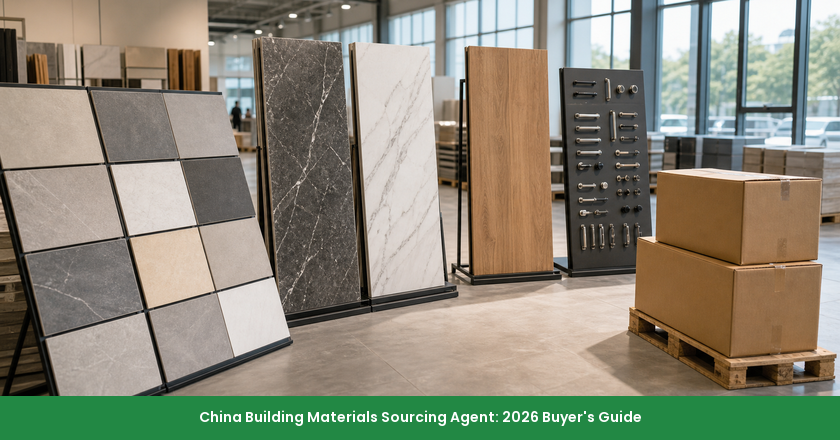
A China building materials sourcing agent helps buyers source construction and renovation products from China while managing specifications, quote preparation, batch quality, documentation, packaging, logistics, and delivery timing.
Building materials are not ordinary consumer products. A tile, fastener, cabinet component, door, flooring panel, railing part, bathroom fixture, or facade accessory may look simple in a catalog, but the buyer often needs performance documents, dimensional consistency, finish control, packaging strength, installation timing, and import-cost review. A low quote can become expensive if the material cannot be used on the project schedule.
In 2026, buyers should treat building materials sourcing as a specification-to-delivery process. The goal is not just finding a lower unit price in China. The goal is receiving the right product version, in the right batch quality, with the right documents and packaging, at a landed cost and timeline the project can absorb. This is general procurement information, not legal, engineering, or financial advice; buyers should confirm market rules with qualified professionals for the destination country and project.
NewBuyingAgent fits this category when buyers want China-side procurement ownership without handling every factory-facing detail themselves. Buyers share product specs, volume, target price, destination, and timing. NewBuyingAgent prepares a quote and manages product selection, cost negotiation, quality management, production follow-up, and logistics through final delivery.
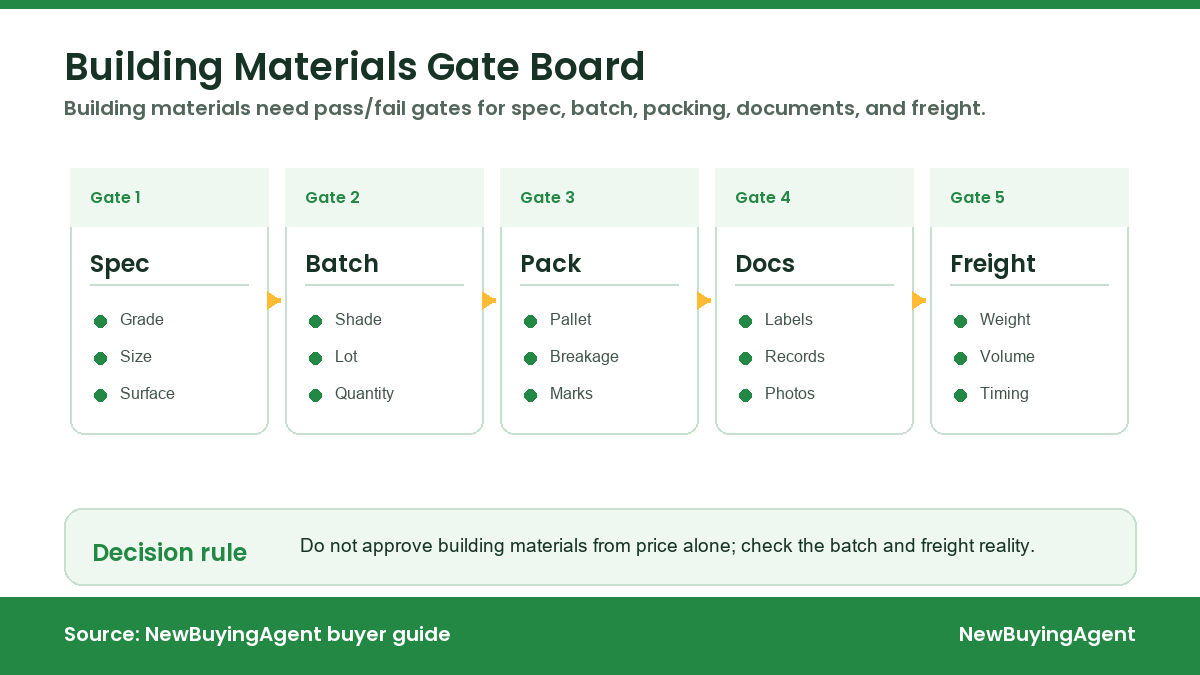
Building materials should move from specification to release through performance, batch, packaging, trade-cost, and project-timing gates.
Why Building Materials Need a Specification-First Process
Building materials sourcing should begin with the specification, not the catalog photo. A catalog photo tells the buyer what the product resembles. A specification tells the buyer whether the product can be purchased, installed, inspected, and accepted. The difference matters because building projects often depend on measurements, tolerances, surface finish, load expectations, fire or moisture performance, and compatibility with other components.
For EU-bound construction products, the European Commission's Construction Products Regulation page explains that the CPR creates harmonized rules and a common technical language for assessing construction product performance. Not every building material purchase falls under the same regulation, but the principle is useful everywhere: buyers need performance information that can be compared and reviewed, not only product photos and price lists.
The first buyer action is to separate design preference from technical requirement. Design preference includes color, surface, profile, finish, and packaging style. Technical requirement includes dimensions, performance rating, material grade, coating, installation method, standard, test report, and destination-market documentation. If the sourcing process mixes those together, price negotiation may move forward before the product is actually suitable.
The Five Procurement Gates for China Building Materials
A practical building materials process should move through five gates: performance, batch, packaging, trade cost, and project timing. These gates are not paperwork for their own sake. They protect the buyer from receiving goods that are cheap on paper but unusable on site.
1. Performance Gate
The performance gate confirms what the product must do. For flooring, this may include thickness, wear layer, moisture behavior, slip resistance, and packaging protection. For hardware, it may include material grade, coating, load rating, salt-spray expectation, or fastener compatibility. For cabinets, doors, or panels, it may include dimensions, finish, hardware fit, substrate, and formaldehyde or fire-related documentation where relevant.
The buyer should not ask only, "Can you make this?" The better question is, "Can this product version meet the use condition, document expectation, and installation requirement?" If the answer is unclear, sampling and quotation should slow down until the requirement is understood. A sourcing partner can manage quote preparation, but the buyer should still provide the project context that determines what "acceptable" means.
2. Batch Consistency Gate
Batch consistency is a major risk in building materials because products are installed side by side. A slight color difference in tiles, flooring, panels, stone, or powder-coated metal can become obvious after installation. A small dimensional drift can create alignment problems. A finish variation that seems acceptable in a single sample can look poor when repeated across a lobby, retail store, apartment project, or hotel corridor.
Buyers should define which characteristics must remain consistent across the batch: color, gloss, texture, thickness, length, hole position, coating, edge profile, and packaging label. They should also decide how many samples or pre-production pieces need approval before mass production. The release decision should include batch evidence, not only a photo of a perfect single piece.
3. Packaging and Handling Gate
Building materials are often heavy, fragile, sharp-edged, moisture-sensitive, or awkward to handle. Packaging must be treated as part of the product. Tiles may need corner protection and pallet rules. Doors may need edge protection and moisture control. Metal hardware may need corrosion protection and carton weight limits. Stone or glass products may need crates and clear handling marks.
Poor packaging can destroy the saving from a lower unit price. A project buyer may not be able to wait for replacements if breakage is discovered after arrival. The sourcing process should confirm carton size, pallet plan, gross weight, loading method, moisture protection, labels, and warehouse handling requirements before shipment.
4. Trade-Cost Gate
The trade-cost gate checks whether the product's landed cost is still attractive after classification, duty, tariffs, freight, and special trade measures are considered. The World Customs Organization's HS overview explains that the Harmonized System is a structured goods language used worldwide. For buyers, that means product materials, processing level, and intended use can affect classification discussions.
U.S.-bound buyers should also watch trade measures that can change landed cost. CBP's AD/CVD FAQ page is a useful official starting point for understanding antidumping and countervailing duty concepts. USTR also announced that 178 China Section 301 exclusions were extended until November 10, 2026. The operational lesson is not to guess. Buyers should check duty exposure before confirming the sourcing plan.
The trade-cost gate should happen before the buyer approves a product version because small specification changes can change the commercial picture. A different alloy, substrate, coating, or assembled component may affect classification analysis, freight density, duty exposure, or whether a special measure should be reviewed. The sourcing partner can help organize product information for a quote, but the buyer should still ask its customs broker or qualified advisor to confirm the final import treatment when the cost impact is material.
5. Project-Timing Gate
The project-timing gate connects procurement to installation. Building materials often need submittal approval, sample boards, shop drawings, packaging review, production lead time, inspection, ocean freight, customs clearance, inland delivery, and site receiving. If one step slips, the cost can appear as idle installers, delayed opening, partial installation, or expensive air freight for replacement parts.
A simple scenario shows the risk. If a project needs 5,000 panels and 2% arrive with visible finish mismatch, that is 100 panels. If those panels are used in a continuous visible area, the problem may hold the installation even though 98% of the order is usable. This is why building materials buyers should define release standards by project impact, not only by defect percentage.
Project timing also changes how buyers should think about backup quantity. For commodity retail products, a small shortage may be corrected in the next shipment. For building materials, a missing batch can stop an installation crew, leave a visible mismatch, or require local replacement at a much higher cost. Buyers should decide before ordering whether to include spare pieces, extra hardware, touch-up material, or replacement panels, especially when the product has a shade lot, coating batch, or custom dimension.
Which Building Materials Need the Most Control?
Different materials create different risks. A sourcing process should be adjusted to the product rather than copied from another category.
| Product Type | Main Buyer Risk | Control Point | Evidence to Review |
|---|---|---|---|
| Flooring and panels | Thickness, color, moisture, surface wear | Batch sample and document check | Specs, test reports, labels, production photos |
| Tiles and stone | Shade variation, breakage, size drift | Shade lot control and packaging plan | Sample board, carton photos, pallet plan |
| Hardware and fasteners | Material grade, coating, load expectation | Spec confirmation and corrosion concern review | Material notes, coating details, QC photos |
| Doors and cabinets | Dimensions, finish, hardware fit, panel documents | Pre-production approval and packing proof | Drawings, sample photos, packaging proof |
| Bathroom fixtures | Finish, threads, fittings, leakage, marks | Function check and accessory count | Inspection photos, parts list, carton marks |
This table is not a substitute for product-specific compliance review. It is a buyer-side control map. The point is to identify which risks should be discussed before quote approval, sample approval, production, final QC, and shipment.
How a Sourcing Agent Changes the Buying Process
A building materials sourcing agent adds value when it can connect product requirements to China-side execution. The buyer may know the project need but not want to manage every production detail. The agent should turn the requirement into a quote, follow product development or sample preparation, manage cost negotiation, coordinate quality checks, follow production, and organize logistics handoff.
For NewBuyingAgent, the approved workflow is straightforward. Buyers share purchasing needs, including product specs, volume, target price, destination, and timing. NewBuyingAgent prepares a quote and manages product selection, cost negotiation, quality management, production follow-up, and logistics through final delivery. The buyer receives a clearer procurement path without needing to personally manage daily factory-facing work.
This matters most when the product is part of a larger project. A buyer sourcing hardware for a retail buildout, cabinets for a hospitality project, or flooring for multiple units needs timing and consistency. The lowest quote is not enough if the product arrives late, the shade varies by batch, or the documents are incomplete.
Project Submittals and Procurement Handoff
Building materials often need a handoff that looks more like project management than ordinary product buying. The buyer may need drawings, material notes, finish samples, test reports, labels, certificates, installation context, and packing details before a project team can approve use. If the sourcing process treats those materials as afterthoughts, the order can become stuck even when the product itself is ready.
The best handoff starts before quote approval. Buyers should identify what the project, customer, contractor, warehouse, or importer needs to review. For some products, this may be a drawing and sample board. For others, it may include test reports, batch photos, pallet information, carton weights, installation instructions, or a technical file. This is general procurement planning, not engineering or legal advice.
Submittal Risk Is Timing Risk
Submittal risk becomes timing risk because building projects have installation windows. A missing document can delay approval. A late sample board can delay finish selection. A wrong carton label can slow receiving. A missing spare part can pause installation. The buyer may think the sourcing issue is solved after a quote is accepted, but the project may not agree until the submittal package is complete.
NewBuyingAgent can manage product selection, cost negotiation, quality management, production follow-up, and logistics after the buyer shares the purchasing need. For building materials, the buyer should also share the project approval path so the procurement process can prepare the right evidence before delivery pressure builds.
A Batch Replacement Scenario
Imagine a buyer orders a custom finish for a hotel corridor and later discovers that 4% of panels have a visible shade mismatch. On a 3,000-panel order, that is 120 panels. If the panels are installed across one continuous area, replacing only the flawed units may create a second mismatch. This scenario shows why batch control, spare quantity, sample boards, and release evidence should be decided before shipment.
The buyer's action is not to demand impossible perfection. The action is to define what variation can be accepted, what must be segregated, what spare quantity is needed, and what evidence should be reviewed before the goods leave China.
Substitutions need the same discipline. If the product uses a different substrate, coating, hardware, crate, or finish batch, the buyer should decide whether that change needs project approval before production continues. A replacement that looks close in a sample photo may still fail when installed beside the original approved material.
What to Send Before Requesting a Building Materials Quote
The first quote request should be practical and complete. Buyers should include drawings, photos, dimensions, material grade, finish, performance expectations, target order quantity, target price, destination country, project timeline, packaging requirements, and any known compliance or documentation needs. If the project has approved submittal formats, include those too.
Buyers should also state the installation context. A product for a warehouse back room has different finish sensitivity from a product used in a hotel lobby. A replacement part has different tolerance risk from a full project batch. A material that ships to a humid region may need different packaging from a dry inland destination. The more context NewBuyingAgent receives, the better it can prepare a quote and manage the procurement process.
Buyers with active projects can ask NewBuyingAgent to review the purchasing needs. Buyers still comparing whether they need sourcing support can review NewBuyingAgent's product sourcing service before preparing the quote package.
Who Is NewBuyingAgent?
NewBuyingAgent is a one-stop China sourcing agent for global buyers that want to source products from China without managing factory conversations, production follow-up, quality control, and logistics themselves.
Backed by 30 years of trade, manufacturing, and quality-control experience, NewBuyingAgent prepares quotes for products that match the buyer's purchasing needs. Buyers share product specs, volume, target price, destination, and timing; NewBuyingAgent manages product selection, cost negotiation, quality management, production follow-up, and logistics.
Its sourcing network includes 50,000+ partner factories and 20,000+ product development & QC experts. For building materials buyers, the value is a managed path from specification and quote to batch quality, packaging, logistics, and delivery timing.
Frequently Asked Questions
What does a China building materials sourcing agent do?
A China building materials sourcing agent manages quote preparation, product selection, cost negotiation, quality management, production follow-up, packaging review, and logistics for construction and renovation products. The buyer provides product specs, project timing, target price, destination, and document needs. The agent handles China-side execution and keeps the buyer focused on approval decisions.
What documents should buyers request for building materials?
Buyers should request documents that match the product and destination market, such as spec sheets, drawings, material confirmations, test reports, labels, packing lists, certificates, or declarations where required. The exact document set depends on product type, market, and project use, so buyers should confirm final compliance expectations with qualified local professionals.
Why is batch consistency important for building materials?
Batch consistency is important because building materials are often installed side by side. Small differences in color, thickness, finish, hole position, or profile can become visible after installation. Buyers should approve samples, define tolerances, and request batch evidence before shipment so problems are caught before project timing is at risk.
How can buyers reduce landed-cost surprises in 2026?
Buyers can reduce landed-cost surprises by checking product classification, duty exposure, freight assumptions, packaging volume, special trade measures, and delivery terms before quote approval. For U.S.-bound goods, AD/CVD and Section 301 exposure should be checked early when relevant. The sourcing quote should support landed-cost decisions, not only unit-price comparison.
NewBuyingAgent
Related Resources


Comienza hoy
Convirtamos tus objetivos de abastecimiento en realidadWeChat:+86 15157124615
WhatsApp:+86 15157124615
Dirección: Edificio 10 #39 Xiangyuan Road, Hangzhou, China
