

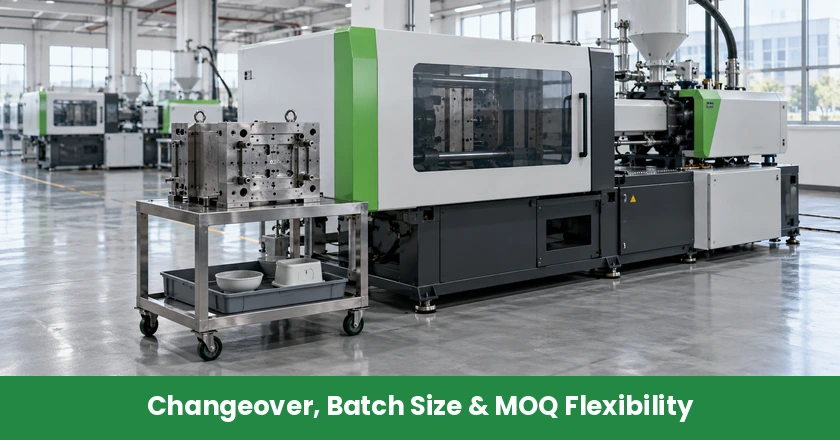
A factory’s willingness to quote a smaller order is only the start of the decision. Changeover time and batch size reveal whether that offer has a workable production basis. Measure the complete transition between products, calculate the setup burden at your quantity, and check the material, packaging, quality, and schedule conditions that remain. A quick tool change can improve flexibility without removing the real minimum. Test those conditions before committing to a trial order.
Where MOQ Flexibility Comes From
MOQ, or minimum order quantity, is the smallest order a supplier accepts under its stated terms. MOQ flexibility comes from changing the constraint behind that minimum: less setup work, compatible variants, available materials, standard packaging, or a suitable production slot. The useful question is which condition changes for your product. A lower number alone does not show that the factory can repeat the run at the agreed quality and date.
- Definition: Time changeover from the last good part of one run to the first good part of the next, not just the physical tool swap.
- Cost comparison: A small batch spreads the same setup across fewer units. Separate a setup charge from the running price before comparing offers.
- Risk: Faster setup does not remove upstream material minimums, custom packaging quantities, or production approval requirements.
- Decision: Approve a smaller batch only with product-specific evidence and written quantity, variant, quality, and delivery conditions.
Measure Changeover to the First Good Part
A meaningful changeover measurement ends when the next product produces a good part, not when the machine starts moving again. NIST’s quick-changeover guidance uses the interval between the last good piece of the current run and the first good piece of the next run. That boundary makes competing production claims comparable. For a buyer assessing MOQ flexibility, it also captures the work needed to restore acceptable output after the change.
Ask what “good” means for the specific product. It might include dimensions, appearance, assembly fit, or another agreed check. A factory that reports only the tool-change duration may leave out temperature adjustment, material purging, trial pieces, and approval waiting. Record those activities separately so you can distinguish machine stoppage from labor preparation and quality checks. Do not assume every minute is charged at the same rate.
The direction of the transition matters too. Switching between two related versions may differ from changing to a different material or finish. Request the starting product, next product, machine, operator arrangement, and approval criteria behind the timing. If the supplier demonstrates a convenient transition, ask whether it represents your planned run. Startup rejects and delayed approval can absorb the time apparently saved by a quick tool swap.
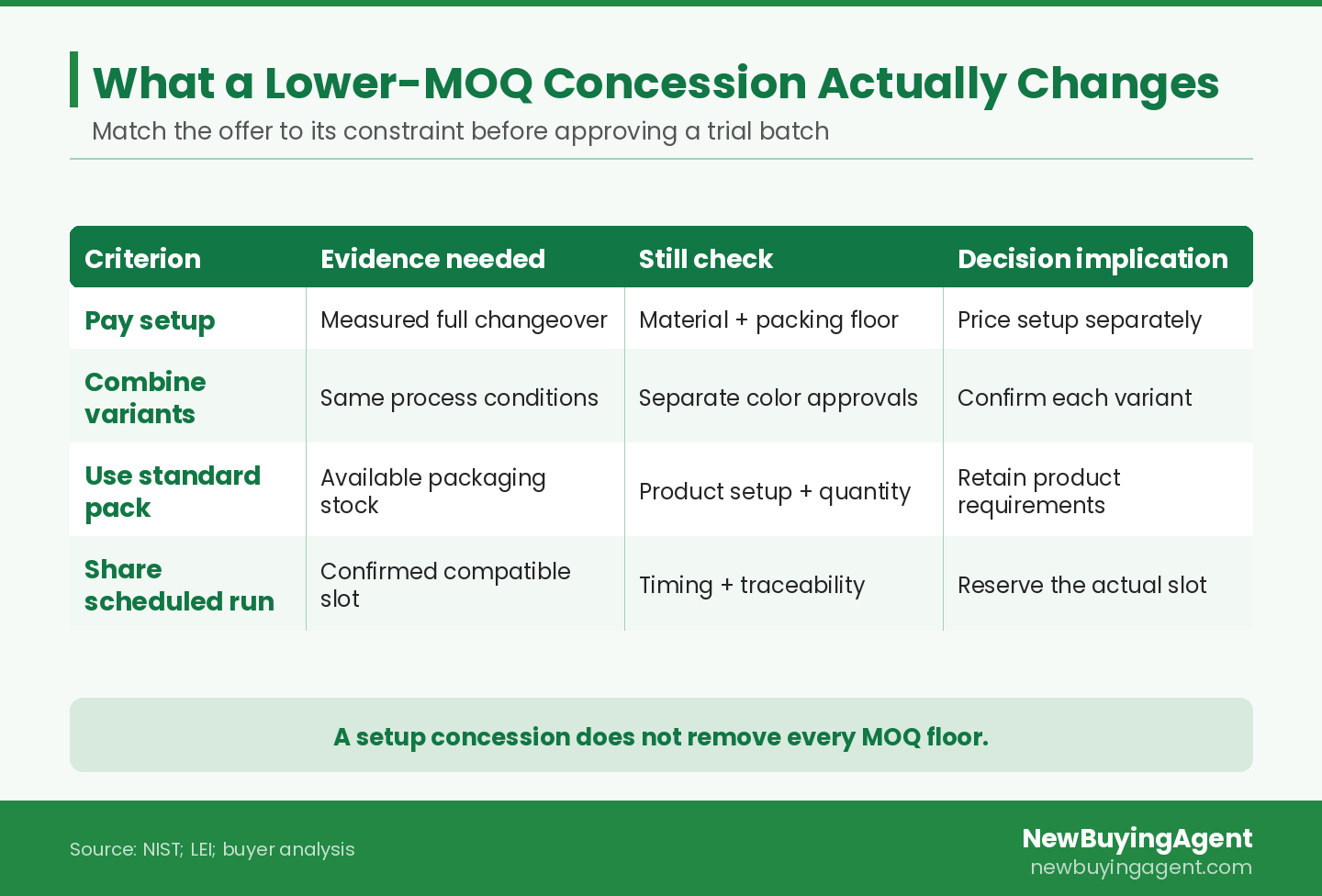
MOQ concessions change different constraints, so each needs matching evidence before a smaller batch is approved
Calculate the Setup Burden Before Negotiating
Setup burden shows how much machine time a proposed batch consumes before useful production begins. The Lean Enterprise Institute’s effective machine cycle time definition adds changeover time divided by the pieces between changeovers to machine and handling time. This helps explain why the same setup has a larger per-piece effect on a short run. It does not reveal the factory’s full cost, margin, or final selling price.
For a simple time comparison, use setup share = setup minutes ÷ (setup minutes + run minutes). Run minutes equal batch quantity multiplied by cycle seconds and divided by 60. Use the relevant bottleneck machine, meaning the production step that limits output. A whole-line estimate may need multiple setups, parallel operations, and handling time; combining those without a process map can make the result misleading.
Consider an illustrative 90-minute setup and a 30-second cycle. A 600-unit batch has 300 run minutes, so setup represents 23.1% of its combined 390 minutes. A 2,000-unit batch has 1,000 run minutes, giving an 8.3% setup share. These assumed figures explain a negotiating problem, not a factory benchmark: the smaller quantity consumes much more setup time per unit even when the equipment runs at the same speed.
Use that calculation to request two comparable offers: the proposed trial quantity and the larger production quantity, with setup, materials, packaging, and delivery assumptions stated. A separately priced setup charge can make the trade-off clearer. Avoid converting time share directly into a required price premium. Machine rates, labor, startup loss, minimum purchases, and commercial terms still affect the quote.
Separate Batch Economics from Calendar Capacity
A small run can be economically acceptable but still unavailable in the required week. The every-product-every-interval concept relates production frequency to changeover time and the number of part numbers assigned to a machine. More competing products can lengthen the interval before yours returns to production. Ask for the proposed slot and sequence, not just the machine’s daily output claim.
Check whether the quoted lead time includes material arrival, setup, first-good approval, the run, and packing. If a supplier proposes adding your units to an existing production campaign, confirm when that campaign happens and what could move it. A flexible quantity paired with an uncertain date may be unsuitable for a launch or replenishment order. Do not treat spare theoretical capacity as a reserved production slot.
Check Which Variants Can Share a Run
Variants can share a run only when the factory confirms which process conditions stay compatible. Two colors may share a mold while still requiring separate material preparation, purging, and approval. Different sizes may use common fabric but different cutting or sewing arrangements. The point is to identify which setup is genuinely avoided; a mixed order total can conceal a minimum that applies separately to each version.
Give the supplier a quantity breakdown by SKU, color, size, and finish. Ask it to mark which variants share materials, equipment settings, packaging, and approvals. Then compare the resulting offer with a simplified trial version. If one standard color reduces setup and material purchasing, record that restriction explicitly. Adding a custom color later can reopen both the economics and the delivery schedule, even when the total quantity stays unchanged.
Request Evidence for the Actual Product Transition
The strongest evidence is a repeatable changeover record for the actual product transition. A stopwatch demonstration shows one event; recent production records show how setup, startup rejects, and approval behave across ordinary runs. Request enough comparable examples to see variation and ask why unusually slow runs occurred. The objective is to establish feasible conditions for your order, rather than demand a universal “fast setup” target or a lean certification.
SMED means single-minute exchange of die, a method for reducing setup time. The Lean Enterprise Institute’s SMED explanation distinguishes internal setup, which needs a stopped machine, from external preparation that can occur while it runs. That distinction gives buyers a concrete question: which preparation has already moved outside machine downtime? The method’s name is a target, not proof that your factory completes every transition in that time.
- Transition record: Previous and next product codes, machine identity, date, and actual quantities.
- Timing evidence: Last-good timestamp, tool or setting work, restart, first-good approval, and elapsed changeover.
- Startup quality: Rejected trial pieces, reasons for rejection, and who accepted the first good part.
- Repeatability: Comparable runs, different shifts where relevant, and explanations for longer transitions.
- Preparation: Tool readiness, material availability, cleaning arrangements, and approval responsibility.
NIST’s Modelcraft improvement case describes documenting and measuring changeover work while addressing setup and first-piece inspection time. It is a US precision-machining example, not evidence of a Chinese supplier’s MOQ. Its useful lesson is the method: connect the claimed improvement to measured process changes and the approval step. Ask your supplier to demonstrate its own results rather than borrow another factory’s performance.
Process details also vary by product category. Use the China manufacturing and product guide to put the factory’s explanation in its manufacturing context, then request records for the actual version you intend to buy. A general audit can establish broader capability, but it cannot replace evidence of this particular material, tool, and changeover sequence.
For an existing China supplier, language and distance can make those records hard to interpret alongside current production. NewBuyingAgent’s factory-management service covers existing-factory production progress, quality management, and logistics. Its China-side follow-up and quality-control capability are relevant when a claimed short changeover still leaves uncertainty about sample consistency or shipment timing. The purchasing team should bring the order record, approved sample, outstanding issues, and required date to that discussion.
Find the Minimum That Setup Reduction Cannot Remove
A setup improvement changes only the constraints it actually affects. Material purchases, custom packaging, outsourced operations, and required production approval can impose separate minimums. Map each floor to the actor and process behind it before choosing a concession. Otherwise, paying more for a short machine run may leave the order blocked by a minimum purchase elsewhere, or turn a smaller finished-goods order into unwanted material or packaging inventory.
Equipment choice can matter as well. EPA’s cellular-manufacturing guidance discusses right-sized equipment and faster changeovers as part of moving away from large batch-and-queue production. That supports checking whether the proposed production route suits your demand. It does not mean every factory can economically replace its equipment, or that smaller batches are always the best option for a particular process.
EPA’s chemical-management guidance illustrates how smaller cleaning equipment can better match actual work than an oversized tank. The buyer’s transferable lesson is to ask whether equipment scale creates a process floor. This is not advice to reduce cleaning, safety, or environmental controls. The supplier needs an appropriate process route, with the same agreed product requirements still satisfied.
| Remaining constraint | Evidence to request | Possible adjustment | Condition to retain |
|---|---|---|---|
| Material purchase | Supplier pack size and stock | Standard stocked material | Same specification and traceability |
| Custom packaging | Printer quantity and ownership | Standard box or agreed surplus | Packing protection and labeling |
| Outside processing | Processor batch and booking | Compatible scheduled campaign | Same finish and quality criteria |
| Approval and startup | Trial results and first-good record | Better preparation or validated route | Agreed acceptance checks |
The table separates concessions by the constraint they change. Before agreeing to buy surplus materials or boxes, confirm ownership, storage, payment, usable lifetime, and what happens if a repeat order never arrives. Those terms affect the buyer’s commitment even when the finished-product MOQ falls. Do not substitute reduced testing or relaxed specifications for production flexibility.
Apply the Evidence to a 600-Unit Trial Order
A 600-unit trial becomes a useful approval exercise when each constraint is tested separately. The following illustrative example uses assumed quantities and timings, not factory benchmarks or a NewBuyingAgent client case. It shows why a setup fee can solve one economic obstacle while packaging still blocks the same order. The decision changes only after the buyer corrects both the product mix and the packaging requirement.
A Setup Fee Solves One Constraint, Not Every Constraint
An importer wants 600 molded household components split across 2 colors. The factory initially quotes a 2,000-unit MOQ. Its transition record shows an assumed 90-minute setup and a 30-second production cycle; a startup tally also records 60 rejected trial pieces before first-good approval. The buyer has not yet approved the smaller order because the quote does not identify which costs or minimums change.
The buyer offers to pay the setup charge. That can address the machine economics, but a second record shows a 1,000-box minimum for custom printed packaging. Even if production accepts 600 pieces, the buyer would still purchase more boxes than the trial requires. The two colors also need confirmation of compatible material and approval conditions. Neither obstacle disappears simply because the buyer accepts a higher unit price.
The proposed correction is a 600-unit trial in one standard stocked color with standard cartons, with setup separately priced. Approval is conditional on retaining the agreed product specification, confirming available material, and reserving a production slot. This is a narrower order than the original two-color request, so the changed scope belongs in the written quote and order record before payment.
Before treating the conditions as repeatable, the buyer requests pilot timestamps, the first-good approval, the startup reject tally, and a written 600-unit offer with the revised packing. If the pilot cannot meet the agreed quality or the reserved slot is unavailable, the buyer reconsiders the quantity or date. This illustrative example excludes other downtime, labor costs, and freight; its calculations demonstrate a decision method rather than predict an actual factory outcome.
Turn MOQ Conditions into a Quote-to-Supply Brief
A useful purchasing brief states the quantity the market needs and the flexibility the buyer can genuinely offer. The supplier’s written quote then identifies the production conditions that make that quantity feasible. Confirm the approved product version, quantity by variant, packing, setup charges, inspection criteria, and delivery date together. A lower MOQ loses its value if the offer quietly changes the material, omits packaging commitments, or leaves scheduling unresolved.
- Define demand: Trial quantity, expected reorder range, destination, and required arrival timing. Treat forecasts as forecasts unless you intend a binding purchase commitment.
- State product limits: Specification, approved sample, critical dimensions, materials, and unacceptable substitutions.
- Offer real flexibility: Stock colors, standard packaging, compatible variants, or an explicitly priced setup charge.
- Record the production basis: Relevant changeover, startup approval, independent minimums, and confirmed slot.
- Confirm change triggers: A new material, color, tool, packaging design, or delivery week calls for rechecking the quote conditions.
For a new product with an uncertain trial quantity, NewBuyingAgent’s product-supply service uses local China factory resources and product-development and quality-control capability to turn purchasing requirements into China-sourced products. Its supply offer covers product selection, cost negotiation, production follow-up, quality control, and logistics coordination. The relevance here is a product route that fits the quantity and specification, with price and delivery terms assessed together. It does not establish a universal low MOQ.
Keep a short approval record alongside the purchase order: the revised specification, accepted quantity breakdown, packing choice, quoted setup charge, evidence reviewed, and person responsible for changes. This makes the next discussion easier if a repeat order uses another color or a different production week. It also helps distinguish a one-time accommodation from a repeatable ordering arrangement.
If the trial quantity is still unquoted, send the purchasing requirements to NewBuyingAgent with the product specification, quantity by variant, target price, destination, and delivery timing. Include which colors or packaging can stay standard. That gives NewBuyingAgent the purchasing context to quote and supply products from China around the actual production constraints, while protecting the intended quality and delivery requirements. Confirm the offered terms before treating any MOQ reduction as agreed.
Frequently Asked Questions
Can a repeat order have a lower MOQ than the first order?
A repeat order may support a lower MOQ when its tooling, materials, packaging, and production schedule are already available. Check whether those conditions still hold at the reorder date. A different color, revised specification, or new packaging design can require another setup or purchase minimum. Ask the supplier to confirm the repeat-order quantity and price in writing rather than assuming the first order permanently changed its policy.
Should I pay a higher unit price for a smaller batch?
A higher unit price can be reasonable when the smaller batch reduces excess inventory enough to offset the added production charge. Compare total committed spending, including setup, surplus materials or boxes, freight, and storage. A trial can also reduce exposure to uncertain demand, but only if the smaller quantity still meets the intended product requirements. Decide against your own demand and cash limits, not an automatic premium percentage.
Can different colors count toward the same production MOQ?
Different colors can count toward one MOQ only when the factory confirms which production and purchasing minimums can actually be combined. Ask whether the quoted total applies across colors or separately to each color. Common tooling does not automatically mean common material preparation or approval. Put the accepted mix in the order record, including any minimum per variant, so the factory cannot reinterpret a combined quantity after the quote is accepted.
Does an approved sample prove the factory can repeat a small batch?
An approved sample demonstrates that version of the product, but it does not establish repeatable production timing or commercial MOQ terms. A sample may use a different route from normal production, or come from existing stock. Request the planned production method and an appropriate pilot or comparable run record. Keep sample acceptance separate from quantity, packaging, and scheduling approval; each answers a different part of the purchasing decision.
NewBuyingAgent
Related Resources


Comienza hoy
Convirtamos tus objetivos de abastecimiento en realidadWeChat:+86 15157124615
WhatsApp:+86 15157124615
Dirección: Edificio 10 #39 Xiangyuan Road, Hangzhou, China
