

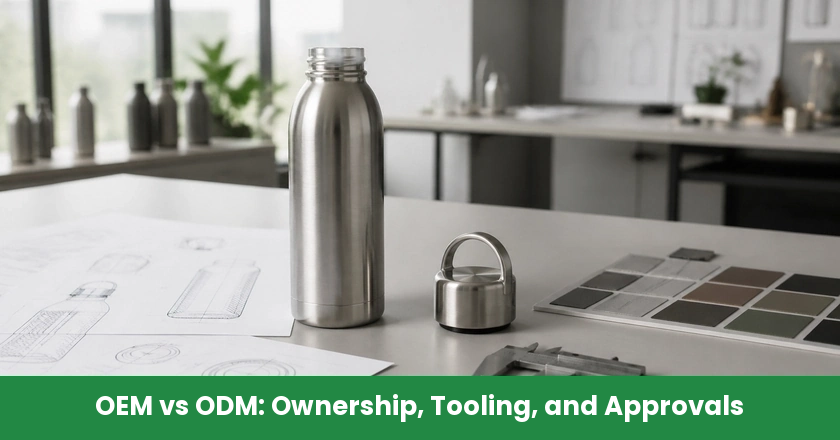
The initial route decision is often presented as a simple fork: bring a design to a factory, or select a factory-developed product. That shorthand is helpful only after the buyer has identified the assets that matter. A China agent can coordinate the conversation, but an agent cannot turn an unlabeled drawing, an untracked tool payment, or a vague sample email into a controlled product program.
Start with the outcome you need after the first production order. Do you need to reuse a tool with another factory? Change a custom component? Protect artwork in a particular market? Keep the factory platform but control your brand-facing version? Those questions point to the product files, physical assets, and approvals that must be defined before a quote becomes a commitment.
OEM or ODM Is a Control Decision, Not a Factory Label
OEM and ODM are useful only after the buyer identifies the starting asset, required control, and the rights it needs after production begins. OEM describes a route where the buyer sets product requirements and a factory builds to that agreed scope. ODM describes a factory-developed product platform; the buyer needs documented rights for its later use of that platform.
Neither label allocates every right on its own. One program may use an ODM bottle body, a buyer-funded OEM-style lid tool, buyer-owned artwork, and a factory-held production method. The workable question is: for each asset, who may use it, change it, retain it, and release the next version? Name the base design, custom change, tool, artwork, and release owner before the factory starts building around assumptions.
- Choose OEM-style control when the buyer needs a defined baseline and a clear record of which outside changes the factory may make.
- Choose an ODM platform when the factory’s existing product shortens development, while the buyer is comfortable documenting the rights it needs rather than assuming control of the whole platform.
- Use a hybrid path when speed comes from the platform but differentiation comes from a buyer-controlled component, tool, finish, artwork, or approved specification.
That is the decision a China agent should help make visible to the actual factory. Hold a payment or production release when the asset and version record do not match the commercial route; do not try to cure the gap by calling the order “OEM” in an email.
Split the Program Into Assets Before You Choose a Route
A sourcing program should identify buyer-contributed, supplier-contributed, and newly created assets separately, then set the limits on how each may be used. WIPO’s outsourcing guidance recommends stating ownership of jointly created or vendor-created IP and the limits on making IP available to a vendor.
IP planning for China should begin before market entry or supplier engagement because rights registered elsewhere do not automatically confer rights in China. International Trade Administration guidance on China IP protection is a useful reminder to treat country-specific registration and agreement questions early, with qualified counsel where needed.
Build an asset schedule before asking factories to price a “custom” product. It can be one page, provided it separates the base design, buyer inputs, factory contributions, tooling, brand artwork, and production records. The same discipline makes a China manufacturing and product guide more useful: factories receive a defined brief rather than a loose request to improve an existing sample.
| Asset | Record to identify | Decision to make |
|---|---|---|
| Factory platform | Model, specification, and permitted modification scope | Use as supplied, change it, or develop a separate baseline? |
| Buyer input | Drawing, artwork, formula, colour, or component file | Who may access, reproduce, or revise it? |
| New development | Revision history, contributors, test requirement, and acceptance point | What rights treatment is required? |
| Tooling | Tool ID, location, custody, condition, and maintenance record | Who may use it, move it, or approve related production? |
| Production data | Approved sample, bill of materials, inspection points, and artwork version | Which version is released to the factory? |
The table is an operational control tool, not a substitute for country-specific legal advice. It prevents a quotation label from hiding the fact that different items in the same product have different commercial boundaries.
In OEM, Define the Buyer Baseline Before Supplier Input
For commissioned or collaborative invention work, the parties should not leave ownership and transfer assumptions unstated; the applicable law and agreement need to be reviewed for the program at hand. CNIPA’s published Patent Law text describes default treatment for commissioned invention-creation unless the parties agree otherwise, which is why an unexamined “we paid for it” assumption is a poor control method.
For an OEM-style program, establish the buyer baseline before the factory suggests substitutions. Give the drawing, bill of materials, performance criteria, target market, and artwork a version code. Then record each factory proposal as a change to that baseline. This keeps the factory’s engineering contribution visible without treating every suggestion as either automatically transferred or automatically unusable.
In ODM, Define the Rights You Need to Use and Change
Where a supplier platform is used, the parties should identify what is licensed or owned, what improvements may be made, and who owns newly created IP. WIPO’s technology-licensing guidance similarly separates contributed technology, new work, deliverables, responsibilities, and development standards.
An ODM platform does not require the buyer to own every underlying product element. It does require clarity about the rights that matter commercially: the markets in which the branded version may be sold, whether a custom feature may be changed, whether the factory may use buyer artwork elsewhere, and what happens to new files after the relationship ends. Here, permitted use means what a party may make, modify, sell, share, or retain under the agreed arrangement. Ask for that scope in writing rather than inferring it from the catalogue model.
Treat Tooling as a Separate Physical Asset
A buyer-funded tool should be controlled through an asset record and agreed rights of use, custody, data access, and end-of-relationship treatment rather than through a vague tooling line alone. Before sensitive product information moves, the USPTO’s China IP Rights Toolkit recommends planning protections, classifying sensitive information, and using written confidentiality and nonuse controls before negotiations.
A tool is physical, while the tool drawing, cavity layout, CAD data, maintenance history, and right to use it are separate records. A practical tool schedule gives the tool a unique ID, names the factory location, states what it produces, identifies the approved drawing revision, and notes custody, maintenance, permitted use, and the requested process for inspection or handover. Payment alone does not answer each of those questions.
NewBuyingAgent can help keep that schedule attached to the live factory conversation. The useful role is to confirm the actual factory, connect the quotation to the tool and sample record, and surface a missing approval before a China-side payment or production step advances. The buyer still decides the commercial rights, acceptance criteria, and release authority. For a new program, buyers can source a defined OEM or ODM product from China.
Use Five Approval Gates From Brief to Production
Development planning is stronger when responsibilities, interfaces, review points, validation, and approval of changes are defined before production release. ISO/IAF design-and-development guidance describes those kinds of defined responsibilities, validation records, and controlled changes.
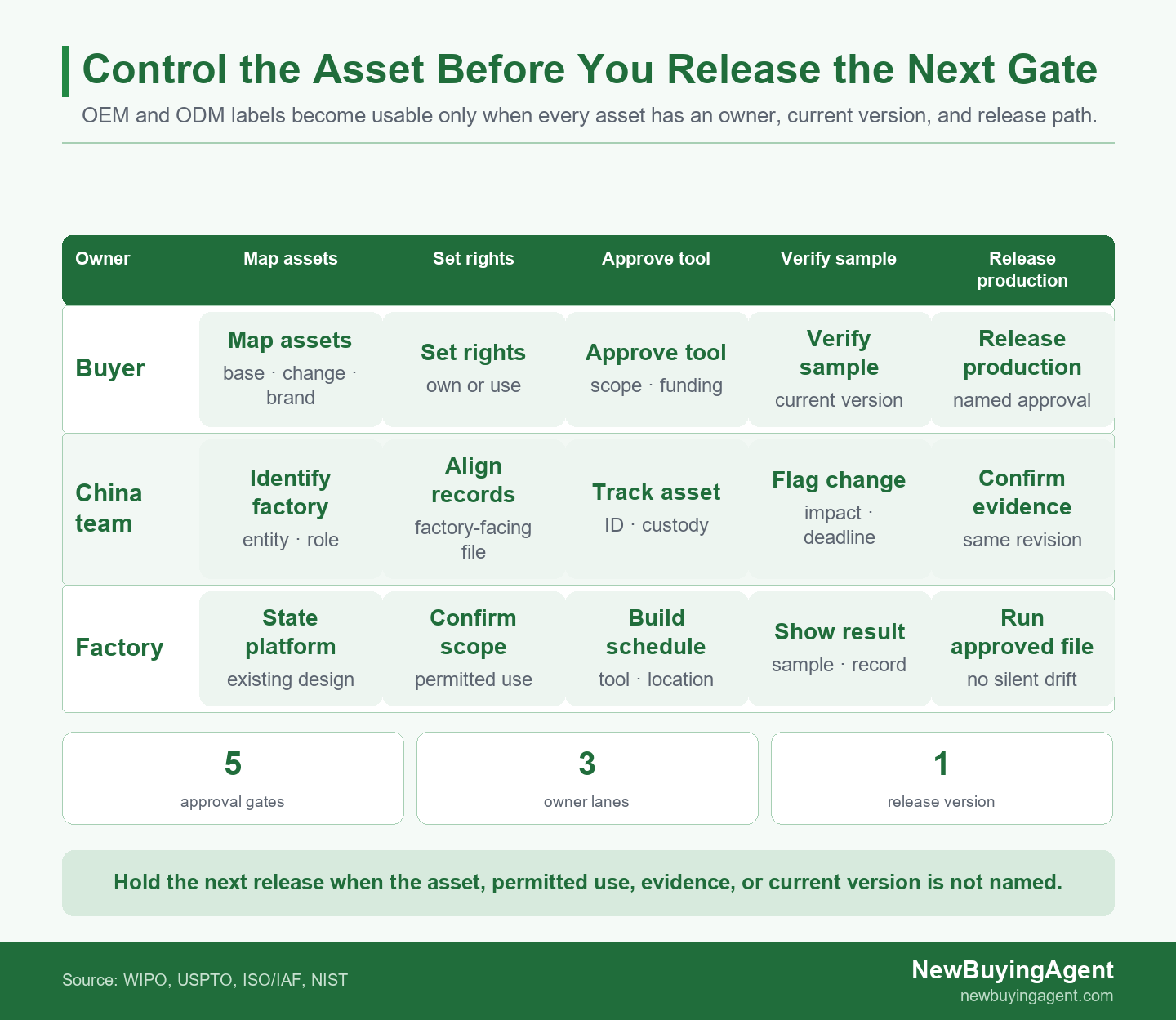
Three-lane OEM and ODM approval map showing buyer, China-side coordinator, and factory responsibilities from asset map to production release
Use a gate to release a named version, not merely to mark a conversation as complete. The buyer, China coordinator, and factory each have a different role: the buyer sets commercial direction and accepts the evidence; the coordinator keeps the factory, files, and follow-up aligned; the factory responds against the current specification and provides the actual sample or production evidence.
- Map assets: name the platform, buyer inputs, factory contribution, tool, and artwork.
- Set rights: record ownership or permitted use, confidentiality, and the decision owner for each relevant asset.
- Approve tooling: lock the tool specification, tool ID, payment trigger, and custody record.
- Verify the sample: compare the sample, drawings, artwork, and required checks against one revision.
- Release production: issue a dated buyer approval for the defined product, packaging, and agreed change status.
Do Not Let Sample Approval Replace Change Control
A usable change record identifies the affected component and version baseline so that approval applies to a defined configuration rather than a conversation. NIST’s configuration-management concepts describe the underlying idea: identify components, versions, and baselines, then control changes to them.
A configuration baseline means a locked, named version of the files, components, and requirements; later changes are assessed against that set. For a physical product, it can include the drawing revision, material list, approved colour, artwork file, packaging, sample date, and acceptance points. If the factory changes a hinge, finish, lid seal, carton, or logo placement after sample approval, log the affected version, impact, required retest, and authorised approver. A friendly message saying “approved” is not a reliable substitute.
Plan the Handover Before the Relationship Is Tested
An end-of-relationship plan should state what files, copies, confidential information, and permitted supplier use are expected when the relationship ends. WIPO’s supplier-IP guidance likewise highlights ownership, copies, confidentiality, permitted use, and exit arrangements.
Do this before conflict makes the request difficult. An operational handover list can name the physical tool, current design files, approved samples, inspection records, artwork, contact points, and the process for confirming receipt. It does not promise that a transfer is available in every situation; it makes the buyer’s intended transition requirements clear enough to review in the applicable agreement. For broader sourcing context, buyers can review NewBuyingAgent client cases.
Illustrative Scenario: An ODM Bottle With a Buyer-Funded Lid Tool
In the illustrative bottle program, the buyer can keep an ODM base body while placing the branded lid tool and approved artwork in a separate controlled asset file. This is a common hybrid logic: use the existing factory platform where it creates speed, then create a separate decision path for the change that creates the buyer’s differentiation.
Separate the Factory Platform From the Buyer-Funded Change
A global home-and-outdoor brand is evaluating a China supplier for an insulated bottle line. This illustrative 4,800-unit first order uses the factory’s existing bottle body, buyer artwork, and 1 buyer-funded injection-molded lid tool. The factory offers an ODM body platform, while the buyer wants a custom lid, colour palette, trademark artwork, and the ability to reuse the lid tool for future orders.
The scenario releases the base product, tool, and artwork only after each has a named owner or permitted-use record and a matching version. The quotation calls the product ODM but does not separate the base body from the new lid tool. The sample approval email has no version code for the artwork or lid drawing. The agent has a tool charge but no factory-facing record of custody, permitted use, or future transfer. The product is neither fully buyer-designed nor entirely factory-controlled: the base body may remain a factory platform while the buyer’s custom lid, artwork, and associated records need their own documented boundary. The buyer holds the tooling payment and production release until the parties can distinguish the base platform, buyer-contributed assets, tool schedule, sample baseline, and the factory’s permitted use.
Create a one-page asset schedule, assign a tool identifier, lock a revision code for the lid drawing and 2 artwork files, set the sample acceptance test, and name the buyer-side release owner. Before production release, the quote, tool schedule, approved sample, lid drawing, artwork, and factory acknowledgment all point to the same revision. This is illustrative only; it is not a NewBuyingAgent customer case, legal opinion, or guarantee of ownership or transfer rights.
Where China-Side Coordination Adds Value Without Taking Over Ownership
NewBuyingAgent can connect a defined product brief to China-side factory communication, supplier follow-up, quality-control coordination, and logistics support without replacing the buyer’s ownership decisions. The buyer receives a clearer factory-facing record, while retaining the commercial decisions about rights, acceptance, and release.
For an existing supplier relationship, the work may instead be to manage the current tool, sample, inspection, and production record against a verified factory-facing baseline. In every route, the coordinator’s job is to keep the evidence connected; it is not to decide the buyer’s ownership or licensing position. Buyers can manage China-side factory follow-up.
The Approval File to Prepare Before You Ask for a Quote
A buyer can make OEM and ODM quotations comparable by sending a concise brief that distinguishes assets, rights, tooling, sample gates, and release authority. Ask every prospective factory to respond to the same versioned file, then compare the stated platform, custom work, tool charge, sample timing, and exceptions against that file.
- Product concept or existing model, target market, expected quantity, and required custom changes.
- Asset schedule naming the factory platform, buyer files, new development, tool, artwork, and production records.
- Requested ownership or permitted-use treatment and the point for China-qualified legal review.
- Tool schedule with drawing revision, tool ID, location, custody, maintenance, and proposed payment trigger.
- Sample acceptance criteria, including the buyer-side release owner and how changes will be logged.
- Production-release file: approved sample, bill of materials, artwork, packaging, inspection points, and revision date.
- Exit and handover request for files, samples, tools, confidential information, and permitted supplier use.
With those inputs, the conversation can begin with a real product, factory-facing records, and a defined approval path rather than a generic request for “OEM pricing.” Buyers ready to start can Submit product requirements to NewBuyingAgent.
Questions Buyers Ask Before Choosing OEM or ODM Through a China Agent
Does paying for a mold automatically make the buyer its owner?
Ownership and future-use rights should be made explicit for the actual product assets and jurisdiction rather than inferred from the label OEM or ODM. WIPO’s technology-licensing guidance supports separating contributed assets, new work, responsibilities, and development deliverables. No: payment, ownership, custody, permitted use, and transfer are separate questions that should be stated in the applicable written agreement and asset record. Before the payment trigger, identify the tool, drawing revision, factory location, maintenance responsibility, access to records, production scope, and expected process if the relationship ends. Obtain China-qualified advice for rights or enforceability questions.
Can an ODM product still include buyer-controlled custom parts?
Yes. A buyer can use a factory platform while separately documenting the rights and approval controls for a custom component, brand asset, or buyer-funded tool. The practical requirement is to avoid collapsing those items into the ODM label. Give each asset a record, a current version, and a named release owner, then ask the factory to acknowledge the same scope. The resulting product can be an ODM-based program with a buyer-controlled change path; the record should identify what remains a factory platform and what requires buyer approval.
What should a China sourcing agent do before a tooling payment?
The agent should help align the actual factory, tool specification, versioned product file, sample plan, and buyer approval record before the program advances. The agent can clarify missing records, confirm that the quotation references the current scope, and follow up on the sample or tool schedule with the factory. The buyer should retain commercial and legal decisions, including the rights it needs, the product acceptance criteria, and the conditions for release. If those terms are unclear, hold the payment step while the appropriate records are reviewed.
When should a buyer involve China IP or contract counsel?
Involve qualified counsel before sharing material design files, paying for tooling, signing ownership or licensing terms, or relying on rights that affect a China manufacturing relationship. Counsel is especially important when the buyer needs a defined ownership, licence, transfer, confidentiality, nonuse, or enforcement position. Bring the asset schedule, current drawing and artwork versions, target market, and intended factory relationship to that review. The asset map and approval gates make the discussion more focused; they do not replace it.
NewBuyingAgent
Related Resources

ابدأ اليوم
دعنا نحول أهداف التوريد الخاصة بك إلى واقعWeChat:+86 15157124615
WhatsApp:+86 15157124615
العنوان: مبنى 10 #39 طريق شيانغيوان، هانغتشو، الصين
