
A China sourcing operating system is not another weekly update, a supplier list, or a dashboard full of numbers. It is a shared way to make and record the decisions that determine whether an order can move: who owns the decision, what baseline they are comparing against, what evidence they need, and what happens when the evidence changes. That structure keeps commercial, product, quality, and release questions connected even when several factories and internal stakeholders are involved.
The practical goal is modest. Before the next quotation, production release, or shipment handoff, make the relevant decision visible enough that a late material change, missing sample reference, or cost variance has an owner and an action. The system can begin as one controlled record per buying program; it does not require new procurement software or a universal rulebook.
A China Sourcing Operating System Is a Decision System
A China sourcing operating system assigns authority, evidence, and trigger actions to decisions across an order. Its job is to make a buyer’s next commitment clear: approve a revised quote, hold a SKU, accept an inspection result, request a correction, or release a shipment.
Most programs already have the raw inputs: a quote, a sample, a purchase order, inspection photos, and chat history. The gap is that those items often live in separate conversations. An operating system links them to the decision they are meant to support. A wider China sourcing guide can help establish market and supplier context before individual buying decisions are made.
Use the system at the program level rather than trying to standardize every factory conversation. A simple record can name the product revision, target market, quantity, commercial term, cost baseline, buyer, China-side coordinator, factory contact, evidence due, release condition, and next review date. A generic “follow up with supplier” task does not say whether the supplier must provide a revised sample, a material confirmation, a test report, or a revised cost calculation.
Four Decisions That Keep the Program Coherent
A sourcing operating system is most useful when ownership, the approved baseline, current evidence, and trigger action are visible in one shared record.
- Name the owner: identify the person who may accept, hold, or escalate a commercial, quality, or release change. A coordinator can collect evidence but should not silently inherit buyer authority.
- Freeze the comparable baseline: label the product revision, quantity, packaging, commercial term, inspection scope, and cost assumptions used for comparison.
- Define acceptable evidence: decide what proves the current state of the item: a revision-controlled sample, material confirmation, inspection record, technical file, or other product- and market-specific item.
- Pre-agree the action: state what happens when the baseline and evidence conflict. The next step may be correction, an approved variance, a SKU-level hold, or a request for specialist advice.
These controls do not promise that every outcome can be predicted. Freight volatility, factory capacity, changing market rules, and product design changes still require judgment. The system makes that judgment traceable and timely by showing which assumption changed and who must decide what happens next.
Start With Governance, Not Another Status Meeting
Each sourcing approval should name an accountable owner, an evidence standard, and the decision that person may make. This is governance in a usable form: a person knows whether they may approve, recommend, or merely collect information.
A defined exception path converts material, timing, or quality drift into a hold, correction, or approved variance before shipment pressure narrows the choice. The purpose is not to delay every change; it is to prevent a relevant change from being absorbed into an email thread without a decision.
Start with three roles. The buyer owns commercial direction, acceptable risk, and final release authority. The China-side team keeps the factory, product record, and evidence request aligned with that direction. The factory confirms production conditions, supplies the requested evidence, and implements only the approved change. One person may occupy more than one role in a small program, but the responsibilities should remain distinct.
Give Each Approval One Owner and One Evidence Standard
A decision right is usable only when it names the accountable owner, the evidence that owner must review, and the decision they may release or hold.
Build a short decision-rights map before production begins. The product lead may approve an aesthetic sample against the current artwork revision; the procurement lead may approve a quote variance only after the quantity and commercial term are normalized; the quality lead may accept or reject a pre-shipment result against the approved inspection plan; and the buyer or delegated executive may release a shipment after the required records are complete. The names will differ by organization, but the evidence-to-decision connection should remain explicit.
Keep the map close to the operative record. When a quote changes, attach the prior and proposed baseline. When a sample changes, attach the revision code, photographs, and acceptance criteria. When an inspection is complete, attach the relevant plan and decision. This creates a useful audit trail without turning every sourcing action into a long approval cycle.
Escalate Changes Before They Become Shipment Problems
An exception record should distinguish an issue that can be corrected within an approved baseline from one that changes the buyer’s commercial, quality, or compliance decision.
Use a short exception record whenever a supplier proposes a substitute material, different packaging, a changed production date, a different inspection scope, or a cost change. Record the affected SKU, current baseline, proposed change, evidence received, decision owner, deadline, and status. The record is not a complaint log. It tells the team whether the issue is a correction inside the approved plan or a change that needs new approval.
A practical rule is to hold the affected release when the product baseline, required evidence, or accountable decision is missing or conflicts. That does not automatically stop unrelated work. It lets a buyer separate the affected SKU or lot from items that still match their approved baseline.
Control Total Cost With a Comparable Baseline
A comparable cost baseline names the product revision, commercial term, quantity, packaging, inspection scope, freight assumption, and excluded cost fields before a variance is evaluated.
Incoterms clarify specified buyer and seller tasks, costs, and risks, but they do not replace a complete sales agreement. Trade.gov’s Incoterms guidance explains the boundary. Treat the named commercial term as one field in the baseline, alongside payment, product requirements, and the other conditions that the agreement must address.
A factory may quote a lower unit price because the quantity is different, the packaging is simpler, the inspection level is reduced, a component has changed, or a freight assumption was omitted. A buyer cannot decide whether the quote is favorable until those assumptions are visible. Use the same row structure for comparable offers and keep the product revision in the title of the record.
| Baseline field | What to record | Why it changes the decision |
|---|---|---|
| Product and revision | SKU, approved sample or drawing code, material, and packaging version | Prevents a quote for a changed item from being compared with the original item. |
| Commercial scope | Quantity, currency, payment terms, Incoterm, port or destination, and validity date | Makes the allocation of cost and risk visible rather than assumed. |
| Quality and release scope | Inspection plan, sampling level, rework treatment, and evidence required before release | Shows whether a lower price removes a control or changes the release burden. |
| Freight and exclusions | Freight assumption, insurance, duties or taxes where relevant, tooling, testing, and excluded services | Keeps a unit-price discussion from hiding order-level exposure. |
Use transparent arithmetic for a variance review. In an illustrative 12,000-unit order, a $0.25 unit increase on one 4,000-unit SKU changes that SKU’s product cost by $1,000. If inspection scope also rises by $0.04 per unit for the same 4,000 units, that is another $160. The comparable variance is $1,160 for the affected SKU before considering separate freight, duty, payment, or currency effects. The calculation does not decide whether to accept the change; it tells the decision owner what changed and what evidence remains needed.
Keep an “unknown or excluded” field rather than forcing a false total. It is better to record that a destination-market test requirement is still being verified than to present a complete landed-cost figure built on an unstated assumption.
Treat Supplier Choice as an Evidence Path
A supplier quote should be evaluated alongside product-specific capability, specification, material, sample, and documentation evidence appropriate to the next commitment. A low quote can begin the conversation, but it cannot by itself prove that the factory can reproduce the current product revision at the required control level.
A buyer with a new product need and a buyer with an existing factory control gap require different China-side support. A new product program may need factory matching, sample development, and a product record; an established supplier relationship may need clearer production evidence, inspection coordination, and an escalation record.
NIST MEP identifies supplier evaluation and selection, supply-chain mapping and risk assessment, and total cost of ownership as related supply-chain management areas. In practice, decide which evidence categories are proportionate to the product and commitment in front of you.
NIST describes due-diligence research as gathering pertinent information about a supplier or product to inform decisions, while scoping its Quick-Start Guide to ICT suppliers. Read the NIST source. For other product categories, define the evidence standard against the actual item and destination market.
For a new product, ask the factory to respond against a defined brief: product use, dimensions or tolerances where relevant, material requirement, packaging, target market, sample standard, quantity range, and evidence required before release. For an existing product, compare the current factory record to the buyer’s approved baseline. If the factory cannot connect the quote, current sample, material confirmation, and quality record to the same revision, the next step is evidence collection or a controlled change—not a confident release.
When a buyer is still defining the product and factory route, it can turn a defined brief into China-supplied products with NewBuyingAgent’s local factory resources, product-development support, and quality coordination. The buyer should still keep acceptance criteria, commercial authority, and product-market requirements in its own decision record.
Separate Capability Proof From a Low Quote
A quote or factory update is not release evidence until it can be traced to the current product revision, requirement, and decision owner.
Use a staged evidence path. Before supplier selection, evaluate whether the factory can address the defined product, capacity, and communication requirement. Before a production commitment, connect the current sample, bill of materials or equivalent product record, packaging, and quote to one revision. Before release, connect the inspection result and any required market documentation to that same revision. The exact evidence set changes by product, risk, and destination market; the traceability principle does not.
Do not replace factory evaluation with a generic scorecard. A score of eight out of ten says little if the buyer cannot see which product was sampled, which material was confirmed, or how the factory addressed a relevant change. A concise evidence log with file or photo references, dates, revision codes, limitations, and owner decisions is often more useful than a broad qualification worksheet.
Review Recurring Suppliers for Drift, Not Just Emergencies
A performance review should connect measured drift to a named threshold, owner, and corrective decision instead of treating KPI reporting as an end in itself.
For recurring suppliers, review a small number of trends that change future buying decisions: milestones reached on the agreed date, recurring defects by product revision, quote changes after sample approval, document readiness, and corrective actions that remain open beyond the agreed review date. Compare results with the same baseline definition each time. A delivery figure that ignores approved schedule changes, for example, creates noise rather than a useful signal.
Where an existing factory needs tighter production visibility, the operating-system record remains buyer-owned: it should state the evidence sought, the decision owner, and the action if evidence is late or conflicts. A factory-management service may help coordinate information, but it should not replace the buyer’s commercial approval.
Use Release Controls That Match the Product and Market
A release decision should reconcile the approved product baseline with the evidence and documentation needed for the destination market. “Ready to ship” should mean that the required product, commercial, quality, and market-specific release conditions have been checked for the actual SKU and route.
Product and market requirements can vary by product category, so the evidence checklist must be tested against the destination rather than reused blindly. This is an operating guide, not legal, customs, testing, or certification advice.
Trade.gov’s China standards overview notes that product-specific standards, testing, and certification requirements can vary across categories and markets. That is a reason to assign the verification task rather than assume that a China factory’s generic certificate answers the destination-market question.
Trade.gov describes conformity assessment as potentially including testing, certification, quality-management-system assessment, accreditation, and supplier declarations of conformity. Which combination applies depends on the product and rule set; document the path before treating a file as sufficient release evidence.
Trade.gov explains that EU conformity assessment can involve sampling, testing, inspection, certification, and technical documentation depending on the product and legislation. See the EU standards guidance. Use that as a reminder to verify the actual destination route with qualified specialists where necessary, not as a universal checklist.
Where the buyer already has factories but needs better follow-up on production, documentation, or inspection evidence, it can use China-side factory-management support from NewBuyingAgent. The value is in local coordination and evidence visibility; release authority and market-specific decisions remain with the buyer and its qualified advisers.
A release-control checklist can be short: current product revision confirmed; approved cost baseline or variance decision recorded; sample and production evidence aligned; inspection or test evidence reviewed where applicable; required destination-market documentation assigned and checked; shipment release owner named. Give each item a status and a link or reference to its proof. If an item is not applicable, record why and who made that determination. That is stronger than leaving a blank field that later looks like an overlooked requirement.
Choose KPIs That Trigger an Action
A sourcing KPI is useful when it is tied to an approved baseline, a named owner, a review cadence, and a pre-agreed action when tolerance is crossed.
NIST describes integrating cybersecurity supply-chain risk management into risk-management activities through strategy implementation plans, policies, plans, and risk assessments for products and services. Read NIST SP 800-161. Its scope is cybersecurity, but the planning discipline is a useful bounded analogy: metrics should feed a risk-and-action decision, not sit apart from the operating plan.
Avoid generic targets such as “zero defects” or “100% on time” unless the organization has defined their measurement method, product scope, and commercial consequence. The table below provides decision-oriented KPI examples. The tolerance and cadence depend on the product, supplier history, market, and program stage.
| KPI | Baseline and review | Action when tolerance is crossed |
|---|---|---|
| Quote variance | Compare the current quote with the same product revision, quantity, and commercial terms. | Require an explanation and buyer decision; separate a product change from a freight or market change. |
| Milestone reliability | Review promised versus achieved dates using the approved plan and recorded changes. | Request a recovery plan, adjust the release path, or escalate the commercial effect. |
| Evidence readiness | Check whether the current sample, material record, inspection evidence, and release documents are complete by the gate. | Hold the affected release until evidence aligns or the buyer approves a documented exception. |
| Corrective-action closure | Review open actions against owner, due date, and verification method. | Escalate overdue or unverified actions; do not close an item solely because a supplier says it is fixed. |
Review KPIs at the cadence of the decision, not only at month end. A buyer may need a short review before sample sign-off, container booking, or a release gate. A recurring review can then identify supplier drift across programs. A KPI that does not alter a decision, request evidence, or change a review date is probably a report, not a control.
Apply the System to One Live Sourcing Program
An illustrative 12,000-unit program can isolate a held SKU while unchanged SKUs continue when the cost baseline and release evidence are recorded separately. This prevents a local exception from becoming an unstructured decision about the entire order.
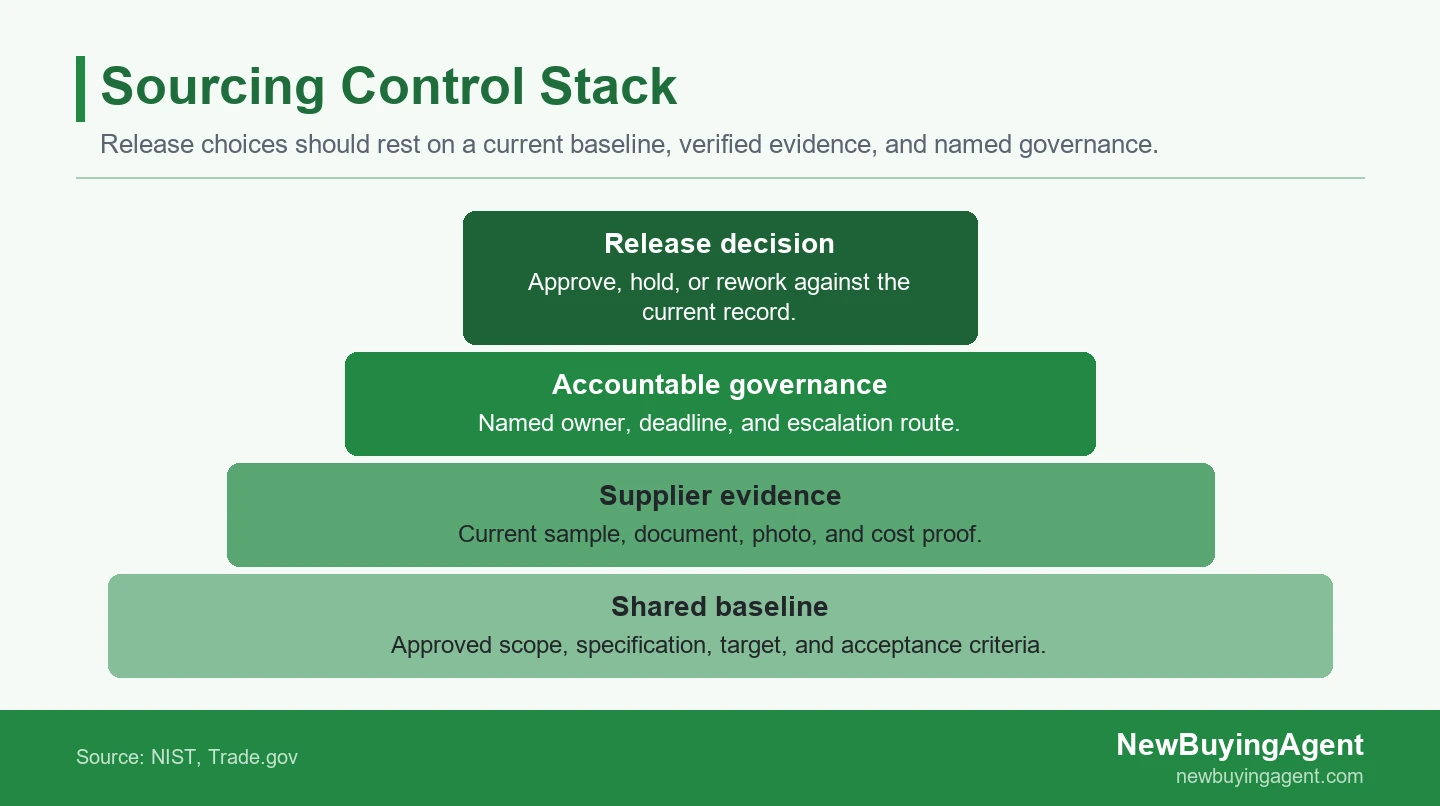
A sourcing program becomes controllable when release decisions rest on an agreed baseline, current evidence, and named governance.
The example below is illustrative. It is not a benchmark for unit economics, inspection costs, certification, release criteria, or supplier performance. Its value is the sequence: identify the affected scope, compare against the approved baseline, gather evidence, record the owner decision, and verify the correction against the same revision.
A useful first operating record uses one row for the current baseline and separate exception rows for changes. The baseline row is the agreed starting point, not a historical archive. Each exception row should point back to the baseline and explain whether it changes cost, product, timing, quality, market documentation, or release status. That relationship makes it possible to understand why one SKU can be held while another continues.
Before treating a local exception as a whole-order failure, buyers can review NewBuyingAgent success stories across product programs. The relevant comparison is not a promise of a matching outcome; it is whether the factory, product requirement, and operating evidence resemble the decision problem that the buyer needs to solve.
A SKU-Level Hold Keeps an Exception From Stopping the Whole Program
A traceable SKU-level exception can separate the decision to hold an affected product revision from the decision to release unaffected SKUs.
A Canada-based outdoor-goods retailer is sourcing an illustrative 12,000-unit seasonal order of three unbranded travel-accessory SKUs from three factories in China. Two SKUs have an approved product and cost baseline. The third has a material-substitution request and no complete reference connecting the current sample to the proposed material. The affected scope is 1 affected SKU, 4,000 units, while 2 unchanged SKUs remain eligible for approval.
The lead factory proposes the substitute and raises the unit quote for that SKU by $0.25. The inspection scope also increases by $0.04 per unit, while the freight assumption remains unchanged. The pre-shipment documentation pack contains photos and a factory update, but not the current-sample reference needed to show which product revision the evidence represents.
The procurement lead calculates the affected SKU variance separately: $1,000 for the $0.25 unit change across 4,000 units, plus $160 for the inspection-scope change. The China-side coordinator records the material proposal, sample-reference gap, evidence request, and decision deadline in one exception record. The buyer approves the unaffected SKUs only if their own baseline and release evidence remain complete. The affected SKU is held—not rejected—until its material, sample, inspection, and buyer decision can be reconciled.
The coordinator requests a material confirmation from the factory, connects the current sample reference to the inspection plan, and records the revised cost baseline and owner decision. Before the held SKU advances, the material evidence, current sample reference, inspection result, and buyer release record must point to the same product revision. This is an illustrative example. Actual cost, quality, certification, and release obligations depend on the product, destination market, contract, and applicable law.
This pattern also supports better supplier conversations. Instead of asking a factory whether it can “fix the issue,” the coordinator can request the exact missing evidence, date, and product revision. Instead of asking the buyer whether to “go ahead,” the coordinator can present the comparable cost effect, affected scope, unresolved proof, and available decisions. That is the operating benefit of a traceable exception: it replaces vague urgency with a defined decision.
Build the First Version Before the Next Purchase Order
The first useful operating-system version is a compact shared record, not a new software project. Start with one active sourcing program and make the next decision easier to verify.
- Choose one product family or pending purchase order.
- Name the buyer, China-side coordinator, and factory contact for that program.
- Record the current product revision, comparable cost baseline, target market, and required release evidence.
- List the decisions that may change before shipment, then assign the owner and trigger for each.
- Run one review before the next commercial or release commitment and keep the resulting exception records with the program.
Start where uncertainty is highest. A product with recent sample changes, several supplier quotes, an approaching production release, or a new destination market usually exposes the value of the record quickly. Avoid starting with a giant historical cleanup. The goal is to create a repeatable habit around live decisions, then extend it to the next program after the first review reveals which fields and controls actually help.
If the operating record reveals a gap in factory coordination, product development, quality control, or evidence collection, buyers can contact NewBuyingAgent about the sourcing brief and include the product scope, quantity, target market, price basis, supplier history, quality requirements, destination, and timing. This makes the China sourcing conversation grounded in clear decisions and operating evidence.
Buyer Questions
What belongs in a China sourcing operating system?
The remaining buyer questions are implementation boundaries that should not replace the core operating decisions in the guide. A useful China sourcing operating system assigns decision owners, cost baselines, supplier evidence, release gates, and a KPI review cadence to the same buying program. The first version can be a controlled shared record if it links the current product revision to the next buyer decision. Add fields only when they help someone approve, hold, correct, or verify an active commitment; avoid turning the record into a disconnected archive of supplier messages.
Which sourcing KPIs should a procurement leader review?
Review only the KPIs that change a decision, usually cost variance, on-time milestone performance, defect or rework evidence, documentation readiness, and corrective-action closure. Each KPI needs a defined measure, an approved baseline, a named owner, and an action when tolerance is crossed. For instance, an evidence-readiness measure can trigger a hold on an affected SKU, while a recurring milestone delay can trigger a recovery-plan review. Start with the one measure that reveals the next operational decision, then add another only when a different owner needs a different action. Avoid aggregate scores that do not tell the team what to request, decide, or verify next.
How should a buyer compare China supplier quotations?
Compare China supplier quotations only after the product revision, commercial terms, quantity, packaging, inspection scope, freight assumption, and excluded costs are named consistently. Put payment terms, currency, quote validity, tooling, test assumptions, and any unknown field in the same comparison record. Then isolate the variance for the affected SKU or order line rather than treating a different product scope as a price movement. A total landed cost view is useful only when every included and excluded item is stated, with unresolved items still marked as assumptions. Keep the same baseline through negotiation so the buyer can identify whether a factory has changed scope, not merely changed price.
When does a sourcing issue need China-side management?
China-side management becomes valuable when the buyer has a current supplier but lacks reliable production evidence, quality-release visibility, or ownership of the next escalation decision. It can also help when a new product needs local factory communication, sample coordination, and checks against a defined brief. The service should make buyer decisions and proof easier to see, not conceal them behind status updates. Agree in advance on who will collect information, who can ask the factory to correct a discrepancy, and which buyer retains the authority to approve a commercial or release change. It does not transfer commercial authority or remove the need to verify obligations for the actual product and destination market.
NewBuyingAgent
Related Resources


ابدأ اليوم
دعنا نحول أهداف التوريد الخاصة بك إلى واقعWeChat:+86 15157124615
WhatsApp:+86 15157124615
العنوان: مبنى 10 #39 طريق شيانغيوان، هانغتشو، الصين