A sourcing SLA is a written operating schedule for the work around a buying program. It states what starts the work, what the agent delivers, which record proves delivery, who accepts it, and what happens when the usual path fails. It is not a substitute for a contract or for legal advice on the parties, product, or market.
That distinction matters because a proposal can sound complete while still leaving a buyer unable to judge a late quotation, an unapproved sample change, a delayed inspection report, or a supplier request that needs an answer. Write the SLA as the working layer of the engagement: short enough for a project team to use, but specific enough that a service promise can be checked without reconstructing a long message thread.
A Service-Level Agreement Should Make Work Testable, Not Just Promised
A sourcing agent service-level agreement is a written operating schedule that states service scope, evidence, owner, exception, and review. An SLA should name the service, owner, evidence, exception, and review point that make a sourcing promise testable. For every material line, add the buyer input that starts the work, the agent output, the due point, the evidence record, the acceptance owner, and the exception rule. If one of those fields is blank, the line may still describe a good intention, but it will be hard to manage under pressure. ICC describes its voluntary guidelines as advice on how companies choose and manage agents, intermediaries, and other third parties. Read the ICC guidance. That is useful context for treating the operating schedule as a deliberate control, not a friendly promise of availability.
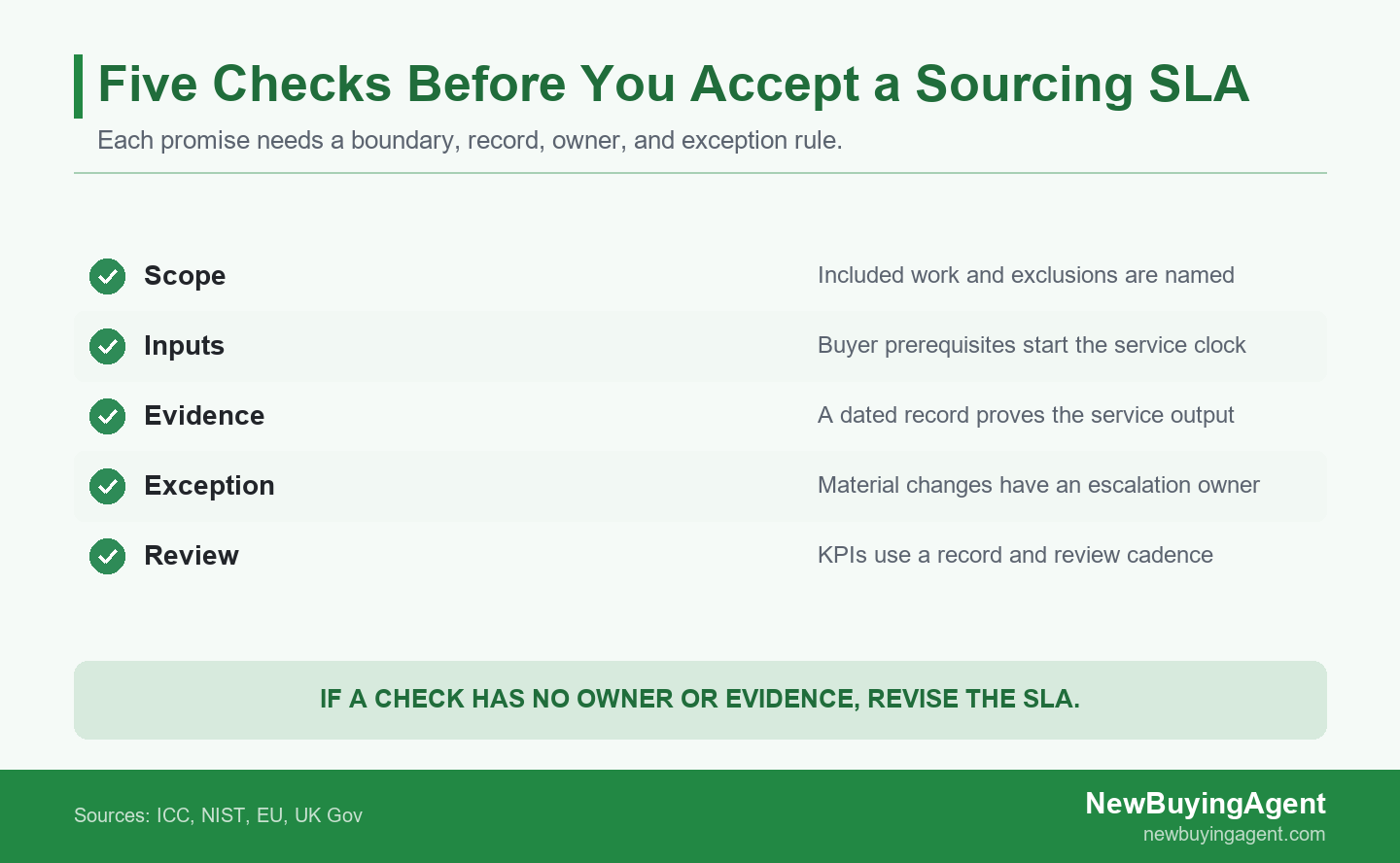
A five-item sourcing SLA scorecard checks scope, buyer input, evidence, exception handling, and KPI review before the agreement is accepted
- Scope: what is included and excluded for this order or program.
- Prerequisite: the buyer input required before the service clock starts.
- Proof: the dated file, update, sample status, or inspection record to deliver.
- Decision: the person or role that accepts the result or escalates it.
- Review: the evidence-backed KPI and cadence used to improve the work.
Start With the Operating Boundary
A useful sourcing-agent SLA separates the service boundary from the buyer decisions and inputs that remain outside the agent's authority. Begin with the buying situation rather than a generic list of services: is the agent finding new factories, supporting an existing supplier, coordinating samples, following production, arranging inspection, or compiling logistics information? Then state what the agent may coordinate, what it may recommend, and what still needs the buyer's decision. Timing is meaningful only after that line is clear.
Write exclusions just as plainly. A project may not include price approval, product-signoff authority, customs advice, financial approval, market-access decisions, or legal interpretation unless the engagement separately defines and supports those roles. The SLA can set an escalation path for such questions; it should not imply that a China-side coordinator automatically takes responsibility for every decision raised by a supplier.
Define Scope, Exclusions, and Buyer Inputs
A useful SLA names what is included, what is excluded, and what the buyer must provide before the service clock begins. For example, a quotation-update service might start only after the buyer supplies the product specification, target quantity, destination, desired packaging, and the role that can decide on a supplier shortlist. The output could be a dated comparison file rather than an undefined promise to “follow up.” If an input changes, record whether the original due point is still applicable or a new one begins.
That approach helps a new sourcing brief move from a request for “suppliers and pricing” to a controlled work package. When the product and decision inputs are ready, a buyer can use NewBuyingAgent's product-supply service for a defined China sourcing brief. The SLA should still state the working inputs and acceptance point, even when the service partner has local supplier resources and product-development capability.
Keep Product and Market Responsibilities With the Right Party
Use the SLA to name evidence and escalation owners without implying that an agent automatically assumes manufacturer or importer responsibilities. The schedule can say who requests a document, where it is stored, who reviews it, and who must decide whether an issue changes the product or shipment plan. It cannot safely turn a coordination activity into an unstated transfer of regulatory or commercial responsibility.
GOV.UK says manufacturers and importers placing products on the UK market need to demonstrate compliance with relevant safety requirements. Read the GOV.UK guidance. In the EU context, The European Commission explains CE marking as a manufacturer's declaration that a product meets applicable EU requirements. Read the European Commission guidance. These sources set a boundary, not a clause template. For a specific product and market, obtain the appropriate regulatory and legal advice before using an SLA as part of the operating record.
Write Service Levels Around Evidence, Not Activity Lists
Each sourcing service level needs a due point, visible record, review owner, and exception rule, not only an activity label. “Contact factories” becomes “send a dated sourcing update showing factories contacted, response status, open questions, and the buyer decision needed.” “Monitor production” becomes “send the agreed production record at the agreed stage, flag material variance, and log the buyer's direction.” The goal is not to turn every supplier message into paperwork. It is to preserve the record that proves a decision-critical service occurred.
NIST describes performance measurement, analysis, review, and improvement as helping organisations achieve results and respond to unexpected change. Read the NIST commentary. The article applies that general management principle as an operating model for sourcing, not as a certification standard or a legal requirement.
| SLA field | Example for a sourcing service | Evidence to retain | Decision if it changes |
|---|---|---|---|
| Buyer input | Approved specification and target quantity | Current brief and version date | Confirm whether timing restarts |
| Agent output | Supplier comparison or production update | Dated file with open questions | Buyer accepts, revises, or escalates |
| Due point | Agreed update after input is complete | Timestamp and delivery channel | Log a missed or blocked due point |
| Exception rule | Material product or supplier change | Change notice and evidence pack | Named owner pauses, approves, or redirects |
For broader context on factory selection, communication, production, and quality work, buyers can read the China sourcing guide. Use the guide to understand the wider workflow; use the SLA to make the particular engagement measurable.
Set Reporting Levels for the Decisions That Matter
Routine status, material changes, and release-critical exceptions need different reporting targets because they require different buyer decisions. A routine weekly update can cover progress, blockers, and the next planned action. A material change—such as a supplier, material, specification, quantity, or agreed evidence change—should trigger a faster notice with the decision needed. A release-critical issue should identify the affected lot or order stage, the evidence available, the person who can decide, and the deadline created by the supplier or shipment schedule.
A useful response target includes the dependency. Do not write “agent responds within 24 hours” when the agent cannot resolve a missing product instruction without the buyer. Write what the agent must acknowledge, what it must investigate, what record it must deliver, and which buyer response is needed for the service to continue.
Use Acceptance Criteria for Samples, Changes, and Inspections
An SLA should state what file, sample, or inspection evidence turns a service update into a buyer decision. For a sample, name the required sample version, review owner, decision deadline, and whether a pass, conditional pass, or rework request is recorded. For inspection coordination, name the inspection brief, report format, evidence location, and the buyer who decides whether an exception affects shipment. This keeps “sent” separate from “accepted.”
Trade.gov notes that China uses standards and conformity-assessment systems, and some product routes can involve certification or testing. Read Trade.gov's China standards guidance. That is one reason an SLA should identify the evidence to collect and the person who decides what it means, rather than treating a test or certificate request as an automatic approval.
Assign Governance: Owners, Escalation, Data, and KPIs
A key performance indicator (KPI) is a measure tied to an agreed record that shows whether a service expectation was met. Give each KPI a data source, named reviewer, escalation owner, and review cadence rather than treating performance reporting as a dashboard. Start with a small set: agreed update delivered, unresolved decision age, evidence completeness at the required stage, and recurring exception type. Each measure should show the service line it belongs to and the record behind the number. A KPI without a record becomes a dispute about recollection.
NIST CSF implementation examples describe establishing supplier roles, responsibilities, performance goals, and information-sharing rules. Read the NIST CSF examples. That framework concerns cybersecurity, so it does not prescribe a sourcing SLA; its role-and-record principle is a useful boundary for a buyer's governance design. Name the escalation owner for each exception type, then decide whether an overdue or incomplete record needs a clarification, a buyer decision, or a review of the service line itself.
Data rules deserve their own sentence in the SLA or linked operating policy: which project contacts and files are needed, who may access them, where they are kept, and what is handed over when the scope changes. European Commission guidance describes purpose, storage, access, and security expectations when organisations process personal data. Read the European Commission guidance. Apply the appropriate privacy rules to the actual parties and data; do not use an SLA as a replacement for that assessment.
Where an existing supplier needs China-side follow-up, production visibility, quality coordination, or logistics support, buyers can use NewBuyingAgent's factory-management service for suppliers you already use. The operating schedule should make clear what the service will report and who still approves a changed commercial or product decision.
Test the Draft SLA With a Material-Change Scenario
A non-routine change tests whether a sourcing SLA connects a trigger, record, owner, and release decision. Read the exception rule as if it has just arrived during a live order: can the agent tell that it is material, can the buyer see the evidence, is one person able to decide, and is the supplier told what happens next? If not, revise the line before it becomes an urgent issue.
Illustrative Scenario: A Material Change Needs a Recorded Decision
A service-level promise is credible only if the agreement tells people what happens when an approved order assumption changes. The following example uses a 9,600-unit storage-container order to show the operating logic, not to decide compliance, contract interpretation, or liability.
A global home-organisation retailer starts a China sourcing program with a local agent. The illustrative order is for 9,600 storage containers in 2 colour variants. Before mass production, the supplier says its planned resin source is unavailable and proposes 1 alternative material source. The approved sample exists, but the draft service schedule does not classify the change, name the comparison evidence needed, or identify the buyer role that can release production.
The agent sends a prompt update, yet the team still lacks a decision-ready record. No one can tell whether the proposed resin is a routine procurement substitution or a material product change. The supplier needs an answer before it can plan production, while the buyer's product lead needs a comparison against the approved sample and the current specification. A response-time promise alone does not settle that conflict.
The SLA should require the agent to flag the material-change trigger, assemble the agreed comparison and supporting evidence, and route it to the named approval owner. The buyer places the affected production decision on hold while reviewing that pack. The service clock for the exception is measured from a complete change notice, not from the first informal supplier message. Once the named buyer approves or rejects the change, the agent records the decision and sends the correct instruction to the supplier.
The corrective clause names trigger examples, the evidence checklist, a decision owner, a response target, and a controlled record location. Production resumes only after the record identifies the accepted material, relevant evidence, decision owner, and supplier instruction. This is an illustrative operating-control example, not legal or product-compliance advice. For a real product or market requirement, the buyer should use the appropriate technical, regulatory, and legal review.
Turn the SLA Into a China-Side Operating Brief
After the schedule is written, a buyer should choose new-product sourcing or existing-factory management based on the defined work and evidence needs. Put the finished SLA beside the product brief and check five questions: What work begins when? What record proves it? Who accepts it? What exception changes the path? Who reviews performance? Those answers make the handover to a sourcing or factory-management team more useful than a generic request for updates.
For a market-specific order, also identify the relevant economic-operator role and evidence owner instead of assuming an agent's coordination role answers that question. Great Britain guidance distinguishes manufacturer, importer, and distributor responsibilities for products placed on that market. Read the Great Britain guidance. The right structure is to record what the sourcing team must coordinate, then direct responsibility questions to the roles and advisers that own them.
NewBuyingAgent supports global buyers with China-side sourcing and existing-factory management. Bring a product brief, the scope to be managed, the evidence you need, the buyer decision owner, and the exception triggers. Then compare NewBuyingAgent service options for your sourcing brief.
Frequently Asked Questions
Is a sourcing agent SLA the same as a contract?
No. An SLA is the operating schedule inside or alongside an engagement: it says how the parties will run, evidence, accept, and review particular services. Contractual terms, product-market responsibilities, data obligations, and legal remedies may need separate wording and professional review for the parties and markets involved. Treat the SLA as a practical companion that makes the daily work more observable, not as a substitute for legal advice.
Which service levels should a new sourcing project include?
Start with the service lines that affect a buying decision: product clarification, supplier outreach, quotation updates, sample decisions, production evidence, inspection coordination, material changes, and shipment-critical exceptions. For each selected line, state the buyer input, agent output, due point, evidence record, acceptance owner, and escalation rule. Do not include a service just because it sounds comprehensive; include it because the project team can recognise when it starts and how it is accepted.
How should a buyer measure sourcing-agent performance?
Measure the agreed service through its own evidence, such as a dated update, current file, inspection record, approved exception, or review log. Pair each KPI with the service line, its evidence source, a named reviewer, and a review cadence. Then use recurring failures to ask a focused question: was the scope unclear, was the buyer input late, was the evidence incomplete, or did an exception lack an owner? That is more useful than rating activity alone.
When should the SLA be revised during an order?
Revise the operating schedule when the product scope, supplier, order stage, evidence requirement, buyer decision owner, destination, or exception path changes the work being measured. Record the revised rule and the effective point, rather than silently applying a new expectation to an old due date. A short scheduled review is also useful after a material exception, because it shows whether the event exposed a missing input, record, owner, or escalation step.
NewBuyingAgent
Related Resources

ابدأ اليوم
دعنا نحول أهداف التوريد الخاصة بك إلى واقعWeChat:+86 15157124615
WhatsApp:+86 15157124615
العنوان: مبنى 10 #39 طريق شيانغيوان، هانغتشو، الصين