

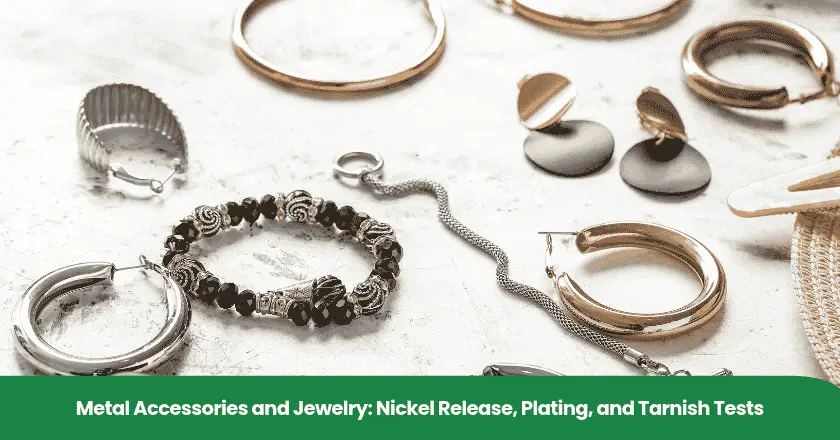
Before placing a jewelry or metal accessory order, approve three things separately: nickel release from the parts that contact skin, the plating stack on the finished piece, and how the surface looks after the exposure you specify. Start with a component drawing. Mark the parts that touch the wearer, the surfaces where thickness matters, and the areas where a color or finish change would stop the order. Ask each supplier to quote and submit samples against that same drawing.
Three Checks for the Finished Piece
Nickel release, plating and tarnish test results each support a different decision. Check nickel release on relevant contact parts, verify the named layer and adhesion on production-representative pieces, and assess appearance after the agreed exposure. Sign each result against the actual component and finish revisions, then tie those revisions to the first eligible production lot.
- How it works: Mark the skin-contact surfaces, plating measurement points and appearance zones on the product drawings.
- Risk: The polished front can look right while the clasp or back uses a different material or finish.
- Decision: Hold the affected build when a required result fails, a component changes, or a report cannot be traced to it.
An earring post, a bracelet clasp and a decorative zipper pull can have different contact patterns even if they share a finish name. For each style, write down where it is sold, how the wearer uses it, and what claims the listing will make. Those details help the compliance reviewer choose which parts to test and help the factory understand which substitutions need approval.
Map Nickel Release to the Parts That Touch Skin
Map every part that passes through a piercing or is intended for direct and prolonged skin contact. Name the finished component and mark the relevant surface on the drawing. Give the map to the compliance reviewer and the lab before sampling, so the test request covers the parts and conditions that matter for the destination market.
For EU orders, REACH Annex XVII entry 27 restricts nickel release from piercing post assemblies and specified skin-contact parts. Covered piercing post assemblies must release less than 0.2 µg/cm²/week. The skin-contact parts of covered articles must release no more than 0.5 µg/cm²/week. If those articles have a non-nickel coating, the applicable parts must stay at or below 0.5 µg/cm²/week for at least two years of normal use.
Work from how the product will be worn. On an earring, show the post, back and decorative face separately so the lab can assign the applicable category to each relevant part. On a bracelet, draw the inside of the links and the clasp as worn, including any separately sourced hinge or fastener that makes relevant contact. For a garment fastener, show how it is installed and which surfaces the wearer can touch during prolonged use.
The European Commission list of nickel test standards lists EN 1811:2023 for nickel release and EN 12472:2020 for accelerated wear and corrosion of coated items. Ask the lab to confirm applicable standards, classification and conditioning for the completed piece, including a wear and corrosion simulation before the release test where required. Retain the method editions, specimen photos, evaluated surfaces, laboratory conclusion and any limits on what the report covers.
Track the supplier's alloy or finish declaration as a material record. Release evidence should identify how much nickel migrates from the tested part under the applicable method. An elemental screening result can help investigate a material mix-up, while an actual release test addresses migration. If an offer says 'nickel-free,' define exactly what that claim means and have the compliance reviewer confirm the evidence for the product and market.
If the contact classification or scope is uncertain, resolve it with a qualified reviewer before clearing the affected parts. Keep an approved part list with separate references for posts, backs, links, clasps and other contact pieces. When a part supplier or finish changes, use that list to identify which reports need review.
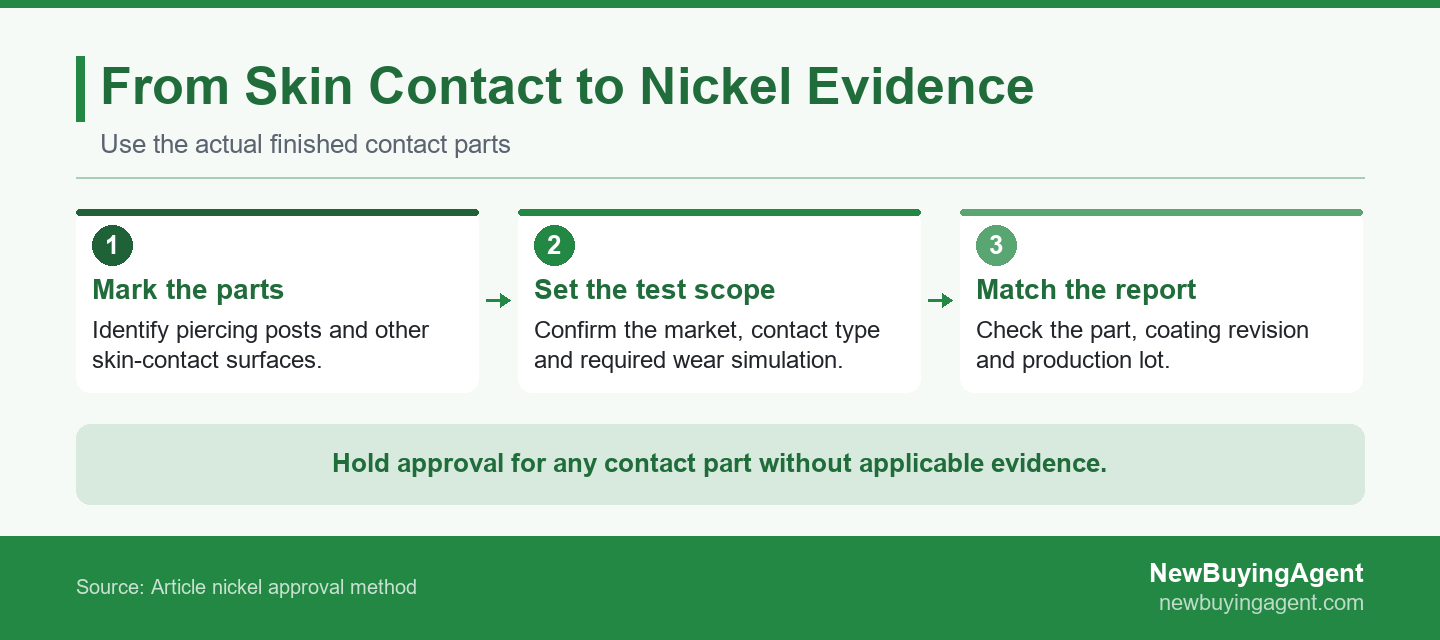
Map the contact parts, select the applicable method and link each result to the tested build
Specify the Plating Stack and Its Measurement Points
The plating stack is the sequence of layers applied over a metal base. Name the base metal, intermediate layers, finish layer and any protective topcoat for each relevant part. Set the thickness at named locations and define a separate adhesion check on the production finish, so the buyer can compare quotes and confirm both requirements on the proposed piece.
Put the stack and the requested color, such as gold tone, on separate lines in the order. Identify the component and finish revisions, the process type, the layers and the surface appearance expected on the finished piece. If only the decorative layer is subject to a thickness target, say so. If a barrier layer is critical to performance, list it as its own requirement and demonstrate how it will be verified.
The public scope of ISO 10713 for gold alloy coatings describes requirements for gold and gold alloy coatings on jewelry and decorative articles, with watch cases and their accessories outside its scope. Ask the technical team to confirm applicability where a product or claim refers to a gold coating. Record any relevant layer thickness and finish designation alongside the approved drawing.
ASTM B568 on coating thickness describes measuring thickness by X-ray spectrometry for metallic and certain nonmetallic coatings. Ask the lab if its setup can distinguish the intended layer on the actual substrate and shape. Mark accessible locations and agree how it will handle small, curved or recessed points. If a flat witness coupon is used for process monitoring, state which production surfaces still need direct evidence or another suitable method.
ASTM B571 on metallic coating adhesion describes qualitative tests whose applicability depends on the coating and substrate. Agree how the lab will judge lifting or peeling on a representative component and write the rejection rule before testing. Where a piece bends or moves in use, discuss the critical area with the lab. Retain photographs or test observations for any failure around a hinge, edge or contact point.
| Requirement | Specify in the order | Evidence to keep |
|---|---|---|
| Finish construction | Base alloy, intermediate layers, decorative layer and seal. | Part ID, approved stack and production finish code. |
| Thickness | Named layer, units, measurement locations and limits. | Individual readings and method for the actual stack. |
| Adhesion | Applicable method, specimen and rejection criterion. | Observed result linked to part and finish revision. |
Check results by component and by point. A thick reading on the visible face cannot clear a separately specified minimum on an edge or clasp. If the supplier requests an alternate measurement location, have the technical reviewer agree what that location represents before accepting it. Record finish-lot identifiers to help quality trace a later failure.
Match the Tarnish Test to the Finish and Use
Choose a tarnish exposure that reflects the finish and the appearance risk the buyer wants to evaluate. Set the test conditions before comparing samples, then inspect defined areas against an unexposed reference using agreed lighting. Record changes such as darkening, spotting or loss of luster and decide how much change the actual product can tolerate.
Start with the failure you care about. A polished ring may show uneven darkening on its face, while a bracelet may show discoloration around the clasp after repeated skin contact. Ask the lab to recommend an exposure relevant to the conditions of use or storage. Name the finish, sample state, exposure duration and comparison procedure. For a product sold in a specified presentation pack, consider whether storage in that packaging needs a separate check.
For a coating-coverage investigation, ASTM B809 on metallic coating porosity describes a humid sulfur vapor method for suitable coating and substrate combinations. Its scope refers to pores that reach specified underlying materials, and the resulting tarnish films can differ from those in other environments. Ask the lab whether the method can address the suspected pore mechanism. Use a separate fit-for-purpose appearance exposure if the decision is how the piece should look after the intended conditions.
Retain an unexposed control from the same build and record baseline photos before the test. Specify the important areas, such as the clasp, interior band or decorative face. Agree whether the pieces are evaluated as received after exposure or after specified recovery and handling. Compare them under consistent lighting with the same orientation, and record whether the change is uniform, localized at contacts, or associated with lifting or visible wear.
Name the acceptable change in the purchase specification. Set an appearance match for a coordinated assortment, and document the approved variation for an antiqued piece. Where a finish has intentional variation, use signed boundary samples or visual criteria to distinguish the approved effect from an unacceptable patch or spot. Report the result with the method and exposure it covers.
When a ring, clasp and chain need a coordinated finish, NewBuyingAgent's accessory sourcing and supply in China can use cooperating factories to quote and supply the specified pieces, with quality control and logistics support. Give the team the approved finish samples and critical surfaces for each component, so competing builds can be compared on appearance, materials, and the tests required for the order.
Hold a Plated Build With Unresolved Evidence
In a hypothetical plated bracelet pilot, the links meet their thickness targets. The factory has substituted the clasp, so the existing nickel-release result after applicable conditioning leaves the new clasp unverified. A finished pilot piece also shows unacceptable discoloration after the agreed appearance exposure. Hold the affected build and open separate actions for the substituted clasp and the appearance failure.
Start with the component and finish revisions. Ask the factory to identify every pilot or bulk unit with the replacement clasp and preserve both old and new parts for comparison. If the lot cannot be sorted reliably by its material and finish records, keep the wider affected group on hold. The passing reading on the link applies to its tested points and finish.
Give the lab the actual replacement clasp, the finished bracelet and the skin-contact map. Ask how the proposed parts should be represented in applicable release testing and how any required conditioning will be recorded. Check the replacement against its own finish drawing and measurement points. A written proposal to keep the substitution should name the evidence the buyer will require before it can be approved.
For the discoloration, record its exact location and compare the affected piece with an unexposed unit of the same build. If the change is near the hardware, identify whether it follows a contact area, coating edge, or region rubbed during operation. Those observations guide the investigation. Ask the factory for a traceable correction and confirm appearance again on the corrected production build.
If the original clasp is restored, verify the parts and scope of the earlier evidence before carrying it forward. If the new clasp is accepted after testing, update the approved component list, finish revision and lot limits. Close the appearance failure separately. Release only the identified units that meet all relevant checks under the final approved build.
Send the Supplier One Test and Release Record
Put the contact map, finish stack, specimen IDs, methods, and signed decisions into one order record. Agree who can approve a replacement component or wider lot before production starts. Verify that the final report and the lot record describe the same finished piece, and tie each open issue to a specific part and release decision.
| Approval item | Fields to complete | Release evidence |
|---|---|---|
| Contact parts | [Destination, relevant surfaces, contact category, part and finish IDs.] | Applicable nickel result for each defined scope. |
| Plating | [Base metal, layers, thickness points, tolerances and adhesion method.] | Traceable readings and adhesion findings. |
| Appearance | [Intended use, exposure, areas to inspect and signed limits.] | Compared samples, observations and approval. |
| Lot disposition | [Component revisions, sample IDs, affected quantities, holds and sign-off.] | Approved build and eligible lots identified. |
Before approving bulk, confirm which checks are performed at development, which are repeated on pilot pieces and which need agreed ongoing sampling. Retain the sample selection record and the relevant component traceability. Keep replacement parts identified separately until the supplier has confirmed where they were used and the authorized reviewer has signed the new scope.
NewBuyingAgent's manufacturing and quality-control background and cooperating factory resources can support repeat orders where a change in finish or components can affect a coordinated range. Give the team the approved part drawings and reference pieces so a reorder can be quoted and supplied against the same documented requirements.
To source these products from China, send the jewelry or accessory specification to NewBuyingAgent with the destination, intended contact, finish, quantities, target price, delivery timing and test requirements. Include the list of critical surfaces and approved component revisions. Those details support a quote for the intended products and give production quality a clear basis for checking the order.
Frequently Asked Questions
Is a nickel-free declaration enough for nickel release approval?
Where a release test applies, approval requires a result covering the actual contact parts. A declaration can document what the supplier says about the alloy or layer composition. A release result addresses migration from the evaluated part and condition. Keep the two records linked to their specific components, and have the compliance reviewer verify any retail composition claim separately.
Does thicker plating guarantee better performance?
A thicker coating still has to meet separate requirements for adhesion and appearance in use. A reading at one measurement point covers that location and setup. Give critical edges, recesses or clasps their own specification where needed, and agree which results the supplier must refresh if it changes the layer or underlying metal.
Can a tarnish test prove how long the finish will last?
A useful-life claim needs evidence for the finished piece under the stated conditions of use. A tarnish test supports a comparison under its specific exposure, so record the specimen, control, duration and comparison lighting. If the piece will be exposed to different conditions in use or storage, ask the responsible reviewer what additional evidence the claim needs.
When does a component change require another test?
Review the affected approvals before using a changed component or finish. A different substrate, undercoat, plating supplier or protective layer can affect results. Identify the contact surfaces and finish checks tied to the changed part. Confirm the relevant retest or documented extension of scope and record the first eligible lot before using the new configuration in bulk.
NewBuyingAgent
موارد ذات صلة


ابدأ اليوم
دعنا نحول أهداف التوريد الخاصة بك إلى واقعWeChat:+86 15157124615
WhatsApp:+86 15157124615
العنوان: مبنى 10 #39 طريق شيانغيوان، هانغتشو، الصين
