

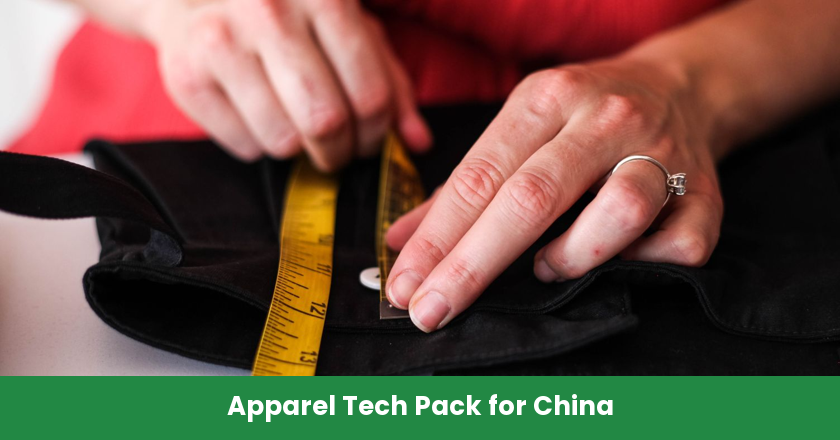
An apparel tech pack for China should give the factory four things it can quote and reproduce: finished measurements, grade rules, specified fabrics and trims, and sewing instructions. Put them under one style number and revision. Use the same version to compare quotes, measure samples, and authorize bulk cutting. If a line in the pack leaves the factory choosing between two reasonable interpretations, settle that choice before the affected material or size goes into production.
What to Put in an Apparel Tech Pack
An apparel tech pack connects one style to its measurement method, graded size targets, material codes, and stitch details. Send the same dated revision to sourcing, patternmaking, sampling, and quality. Before authorizing bulk, check that the proposed production build matches the pack and that the approved size set uses the agreed measurements.
- How it works: Mark the measurement endpoints and garment state, then enter a target and tolerance for each size.
- Risk: A fabric name alone leaves room for substitutions. Name fabrics and trims by code, and draw the seams and stitches that affect fit, durability, or appearance.
- Decision: Record the sample round and approved revision. Hold affected work when a critical measurement fails or production would use an unapproved substitute.
Add front and back flats, with close-ups for areas like a shaped pocket or the inside of a waistband. A flat is a technical drawing of the garment laid out to show construction. Match each callout on the flat to the measurement table, material list, or sewing note. The supplier should be able to answer a question about the hem by pointing to the same drawing and revision as the buyer.
Define Finished Garment Measurements
A point of measure, or POM, is a named garment dimension with instructions for where and how to measure it. Mark the endpoints on a drawing, specify the units, and say whether to follow a curve or take a straight line. Describe the garment state as well: fastened or open, laid flat or on a form, relaxed or extended, and before or after any agreed conditioning.
For a knit top, a useable half-chest instruction might say to lay the unworn, unwashed sample face up, smooth it without stretching, and measure straight across between the side edges 2 cm below the underarm seams. Mark those marks on the flat. A buyer who wants full circumference should define how to obtain it. Doubling a flat width assumes that the measurement represents half of the intended circumference, which may be unsuitable when front and back panels differ.
Use a garment chart for sample readings and keep any body size chart separate. A garment includes the room designed for movement, layering or silhouette, and a fitted stretch style can be smaller than the body in some areas. If a retail size chart uses body dimensions, label it that way before sharing it with a supplier. The factory needs finished-garment targets to establish what a sample should measure.
The Techpacker measurement-table documentation puts points of measure, per-size specifications and tolerances in distinct fields. Keep the observed sample reading in a separate column. Include sample ID, size, revision and measurement state, so a second person can trace a discrepancy. When a reading is close to a boundary, use the agreed rounding and remeasurement rule before deciding.
Try the instructions on one garment before the pack goes out. Give the drawing and table to someone who did not write them. If that person has to ask which side of the seam to start from or pulls the fabric to remove wrinkles, revise the sketch or measuring instructions while the correction is still cheap.
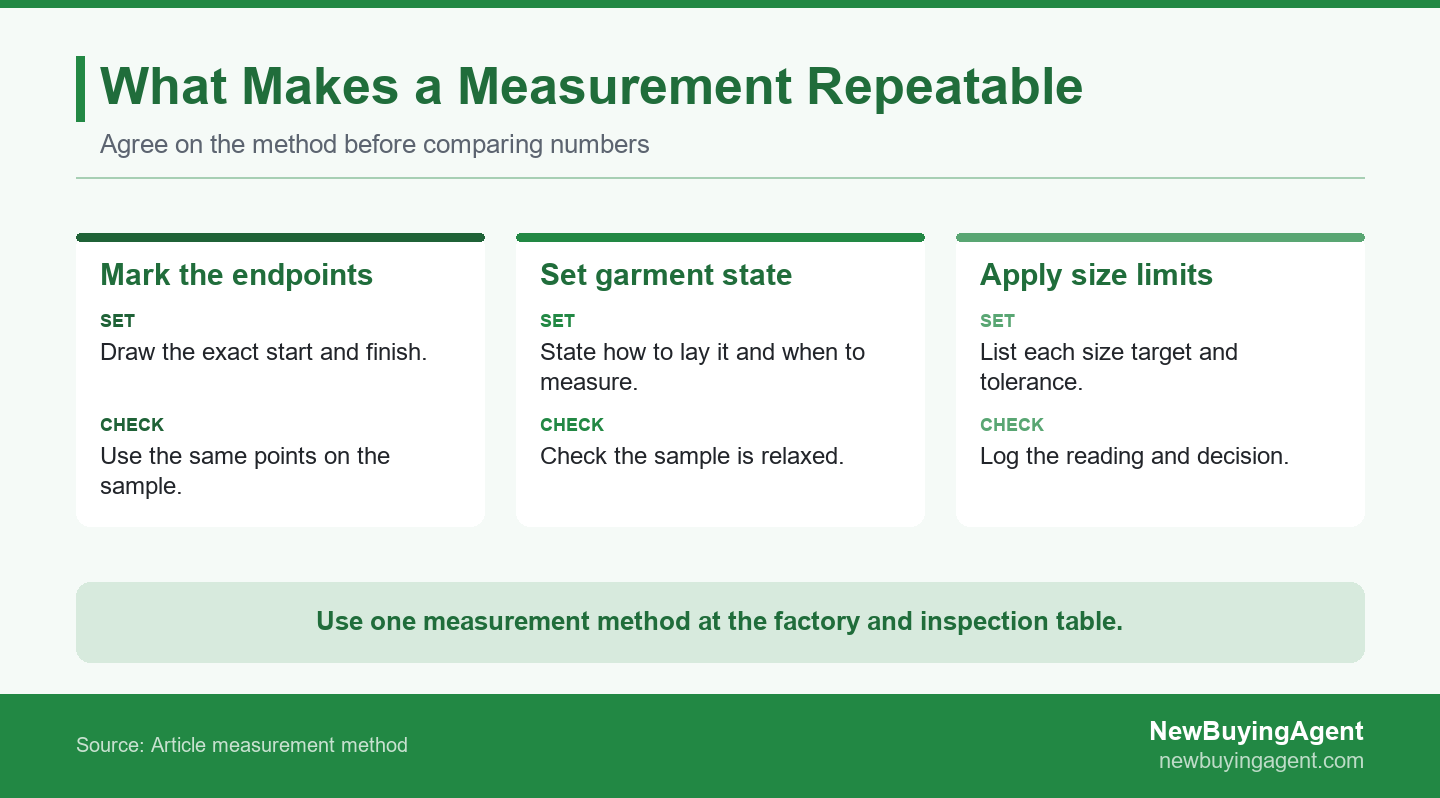
One measuring method gives the factory and buyer comparable readings
Build the Size Range From the Approved Base
Grade rules set how measurements change from one size to the next. A tolerance sets the acceptable range around the target for a particular size. Start with the approved base measurement and write out the size targets for every point. Then ask for a size set, meaning sewn samples in agreed sizes, to verify the intended progression as well as individual readings.
The Techpacker grading documentation shows how to derive measurements from a selected sample size using repeated increments or separately entered values. A shirt can gain more across the chest than it does in length, and a size range may change increments at a fit-block boundary. Put irregular increments in the chart and identify which sizes the technical designer must review on separate fit models or forms.
Here is a hypothetical section of a knit top chart. M is the base. These values show the arithmetic for this style, and the factory and buyer would set their own approved values for a different garment.
| Point of measure | S / M / L target | Tolerance |
|---|---|---|
| Half chest, 2 cm below underarm | 50.0 / 53.0 / 56.0 cm | +/- 1.0 cm |
| Front length from high shoulder point | 64.0 / 65.0 / 66.0 cm | +/- 0.7 cm |
| Sleeve opening measured flat | 15.5 / 16.0 / 16.5 cm | +/- 0.5 cm |
The half-chest grade from M to L is +3.0 cm, but the L half-chest acceptance range is 55.0 to 57.0 cm. Apply the tolerance to 56.0 cm, the L target. Before approving the range, check extreme sizes, any change in fit block, and details that can become disproportionate, such as a pocket opening or neckline. Agree who will grade the pattern and who signs off the size set, especially when the supplier produces the first graded files.
Specify Fabric, Trims, and Wash Performance
Use the bill of materials, or BOM, to name each fabric, trim and label in the style. For a main fabric, include the item or mill reference, fiber composition, knit or weave construction, target mass in grams per square meter and allowed variation, usable width, finish and colorway. For a rib neckband, lining, elastic or interlining, give it a separate row and link it to a callout on the flat. Record the approved swatch or trim reference and whether any substitute can be proposed.
Tell the supplier which properties must survive a change. Two jerseys of the same nominal weight can differ in stretch, recovery, opacity or feel. If fit depends on stretch, identify direction and test condition. For a top with rib trim, check the body and neckband together in a sewn sample so the way the two materials recover after handling or laundering is visible. Keep the fabric width and finish in the quote so the team can compare cost against the same material assumptions.
The public scope for AATCC TM135 covers length and width changes of fabric under home laundering procedures. A fabric result is useful for material screening and pattern development. Specify the relevant wash and dry condition and retain the fabric reference. Give the lab the specimen and planned care so the result can be read against a buyer-defined limit.
The separate AATCC TM150 garment method measures length and width changes on garments after home laundering and may not apply to garments made of certain stretch fabrics. Ask the lab to confirm applicability and record the actual garment, procedure and cycles. Decide before testing which finished measurements or appearance changes would stop approval. A fabric swatch report leaves open how the sewn garment, trims and seams will behave together.
When a proposed fabric changes the look or price, NewBuyingAgent's apparel sourcing and supply in China can use cooperating factories to quote and supply the specified style, with quality and logistics support. Give the team the swatch reference, acceptable alternatives and intended size mix. Ask for any change to be shown against the original material line before treating two offers as commercially comparable.
Draw the Seams and Stitching
Put seam and stitch instructions at the location where the operator needs them. The seam describes how pieces are joined or finished, and the stitch describes the thread formation used to do it. For each critical location, draw the assembly and specify the seam allowance, stitch and thread details, stitch density where relevant, and any reinforcement or topstitch position. Put a close-up of the accepted sample beside any detail the factory would struggle to infer from the flat.
ASTM D6193 on stitches and seams classifies stitch and seam types and explains why the relationship among thread, stitch density and fabric affects a sewn seam. Use a numeric classification if the factory and quality team work from it, and include a detail drawing or approved construction sample. Determine the acceptable build on the actual fabric instead of assuming that a stitch name fixes the way it will perform.
For the knit top, call out the side seam separately from the bottom hem. On the seam detail, specify the edge alignment and allowance, the required stitch formation, and the thread and density if those affect the agreed result. On the hem detail, draw the turn-up and where the visible rows should land. If the seam must stretch in use, agree how the team will check the finished sample for broken stitches or opening. Check skipped stitches, puckering, uneven rows and twisting at the areas shown on the drawing.
When sewing requires a different allowance from the pattern, send the conflict back to the technical designer before accepting a sample workaround. A wider side seam may make the stitching look tidy while reducing chest width. The factory should mark the actual setting or construction used in the next sample, and quality should repeat the relevant measurement alongside the construction check.
Decide What to Hold When a Size Fails
In the hypothetical knit top, the M fit sample has passed. The signed L half-chest target is 56.0 cm with a tolerance of 1.0 cm in either direction. The unworn, unwashed L sample reads 54.8 cm, below the 55.0 cm lower limit. Record the raw measurement and hold approval for L and any other sizes that depend on the same unverified grade or build.
The reading misses by 0.2 cm. Confirm the sample tag and the revision on the pattern and measurement sheet. Recheck the agreed endpoints and garment state with the supplier. If the reading holds, compare the graded pattern, cut panels and seam allowance against their approved references. For example, if cut panels match the intended L pattern but the sewn sample is narrow, lay an approved construction reference beside the sample and compare where the seam was sewn. If the panels themselves are narrow, investigate the pattern or cutting before asking the sewing line for a correction.
Ask for a corrected sample and remeasure the affected points on it and on the relevant neighboring sizes. Keep the original readings in the record. If the team discovers that its retail fit objective actually requires a narrower L, approve that design change with a new chart and revision. Leaving the target at 56.0 cm while quietly accepting a measurement outside tolerance leaves the factory and inspector with conflicting instructions for every later lot.
Size-set approval should name the material and construction used for the samples. If a substitute fabric or revised seam entered the sample without approval, record it separately and decide which fit, wash or sewing checks need repeating. A correct reading on a sample in a substitute material can settle a measurement question while leaving bulk approval open.
Send One Revision for Quoting and Bulk Approval
Send one dated revision with the request for quote, then state what remains open for the next sample. The order should identify the revision, fabric and trim codes, and any approved exceptions. Before cutting, have the factory acknowledge the version and confirm that the size set, production materials, stitch details and required checks have been accepted.
| Tech pack page | Fields to complete | Who confirms it |
|---|---|---|
| Style and scope | [Style ID, revision, date, front/back flats, size and color mix, destination.] | Buyer and supplier acknowledge one version. |
| Measurements and grade | [POM sketch, method, units, base and size targets, tolerances.] | Technical designer signs the size set. |
| Fabrics and trims | [Item codes, fibers, construction, weight, finish, swatch, tests.] | Buyer approves materials; quality traces the evidence. |
| Seams and stitches | [Detail ID, allowance, stitch, thread, density and acceptance checks.] | Factory and quality check the sewn sample. |
| Bulk sign-off | [Sample IDs, exceptions, open items, owner, and release date.] | Named buyer approves bulk against the current file. |
Keep artwork, placement and the target-market label record together. For a U.S. order, the U.S. textile labeling rules address fiber-content and country-of-origin disclosures for covered textile products. Have the responsible reviewer check the actual product and market, then match approved artwork to the material records. The destination may also affect care instructions and other labeling, so keep the approved files keyed to the order.
NewBuyingAgent's manufacturing and quality-control background and local cooperating factory resources support repeat sourcing when buyers specify what needs to stay consistent. A signed size chart and material record can make a reorder easier to compare, especially when a new fabric lot or a revised size mix changes the assumptions behind the first order.
To source a style from China, send the apparel tech pack to NewBuyingAgent with the destination, delivery timing, target price, quantities by size and color, intended use, and required tests. Identify any fabric or trim that has to remain fixed, then flag decisions that can be quoted as alternatives. That gives the team a basis to quote and supply the intended apparel.
Frequently Asked Questions
Should a tech pack use garment measurements or body measurements?
Use finished garment measurements for sample inspection and keep any body size chart separate. Body measurements describe the intended wearer. The garment chart describes the sewn piece and gives the supplier a measurable target with a method and tolerance. Mark both charts clearly if you share both, and identify which one governs the size set and inspection report.
Can the factory grade every dimension by the chest increment?
Use a separate grade rule for each point of measure. A chest width, a sleeve length and a neck opening may need different changes to preserve the intended fit. Write the resulting targets out by size and mark any place the increments change. Have the pattern and sample teams verify the progression before bulk cutting.
Can the factory use another fabric with the same weight?
Treat a change of fabric as a substitution to review before bulk. A match in grams per square meter leaves stretch, recovery, shrinkage, opacity and sewing behavior to check. Ask the supplier for a new reference, compare critical properties, and repeat any fit, wash or seam check that could be affected. Record approval against the exact replacement code.
Which tech pack applies when a sample note changes the spec?
Issue a new tech pack revision and have the factory acknowledge it before bulk cutting. Transfer the accepted sample note into the relevant drawing, material row or measurement table. Name the sample and affected sizes, and state which file and date apply to the order. Ask the factory to confirm the same version reached patternmaking and quality.
NewBuyingAgent
موارد ذات صلة
ابدأ اليوم
دعنا نحول أهداف التوريد الخاصة بك إلى واقعWeChat:+86 15157124615
WhatsApp:+86 15157124615
العنوان: مبنى 10 #39 طريق شيانغيوان، هانغتشو، الصين
