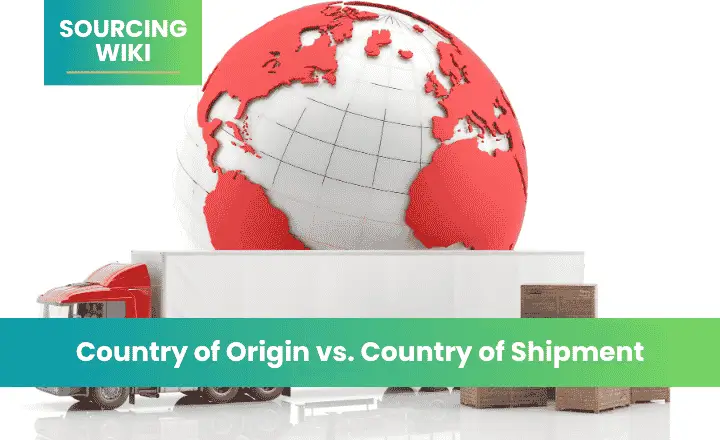
Country of Origin vs. Country of Shipment
What Is the Country of Origin?
The country of origin is the country where a product is considered to have originated under the applicable customs rules. It is generally determined by where the goods were wholly obtained or produced, or—when manufacturing involves multiple countries—where the relevant origin rules consider the required transformation to have taken place. The exact test depends on the importing country, the product, and the purpose for which origin is being determined. [1][2]
For example, if a product is manufactured in China and then shipped directly to the United States, China may be its country of origin. If the same product is shipped through Singapore before arriving in the United States, its origin does not automatically become Singapore.
Country of origin is not necessarily the same as the country where a seller is registered, where an order is paid for, or where the goods are stored before shipment.
What Is the Country of Shipment?
The country of shipment is the country from which goods are dispatched or shipped toward their destination. Depending on the shipping and customs documents, related terms may include country of dispatch, country of export, or country of consignment. These terms can have specific meanings under particular customs systems, so importers should follow the terminology and definitions used by the destination country's declaration requirements.
The country of shipment describes the goods' movement through the supply chain; it does not, by itself, establish where the goods were manufactured or where they acquired their origin.
For example, a Chinese manufacturer might send products to a warehouse in Malaysia, from which the products are later shipped to an overseas buyer. Malaysia could be the country of shipment for the final leg, while the goods may retain Chinese origin if no processing has occurred that changes their origin under the applicable rules.
Country of Origin vs. Country of Shipment: Key Differences
| Comparison | Country of Origin | Country of Shipment |
|---|---|---|
| Main question | Where do the goods originate under the applicable origin rules? | From which country are the goods dispatched? |
| What determines it? | Production history and the relevant origin rules | The actual shipping route and dispatch arrangements |
| Must it be the manufacturing country? | Often, but the applicable origin rule determines the result | No |
| Can it differ from the other country? | Yes | Yes |
| Potential customs impact | Tariff treatment, trade remedies, origin marking, and other origin-related requirements | Routing information, transport records, and destination-specific declaration requirements |
| Common supporting information | Production records, supplier declarations, origin certificates where required | Commercial invoice, transport documents, dispatch records, and shipment details |
| Does transit through another country automatically change it? | No | The shipment's dispatch or transit details may change, but origin does not automatically change |
Key takeaway: Country of origin describes the product's origin under customs rules. Country of shipment describes where the shipment comes from. They can be different and should not be used interchangeably.
How Does Country of Origin Affect Import Duties?
Country of origin can affect the customs treatment of imported goods in several ways. Importers should determine origin before estimating landed costs or finalizing their customs declarations.
Ordinary customs duties
The duty rate for a product may depend on its tariff classification and country of origin. The same product category can receive different tariff treatment depending on the destination country's tariff schedule and applicable trade arrangements. [1][2]
For this reason, an importer should not estimate duties based only on the country from which a shipment departs. The applicable tariff classification and origin rules must be considered together.
Preferential tariff treatment
Some trade agreements allow qualifying goods to receive reduced or zero customs duty. However, the goods must satisfy the agreement's specific rules of origin and any relevant documentary requirements.
A product shipped from a country that has a trade agreement with the destination market does not automatically qualify for preferential treatment. The product must meet the applicable origin criteria, and the importer may need to provide a valid origin declaration, certification, or other supporting evidence. [1][3]
Additional duties and trade measures
Origin can also affect whether goods are subject to additional duties, anti-dumping measures, countervailing duties, safeguards, or other trade measures. These measures may apply to specified products originating in particular countries. [1][2]
Importers should verify the measures applicable to the actual product and its origin rather than assuming that shipping the goods through another country will remove those obligations.
Country-of-origin marking
Some markets require imported products to be marked with their country of origin, subject to the applicable rules and exceptions. The marking requirement may be different from the information used to describe a shipment's route.
Importers should check the destination market's labeling rules and make sure product markings, customs declarations, and supporting records are consistent with the applicable origin determination.
Does Transshipment Change the Country of Origin?
Usually, simply routing goods through another country does not change their origin. The outcome depends on the applicable origin rules and the actual processing performed there.
Consider these examples:
| Scenario | Likely origin implication | What the importer should check |
|---|---|---|
| Goods manufactured in China and shipped directly to the United States | May be China-origin goods | Manufacturing records and the applicable U.S. origin rules |
| Goods manufactured in China and routed through Singapore without meaningful manufacturing | The transit route alone generally does not change origin | Transit records, origin evidence, and any applicable documentation requirements |
| Goods manufactured in China and repackaged in another country | Repackaging alone generally does not establish a new origin | The importing country's origin and marking rules |
| Components from several countries assembled in a third country | Origin depends on the applicable product-specific rule and processing | Production steps, component origins, tariff classification, and relevant origin criteria |
| Goods processed in another country under a qualifying trade agreement | Preferential origin may be possible if all relevant rules are met | The agreement's product-specific origin rule and required proof |
The term transshipment can describe different shipping arrangements, including cargo transferred between vessels or routed through an intermediate country. It should not be treated as proof that the goods have acquired a new origin.
For example, customs rules may distinguish between simple handling or repacking and manufacturing that meets a substantial-transformation or other specified test. Japan Customs' guidance identifies operations such as repacking and affixing marks as operations that do not, by themselves, constitute substantial transformation under the rules discussed in that guidance. The precise treatment must still be checked against the importing country's applicable rules. [4]
Importers should never rely on a change in shipping route, warehouse location, shipping label, or invoice wording alone to establish a different country of origin.
How Is Country of Origin Determined?
There is no single origin test that applies identically to every product and every customs purpose. Two broad concepts are useful starting points.
Wholly obtained or produced goods
Some goods originate in a country because they are wholly obtained or produced there. Examples may include agricultural products harvested in that country or minerals extracted there, subject to the relevant rules.
Goods involving multiple countries
When a product involves materials or manufacturing in multiple countries, the applicable rules may consider where the last substantial transformation occurred. Depending on the jurisdiction and product, the test may involve a change in tariff classification, a regional-value or other value-content requirement, specified manufacturing operations, or a combination of criteria. [1][2]
This means that the location of final assembly is relevant but is not always conclusive. Minor processing may be insufficient, while a more substantial manufacturing process may qualify under a particular rule.
Preferential vs. non-preferential origin
Importers should also distinguish between two purposes for determining origin:
- Non-preferential origin: Used for purposes such as ordinary customs treatment, origin marking, trade remedies, and trade statistics, according to the importing country's rules.
- Preferential origin: Used to determine whether goods qualify for special tariff treatment under a trade agreement or preference program. These rules may differ from non-preferential origin rules.
A product's origin for one purpose should not automatically be assumed to establish its eligibility for another. If preferential duty treatment is claimed, the relevant agreement and its product-specific rules must be checked.
Which Documents Help Verify Country of Origin?
The documents needed depend on the product, destination market, applicable trade agreement, and customs requirements. The following records can help an importer establish and support the origin declaration.
| Document or record | How it helps |
|---|---|
| Commercial invoice | Identifies the goods, seller, buyer, and transaction details; it may include origin information where required |
| Packing list | Helps identify the goods and packages covered by the shipment |
| Bill of lading or air waybill | Provides transport and routing information; it does not necessarily prove manufacturing origin |
| Certificate of origin | May provide formal origin evidence when required or accepted by the destination market |
| Supplier declaration | Can provide information about manufacturing location, materials, or origin, depending on its content and reliability |
| Production records | May help demonstrate where manufacturing or qualifying processing occurred |
| Preferential origin certification or declaration | Supports a claim under a relevant trade agreement when its requirements are met |
A certificate of origin is not universally required for every import, and having one does not automatically guarantee a particular duty rate. Importers should verify whether the destination market requires a certificate, accepts a declaration, or requires other evidence for the specific shipment and origin claim. [1][3]
Where products undergo processing in multiple countries, the importer may need more detailed production and supplier records than a simple shipping document can provide.
Common Mistakes Importers Should Avoid
Mistake 1: Assuming the country of shipment is the country of origin
Goods dispatched from Malaysia, Singapore, or another transit location may have originated elsewhere. Verify the manufacturing history and applicable origin rules.
Mistake 2: Assuming final assembly always determines origin
Final assembly may be important, but the applicable test may require more than assembly or simple processing. Review the product-specific rules before making a declaration.
Mistake 3: Assuming repackaging changes origin
Changing packaging, labels, or warehouse location does not automatically confer a new origin. Do not use these changes alone to justify a different origin declaration.
Mistake 4: Using a certificate of origin without checking the relevant rule
A certificate or supplier statement should be consistent with the actual production history and the requirements of the relevant customs regime. Preferential claims may require specific wording, certification procedures, or supporting records.
Mistake 5: Treating origin rules as identical across markets
Rules may differ by destination, product, trade agreement, and customs purpose. An origin conclusion for one market or program should not automatically be reused for another.
Mistake 6: Ignoring origin when calculating landed costs
Duty estimates based only on a product's price and shipping cost may be incomplete. Importers should verify the tariff classification, country of origin, and any applicable additional duties before making purchasing decisions.
Frequently Asked Questions
Is the country of origin always the country where a product is made?
Not necessarily. For goods involving production in multiple countries, origin is determined under the applicable rules. These may consider substantial transformation or other product-specific criteria. The final assembly location alone may not settle the question.
If goods are shipped from China, are they automatically of Chinese origin?
No. Goods shipped from China may have originated in China or another country. The shipment's departure point does not, by itself, establish origin.
Does shipping goods through a third country reduce import duties?
Not automatically. Duties and trade measures may depend on the goods' actual origin, tariff classification, and the destination market's rules. Routing goods through a third country does not by itself establish a new origin or qualify goods for preferential treatment.
Can repackaging or relabeling change the country of origin?
Generally, repackaging or relabeling alone is not enough to establish a new origin. The applicable rules and actual processing must be examined before making an origin determination.
Is a certificate of origin always required?
No. Requirements vary by destination market, product, and purpose. A certificate may be required for certain procedures or preferential claims, while other shipments may rely on different forms of evidence. Check the importing country's requirements before shipping.
Who is responsible for providing correct origin information?
The exact legal responsibilities depend on the destination market and transaction. Importers should ensure that their declarations and any preferential claims are supported by reliable information. Suppliers and manufacturers can provide important production records, but importers should not assume that a supplier's statement removes the need to verify applicable customs requirements. [3]
Conclusion
Country of origin and country of shipment answer different questions. The country of shipment identifies where goods are dispatched from, while country of origin is determined under the customs rules applicable to the goods and the relevant purpose.
For importers, this distinction matters because origin can affect customs duties, preferential tariff eligibility, trade measures, and product marking requirements. Before finalizing an order, confirm where the product is manufactured, understand any processing performed in other countries, and collect records that support the origin declaration.
When sourcing products from China, NewBuyingAgent helps buyers communicate their purchasing requirements and source products across a wide range of categories. Importers should separately confirm the applicable origin rules, customs documentation, and shipping arrangements for their destination market.
References
[1] World Trade Organization (WTO). Agreement on Rules of Origin. https://www.wto.org/english/docs_e/legal_e/ro_e.htm
[2] World Trade Organization (WTO). Rules of Origin: Technical Information. https://www.wto.org/english/tratop_e/roi_e/roi_info_e.htm
[3] U.S. Customs and Border Protection (CBP). Updated Guidance – Importer Obligation and Requirements in Completing Origin Documents: Declarations, Statements, and Certifications of Origin. https://content.govdelivery.com/accounts/USDHSCBP/bulletins/3c2c778
[4] Japan Customs. Outline of Rules of Origin. https://www.customs.go.jp/roo/english/origin/outline_of_roo.pdf
Related Knowledge Base
Sourcing Practices & Insights: Country of Origin vs. Country of Shipment
Latest Sourcing Guides

Get Started Today
Let's Turn Your Sourcing Goals into RealityWeChat:+86 15157124615
WhatsApp:+86 15157124615
Address:Building 10 #39 Xiangyuan Road, Hangzhou, China