


Durable demand is retained paid customer demand that persists across comparable observations at workable product economics within a declared market and period.
Use a 90-day plan to investigate whether an early response supports the next China purchasing commitment. Define the offer and decision conditions, run a bounded trial, then compare later demand with matched observation age. At the end, choose a bounded repeat, a specific revision, an extended observation or a stop. Annual seasonality and longer buying cycles may require evidence beyond the test window.
Use the test to decide the next purchasing commitment
A strong launch becomes more useful purchasing evidence when later customers continue buying the same defined offer under understood conditions. Retained orders, acquisition costs, product issues and remaining inventory all affect the commitment. Set the decision criteria before testing and revisit the assumptions when conditions change. The calendar organizes the investigation, while the evidence determines how far the buyer can proceed.
- Definition. Judge persistence within an explicit market, product and observation period.
- How it works. Define, trial, recheck and reconcile across four planned phases.
- Risk. Match refund maturity and account for promotions, availability and seasonality.
- Decision. Repeat, revise, extend or stop according to the buying case.
Distinguish a short spike from evidence of persistence
A trend spike is a concentrated rise in attention or buying activity whose continuation still needs investigation. Evidence of persistence comes from relevant later observations after the initial trigger and its conditions have been examined. Compare the same offer, market and channel with known exposure and stock availability. Then assess retained paid response and economics, keeping the conclusion within the periods and conditions actually observed.
The SBA’s market-research guidance asks about demand, customer location, alternatives and pricing. Use those questions to define the customer and buying problem before creating a calendar. A category team evaluating a replenishable home product needs a different observation plan from a buyer preparing a single seasonal launch. The task determines which response would justify another order.
NewBuyingAgent’s market-fit product analysis can help form the initial product hypothesis when a category team sees several promising directions. Its Trending Products service presents AI-driven analysis and a free Bestseller Market Analysis Report. Relate that research to the intended buyer, destination, channel and price, then use actual commercial observations to assess the next commitment. A specific hypothesis gives the test a product and a buying question to investigate.
Keep search interest separate from paid demand
Investigate what triggered the peak. A creator post, promotion, seasonal event, new feature or short-lived news item can change how customers search or buy. Record the date and the product version affected. Look for evidence after that trigger and note whether the same audience and offer remain available. The useful question is whether the later observation supports another purchase under the expected selling conditions.
Google Trends methodology describes sampled search data normalized by geography and time and scaled from zero to one hundred. Use the pattern to investigate language and timing within that scope. A high point leaves the product’s paid demand and retained margin unresolved. Keep the same query or topic definition and geography when comparing periods, and use transaction evidence to assess the actual offer.
Check whether the calendar explains the pattern
Review the available longer history and mark holidays, weather-sensitive periods, gifting occasions and recurring buying events relevant to the product. Compare like seasonal positions where the evidence permits. A seasonal product can support a commercially sensible purchase when the quantity and delivery plan fit that season. If a full cycle remains unobserved, preserve that uncertainty when discussing all-year demand.
NIST’s time-series guidance describes seasonality as periodic fluctuations and illustrates recurring retail peaks and declines. Apply that distinction when interpreting a quarter of product observations. A post-holiday decline can coexist with a repeatable seasonal opportunity. Obtain suitable longer history or comparable seasonal evidence before inferring an annual pattern from the current test.
The 90-Day Demand Persistence Framework connects a defined baseline to a paid trial, a later comparison and a purchasing decision. Material questions about seasonality, returns or supply can extend the observation beyond the planned end date.
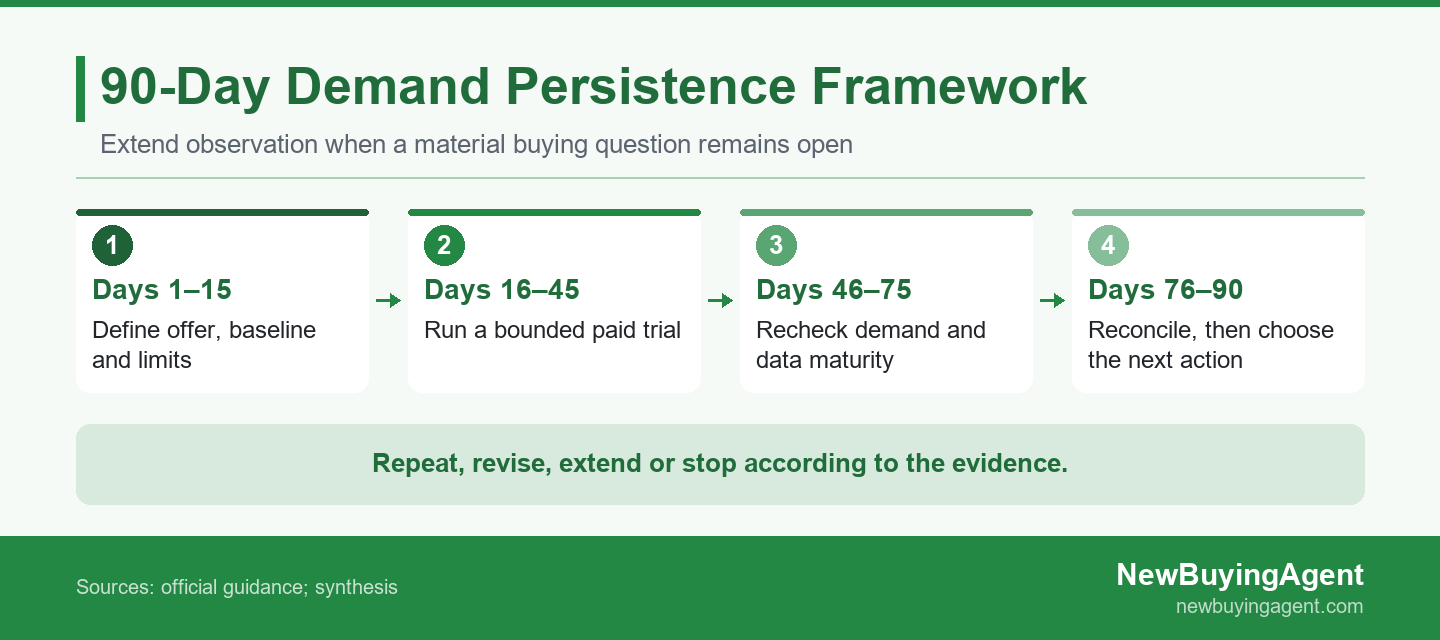
Define the baseline, run a paid trial, recheck comparable demand and reconcile the evidence before choosing a bounded repeat or extending observation.
90-Day Demand Persistence Framework
The 90-Day Demand Persistence Framework is a proposed planning sequence for defining an offer, observing paid response, rechecking later demand and reconciling the purchase case. Its phase dates organize work and responsibility. Start commercial testing only when the product and applicable presale requirements are ready. Adapt the schedule to the real buying cycle, and keep a material conclusion open when the necessary evidence cannot mature within the plan.
Days 1–15. Define the offer, baseline and decision limits
Choose one identifiable product version, target buyer, destination, channel and price proposition. Confirm sample feasibility, relevant product requirements, labeling and the responsibilities needed before sale. Record the available baseline and historical context. Define what the business needs to observe, what it can afford to lose and which finding would prevent the next order. Use actual costs and the replenishment task to set criteria for this product.
Copy the record below and replace each bracketed field. Use it throughout the test, adding a dated version when a material input changes. Each open item should identify the next observation and the purchase held until the answer arrives.
- Offer. [Product version, essential benefit, sample reference, buyer, country, channel and tested price.]
- Readiness. [Applicable presale requirements, documents, pack/label checks and responsible parties.]
- Baseline. [Historical period, season, promotion, traffic source, availability and current sales evidence.]
- Trial exposure. [Quantity, selling windows, audience, spending limit and loss limit.]
- Decision criteria. [Required retained response, minimum acceptable contribution, product issues to resolve and affordable next order.]
- Maturity. [Refund or return follow-up, reporting cutoff and the age at which each cohort will be compared.]
- Supply. [Actual minimum order, current landed-cost assumptions, production/delivery timing and usable inventory.]
- Decision record. [Repeat, revise, extend or stop, with the finding, owner and next review date.]
Google Keyword Planner guidance distinguishes search and targeting-cost estimates from campaign performance, which also depends on factors such as budget, bidding, ad quality, location and customer behavior. Record the acquisition conditions used in the trial. If the traffic mix or promotion changes later, explain how that affects comparison instead of treating every selling window as equivalent.
Days 16–45. Run a bounded paid trial
Release a feasible test quantity after readiness is established. Sell the specified version to the intended buyers within the declared spending and inventory exposure. Record price, promotion, channel, available stock, delivery performance and product issues alongside orders. Plan the initial selling window early enough for the required follow-up to mature, or accept that the decision date will move. Investigate an unsafe or materially nonconforming product before further selling.
Google Analytics ecommerce documentation distinguishes product views, cart activity, checkout, purchases and refunds. Use those distinctions to reconcile paid orders, cancellations and refunds with the actual order records. State the observation cutoff and the quantity still awaiting follow-up. Calculate contribution after the declared variable costs, including acquisition and return-related costs, while keeping fixed test expenses and remaining inventory visible separately.
Record customer objections in terms that can change the product or offer. A dimension that prevents use, damaged packaging or a misunderstood pack quantity needs a specific finding and action. Mark a material revision as a new version. Demand for the original version gives context, while the changed product requires an appropriately scoped observation of its own.
Days 46–75. Recheck demand under comparable conditions
Observe a later selling window with the same product, destination, channel and price basis where feasible. Match the length of exposure and inspect the traffic mix, promotions, availability and delivery conditions. Compare customer groups at the same elapsed follow-up age. When a key input changes, describe the changed question and limit the conclusion until its effect can be investigated.
Google Analytics cohort exploration uses selected inclusion and return criteria to track groups over time. A returning user meets the configured criterion, which can represent an activity other than another purchase. For this validation, define the commercial event of interest and reconcile the underlying transactions. Compare equally aged groups so the younger period’s unresolved refunds do not create an artificial advantage.
The later test also needs a consistent product. NewBuyingAgent’s complete China product supply and local factory resources and product/QC capability are relevant when the tested benefit depends on repeatable dimensions, materials, construction or pack protection. Translate the accepted sample into defined production and QC requirements within the agreed purchasing scope. This helps the next order preserve the product customers evaluated, while any proposed material or pack change remains visible to the buyer.
Days 76–90. Reconcile the evidence and choose an action
Reconcile the matched selling periods, paid orders, refunds, costs, product issues and inventory. Check the result against the decision conditions established for the actual business. A bounded repeat needs supported demand, workable economics and feasible supply. Choose a focused revision when a specific product or offer problem explains the result, extend observation when a material input remains open, or stop when the purchasing case no longer fits the required economics or risk limit.
The review should identify the finding, its scope and the next action. If the product becomes sale-ready late, if the relevant return window runs beyond the plan, or if the buying cycle is longer, carry the affected decision forward to a stated review date. Keep any early commitment within what the available evidence and affordable downside support. Day 90 supplies a decision checkpoint for this plan.
Interpret the observed pattern before choosing an order
The observed pattern changes the next action only after the comparison conditions are understood. A short peak calls for a focused later check, recurring seasonal response needs appropriate cycle context, and steady retained demand can support a bounded repeat when economics and supply also fit. A weakening result requires investigation of the product, audience, offer and costs. Preserve unresolved causes and avoid turning a pattern label into a quantity forecast.
Separate spike, seasonal, steady and weakening signals
The table compares four illustrative demand patterns for the same defined offer. Read each row using known exposure, availability, price and acquisition context, with refunds assessed at a matched follow-up age. Seasonal recurrence requires appropriate longer history. The cells identify a purchasing action and the evidence still open, using the framework’s qualitative distinctions rather than a universal numerical durability cutoff.
| Pattern | Observed | Next action | Still open |
|---|---|---|---|
| Spike | Early peak | Focused retest | Later demand |
| Seasonal | Calendar cycle | Season plan | Cycle history |
| Steady | Later response | Bounded repeat | Cost, supply |
| Weakening | Later decline | Revise, extend | Cause, costs |
Based on this comparison, steady observed demand becomes a repeat-order candidate alongside confirmed economics and supply. Seasonal demand can justify a season-limited plan with relevant history. A spike or weakening response needs a specific explanation and next observation before the buyer increases exposure. The appropriate action follows the evidence and the product’s buying cycle.
Amazon’s Product Opportunity Explorer guide describes tracking sales trends to investigate year-round demand and periods such as holidays or summer. Use that information as channel-specific context when available. Check the actual niche, product need and selling period. A marketplace pattern helps frame the test while the new offer’s attainable demand and purchasing economics remain to be established.
Work through a hypothetical two-window comparison
Consider a hypothetical importer testing a home-organization set sourced from China. Before the trial, the team defines an illustrative minimum of 60 retained orders per 1,000 qualified visits in a 14-day selling window, alongside a separately checked contribution requirement. This is a business-specific teaching assumption. The first window, days 16–29, records 80 paid orders and 8 full refunds after a 30-day follow-up, leaving 72 retained orders. The later window, days 46–59, records 60 paid orders and 6 full refunds at the same follow-up age, leaving 54 retained orders. Each window has 1,000 qualified visits to the same product version, country, channel and selling price, with stock available and traffic-source mix documented. Costs are assessed separately using each window’s actual spending assumptions.
The initial response clears the example’s retained-order criterion, while the later response falls below it. The decline warrants investigation even though the product continues selling. Check whether the audience mix, competing offers, the initial trigger or another material condition changed. Hold the larger commitment while the team tests the relevant explanation or revises the proposition. The record supports a finding about these windows, with no universal pass rate inferred.
The final order in the later window can reach its 30-day follow-up by day 89, allowing the planned review to use equally aged observations. If the actual return pattern requires longer follow-up, or records are incomplete, carry that part of the conclusion beyond day 90. A product problem discovered in the returns also needs an identified correction and a relevant check before the affected version is repeated.
If the later period instead produced 72 retained orders under comparable conditions, the team would have stronger evidence of persistence within the observed scope. It would still check the later period’s acquisition and return costs, current product requirements and the next production quote. If contribution or supply information remained missing, the larger purchase would stay open until that input could be assessed. These alternatives show how changed or missing evidence changes the action.
Size a repeat purchase around demand and supply conditions
A repeat quantity should cover a justified selling period using relevant retained-demand evidence, usable stock and confirmed inbound supply. Check the actual production minimum, cash exposure, landed cost and delivery assumptions. Allow for the product’s seasonal position and the consequences of an unsold remainder. The 90-day test can inform those inputs, while the quantity decision also needs a feasible current supply plan and an affordable downside.
The International Trade Administration’s research guidance connects destination market assessment with distribution, landed costs and required product changes. Although written for U.S. exporters, those questions help structure a destination-specific China purchasing case. Apply them to the actual product and market. Include applicable product requirements, pack changes and current cost assumptions when deciding whether the proposed repeat remains commercially workable.
Calculate the need over the period the next batch must cover, then account for usable stock and confirmed inbound goods. Examine the minimum order against that need. Where the minimum exceeds the supported exposure, discuss a feasible configuration or production option, reduce the commitment where possible, or defer. Record which cost, timing or demand assumption would need to change for the larger order to become justified.
Turn the validation record into a purchasing brief
Prepare the approved product version, matched observations, cost record and remaining questions together. State whether the next action is a bounded repeat, a defined revision, an extension or a stop. Identify the important feature, material or packaging condition that must carry into the next quote and sample. This makes the commercial finding usable by the sourcing and production teams.
For a recurring product-line opportunity, share the product and validation brief with NewBuyingAgent. Include the specification, proposed quantity, target cost, destination, timing and current sourcing situation, plus the dated validation record and material sample findings. NewBuyingAgent’s market-fit analysis, local factory resources and product/QC capability can support a scoped complete China product-supply discussion around the product, quality and delivery needs. Agree the purchasing scope and the unresolved conditions before increasing the commitment.
Frequently Asked Questions
Can a product be called evergreen after 90 days?
A 90-day test supports a conclusion about the conditions and periods it actually observed. Annual seasonality, long replacement cycles and a different audience can remain untested. Use suitable longer history and additional observations when those questions affect the purchase. State the scope of the current decision and choose a bounded commitment that the evidence can support.
Does durable demand require customers to buy the same item again?
Durable demand can come from a continuing flow of new buyers when the product has a long replacement cycle. A household item may satisfy each customer for years while continuing to attract other relevant customers. Choose observations that match that buying model. Customer repurchase can be informative for replenishable goods, while category demand and retained new-customer purchases may better fit other products.
What if the minimum order is larger than the test supports?
An order minimum larger than the justified exposure requires a different feasible purchase plan or a deferred commitment. Check the configuration, material, pack mix, pricing and production assumptions with the responsible supplier or sourcing partner. Evaluate any proposed change against the tested offer and downside inventory. Keep the larger commitment conditional until the revised plan fits the buying case.
What should happen when returns are still arriving at day 90?
When material returns remain unresolved at day 90, keep the affected commercial conclusion open and extend the relevant observation. Record the pending order group, required follow-up and next review date. Compare earlier and later periods at the same observation age, and include return-related costs when they become known. Product issues requiring correction also need an appropriate verification before repeat supply.
NewBuyingAgent
Похожие материалы



Начните сегодня
Давайте превратим ваши цели по закупкам в реальностьWeChat:+86 15157124615
WhatsApp:+86 15157124615
Адрес: Здание 10 #39 Xiangyuan Road, Ханчжоу, Китай
