

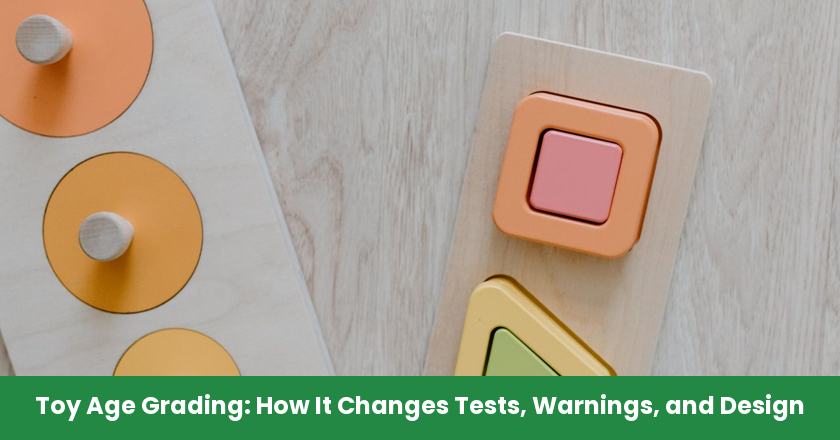
Set the toy's intended age range before you sign off on tooling, order printed boxes or send samples for testing. A U.S. toy age grade can change which test methods apply, which parts the factory must redesign and what warning belongs on the package or sales listing. Start with the toy as it will be played with and sold. Give the designer, lab and packaging team the same description of that toy.
Decide the Age Grade Before Approving Tooling
Toy age grading is deciding the age range for which a toy is intended and developmentally suitable. Use the way children play with the design, the youngest user your product is meant to serve and the way you market it. Record that decision before tooling, then use it to set applicable tests and approve warnings alongside the design.
- Decision: Identify the youngest plausible intended user and the play actions the toy invites before approving tooling.
- How it works: Tell the lab the full age range and send the same construction the factory plans to make.
- Risk: Check the age mark and any required hazard warning against the approved build and sales listing before printing.
The U.S. examples below cover the age decisions a buyer can make before sample approval. They focus on small parts because the same design can contain pieces that look too large to swallow while hiding a separate part that comes loose under test. Confirm each destination's rules before approving a toy for multiple markets.
Build the Case for the Intended Age
Begin with the play task. Ask what the child has to grasp, recognize, line up or assemble. Record the piece count, grip size, resistance, need for instructions and likely ways a younger child will handle it. On an inset puzzle, placing a single recognizable shape in its matching hole is a different task from following a picture and assembling interlocking pieces. Show the reviewer both the physical toy and the instructions needed to use it.
For the U.S. small-parts rule, 16 CFR 1501.2 considers the manufacturer's stated intent when reasonable, the toy's advertising, promotion and marketing, and whether the product is commonly recognized as intended for children under 3. A factory's age mark is one input. Product photos, catalog copy and the features that make the toy easy for very young children to use can support a different conclusion.
The CPSC guidance on children's products points to the staff's Age Determination Guidelines for characteristics that appeal to children and activities they can perform at different ages. Compare the actual play pattern with the closest examples. For a simple puzzle, look at what a child can do with the pieces even before solving it. Gripping, mouthing or banging the pieces may be part of exploratory play.
| Evidence to collect | Question to resolve | Record to keep |
|---|---|---|
| Drawings and sample | What can a child grasp, remove or operate? | Annotated piece list and photos. |
| Play task | What skill is needed to start and complete play? | Short rationale for the age range. |
| Box and sales listing | What age and play use does the product promise? | Dated artwork and listing drafts. |
Write down any conflict before submitting the request. A retailer may want a higher age mark for its shelf category while the box copy still calls the toy a first puzzle for toddlers. Send both to the reviewer with the prototype. Where the intended age is uncertain, keep sample and artwork approval open until the reviewer can reconcile the evidence.
Use a single dated age rationale for the drawing, lab request and artwork. Replace it when a change in the design or the way the toy is sold changes the basis for the grade.
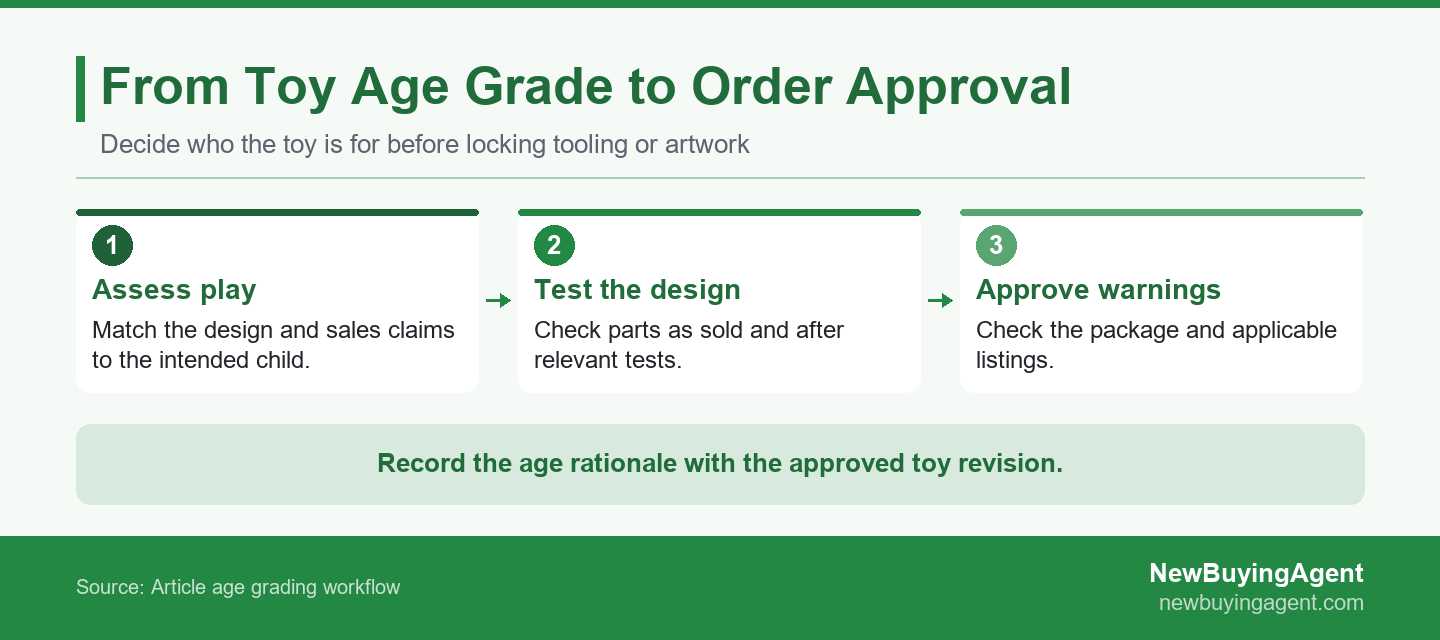
Use one age rationale to confirm the design, tests and warnings
Turn the Age Grade into a Test Request
Send the lab the intended age range from youngest to oldest, the destination, drawings and the complete sample as sold. Include every accessory, the details of assembled joints and the production materials the factory proposes. Ask for a written test scope with the relevant age bands, product features and specimen versions. Where the lab excludes a requirement, ask what feature or rule supports that decision.
The CPSC toy safety guidance distinguishes ASTM F963's scope for toys intended for children under 14 from the CPSC children's-product testing and certification scope for products designed or intended primarily for children 12 or younger. The guidance also explains that applicable ASTM F963 sections vary by product. A lab needs both the age and the actual construction to scope that work.
The federal use-and-abuse procedures in 16 CFR 1500.50 use three age groups: up to and including 18 months, over 18 through 36 months, and over 36 through 96 months. If the intended range spans more than one group, those procedures call for the tests with the most stringent requirements. Ask the lab to identify those methods for the toy in question. Use-and-abuse tests simulate stresses a child may put on the toy, such as impact, pulling or twisting, where the relevant procedure calls for them.
For a covered toy intended for children under 3, the Part 1501 test procedure checks the article and detachable components against the small-parts cylinder, then checks applicable pieces released after appropriate use-and-abuse tests. A piece within the procedure's scope that fits entirely in the cylinder in any orientation without compression fails that check. On a wooden inset puzzle, identify each removable piece, any separately fitted knob and fragments produced during the test. The lab should tie any failure to the actual point of separation.
Use the same approach to scope other design features. A cord, accessible magnet or battery compartment can add a check tied to its own applicable rule. A color or piece-count variant can share a test plan only when the reviewer can show that the specimen represents the relevant hazard for that variant. Ask the lab which sample it plans to use for each feature and ask the factory to record how the sample differs from bulk construction, if at all.
When ordering several toy variants from China, NewBuyingAgent's China toy sourcing and supply can quote and supply products through its cooperating factories, with quality control and logistics support. Share the intended ages alongside drawings and variant details. This gives the team a basis for quoting the actual construction and for checking whether the factory changes the grip, finish or assembly between samples and bulk.
Approve Warnings Where Buyers Will See Them
Approve the age mark and hazard warning as separate decisions. The age mark states who the toy is for. A hazard warning tells the purchaser about a specific hazard under the applicable rule. Compare the package, accompanying materials and sales listing to the same age rationale and sample before signing the artwork proof.
Under 16 CFR 1500.19, a covered toy or game that contains a small part and is intended for children at least 3 and under 6 requires the prescribed cautionary statement, subject to the rule's exclusions. Small balls, marbles and latex balloons have separate warning provisions. Give the artwork reviewer the component list so the reviewer can select the appropriate provision and check its required wording and prominence.
When a toy is intended for children under 3 and fails the applicable small-parts test, stop release and correct the design. A warning for an eligible older toy cannot make that under-three failure acceptable. If the team genuinely develops a separate older-age design, review its play task, markings, marketing and applicable tests as a distinct product before it goes to print.
For products requiring a cautionary statement under the U.S. statute, 15 U.S.C. § 1278 also applies to covered ads that let a customer purchase or order directly, including online ads. Put the applicable warning in or immediately adjacent to the advertisement as required, and have the reviewer check the statutory display provisions. Keep a screenshot of the actual purchase page and the approved box proof. Check each channel again when the retailer changes the listing or bundles the toy with another item.
Decide What to Do When a Puzzle Peg Comes Loose
Consider a hypothetical wooden inset puzzle proposed for ages 18 to 36 months. The board has a few large, familiar shapes with glued-on knobs, and the product page shows a toddler using one of the knobs to lift a piece. A lab finds that a knob separates during the appropriate use-and-abuse testing and that the released knob fits wholly inside the small-parts cylinder. Hold tooling approval and keep the proposed grade under review while the design is corrected.
The age case and the failure point are both visible. For age, the simple fitting task, easy grips and toddler marketing align with the proposed younger users. The 18-month lower edge also puts the proposed range across two federal test age groups. For the failure, the large puzzle piece is only one specimen. The released knob is the piece that failed the cylinder check. Save the lab photo and record the piece, the attachment construction and the drawing revision.
Ask the factory to prototype a grip formed as part of the larger piece, or a recess a child can use to lift the piece without a separate knob. Compare the options for grip and ease of alignment at the youngest intended age. A recessed grip may remove the failed joint while making the puzzle harder for small hands. An integral grip may preserve the intended play action, but could still break, splinter or change the edge profile. Give the lab the corrected finished piece and base so it can check the changed geometry and any relevant released parts.
Suppose a supplier instead offers the original piece with a 3+ sticker. The physical design and sales copy still point to toddlers, and the failed attachment remains in the product. Keep the hold. For the toddler design, approve tooling only when the required results support the revised sample and the factory drawings show that revision. Separately, if the commercial team chooses to develop a version for older children, settle its age rationale and approve its own scope and artwork. Use the earlier failure as a design input for that version too.
Keep the Age Decision With the Order
Make the age record part of the purchase specification. It should let a new quality reviewer identify the same toy that the lab received, the age claim that the retailer will show and the production lots that use the approved design. You can give the following fields to the supplier, lab and artwork reviewer before booking the tests.
| Record | Fields to complete | Who verifies |
|---|---|---|
| Age rationale | [SKU, intended ages, play task, destination, marketing evidence.] | Product and compliance. |
| Specimen and test scope | [Drawing, pieces and accessories, lab sample ID, rules and age bands.] | Quality and lab. |
| Artwork and listing | [Age mark, applicable warning, box proof and sales-page revision.] | Artwork and compliance. |
| Release and changes | [Report IDs, certificate, approved lot, changes and disposition.] | Importer and quality. |
The CPSC Children's Product Certificate guidance assigns the written Children's Product Certificate, or CPC, to the U.S. domestic manufacturer or importer for covered children's products. It explains that required third-party tests must come from a CPSC-accepted laboratory and describes applicable testing exceptions or relief. Check that the lab is accepted for the rules it tested and that the certificate identifies the toy covered. Before approving shipment, verify the production build and the applicable import filing requirements.
Reopen the relevant checks if the factory changes the knob material, attachment, piece geometry or instructions, or if a new retailer markets the toy to younger children. Record the changed feature, the associated rule or warning and any evidence still needed for release. NewBuyingAgent's manufacturing and quality-control background supports arranging repeat supply and quality checks against the approved build. Give its team the updated drawings and lot instructions so the next quote and production check refer to the same revision.
For a new or repeat order from China, send the toy specification to NewBuyingAgent with the intended age, destination, quantities, target price and delivery timing. Include the drawing, accessories, artwork and required test or documentation scope. The team can use that brief to quote and supply the specified toy with quality control and delivery support.
Frequently Asked Questions
Can changing the age mark to 3+ resolve an under-three small-parts failure?
Changing the printed age to 3+ cannot resolve a failure on a toy that is still intended for children under 3. Revisit the design, the marketing evidence and the test result together. For the same younger age range, correct the failure and submit the revised sample for the applicable checks before bulk release.
Which use-and-abuse tests apply when a toy spans age bands?
For the federal procedures in 16 CFR 1500.50, a toy spanning prescribed age groups is subject to the tests with the most stringent requirements. Give the lab the full intended range, the actual sample and the marketing evidence. Ask which methods apply for that toy and document the answer with the specimen revision.
Does every toy with a 3+ mark need a choking warning?
The ordinary small-parts warning applies when the covered toy or game contains a small part and is intended for children at least 3 and under 6. Confirm applicable exclusions and check the other warning provisions if it contains a small ball, a marble or a latex balloon. Verify the approved warning on the actual sales materials.
Can the factory reuse a report for an earlier version of the toy?
A prior report is useful only to the extent that its tested specimen, age range and rule scope support the current build. Compare drawings, materials, attachment construction, accessories and the sales presentation. Where a change affects an applicable requirement, have the responsible compliance reviewer determine what new evidence is needed before relying on the earlier report.
NewBuyingAgent
Похожие материалы

Начните сегодня
Давайте превратим ваши цели по закупкам в реальностьWeChat:+86 15157124615
WhatsApp:+86 15157124615
Адрес: Здание 10 #39 Xiangyuan Road, Ханчжоу, Китай
