

Market-fit product sourcing is the selection and development of a feasible product around a defined buyer, use, price and sales channel, supported by evidence that customers will buy and retain it at workable economics.
For a China purchase, that evidence should guide the next commitment. Define the offer, check product feasibility, then test paid behavior within an affordable exposure. Expand when retained demand, margin and a repeatable production plan support the larger order. Keep the unresolved assumptions visible when deciding how much to buy.
Prove a buying case before expanding the order
A product becomes a stronger sourcing candidate when a specific buyer values its benefit, its delivered cost leaves room for the channel, and the intended version can be produced consistently. Research helps narrow the hypothesis. A paid trial shows how the offer performs under declared conditions, while returns, acquisition costs and remaining stock determine what that result means for the next order.
- Definition. Specify the buyer, use, market, channel and target price.
- Risk. Resolve sample feasibility and applicable requirements before selling.
- Cost comparison. Calculate contribution from retained sales on a consistent cost basis.
- Decision. Size the repeat purchase around evidence and remaining uncertainty.
Define the buyer, use and price before choosing a product
A testable sourcing idea identifies who will buy the product, what task it performs, where the buyer will encounter it and the price being tested. Those inputs shape both the demand investigation and the product specification. They also reveal whether the opportunity fits the purchasing team’s channel, quality expectations and replenishment plan. Establish them before investing in customized samples, tooling or a larger inventory position.
The SBA's market-research guidance asks about demand, customer location, competing options and the prices customers already pay. Use those questions to narrow a product idea."Home storage" leaves too much unresolved. A stackable set for renters with narrow cupboards gives the category manager a concrete use, competing alternatives and physical dimensions to investigate.
When a category team has several promising directions, NewBuyingAgent's market-fit product analysis can inform the initial product hypothesis. Its Trending Products service presents AI-driven analysis and a free Bestseller Market Analysis Report. Relate any findings to the intended country, channel, customer and price. The buyer’s paid-demand test and purchasing economics provide the evidence for the eventual order decision.
Write a testable market and product brief
Complete this brief for one product proposition before requesting a sourcing quote or designing a trial. Replace the bracketed fields with evidence or a clearly marked assumption. Assign a person to close each material unknown. Use the same version when speaking to customers, reviewing samples and calculating the trial, so a change in design or price can be traced to the result.
- Buyer and use. [Decision maker or end user, job to be done, present alternative and reason to switch.]
- Market and channel. [Country, sales route, intended audience and route to reach them.]
- Offer. [Product version, essential benefit, pack quantity, target price and delivery promise.]
- Feasibility. [Required materials, dimensions, sample checks, applicable market requirements and expected landed-cost range.]
- Trial. [Quantity or commercial exposure, observation period, acquisition method and spending limit.]
- Decision. [Required retained demand, acceptable contribution, return issues to resolve and affordable next-order exposure.]
- Unknowns. [Missing evidence, owner, next action and the commitment held until it is answered.]
Move from a defined buying proposition to a feasible product, a bounded paid trial and a justified repeat order. Each stage should answer the uncertainty that matters to the next commitment.
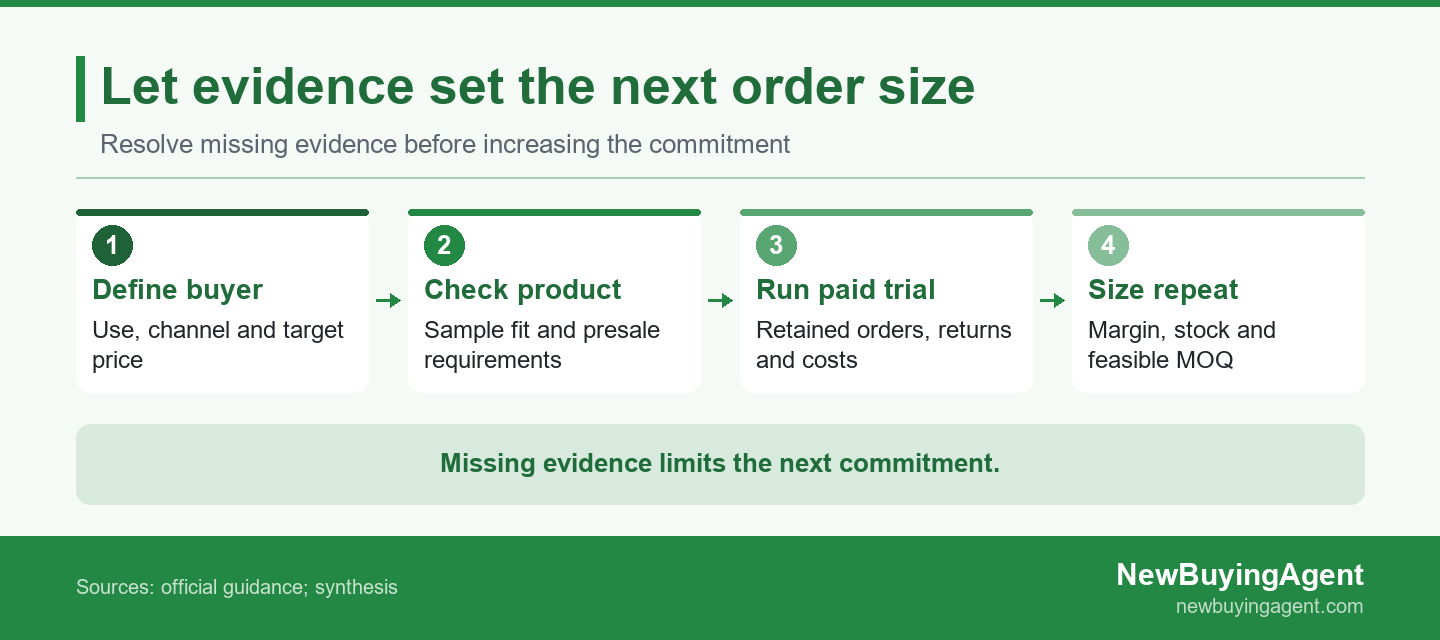
Define the buyer, confirm product feasibility, measure a paid trial and size the next order from retained demand and margin.
Build a demand case from evidence with a known scope
Demand research is useful when its geography, channel, period and product scope match the proposed offer. Combine broad context with evidence close to the target customer's purchase. Record what each source measures and which question remains open. A useful research conclusion identifies a testable opportunity, the competing explanation and the observation that would change the purchasing decision.
The International Trade Administration's research guidance connects destination demand with competition, landed costs, distribution and required product changes. It is written for U.S. exporters. Its research questions also help an importer structure a destination-specific buying case, while the actual China-sourced product still needs its own evidence. A broad category’s growth can justify investigation without establishing the sales available to one new offer.
Read search and marketplace signals in context
Start with the buyer's problem and the words used to find a solution. Review comparable products at the intended price and inspect whether demand persists outside promotional periods. Keep the country, channel and observation window attached to each finding. A fashionable design can attract attention while a different size, pack or delivery promise determines which offer customers actually choose.
Google Trends methodology describes sampled search data normalized by time and geography and scaled from zero to one hundred. Equal relative interest across two regions can represent different search volumes. Use a trend to investigate timing and language, then seek evidence of a purchase at the proposed price. A rising index alone leaves the quantity for a China order unresolved.
Google Keyword Planner provides estimates of keyword searches and targeting cost. Its guidance also identifies budget, bidding, ad quality, location and customer behavior among performance factors. Record the settings behind an estimate and test the actual acquisition route. The cost of reaching and converting the intended audience belongs in the product’s economics.
For an Amazon-channel proposition, Product Opportunity Explorer groups niches using search terms and the products shoppers view or buy, with demand, competition, review and return insights. Inspect whether the relevant niche matches the proposed benefit and price. Treat the findings as Amazon-context evidence. A wholesaler selling through regional stores needs evidence from that distribution route as well.
Ask target customers about actual buying choices
Customer conversations are most informative when they explore a recent purchase, an unresolved task or a concrete buying decision. Ask what the person uses now, what fails, what they paid and what would prevent a switch. Show the proposed size, pack and price together. Record objections and indifferent responses alongside positive reactions, particularly when the interview group comes from an existing audience.
Shopify's market-validation guide describes interviews, surveys and focus groups as ways to obtain target-customer feedback. Use that feedback to refine the offer and select what to test. For a wholesale proposition, discuss the retailer's shelf space, margin expectations, order cycle and evidence required for a trial purchase. A stated preference becomes more informative when linked to a real purchasing constraint.
Check that the product can meet the buying promise
Product feasibility determines whether the proposed benefit can survive the sample, production, packaging and destination requirements at an acceptable cost. Identify the features responsible for the customer’s interest and define how they will be checked. Resolve applicable presale obligations before a commercial trial. A demand test is interpretable only when customers receive the version and delivery promise the buyer intended to test.
Connect the desired benefit to a feasible sample
Translate each essential benefit into a product requirement. If buyers want storage that fits a narrow cupboard, record the outside dimensions, usable capacity, stacking arrangement and pack protection. Inspect a representative sample in the intended use. Record which feature is essential, which can vary and how a material or dimension change would affect the target price. Keep the approved version identifiable during production.
This is where NewBuyingAgent's complete China product supply and local factory resources and product/QC capability are relevant. A category-fit product needs more than an attractive reference image. Local factory resources and product-development and QC capability can support a purchasing path around the required material, construction, sample and quality expectations. Agree the product and execution scope for the project, then use those inputs to establish whether the proposed offer is commercially feasible.
Obtain the actual minimum order quantity, pack options, setup charges and replenishment assumptions. A test quantity must be feasible to produce and affordable to carry. When tooling or a high minimum makes the first exposure excessive, consider a supported existing configuration or revise the proposition before committing. Record any difference between the tested version and the proposed repeat version, because the earlier customer response may not transfer.
Resolve market requirements before a paid trial
Identify the intended user, materials, function, claims and destination early enough to determine applicable product obligations. Assign responsibility for the required documents, testing, labeling and manufacturing information. Include the resulting costs and timing in the plan. If a material requirement remains unresolved, hold the sale and resolve that gap before using a commercial trial to assess demand.
For U.S. consumer products, the CPSC Business Education Library separates questions about applicable rules, testing and certification, and labeling, with category-specific guidance. Follow the requirements for the actual product and confirm other destination rules separately. General sourcing information cannot determine an individual product’s legal status. Obtain the relevant official guidance or qualified professional advice before releasing the trial product for sale.
Run a bounded commercial test and count retained demand
A commercial test should expose a defined offer to the intended buyers within a declared quantity, time and spending limit. Decide in advance which observations will support a repeat order and which will require revision. Measure paid orders, refunds, product problems and the cost of achieving the sales. Use a consistent version and cost basis so the result can inform the next purchasing commitment.
Define the trial and reconcile orders with returns
Choose the trial around the channel’s buying cycle and the loss the business can afford. Record the audience, price, promotions, stock availability, acquisition spending and delivery performance. For wholesale, separate an initial retailer purchase from evidence of downstream sell-through and a reorder. For ecommerce, distinguish shipments from retained sales after refunds. Keep the observation cutoff explicit and revisit returns that arrive later.
Google Analytics ecommerce documentation distinguishes views, cart activity, checkout, purchases and refunds. Those events help structure measurement, while the decision also needs reconciled order and refund records. Check that duplicate transactions, cancellations and refunds are handled consistently. Measure acquisition cost on the same retained-sales basis used in the contribution calculation, with costs from unsuccessful or refunded orders allocated rather than omitted.
Use a hypothetical trial to test the economics
Consider a hypothetical importer testing 300 home-organization sets sourced from China. During a 60-day observation window, 180 sets ship and 15 are fully refunded and written off, leaving 165 retained sales and 120 unsold sets. Net revenue is USD 24 per retained sale. The assumed variable-cost allocation per retained sale is USD 6 landed goods cost, USD 3 channel and payment charges, USD 3 fulfillment, USD 5 acquisition and USD 1 return/loss allowance. It totals USD 18, leaving USD 6 contribution. The allowance is assumed to cover the 15 written-off sets and associated return costs in this simplified model. Other variable costs, including those incurred on refunded orders, are already allocated across retained sales. Fixed trial expenses are USD 900. These are teaching assumptions, with no actual customer result or market benchmark claimed.
The table applies those assumptions to the observed 165 retained sales. The second case changes acquisition cost to USD 7 per retained sale and holds the other inputs constant. Contribution covers the declared variable costs, while the result shown below also deducts the stated fixed trial expenses.
| Measure | Base case | Higher acquisition |
|---|---|---|
| Contribution per sale | USD 6 | USD 4 |
| Break-even sales | 150 | 225 |
| Contribution at 165 | USD 990 | USD 660 |
| After fixed expenses | USD 90 | Minus USD 240 |
The base case leaves USD 90 after the stated fixed trial expenses, while the higher acquisition case leaves a USD 240 shortfall. Break-even follows USD 900 divided by per-sale contribution. Neither case accounts for every business overhead or establishes net profit. The 120 unsold sets still carry USD 720 of landed cost, and future storage, markdown or disposal costs remain to be assessed.
The importer has evidence of retained demand for this offer under the trial conditions. A larger order still needs a current acquisition-cost assumption, the remaining stock position and a feasible replenishment quote. If the next audience costs more to reach, seek supporting acquisition evidence or limit the repeat commitment. If that evidence is missing, keep the larger purchase on hold while testing the specific uncertainty.
Size the next order around what the trial actually proved
The next order should fit observed retained demand, usable inventory, replenishment timing and the costs expected at the next volume. Expand when the commercial case and production plan remain supported. Revise the offer when a specific benefit, price or product issue explains the result. Defer a larger commitment when missing demand or cost evidence could change the decision, and identify the observation needed to release it.
Estimate the units likely to sell while the next batch is produced and delivered, then subtract usable stock and confirmed inbound units. Evaluate any additional buffer against seasonality and demand uncertainty. Check this quantity against the actual minimum, cash requirement and downside inventory. A minimum larger than the justified need is a reason to renegotiate the configuration, seek another supported production path or defer the order.
Before repeating, reconcile the tested sample with the production specification, packaging and quality checks. Confirm current price, capacity and delivery assumptions. Record whether the larger order changes material, supplier process, pack quantity or sales audience. Each change should have an identified commercial or product consequence, so the team can choose a bounded repeat or a focused retest instead of treating the first trial as permanent approval.
Turn the evidence into a China purchasing brief
Bring the market hypothesis, customer observations and trial records together with the product version the team can approve. Include the intended repeat quantity, current stock, target economics and unresolved assumptions. This gives the sourcing discussion a concrete purchasing task and shows which product or timing choices would improve the case. Update the brief when the evidence changes the requirement.
For a recurring product-line or replenishment opportunity, share the product brief with NewBuyingAgent. Include the specification, quantity, target cost, destination, timing and current sourcing situation, plus the buyer/use/channel evidence and important sample findings. NewBuyingAgent’s market-fit analysis, local factory resources and product/QC capability can support a scoped complete China product-supply discussion around the product, quality and delivery needs. Agree what the project will cover before increasing the commitment.
Frequently Asked Questions
How much demand evidence is enough before ordering?
Demand evidence is sufficient for a particular order when paid behavior, retained margin and production feasibility support that order’s exposure. Set the criteria around the business’s channel, cash limit and replenishment cycle. A modest repeat may be justified while a much larger purchase remains unproven. Record which assumption could change the decision and obtain the missing evidence before expanding beyond it.
Can a small trial validate a wholesale product?
A small trial can inform a wholesale decision when it tests the intended buyer, price and ordering conditions. Examine retailer acceptance, downstream sell-through where available, returns and reorder behavior. A direct-to-consumer test may help refine the product, but wholesale margins, pack requirements and payment timing need their own assessment. Keep the evidence attached to the route that produced it.
Should a buyer abandon a product after a weak test?
A weak test calls for identifying the failed assumption before committing more inventory. Investigate whether the audience, offer, price, product version or delivery execution prevented a fair observation. Change a specific variable when there is a supported explanation and an affordable way to retest. If the intended buyer sees little value at a workable price, stop the purchasing commitment and reconsider the proposition.
Can AI product analysis replace a paid market test?
AI product analysis can help form and refine a sourcing hypothesis, while actual customer behavior and order economics still determine the purchasing decision. Check the report’s market, period, channel and product scope against the proposed offer. Combine it with feasible samples and relevant commercial evidence. Keep assumptions about the next audience, acquisition cost and repeat order open until they are supported.
NewBuyingAgent
Похожие материалы



Начните сегодня
Давайте превратим ваши цели по закупкам в реальностьWeChat:+86 15157124615
WhatsApp:+86 15157124615
Адрес: Здание 10 #39 Xiangyuan Road, Ханчжоу, Китай
