

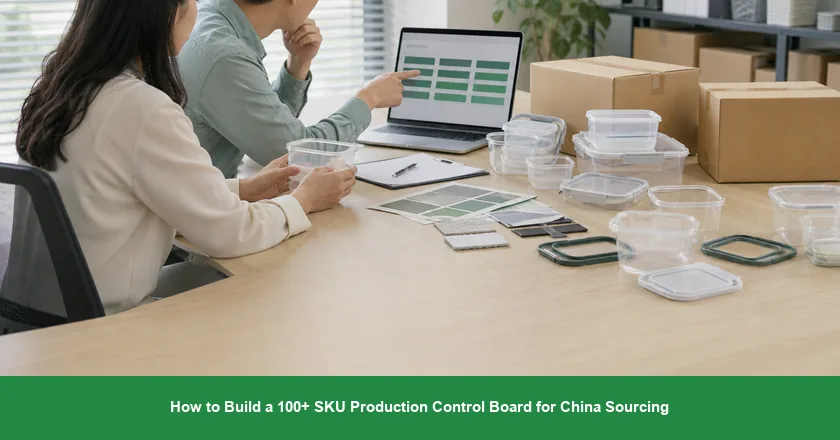
A 100+ SKU production board fails when green status means only that a factory gave an update; it works when every green row also has current evidence, a known dependency state, a named owner, and a release decision.
A SKU is a distinct product record that needs its own production and release status. At 100 or more lines, the hard part is not maintaining a bigger spreadsheet. It is deciding which factory updates are facts, which still need proof, and which group of SKUs can change a booking, a buyer approval, or a launch date.
A useful board is not a message archive. It is an operating record that answers the same four questions for each line: what is true now, what can still change, who must act, and whether this SKU can move to its next agreed stage.
Start With the Release Question
Build the board around a release question, not a reporting habit. Most buyers do not need every phone call, production photo, or line adjustment. They need to know whether a SKU can stay on schedule, whether a related SKU must be contained, and what proof is missing before inspection, booking, or release can proceed.
A factory may be 90% complete while a commercially important SKU is still not ready. Its carton mark may use an old artwork revision. A shared component may have changed. A sample may be approved, but the current production sample may not match it. If the board gives every condition the same green label, it hides the only part of the order that needs a decision.
Use four plain outcomes: continue, contain, request proof, or hold. These are clearer than “almost finished” because they identify the next move. They also make the buyer update shorter: explain only the exception, its scope, the owner, and the decision deadline.
What a 100+ SKU Board Must Make Visible
The Five-Signal Control Board keeps a multi-SKU order readable by separating identity, verified fact, exception ownership, dependency scope, and release state.
- Identity: one durable SKU or controlled-bundle reference.
- Verified fact: a dated milestone and a link to supporting proof.
- Exception ownership: one owner, deadline, and next evidence request.
- Dependency scope: the component, artwork, carton, or decision shared by affected rows.
- Release state: the next permitted move, not a generic completion label.
The buyer view should show exceptions first. Routine progress can stay in the underlying rows, but an open version mismatch or missing quality record should never have the same visual priority as a routine production update. That is how the board reduces noise without hiding risk.
Build the Five-Signal Control Board
A production event becomes usable only when the board captures what changed, when it was verified, where it applies, and why the buyer should care. GS1 EPCIS provides a shared event vocabulary for recording that context.
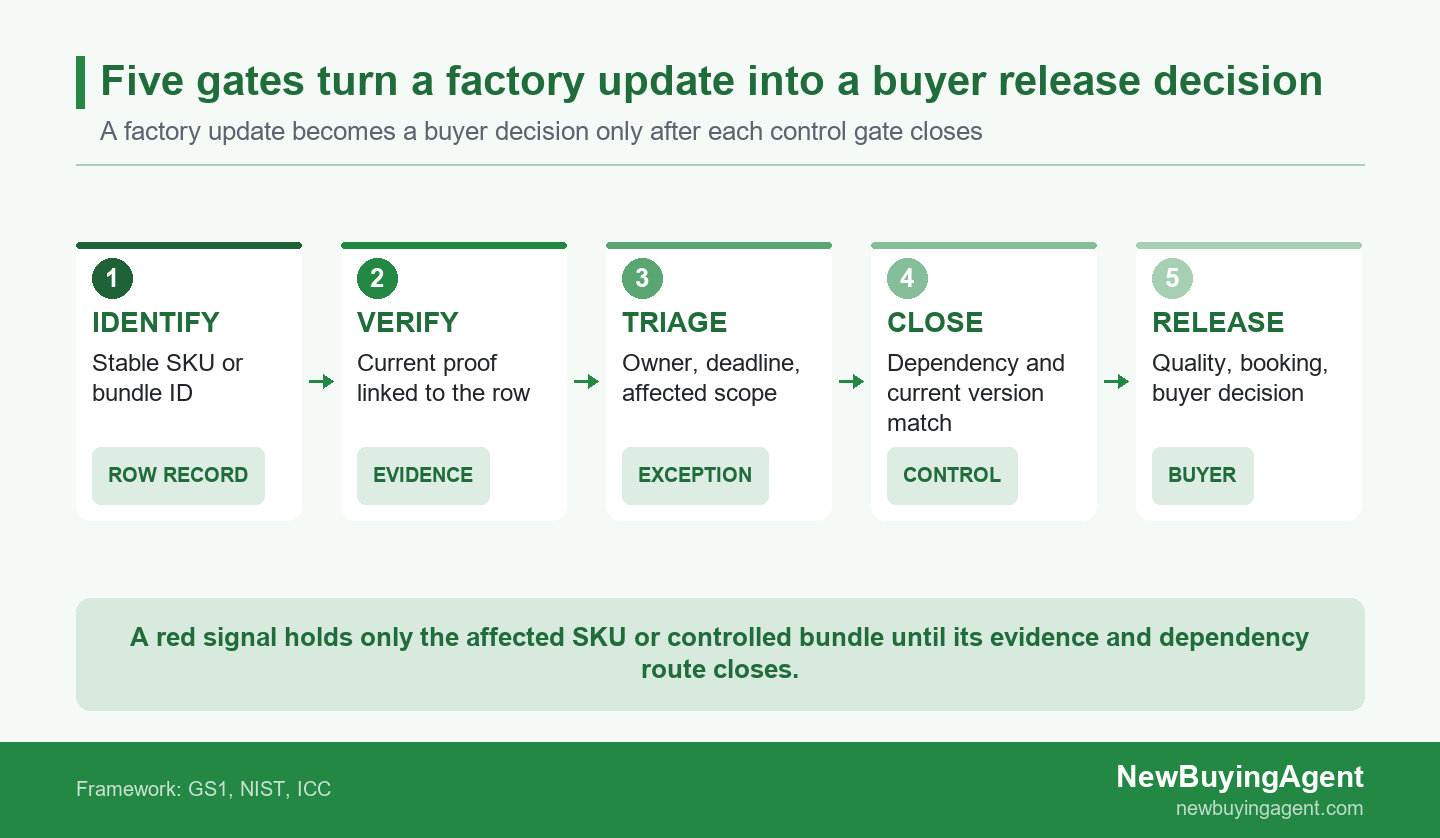
Five green control gates showing SKU identity, current evidence, scoped exception, dependency closure, and buyer release
The Five-Signal Control Board translates that idea into a buyer-facing record. It does not require a particular platform. A spreadsheet, project system, or ERP export can work if the five signals stay connected and everyone uses the same meaning for each status.
| Signal | What the Row Shows | Buyer Decision | Weak Version |
|---|---|---|---|
| Identity | SKU, factory, version | Know what is affected | Color name only |
| Verified fact | Dated event and proof | Trust current status | “Factory says complete” |
| Exception owner | Issue, owner, deadline | Escalate action | Red label only |
| Dependency scope | Linked component or carton | Contain real group | Hold all SKUs |
| Release state | Next permitted move | Release, hold, inspect, book | One green status |
Based on this comparison, more columns do not automatically make a board useful. The board works when each row can prove its identity, current fact, exception route, dependency boundary, and release decision without forcing the buyer to reconstruct the story from chat messages.
Start With an Identifier That Cannot Drift
Each board row needs a stable SKU or controlled-bundle ID, a current version reference, and a link to the proof that supports its status. GS1 explains how a GTIN gives a trade item a globally unique identity.
The identifier does not have to be a GTIN. It can be the buyer’s product code, a PO line plus variant, or another durable reference. The key should appear on the quote, sample record, production update, inspection evidence, carton reference, and shipping file. “Medium gray container” is not durable enough when several factories use different names for related items.
A controlled bundle is appropriate only when the rows genuinely rise and fall together. A container, its silicone seal, and shared carton artwork may belong in one change review. If one SKU has a different version, factory, proof, or release state, split it back into its own row. Bundling is a readability tool, not permission to hide differences.
Then Bind the Current Version to the Affected Scope
A product or packaging change needs an explicit hierarchy scope because an each, pack, case, or pallet can represent a distinct linked unit. The GS1 Global Data Model implementation guide distinguishes product and packaging attributes by level.
Put a version reference beside the identifier: sample version, artwork revision, component batch, carton proof, or approved specification. Then state the scope in plain language. “Carton updated” is not enough. Say whether the change affects the retail each, inner pack, master carton, pallet mark, or only a color family.
Keep the current approved version, prior version, change owner, and affected-row list together until the discrepancy closes. A factory may correct a file it received, but the buyer still needs to know whether the correction reaches every physical and packaging level that will move through production and shipping.
Make Evidence Stronger Than a Factory Update
A useful evidence field links the current version, record, and decision because traceability data that uses different models is difficult to connect and usefully combine. NIST describes the value of traceability and data linking for efficient supply chains.
Evidence does not mean collecting every attachment. It means attaching the proof that answers the next question. For a color approval, that may be a current sample photo beside the approved master and a material-batch reference. For carton readiness, it may be the approved flat artwork, carton dimensions, and a current packing photo. For booking readiness, it may be confirmed carton counts, gross weight, volume, and released shipping instructions.
Use an evidence-age rule as well as an evidence-type rule. A photo taken before a material substitution does not prove the status after that substitution. A report that names a previous artwork revision does not prove the cartons now on the line. Add “verified on” plus the version or batch reference; otherwise old proof can keep an obsolete status green.
Use a three-part test: is the evidence current, traceable to this row, and adequate for the next decision? If any answer is no, label the row “evidence needed,” not “complete.” That wording tells the owner exactly what must arrive next.
Triage Exceptions by Scope and Decision Deadline
An exception should carry one owner, a decision deadline, affected scope, and a next evidence request; otherwise it is just a red label with no route to closure.
The board should hold only the SKU scope that shares the unresolved dependency, so unrelated finished lines can continue toward their own checks.
Separate a risk from an active exception. A risk is something that may happen, such as a long-lead component arriving late. An exception already changes the current plan: a component batch is late, a mass-production sample differs, or carton proof is unresolved. An active exception deserves one owner and a response time. A generic risk note does not.
Use this scope rule: hold the smallest group that shares the unresolved decision, then expand the hold only when the evidence cannot separate the group. In the illustrative scenario below, 16 of 118 SKUs are affected, or about 14% of the catalog. Holding the other 102 rows without a shared dependency would widen the operational hold by roughly seven times without adding relevant containment.
For existing China suppliers, local follow-up is most valuable at this point. A buyer who cannot see the affected scope, current proof, or escalation owner can use NewBuyingAgent's factory-management service for existing China suppliers when a China-side team is needed to turn an exception into a clear evidence and release decision. The result is not more updates; it is better containment of the rows that can still change the supplied product outcome.
| Exception Field | Example | Decision Effect |
|---|---|---|
| Affected scope | 16 container-and-seal SKUs | Prevents an assumed whole-order hold |
| Owner | China-side product coordinator | Creates one accountable next move |
| Next proof | Sample, resin reference, carton proof | Defines closure |
| Decision deadline | Before inspection booking | Protects timing without guessing |
Keep Release Separate From Completion
Production complete, evidence complete, quality decision, booking readiness, buyer release, and contractual delivery should remain distinct states on a China sourcing control board.
A useful sequence might be: production in progress; ready for evidence review; evidence gap; ready for inspection or check; quality decision pending; ready for booking; buyer released; delivered under the agreed trade term. The names can vary, but they must not collapse into one “done” field.
Under Incoterms 2020, the place of delivery and risk transfer is governed by the contract and trade term; it is not automatically the same as a factory saying production is complete. Show the operational readiness needed before booking and the separate buyer or contract condition needed for goods to move.
Buyer release is a record of the agreed next move based on the evidence presented. It is not a guarantee that goods will never have a problem. That boundary keeps a status color from replacing the purchase order, inspection requirements, or agreed shipping term.
For a new multi-SKU program, the same release logic should be visible while requirements are being quoted and supplied. Buyers can use NewBuyingAgent's product-supply service for a multi-SKU brief when product files, quantities, destination, timing, and control rules need to be brought into one China-supply discussion.
Illustrative Scenario: A Sample-Mass-Production Mismatch
A board that isolates the affected scope can prevent a disagreement between an approved sample and a mass-production version from blocking an entire multi-factory order.
Consider an illustrative importer preparing a 118-SKU kitchen-storage launch across five China factories. The order includes plastic containers, silicone seals, organizers, and shared retail cartons. It contains 16 linked container-and-seal SKUs and 102 independent SKUs: the linked group uses the same color master, component supplier, and carton-artwork family. Most production is moving, so four factories report their work as largely complete.
A current mass-production resin sample appears warmer than the approved color master. The revised carton proof is also not linked to every affected row. The decision is not whether the full program is “late.” It is whether the 16 linked SKUs can be separated from the other 102 while current physical and document evidence is checked.
Verify the Selective Hold Before Releasing the Rest
In the illustrative 118-SKU program, the 16-SKU hold closes only after the approved color master, current sample, carton proof, and every affected row point to the same version.
Create one exception packet rather than several loose messages. It records the importer’s 118-SKU kitchen-storage launch across five China factories, the 16 linked container-and-seal SKUs, and the other 102 independent SKUs. It also lists the approved version, current sample photos, resin-batch reference, carton proof, local owner, buyer decision deadline, and next verification event. The missing link becomes visible: the physical sample and carton record must agree with the same approved version.
The team does not mark the whole factory red. It holds the linked 16-SKU bundle while unrelated rows continue toward their own inspection and booking evidence. If a shared carton or component reaches more rows than first recorded, the board expands the scope. If evidence confirms separation, it does not create a program-wide pause simply because the exception feels urgent.
The decision is to hold the 16 affected SKUs pending a current sample comparison and linked carton proof, while allowing unrelated rows to continue toward their own inspection and booking evidence. This is the practical value of the Five-Signal Control Board: it replaces “everything is at risk” with a testable decision. The board does not promise that timing will be unaffected; it makes the timing decision visible early enough to manage.
The gate closes only when the current sample and carton proof match the approved version and every affected row links to that evidence. This example is an operating model, not a customer case, delivery promise, or claim about a particular factory.
Set the Board Up Before the First Production Update
Before production starts, a buyer should define the product hierarchy, version source, evidence standard, escalation owner, dependency logic, and release rule in the same control-board brief.
- List each SKU or legitimate controlled bundle with its durable reference.
- Name the approved version source for product, artwork, component, and carton decisions.
- Define the proof needed before each important status can turn green.
- Record dependencies that can reach multiple SKUs and their scope rule.
- Set the owner, buyer deadline, and release state for exceptions.
For a new program, buyers can prepare product files, quantities, target price, destination, timing, and control rules before quoting begins. NewBuyingAgent can use local China factory resources and product/QC capability to quote and supply products with production and release conditions visible from the start, rather than treating them as a late reporting task.
If the order is already running, prepare the current PO, SKU hierarchy, approved files, open evidence, factory updates, and shipment timing. The goal is a practical path to better price, quality, and delivery confidence—not a longer list of status messages. When those materials are ready, send a multi-SKU China sourcing brief to NewBuyingAgent.
Frequently Asked Questions
Should every SKU have its own row?
No—one row can represent a controlled bundle only when its SKUs share the same version, evidence, dependency, and release decision. Split the bundle as soon as one SKU has a different factory, component, proof, or release state. The board should simplify a real shared condition, not combine different conditions for convenience.
How often should a 100+ SKU board be updated?
Update the board when a milestone, evidence item, change, dependency, or buyer decision changes; a daily routine alone is not a control rule. Some rows need no visible update for several days, while a fast-moving exception may need a same-day owner, deadline, and proof request. The event trigger matters more than a calendar.
What counts as enough evidence for a green status?
Enough evidence is the current, traceable proof needed for the next decision, such as approved artwork, dated photos, a measurement record, or a booking confirmation. It must identify the right SKU or bundle and current version. A useful green status explains what is proven and what can happen next; it does not merely report optimism.
Can one factory be green while a related SKU is on hold?
Yes—a factory-level update can remain positive while an individual SKU or controlled bundle is on hold because its shared component, artwork, evidence, or buyer decision remains open. This is why the board needs a SKU-level release state. Factory status is context; it is not a substitute for the row-specific decision.
Does a production control board replace a purchase order or inspection standard?
No. Products, documents, physical locations, and logistics units can be identified with distinct GS1 keys, which is why a control board should connect the relevant references rather than replace them with a message log. The board connects the purchase order, approved version, quality requirements, and release decision, but it does not replace any of them.
NewBuyingAgent
Related Resources

Начните сегодня
Давайте превратим ваши цели по закупкам в реальностьWeChat:+86 15157124615
WhatsApp:+86 15157124615
Адрес: Здание 10 #39 Xiangyuan Road, Ханчжоу, Китай
