

Competitor review mining is the structured examination of feedback on comparable products to identify customer-use problems, preserve their context and develop candidate product requirements for further validation.
Begin with a defined product and buyer, then record what customers say happened and under which conditions. Translate the relevant problem into a required outcome, a measurable condition and an agreed verification method. Use sample evidence to decide what can enter the China purchasing brief and which important requirement still needs work.
Turn a complaint into a requirement the buyer can verify
A useful review finding connects a customer problem with a product decision. Keep the product version, use and consequence attached to the evidence. Identify the outcome the buyer needs before prescribing a design change. Then define how the intended sample will be checked and what result would hold the purchase. This gives sourcing and quality teams something they can quote, investigate and verify.
- Definition. Review themes identify candidate customer needs within a selected evidence set.
- Risk. Mention counts, sentiment and physical causes answer different questions.
- How it works. Link the need to a condition, limit, method and identified sample.
- Decision. Keep failed or unverified requirements open until the relevant evidence is resolved.
Build a review set that matches the proposed product
A relevant review set covers products and use conditions close enough to inform the proposed buying brief. Define the intended customer, function, price position, pack and product version before collecting feedback. Retain the source and date of each usable observation, including favorable and neutral context where relevant. Treat the resulting set as selected evidence for investigation, with its coverage and missing information stated clearly.
Start with the buyer’s actual task. A storage box used for light desk items faces different demands from one carried regularly with a heavy load. Compare the relevant size, closure, material and intended user. Record the selected date range and why each product belongs in the set. Use sources the team is authorized to access and retain enough context to revisit the finding.
When review themes suggest a product-line opportunity, NewBuyingAgent’s market-fit product analysis can help place the need within a buyer-specific product hypothesis. Its Trending Products service presents AI-driven analysis and a free Bestseller Market Analysis Report. Connect that research to the intended use, destination and price. The review record and actual product evidence then help the buyer define what the proposed supply must deliver.
Keep product version and use context attached to each review
Record the listing or product reference, variant, review date, available purchase context and a short faithful extract or paraphrase. Identify the feature discussed, the reported use and the consequence. Keep an uncertainty tag when the variant or use is unclear. Remove duplicate entries from your own working set while preserving a record of what was excluded and why.
Amazon’s Customer Review Insights description explains how product or niche reviews are grouped into positive and negative themes and snippets. Use a theme summary to locate relevant feedback, then inspect the underlying context before converting it into a requirement. A complaint about a small variant can mislead a brief for a larger version, and comments about delivery damage may require different follow-up from comments about normal use.
Separate review themes from return and sales evidence
A theme’s frequency describes how often it appears in the selected set under the chosen coding rules. Document the number of usable reviews, the products covered and whether one review can receive several tags. Avoid inferring a population failure rate from those comments. Sales, returns, warranty records and physical samples have different coverage and need their own interpretation.
Amazon’s Customer Feedback overview distinguishes review topics for an individual product from return-topic insights at category or browse-node level. Check that granularity before combining a review finding with a return report. A category-level return theme can guide investigation, while the buyer still needs evidence about the proposed product version and the specific condition the requirement will address.
Preserve the complaint context, define the buyer need, specify a measurable check and use identified sample evidence to choose the purchasing action. Investigate the physical cause separately from the text summary.
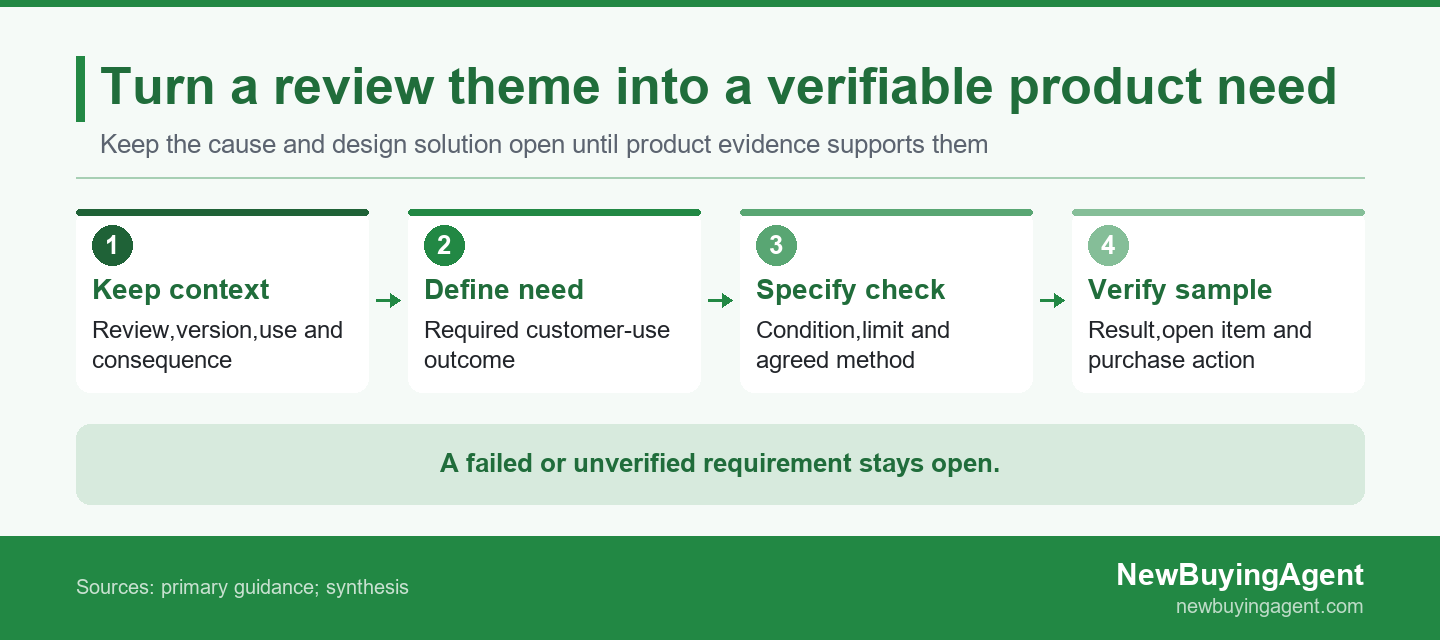
Keep the complaint context, define the buyer need, specify the measurable requirement and use sample evidence to decide the purchase.
Code the customer problem before proposing a design fix
Complaint coding should preserve the feature, use condition and consequence before the team selects a remedy. Separate the observed statement from a suspected cause and a proposed solution. Use clear tags, keep ambiguous cases open and inspect examples behind each important theme. The useful output is a customer-use problem that the product team can investigate and translate into an appropriate buying requirement.
Identify the feature, use and consequence
Use tags that describe what needs investigation. Lid opening during carrying, corner damage on arrival and a mismatch between usable size and the listing describe different problems. They can lead to closure, packaging or product-information requirements. A broad tag such as poor quality hides those distinctions and leaves the factory unsure which outcome the buyer expects.
Microsoft’s opinion-mining documentation describes aspect-based sentiment analysis that associates opinions with particular targets or attributes in text. Apply that distinction when checking a theme summary. Preserve which feature attracted the opinion and what happened in use. The product team still needs to establish the required performance and the physical evidence that will verify it.
Maintain separate fields for the reported observation, the buyer’s interpretation and a cause hypothesis. If a reviewer reports that a lid opened, possible explanations remain to be investigated through the actual sample, closure instructions and use conditions. Record a proposed latch or material change as a candidate solution. This keeps the original need available when another feasible design could meet it.
Use automated text analysis with a human evidence check
Automated analysis can group language and suggest tags, while a person checks the evidence behind consequential findings. Inspect negation, mixed praise and criticism, variant references and translated text. Preserve exceptions that change the meaning of a theme. A product decision needs the actual use problem and its scope, so keep a route back to the original record.
Google Cloud’s Natural Language guidance describes sentiment analysis as identifying emotional opinion or attitude in text, with entity sentiment providing information about particular entities. A sentiment result helps interpret language. It leaves the physical failure mechanism, required design limit and sample method to be established with product evidence. Check important classifications before including them in a sourcing brief.
Write the buying requirement before choosing the solution
A sourcing requirement states the outcome the intended product must achieve under defined conditions and identifies how compliance will be checked. Begin with the customer need, then specify the product version, condition, measurable limit and verification method. Assign ownership and approval status. A draft remains a candidate until the buyer and responsible product team agree that it is relevant, feasible and appropriate for the intended use.
Specify the condition, limit and verification method
Write each requirement so the team can identify what passes and what fails. Replace broad directions such as improve the lid with the required closure behavior under an agreed handling condition. Include units and references to the relevant method, drawing or sample. Define who approves the requirement and who performs the check. If a limit is still unknown, record the investigation needed to set it.
NASA’s requirement-writing checklist emphasizes verifiability and clear success criteria in its systems-engineering context. Borrow that writing discipline when preparing a consumer-product brief. The actual product team determines the appropriate conditions and limits for the goods being purchased. An aerospace checklist supplies a method for expressing a requirement, while product-specific requirements and verification remain to be established.
Use this record for each important need. Replace the bracketed fields with evidence or a clearly marked open item. Keep the review theme and product requirement connected so a later sample change can be assessed against the reason for the requirement.
| Record item | Fill in |
|---|---|
| Evidence | [Theme ID, source set, variant, use and uncertainty] |
| Buyer need | [Customer-use outcome and consequence] |
| Requirement | [ID, version, condition, limit and units] |
| Verification | [Method, sample IDs, sequence and result record] |
| Ownership | [Approver, checker and agreed responsibilities] |
| Status | [Draft, approved, passed, failed or open] |
| Purchase action | [Release scope, hold, next evidence and review date] |
This is where NewBuyingAgent’s complete China product supply and local factory resources and product/QC capability are relevant. A review-derived benefit needs a feasible material, construction, sample and quality expectation. Local factory resources and product-development and QC capability can support a purchasing path around those requirements within the agreed scope. Keep proposed design changes connected to the buyer’s intended use, cost and delivery needs as the sample is developed.
Prioritize by consequence, relevance and remaining uncertainty
Prioritize a theme by the consequence for the intended user, relevance to the proposed version, confidence in the evidence and the effort needed to resolve it. Mention frequency is one input. A less frequent but serious problem can require earlier action than a common cosmetic preference. Keep safety, usability, product information, packaging and commercial preferences distinguishable so each reaches the appropriate responsible person.
For U.S. consumer products, the CPSC Business Education Library separates applicable product rules, testing and certification, and labeling, with category-specific guidance. A potential safety issue calls for an assessment of the actual product and intended user. Confirm the applicable official requirements or obtain qualified advice before release. Treat the review as a reason to investigate the issue and determine the required action.
WIPO’s industrial-design guidance distinguishes protection of a product’s appearance or aesthetic features from patent protection of a technical solution. Define the customer outcome in the brief and obtain the relevant product- and market-specific rights review before adopting a competitor’s particular design. The sourcing team can investigate a feasible way to achieve the intended function while the rights and technical questions are resolved.
Validate the requirement on the intended sample
Sample verification should use the identified product version and an agreed procedure that produces an observable result against the requirement. Confirm the conditions, units, sample identities and pass/fail rule before the check begins. Record failures and any deviation from the method. A result supports only the requirement and conditions tested, while unresolved critical requirements remain open for the purchasing decision.
Work through a hypothetical storage-box complaint
Consider a hypothetical importer developing an adult dry-storage box for a recurring home-organization range. Its selected set contains 120 usable reviews from four comparable listings. Eighteen reviews mention unintended lid opening, seven mention corner damage and ten describe a size mismatch. A review may receive more than one tag. These are teaching counts in a selected review set, with no measured defect rate or actual customer case claimed. The lid theme becomes a candidate need for secure closure during the intended handling, while the physical cause remains to be investigated.
The buyer drafts requirement R-01 for the proposed version and trial method T-01 below. All loads, cycles, angles, sample quantities and acceptance conditions are illustrative engineering-trial assumptions. The responsible product team must confirm their suitability and approve the procedure before testing. The method should use a safe, controlled setup appropriate to the actual product and load.
- Identify three trial samples as S1, S2 and S3. Record the version, materials, closure instructions and ambient conditions. Use the same agreed setup for each sample.
- Open and fully close each lid 50 times using the intended closure action. Record any loss of engagement or visible fracture.
- Distribute a 3 kg inert dry test load evenly in each box and close the lid according to the agreed instructions. The illustrative product is intended for that load.
- For each sample, perform ten cycles from level to 45 degrees toward the designated latch edge and back to level. Hold the inclined position for five seconds in each cycle. Record the orientation and use the approved controlled setup.
- R-01 passes this trial only when all three samples keep the lid engaged throughout the stated sequence and show no visible fracture. Record each observation against its sample ID. Stop and record a failure if a lid disengages.
Suppose S2 disengages on the ninth tilt cycle. R-01 fails the stated trial, so the affected requirement stays open. Investigate the actual closure behavior, product condition and method execution before choosing a correction. A proposed material or geometry change needs an identified revised sample and a relevant repeat check. Verbal reassurance about making the lid stronger leaves the acceptance question unanswered.
If all trial pieces passed R-01, that result would support the tested closure requirement under T-01. Corner protection and usable dimensions would still need their own approved requirements and evidence. The trial sample quantity also establishes no production-lot acceptance plan. If the closing instructions or intended load were missing, agree those inputs before running the check and keep the affected purchasing release on hold.
Keep a trace from the theme to the sample decision
Give the evidence theme, buyer need, requirement and verification method stable references. Link them to the drawing or sample version, result and approval status. When the product changes, identify which requirements and results are affected. Retain both the earlier finding and the revised evidence so the team can see why a requirement passed, failed or remained open.
NASA’s requirements-verification matrix guidance connects identified requirements with verification information and calls for unique requirement references and a clear source. Apply that traceability idea to the buyer’s record, with the procedure and acceptance conditions specific to the actual consumer product.
In the hypothetical example, a theme reference leading to R-01, T-01 and the S2 result makes the purchasing hold understandable. Keep the revised product version and later result connected to those same requirement references when the investigation leads to a change.
Carry the approved requirement into the China purchase
The purchasing handoff should contain the approved product version, requirements, verification responsibilities and the evidence needed before each relevant release. Connect important features to the quote, sample, production and packing assumptions. Keep failed tests and material open items visible to the decision maker. A usable handoff allows the supplier and buyer to identify the agreed outcome, the next check and the consequence of a change.
Confirm that the quoted material, tooling or construction option can meet the required outcome at the intended cost and quantity. Identify any proposed substitution or limit that changes the sample basis. Agree the relevant production checks and packing requirements, with responsibilities and records. Sample approval should remain connected to the specified version and verified requirements as the order develops.
Send a product brief with the important evidence and open items
Prepare the product definition, important theme records and candidate or approved requirements together. Include sample findings and the unresolved decisions that could change the purchase. State which outcomes are essential and which preferences can be traded against cost or timing. This gives the sourcing discussion a concrete product task and a clear route to the evidence still needed.
For a recurring product-line or replenishment opportunity, share the product and requirement brief with NewBuyingAgent. Include the specification, quantity, target cost, destination, timing and current sourcing situation, plus the important review-to-requirement records and sample results. NewBuyingAgent’s market-fit analysis, local factory resources and product/QC capability can support a scoped complete China product-supply discussion around the buyer benefit, quality and delivery needs. Agree the product and verification responsibilities before committing around an unresolved requirement.
Frequently Asked Questions
How many competitor reviews are enough to define a requirement?
A useful review set is one that exposes relevant needs and their context clearly enough to guide the next product investigation. Record the products, variants, period and selection method, then inspect whether important use situations remain missing. A larger pile of comments can still have poor product fit. Use the evidence to choose the next question and obtain the sample or customer input needed to resolve it.
Can repeated complaints establish the cause of a defect?
Repeated complaints identify an issue worth investigating, while the physical cause requires product evidence. Preserve the reported feature, use and consequence, then inspect the actual version and proposed method. Several causes may produce similar language in a review. Keep the cause hypothesis open until the relevant investigation supports a correction and the intended sample can be checked against the requirement.
Should every review theme become a sourcing requirement?
A review theme becomes a requirement when it represents a relevant buyer need with a feasible, verifiable outcome. Consider the intended user, consequence, evidence quality and product economics. Some findings may lead to clearer product information or packing changes, while others require a product-design investigation. Record the decision and the evidence behind it so the team can revisit the choice when conditions change.
Can AI write the final supplier specification from reviews?
AI can help organize review text and draft candidate requirements, while the buyer and responsible technical team approve the specification and verification method. Check consequential tags against the original context and preserve uncertainty. Define the product version, test condition, limit and owner before treating a draft as an acceptance requirement. Use identified sample evidence to decide whether the proposed outcome has been achieved.
NewBuyingAgent
Похожие материалы



Начните сегодня
Давайте превратим ваши цели по закупкам в реальностьWeChat:+86 15157124615
WhatsApp:+86 15157124615
Адрес: Здание 10 #39 Xiangyuan Road, Ханчжоу, Китай
